Free does not always mean a good thing.
Written by: Eric, Foresight News
Starting from the weekend of September 5, a public debate surrounding the fee model of Robinhood Chain brought to the forefront the conflict between the two major factions of Solana and Arbitrum, the idea of "lower Gas" versus "seeking sustainable business models."
The starting point of the story is Robinhood Chain. On July 1, 2026, this once "popular brokerage" officially launched an independent L2, Robinhood Chain, based on Arbitrum Orbit, focusing on tokenizing U.S. stocks, perpetual contracts, and other financial products. Since its launch, this L2 has garnered increasing popularity, with daily transaction fees at one point exceeding several million dollars.
As transaction volume increased, by early September, the average Gas fee on this L2 rose to about $0.4, which is over a hundred times the trading cost on Solana and even twice that of Ethereum's mainnet trading cost.
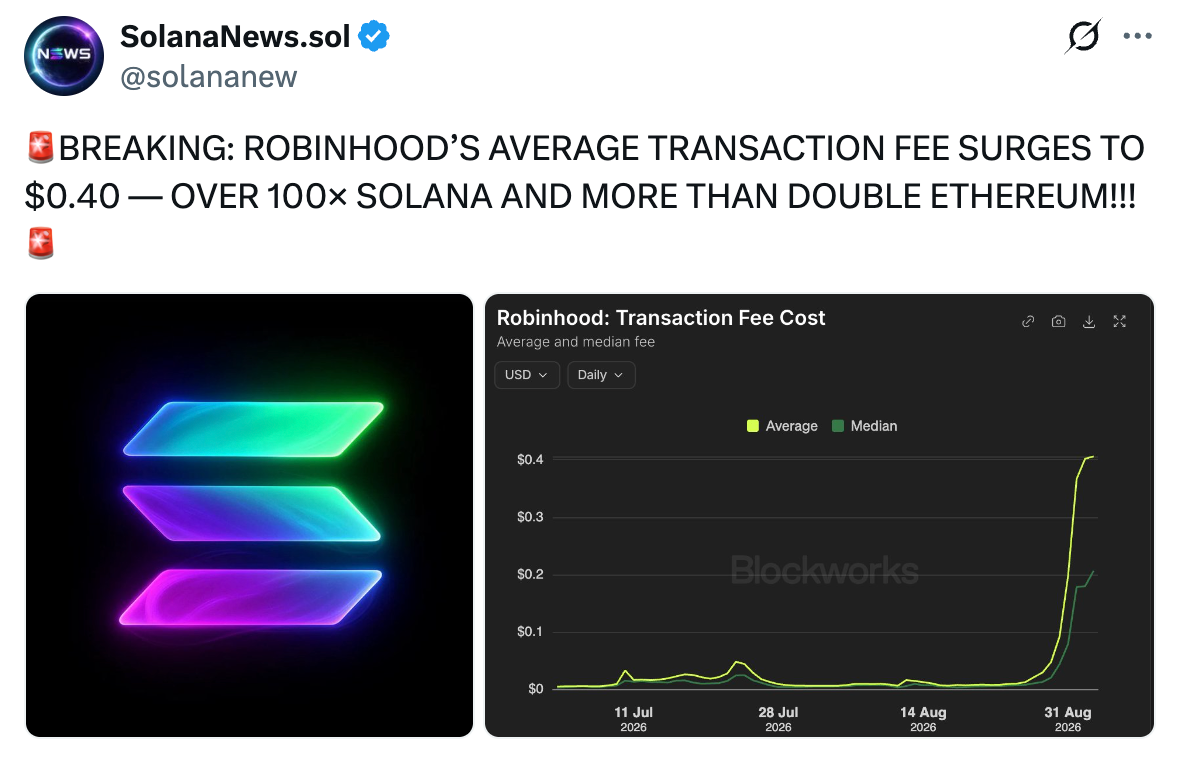
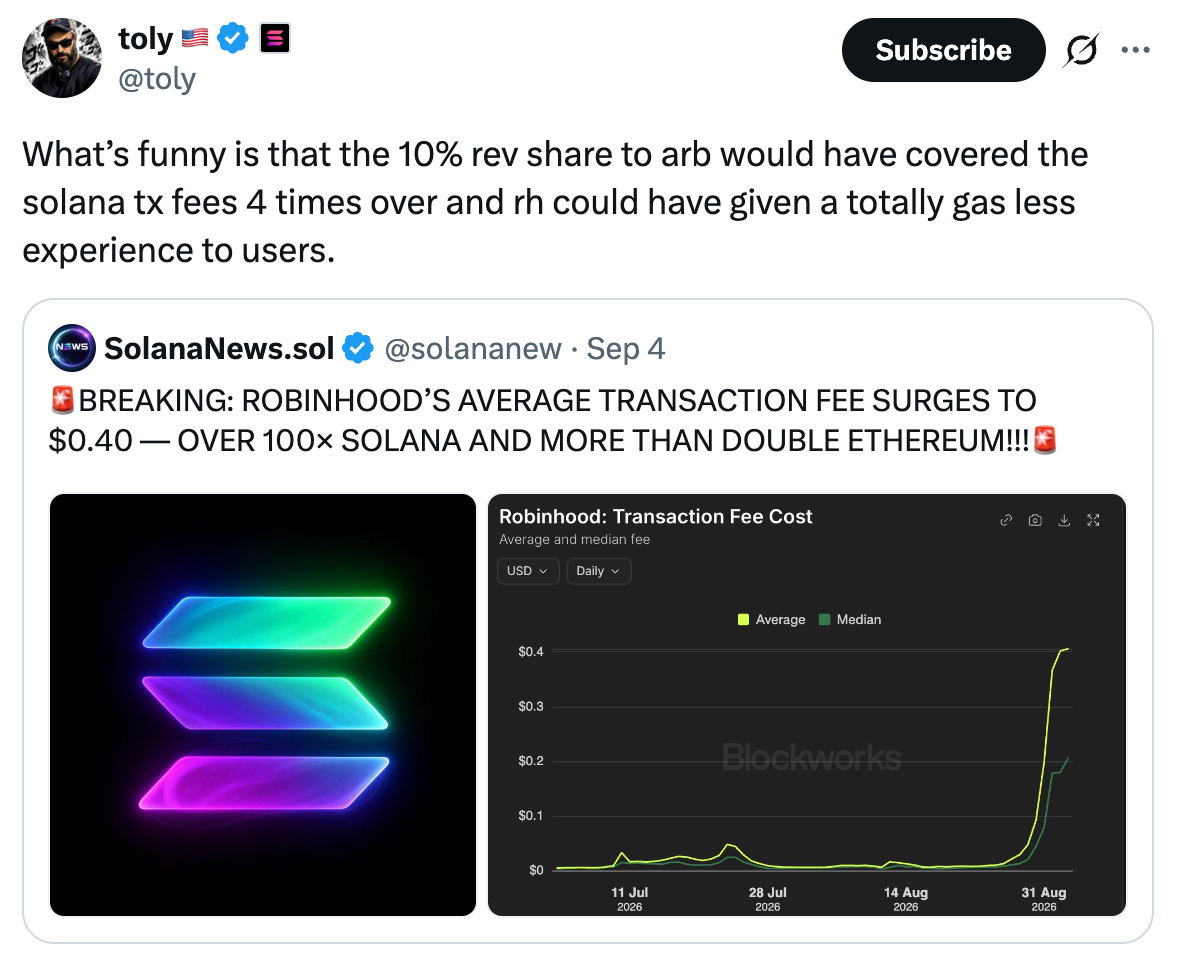
Solana co-founder Anatoly Yakovenko retweeted this post and stated that Robinhood Chain accords 10% of its net protocol revenue to the Arbitrum ecosystem (8% goes to the DAO treasury, and 2% to the development fund), while Robinhood itself retains about 90%. Toly calculated that this 10% share is enough to cover four times the fees for equivalent transaction volumes on Solana. If it had initially been built on Solana, Robinhood could have provided users with an almost gas-free experience instead of making users pay for network congestion. He criticized this model of "profiting from underlying congestion" as unwise, asserting that frontend applications should charge users directly, while the underlying layer should pursue extremely low costs.
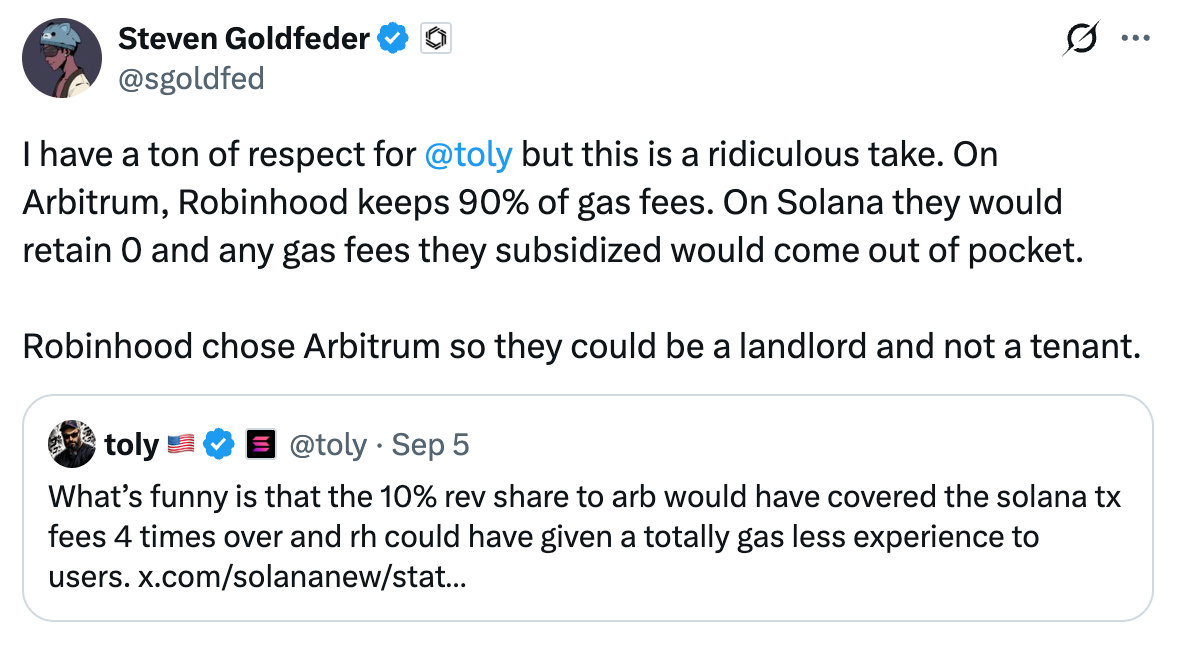
Offchain Labs co-founder Steven Goldfeder quickly responded. He expressed respect for Toly but deemed the viewpoint "ridiculous." Under the Arbitrum architecture, Robinhood can retain 90% of the Gas revenue; if deployed on Solana, the underlying fees would go to validators, leaving Robinhood with nothing. If it wants to subsidize users' Gas, it would have to pay out of its own pocket. Goldfeder succinctly summarized: Robinhood’s choice of Arbitrum is to be the "landlord" rather than the "tenant." Operating its own sequencer and controlling the majority of the revenue is necessary to truly turn the infrastructure into a sustainable business.
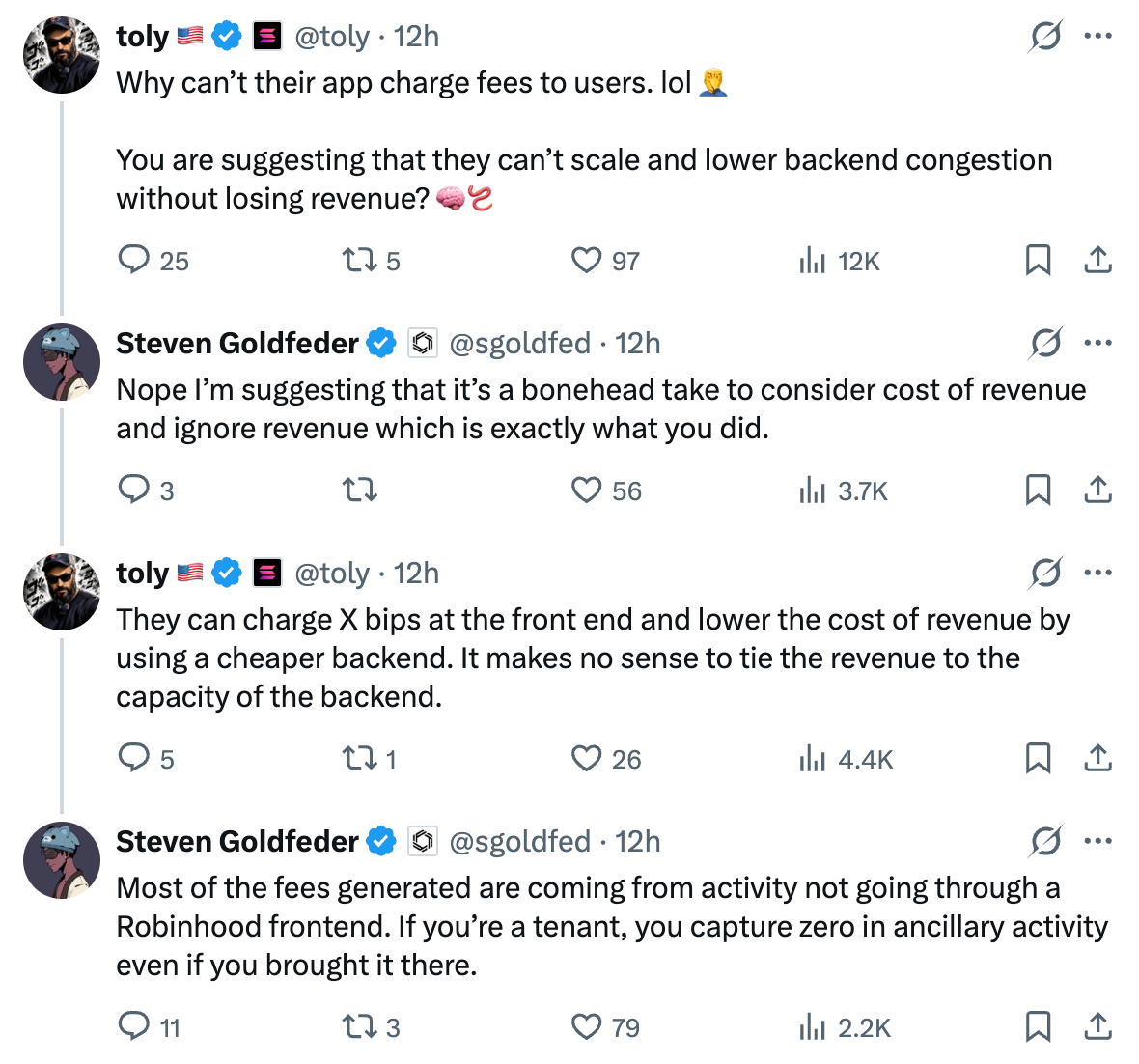
Following Steven Goldfeder's response, the two continued to discuss whether the "chain itself should charge" or whether the "chain is free, charging through applications" model should be followed.
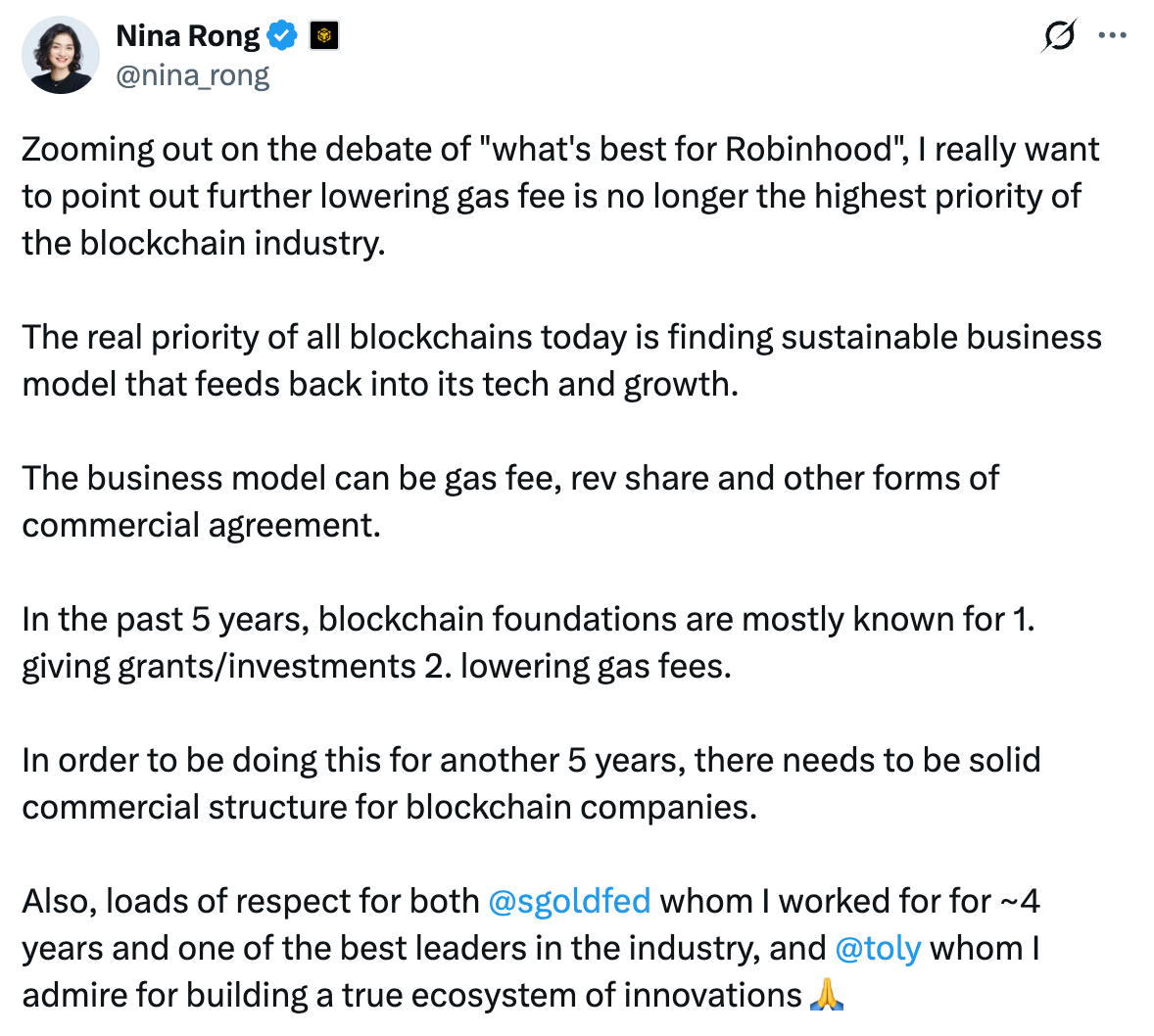
Subsequently, BNB Chain’s growth director, who worked at Arbitrum for about four years, Nina Rong, jumped into the specific debate about "who benefits more from Robinhood." She pointed out that further reducing Gas fees is no longer the highest priority in the blockchain industry. The real priority is to find a sustainable business model that can feed back into technology and growth, whether through Gas fees, revenue sharing, or other business agreements. Over the past five years, blockchain foundations have mostly focused on granting funds and reducing Gas fees; however, if they want to last another five years, they must establish a solid business structure.
Chinese user @lanyihou responded to Nina with more direct data: trading a token worth about 200 USDT on Robinhood Chain might require paying 21 USDT in Gas fees, making it tougher to discuss a business model "worse than drug dealing." Nina responded that fees can be immediately lowered if desired (it's just a matter of changing a number), but this doesn’t solve the fundamental problem of the industry – it’s precisely in such an environment that more effort is needed to find a model that users can accept, which doesn't disadvantage the platform and can even be profitable. She cited products such as GMGN to illustrate that users are willing to pay for truly valuable services.
Sustainable Development of the Chain Itself
The essence of this debate actually revolves around two different paths to value capture.
One is "extremely low cost + ecological flywheel." Solana has long upheld high throughput and low fees, attracting a large number of applications and users. The network itself maintains security and incentives through fundamental fees and mechanisms like MEV. If applications want to offer users gas-free transactions, they need to bear the costs themselves or monetize through frontend fees, advertisements, subscriptions, etc. The advantage lies in the ultimate user experience, while the downside is that application providers find it hard to benefit directly from underlying congestion.
Solana indeed leveraged low costs and rapid transaction confirmations to outpace competitors during the meme wars of the past few years and has given birth to innovative products like propAMM during traffic exuberance. This is a path that has been validated.
The other is "customizable application chains + revenue sharing." Arbitrum Orbit allows project parties to launch dedicated chains, controlling the sequencers and the majority of fee revenue while paying a fixed percentage share to the parent ecosystem. For large entities like Robinhood, this means transforming their user traffic and transaction behaviors into predictable infrastructure income while still benefiting from Ethereum's security and the Arbitrum technology stack. The advantage is a clearer business loop; the downside is that user-side fees may be higher.
Not only Arbitrum, but also Optimism and ZKsync, even the earliest subnets of Avalanche (now an independent L1), are developing based on this logic.
Simply relying on foundations to burn money to grant funds and indefinitely suppress Gas fees is indeed feasible, but for a chain to survive in the long run, it must have a positive cash return mechanism to support R&D, security audits, ecological incentives, and market expansion. Whether L1 or L2, they ultimately need to answer the same question: who pays for the long-term maintenance of the network? Users, application providers, or the protocol itself through reasonable pricing?
This is Arbitrum's perspective and also the underlying logic of the current BNB Chain growth head.
Sustainability does not equal high fees. The key lies in whether the fee structure is transparent, whether it matches real value, and whether it can form a positive cycle. Excessively high fees drive away users, while excessively low fees reduce infrastructure to a tragedy of the commons. The current high fees of Robinhood Chain reflect real demand after early subsidies ended and expose the need for optimization in dynamic pricing and capacity management.
These two lines of thinking are not absolutely right or wrong. When the overall market is prosperous, Solana has attracted attention and liquidity due to low costs; whereas during overall market declines, users are willing to pay a bit more for rare money-making opportunities. Solana's model may rely more on operational capability, while the closed-loop mechanism of the Ethereum ecosystem ensures that "artisans do not starve in lean years."
"Only Ethereum is Taking the Hits"
In this debate, there is a potentially overlooked but very painful fact: although Robinhood Chain settles to Ethereum, most of the value has not flowed back to the Ethereum mainnet.
According to public data and protocol arrangements, the vast majority of the Gas fees paid by users are retained by Robinhood as the chain operator (about 90%), with about 10% distributed to the Arbitrum ecosystem (DAO and development fund). The portion truly used for Ethereum's data availability and settlement is very low, at times barely exceeding one ten-thousandth. In other words, Ethereum provides a security base but only receives a very thin layer of "toll."
This precisely illustrates the structural reality of the current Ethereum L2 ecosystem: application chains and dedicated L2s retain most of the value of the execution layer, while the mainnet plays more of a role as the "settlement and data availability layer." For Ethereum itself, this is both a success in scaling (transactions are diverted, and congestion on the mainnet is relieved) and a challenge in value capture: the security budget ultimately still relies on the fees and staking yields of the mainnet itself. How the mainnet can continuously achieve sufficient incentives after many high-value activities migrate to L2 or even independent application chains becomes a long-term problem that must be faced.
Related discussions have continued for several years, and the emergence of Robinhood Chain has once again brought this issue to the forefront.
In fact, Ethereum has long recognized this issue, but it has not rushed to "capture value." Instead, it maintains strategic patience, betting on the long-term growth trend of blob demand. For Ethereum, as long as ETH is still used to pay Gas fees, and as long as the finality of L2s still requires mainnet settlement, the expectation for long-term value realization remains.
Conclusion
The exchange between Toly and Goldfeder points toward the formation of an industry consensus: the blockchain has moved beyond the purely technical competition phase of "as long as it's cheaper" and has entered the deep waters of business models and ecological sustainability.
For application providers, choosing to be a landlord or a tenant depends on their own traffic scale and monetization ability; for public chains and L2s, how to design mechanisms that can attract builders and generate positive cash flow will determine life or death in the next five years. And as the largest provider of security, Ethereum also needs to continuously think about how to ensure that the mainnet itself gains a more reasonable value return while L2s are thriving.
This debate has no absolute winners; the core lies in the triangular balance between user experience, infrastructure profitability, and underlying security incentives, which is far more complex than "whose Gas is lower." The true winners will be those participants who can find sustainable solutions among these three elements.
免责声明:本文章仅代表作者个人观点,不代表本平台的立场和观点。本文章仅供信息分享,不构成对任何人的任何投资建议。用户与作者之间的任何争议,与本平台无关。如网页中刊载的文章或图片涉及侵权,请提供相关的权利证明和身份证明发送邮件到[email protected],本平台相关工作人员将会进行核查。
