Hello everyone, welcome to Money in Motion. This is a podcast that focuses on "how money flows." We do not discuss which concepts are the hottest, but rather how money is actually being moved, settled, and trusted in the real world.
In this episode, we start with a word analysis, which leads us to an unanswerable question: when AI makes decisions for you and something goes wrong, who is responsible? In between, we have payment organizations, jurisdictions, a vaguely written authorization, and whether crypto is even qualified to handle this matter.
Yuki (Co-founder of Money in Motion) × Kevin (Co-founder of Chain Tech) × Will (Co-founder of Money in Motion) This article is an edited compilation of the first episode of the podcast, with content abridged and formalized, and opinions are those of the guests.

1. The First Transfer of Decision-Making Authority
Yuki: Before we start, let's address a question: why is it "agentic payment," not "agent payment"?
Kevin: Consumption has actually gone through three stages. Initially, people went to physical stores, using cash or credit cards, browsing from store to store; then e-commerce emerged, where comparison costs were nearly zero; and next came live-streaming sales—after watching a live stream, you might buy many items you don't even need, indicating a change in the consumption model itself.
Now we are on the path towards a fourth stage: AI finds products, compares prices, and places orders for you. There is a fundamental difference between this and the previous three stages—in the first three stages, you were always the one making the decisions. What to buy, at what price, when to buy, and the payment method were all decided by the consumer. By the fourth stage, AI has already made these decisions for you before your purchase. As a consumer, you are being replaced for the first time by some intelligent system.
As for the terminology, Chinese is actually more straightforward, as it simply means "intelligent agent." English needed to create "agentic" because "agent" has already been taken—it implies you're a person in a role, so when you say you're an agent overseas, people immediately think of an insurance agent or a travel agent. That is a "human" agent, which is entirely different from AI making decisions for you.
Will: To add a note on parts of speech. "Agent" is a noun, denoting identity; "agentic" emphasizes that this intelligent entity possesses autonomous decision-making authority and that the act of "decision-making" is in motion.
However, many projects on the market claiming to be agentic payments actually haven’t moved at all. They are still doing automatic payments—there is no essential difference from previous subscription renewals that automatically deduct from accounts. They do not involve the agent in the decision-making process, nor do they take responsibility for their decisions. This is the greatest distinction between the two.
Yuki: So the criterion is clear: whether decision-making authority has truly been handed over. Many things are now aiming for this label, rather than the reality of the situation.
Will: Yes. In China, hardly anyone distinguishes between agents autonomously calling APIs, data, and computing power, and agents making large purchases on behalf of people; these are two entirely different scenarios. Everything wants to capitalize on this, and the more exaggerated fact is that they directly call it "AI payment."
Previously, a certain platform claimed to have conducted 100,000 AI payments and achieved substantial trading volume, but many people didn't realize it had this functionality. I guess it included shopping assistants in that count—suddenly you have an AI shopping assistant that helps you complete "AI payments." Regardless of whether it's payment institutions, banks, or card organizations, there is still a misunderstanding about this matter.
2. When Decision-Making Authority Leaves, Responsibility Does Not Follow
Yuki: Vagueness in concepts may not bear a cost on the marketing level, but once decision-making authority is truly handed over, the costs emerge. What do you think is the biggest obstacle?
Will: Let me start with the half that has no obstacles. Agents buying DeepSeek or OpenAI's data tokens and computing tokens, there were a few projects whose trading volume increased particularly fast because of this scenario. Because once purchased, they are consumed, so there is no dispute.
The disputed part lies in the other half. Asking agents to help me book flights or hotels encounters lower levels of trust. I can let it help me search, but I still finalize the order myself—I am not comfortable letting it handle my money.
Yuki: I've moderated an online panel where I asked everyone: would you be willing to give your agent a thousand dollars?
Let's be more specific about the scenario. I tell the agent: help me book a flight to New York on Monday, returning on Wednesday night, with a budget under $8,000. It stays within budget, but books a flight leaving on Tuesday and returning on Thursday; or it chooses a very cheap ticket that cannot be changed or refunded. The money is deducted, and the ticket is issued. You contact the platform, and they say you have authorized the agent; you contact the airline, and they say the ticket is issued and cannot be refunded. Each party has a reason. But who is ultimately responsible for the money?
Kevin: This question was voted on in our public account in June, asking "who is responsible when AI faces issues with card payments":
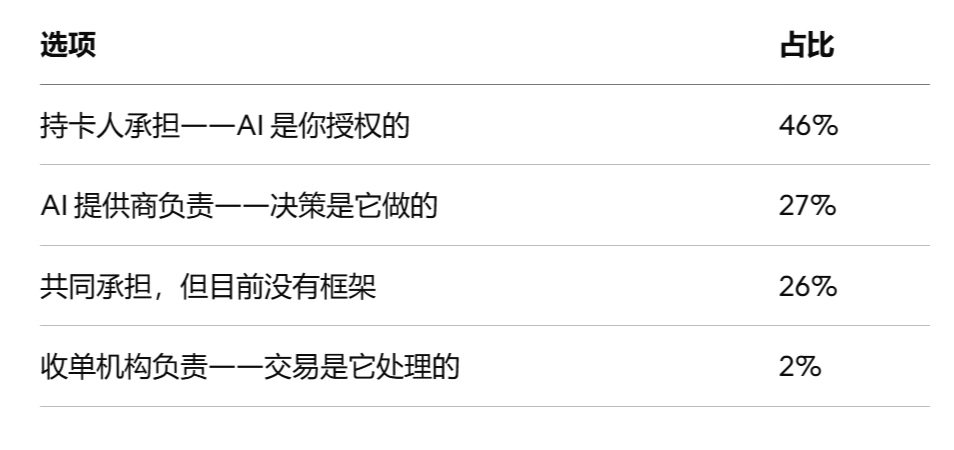
Readers were very active in voting, but the four options were dispersed, indicating a lack of consensus. We should listen to Will on this; he has a legal background.
Will: The responsibility distribution in card organizations' system is relatively complete, after decades of refinement. But when it comes to AI making charges that result in wrong tickets, you will find that every door is closed.
Contact the card issuer—they won't accept it because you have authorized AI, and it ultimately recognizes the authorization of the cardholder. Contact the airline—they don't care if you're human or an agent; what they received is an order with a date and amount, and they will process based on that order. Contact the AI developer—going to OpenAI or Anthropic, it's hard to say this is their problem.
Essentially, this is a delegation relationship: you entrust the agent to buy a ticket, and if something goes wrong, who bears the responsibility. But the first step legally hits a dead end—servers are in the United States, users are in Hong Kong, merchants are in Singapore, which jurisdiction do you seek relief from? AI operates as a Global by Default economy, making it very difficult to assign responsibility within a single jurisdiction.
So we must refer back to private dispute resolution frameworks, like those of card organizations. I have also seen insurance companies offering AI liability insurance, like Munich Re.
Kevin: I find this a bit overwhelming, because I have become accustomed to living under the rules of card organizations. So from a legal perspective, the rules of card organizations and the real legal system are actually two sets? Card-related disputes are often resolved within the card organization system and do not make it to the judicial route?
Will: Yes. This is why the solution to this matter is more likely to lie within private frameworks rather than in courts.
3. The Vague Authorization
Kevin: But private frameworks also need a basis. If my instructions were written incorrectly, the principal is naturally responsible. However, if I wrote it clearly and the records are fine, but it simply bought the wrong ticket, and the money was still paid, who should I turn to? AI is not the subject; arguing with it is useless, but the company behind it is what matters.
Will: Practically, there is actually such a basis. After you have a conversation with the agent and proceed to payment, the agent payment company will issue you a mandate, recording the time, amount, and your transaction intention.
The issue is that its scope is not detailed. It will not specify, "because I have a meeting at 9 AM tomorrow, this ticket must be booked today," it will only write "I’m booking a flight today." The precision level of the scope directly determines who holds responsibility later on.
On a larger scale, this is an authorization letter, which will become the basis for dispute resolution. But how detailed should this authorization letter be? I talked extensively with the AI; to what extent does it understand?
It knows "book a flight at 9 today," but it doesn't know why I want that ticket or whether it's truly what the principal wants when it returns. This is similar to daily life: if you ask your assistant to book a flight, you may not be satisfied, let alone with an agent.
Kevin: In other words, the intention itself cannot be completely written down. Therefore, responsibility must ultimately fall back.
Will: Yes. Previously, when drafting user agreements for agent payment clients, we fundamentally shifted the agent's responsibilities and obligations back to the actual user utilizing it. Because the agent cannot follow up, it cannot take the blame. Ultimately, it is the person using it who bears the responsibility—because this person is easier to locate and hold accountable.
4. Once Responsibility Falls Back on People
Yuki: I agree with this direction, and I believe it is not merely a stopgap measure.
The ultimate outcome is that agents will participate in economic activities. Agents have already integrated into the daily operations of organizations and teams; many companies now operate in a "human + agent" state, and the next step is entering economic activities. In this context, several things must be recorded: how agents identify your intentions, the boundaries of authorization, what needs to be recorded, what needs to be verified, and most importantly for card organizations—who authorized this agent, and who is its owner.
If everyone confirms that this agent's identity belongs to me, then I should take responsibility when it goes wrong. It's akin to hiring an accountant—if the accountant transfers money incorrectly, it is ultimately the boss who bears the blame. You might scold them, or fire them—the intensity of the scolding depends on how much money was mistransferred. In the end, the boss pays for the employee's mistakes.
However, having "who bears the blame" is not enough; there also needs to be a comprehensive set of accident identification rules. This is very similar to smart driving. Fifteen years ago, everyone thought it was far from us; now it is close at hand, but for it to scale, there are still many issues, and they are no longer technical issues. Agentic payment will likely follow a similar path: first with technical issues, then who bears responsibility for accidents, and when piloted, it will transition to how accidents are identified and how responsibility is agreed upon.
Kevin: This analogy is very apt. When drivers choose automation, do they transfer driving responsibility? What happens if something goes wrong? The structure is exactly the same. Moreover, the technology for automated driving is already feasible; the reason it hasn't been widely adopted is also due to liability issues.
Will: Furthermore, the liability concerning automated driving appears to be easier to define than for agentic payment—at least incidents happen within a single country, on a particular road.
5. Can Crypto Handle This?
Yuki: So the question becomes: is there an infrastructure that can record authorization, ownership, and accountability without being changeable? This brings us back to the relationship between crypto and AI.
AI changes productivity, while crypto must address production relationships.AI agents bring a shift in productivity: they begin to understand objectives, access resources, organize tasks, and even perform parts of the work on behalf of people. However, the production relationships have not been resolved—who does the agent represent? Can identity be tampered with? Who owns the data, models, and computing power? How is the value created allocated? Who is accountable when errors occur? What crypto needs to consider going forward is how to incorporate ownership, authorization, profit distribution, and liability relationships once this new productivity comes in, and make it traceable and immutable.
Kevin: The principle is indeed sound. But to handle "disputes," it must first be able to address disputes itself—and this is precisely its weakest point.
For instance, many people say they only accept dollars, nothing else. Then one day someone comes along, saying, "I will pay you with diamonds, do you accept?" At first, diamonds seem good—you can carry them easily; a suitcase of cash is cumbersome, while a small bag of diamonds is simple. But then you realize that cashing in diamonds is very difficult. Once you accept them, you may not even be able to spend them directly and must find a jeweler willing to buy them.
The scenario with stablecoins is very similar. Whether it's USDC or USDT, they are pegged to the dollar one-to-one, and many people want to use them for both trading and daily payments. Consider it: it’s essentially a suitcase full of cash, just in the form of a code.
But the greatest difference from credit cards is: you essentially have no opportunity for chargebacks. Credit cards have chargebacks and an entire set of dispute mechanisms; cryptocurrency is a one-time deal—press the confirm button, and that's it. All possible errors and losses are immediately settled.
Yuki: In other words, we expect it to solve "what happens when AI makes a wrong purchase," yet it hasn't even resolved "what happens when a person makes a wrong purchase."
Moreover, it was not born from this side either. The attributes of decentralization and anonymity naturally attract a specific group of people—it was originally created to meet demands that do not require regulatory compliance, and this demand will always exist.
Kevin: So does compliance mean giving up decentralization? These two aspects are inherently in conflict.
Will: In a sense, yes, but the current direction isn’t about "choosing one"; it's being pushed along by trends and regulations. The behaviors of this group match the trajectory of BTC prices—when prices rise, money on the chain increases, and with more money, there is consumption and project activities. These projects coincide with the current wave of compliance, whether it's pushed by Trump or the passage of the CLARITY Act, and they drive a lot of the original chain participants towards compliance scenarios. Once they enter the compliance scenario, regulation and licensing become huge issues.
Yuki: In other words, what crypto is currently working on is precisely the part of capability that agentic payment needs—rules, identity, dispute resolution. It just hasn't been completed.
6. The iPad Moment Has Not Yet Arrived
Kevin: Whether it has been completed can actually be tested with a very simple standard.
Now, there is so much discussion on how to use AI, it seems that without some AI engagement, you will fall behind the times. But I think this is a paradox. When China promoted QR code payments, if you had to first learn how QR codes came about, what accounts they were linked to, and the differences between primary and secondary accounts, it simply wouldn’t catch on.
What sticks out in my memory is the first generation iPad. At that time, my son was two or three years old, and to be honest, when it came into my hands, I had to adapt and learn where things were. But when you give it to a two- or three-year-old, they just figure it out without needing any instruction. Electronic products that can be used without learning are considered successful. Thus, AI will ultimately hide behind the scenes, rather than being at the forefront.
Yuki: I agree. Its true proliferation occurs when everyone feels indifferent about it, as if it is simply how things should be, rather than constantly educating everyone on how to use AI. As for why all the media is filled with AI tutorials—my perception is, because AI entrepreneurship doesn't yield profits, while selling courses does.
Kevin: You've hit the core issue. Initially, when DeepSeek became popular, weren't there countless tutorials circulating?
Will: So, the timing just hasn't arrived yet, although we can see where that moment lies.
Stablecoins provide global, around-the-clock, uninterrupted settlement capability. Tokens themselves can settle without barriers, but what they contain can be quite varied. Therefore, when this agent line comes in, the question becomes: what value is actually embedded within it—is it computing power tokens, or API services?
This potentially represents a significant outbreak point in the upcoming global AI economy. Yet it is clear that we are not there yet. When it finally arrives, it will also provide the answer to the question Yuki has been asking—when will AI and crypto intersect, I believe that will be the moment.
But we clearly have not reached the moment that Kevin has described as "seizing the iPad." Therefore, there is still much work to be done.
免责声明:本文章仅代表作者个人观点,不代表本平台的立场和观点。本文章仅供信息分享,不构成对任何人的任何投资建议。用户与作者之间的任何争议,与本平台无关。如网页中刊载的文章或图片涉及侵权,请提供相关的权利证明和身份证明发送邮件到[email protected],本平台相关工作人员将会进行核查。