Author: Jae, PANews
On the morning of September 4th, Bitcoin briefly surpassed $82,000, although it later fell back to around $80,000. However, the cryptocurrency market has actually welcomed its strongest rebound since October 2025 since mid-August. Bitcoin recorded an approximately 25% increase in the last month, with a net inflow of $3.52 billion into U.S. spot Bitcoin ETFs during the month, setting a record for the year.
However, more dramatic than the spot market is the collective explosion of the Digital Asset Treasury (DAT) sector. According to PANews statistics, all 10 leading DAT stocks recorded increases in August, with an average monthly increase of about 106%, while their treasury assets saw an average increase of only about 45%. Even when excluding extreme samples, the excess returns of DAT relative to underlying assets remain significant.
It can be said that funds are granting some DATs an extra capital market premium. Within the composition of this premium, there is the beta from rising coin prices, the amplification from financing leverage, the support from staking yields, and the imagination of ecological narratives.
All records in August, doubling performance
According to PANews observations, the total market capitalization of the 10 leading DAT stocks is now over $82 billion, with a month-on-month increase of 46%; the trading volume in August was approximately 2.5 billion shares, an increase of 33% month-on-month, indicating that funds’ attention has returned to the DAT track.
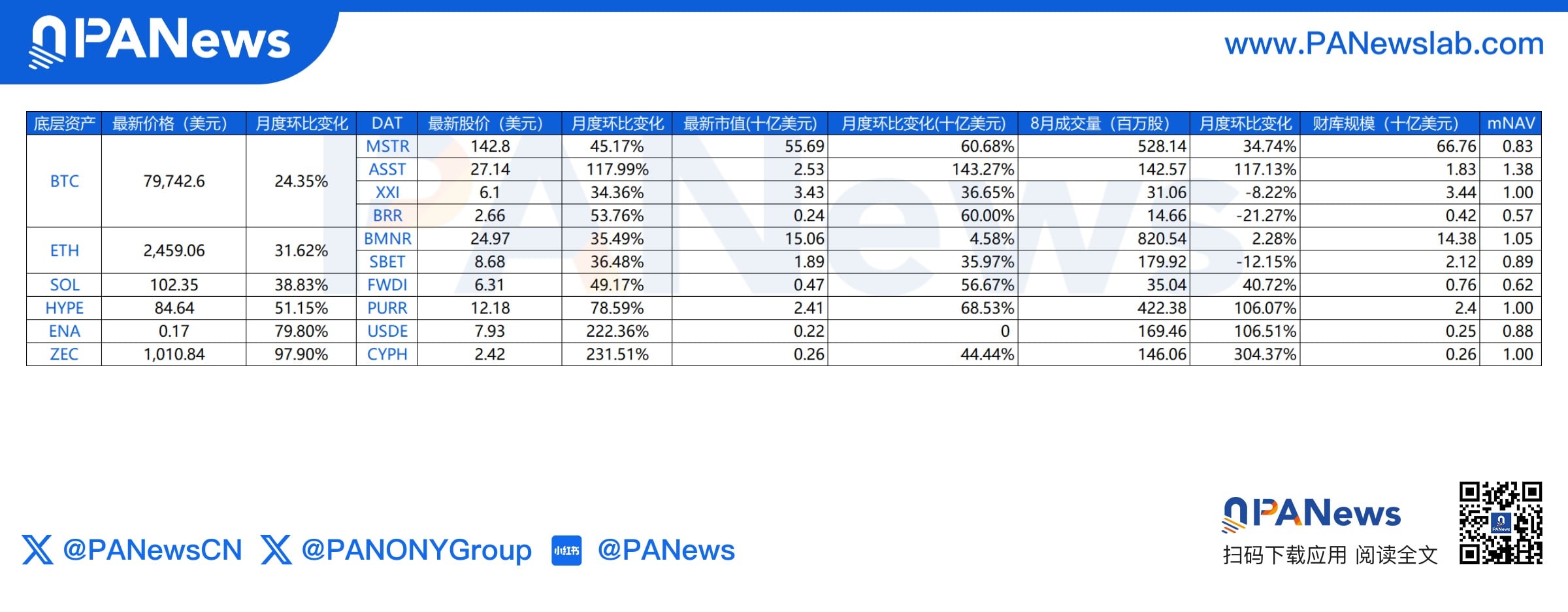
The most interesting phenomenon in this round of market performance is that the price increases of DAT stocks generally outpaced those of their treasury assets, displaying a high degree of "Beta + leverage" characteristics. From a price performance perspective, all 10 leading DAT stocks achieved excess returns relative to their treasury assets. There are three DAT stocks that are particularly noteworthy:
ASST: Treasury asset BTC increased by 24.35% during the same period, while the stock rose by 117.99%, resulting in an excess return of about 94 percentage points.
CYPH: Treasury asset ZEC increased by 97.9% during the same period, while the stock rose by 231.51%, resulting in an excess return of about 134 percentage points;
USDE: Treasury asset ENA increased by 79.8% during the same period, while the stock rose by 222.36%, resulting in an excess return of about 143 percentage points;
In contrast, the leading stock MSTR showed relative restraint, with a 45.17% increase over the past month and an excess return of only about 21 percentage points.
A pattern is emerging: the smaller the market capitalization of a DAT, the lower the stock liquidity, and the newer the narrative, the greater its price elasticity relative to treasury assets. This is the most obvious difference between the current DAT market and the "Strategy's dominance" era: as DAT holdings spread from Bitcoin to more assets, small and medium-cap stocks have shown fiercer market performance than leading stocks due to their smaller float and more diversified narratives.
MSTR dominates nearly 70% of leading DAT market capitalization, treasury leverage creates bidirectional elasticity
However, Strategy remains the most mature example of the DAT model, with MSTR's market value accounting for about 68% of the total market value of the 10 leading DAT stocks.
The most basic business logic of DAT is not a linear mapping of "coin price up → stock price up," but a set of leverage tools that amplify the return rates of treasury assets.
On August 23, BTC surged over 20% within a week, and at that time, Strategy held 840,447 BTC, with a net BTC asset value of approximately $49.68 billion. On August 31, Strategy announced that it had purchased 4,603 BTC for about $370 million, at an average price of approximately $80,318, bringing its total holdings to 845,050 BTC.
This is the capital cycle of the DAT model: BTC rises → balance sheet improves → stock financing capability enhances → secure more funds to buy BTC → per share BTC exposure further increases.
This positive feedback mechanism gives DAT stocks stronger elasticity than treasury assets. When the prices of treasury assets rise, the compound returns of DAT stocks naturally far exceed the simple price increase of the coins. This characteristic also makes DAT stocks a "return amplifier" during market rebound phases.
The most appealing aspect of DAT is leverage, and the most dangerous aspect is also leverage. The flywheel is always bidirectional; the stronger the upward force, the fiercer the downward pull.
The total scale of treasury assets among the 10 DAT stocks is about $92.62 billion, while their total stock market capitalization is only 88.8% of the treasury size. In other words, the DAT sector does not universally exist at a high premium; some stocks are actually below the value of their treasury assets.
It is important to be vigilant that an mNAV below 1 does not equal “risk-free arbitrage.” In addition to treasury assets, companies also carry a series of deductions such as debt, preferred stock, dilution risks, management fees, financing costs, asset pledges, regulatory risks, and operational losses.
According to Bloomberg, Bitcoin DAT Nakamoto, a cryptocurrency entrepreneur David Bailey who previously helped U.S. President Trump shift towards supporting BTC, has seen its stock price plummet by about 99% from its peak, with market premiums reduced to zero.
The volatility of DAT comes from both the underlying coin prices and the expansion and contraction of valuation premiums, with the latter often exhibiting greater fluctuations than the former.
From BTC to ETH/SOL, DAT has an additional layer of staking yield
Strategy represents the initial "coin hoarding" DAT model. Another significant change is that the DAT model is spreading to more cryptocurrency assets, and its approach is being upgraded to give DAT the attributes of "productive assets."
Ethereum treasury is a classic example of this evolution. Taking Bitmine as an example, as of now, it holds over 5.9 million ETH, accounting for about 5% of the total ETH supply, while also holding 211 BTC as well as over $500 million in cash and tradable securities, with the combination of crypto assets and cash reaching as high as $15.6 billion. Approximately 5.07 million ETH have been staked to earn on-chain yields.
SharpLink has also adopted a similar approach, holding over 890,000 ETH and continuously investing in staking and on-chain yield strategies.
The Solana treasury follows closely. Forward Industries holds about 7.807 million SOL and its equivalent assets, accounting for about 1.3% of Solana's circulating supply, and nearly all are staked.
Compared to the Bitcoin treasury that highly relies on price fluctuations, the ETH/SOL treasury has an additional layer of value support from staking yields.
This means that the valuation model of DAT is undergoing a second-stage evolution:
First stage: Treasury value ≈ asset price × holding amount, price-driven;
Second stage: Treasury value ≈ asset price × holding amount + staking/on-chain revenue, bolstered by cash flow;
This model may become the main battleground for competition in the next stage of the DAT sector.
Track differentiation emerges, risk preference spills over to altcoin DATs
Funds are flowing from BTC and ETH treasuries into higher Beta altcoin treasuries, and interest in DAT stocks like HYPE and ZEC has significantly increased. This is also a signal that the market has entered a second stage: after mainstream assets attract incremental funding, funds spill over into mid and small-cap stocks, with risk preferences gradually shifting downwards.
Altcoin DATs are smaller in scale, making them more prone to extreme market performances.
PURR is a typical example. So far, it holds about 30.1 million HYPE, with a holding value of up to $2.54 billion. At the same time, the company has repurchased about 5.8 million shares of PURR, tightening the float.
More importantly, the value anchor of PURR is not just the HYPE price, but a whole set of combined narratives: HYPE price fluctuations + HYPE holding growth + Hyperliquid ecosystem growth + HYPE buyback and destruction + DAT financing capability.
Among them, the ecosystem income and token economics of Hyperliquid provide the main value support. In the past 12 months, the Hyperliquid ecosystem has generated approximately $712 million in retained earnings, with as much as 99% of the value flowing to HYPE holders through the buyback mechanism. Investors buying PURR are essentially betting on the growth of the Hyperliquid ecosystem.
Holding ZEC, CYPH also has imaginative potential. So far, it holds 323.394 ZEC, accounting for about 1.91% of Zcash's circulating supply. Subsequently, the company entered the Zcash mining field through a related transaction with Winklevoss Capital, holding approximately 18% of the network's total computing power. The valuation of CYPH also incorporates the value of the ZEC treasury assets, mining business, and privacy asset narrative.
USDE is a newcomer in the DAT sector, listing on Nasdaq at the end of June, with treasury assets being ENA. USDE holds about 3.029 billion ENA, valued at about $510 million, accounting for 20% of the total ENA supply. The business model of USDE covers six major areas: Ethena ecosystem infrastructure, validation nodes, LayerZero DVN, stablecoin Harness, USDe distribution, and ENA treasury.
In other words, what USDE is trying to construct is a complete flywheel: Ethena ecosystem growth → infrastructure income improvement → ENA value enhancement → capital market financing → further expansion of ENA treasury and its ecological layout.
The combined factors of ecological narrative + low market capitalization + scarcity of new listings in the circulating stock have jointly created a single-month increase of over 2 times, but it resembles more of a special case of “small market cap, high volatility, strong narrative DAT.”
Now, differentiation in the DAT market has already emerged. Funds and attention are concentrating at the top, while elasticity and imaginative space are found in small and medium-sized stocks.
DAT has recently collectively outperformed coin prices, conveying a signal: DAT is becoming a high Beta tool that connects the traditional stock market with cryptocurrency assets.
What is more worthy of in-depth exploration than the numerical increase in price is the source of excess returns. If primarily derived from real growth in per-share assets, staking, and cash flow from ecological businesses, then DAT is evolving into a brand new asset management model for cryptocurrency assets.
From "who holds more coins" to "who creates more value per share," competition in the DAT sector is entering a higher dimension. Ultimately, all leverage and premiums must be tested by the economic cycle.
免责声明:本文章仅代表作者个人观点,不代表本平台的立场和观点。本文章仅供信息分享,不构成对任何人的任何投资建议。用户与作者之间的任何争议,与本平台无关。如网页中刊载的文章或图片涉及侵权,请提供相关的权利证明和身份证明发送邮件到support@aicoin.com,本平台相关工作人员将会进行核查。


