SK hynix Investment Logic
Now that SK hynix (SKHY) has finally been listed on the US stock exchange, I want to start covering this company. However, I have been researching memory chip stocks for a long time. In November 2024, I wrote an article titled "More Memory Will Be Key to AI". That article discussed Micron (MU), whose stock price has risen over 800% since I gave it a "Buy" rating. But considering the quality of the company and its future prospects, I believe SK hynix is superior to Micron and Samsung (SSNLF).
This is also why I initially rated SK hynix as a "Strong Buy," as I believe HBF and HBS will drive SK hynix to dominate the future memory market.
HBF vs. HBM vs. HBS
I believe that HBM, HBF, and HBS will become the most important types of memory technology in the coming years. HBM, which stands for High Bandwidth Memory, has garnered a lot of attention due to its crucial role in AI workloads. HBM technology achieves high bandwidth by vertically stacking DRAM, in other words, allowing for faster data transmission. The main players in the current HBM market are SK hynix, Micron, and Samsung. Interestingly, China has yet to successfully produce competitive HBM. Among these three suppliers, I believe SK hynix currently has the best HBM, which is evident from its market share. However, Samsung is quickly catching up, with its market share rising from 15% to 33% in just one year. Although SK hynix's market share currently remains at 50%, if this trend continues, Samsung may further close the gap. In my view, SK hynix and Samsung are likely to dominate the entire market in the future, while Micron may hold a significantly smaller market share in third place.
Another factor putting Micron at a relative disadvantage is HBF. SK hynix is co-investing in this new flash memory medium with Sandisk (SNDK), while Samsung is also actively working in this area. At least for now, Micron does not seem to intend to invest in HBF. I consider this a mistake because I believe that HBM + HBF will replace the current HBM + DDR5 + SSD AI architecture. HBF, or High Bandwidth Flash, is essentially vertically stacked NAND, and its advantage lies in its significantly lower cost per GB compared to DRAM, along with lower latency than SSD. Therefore, from my personal perspective, HBF is an important evolution that will dominate the AI inference market alongside HBM. This is also why I think SK hynix and Samsung will become core players in the future memory market, while Micron's current wait-and-see attitude is, in my opinion, a mistake.
Another interesting memory medium is HBS, which stands for High Bandwidth Storage. The idea of HBS is to combine NAND and DRAM to provide a superior solution for edge and mobile applications. Thus, this technology is not designed for data centers but rather to prepare for the next phase when AI begins to run on an increasing number of end devices. Currently, SK hynix is the only company developing HBS, which may bring it significant competitive advantage and first-mover advantage.
Why I Believe SK hynix Is the Best Future Choice
Samsung currently has an advantage, but this advantage is gradually diminishing, as Samsung is a large integrated company that can internally produce many things. In particular, Samsung is capable of producing some of the best SSDs on the market, which has consistently given it a strong competitive edge. But as usual, competitors always try to attack this competitive advantage. If HBF succeeds, as I expect it to, then a major competitive advantage for Samsung will be weakened.
Another opportunity comes from CXL. SK hynix recently showcased a memory pooling concept based on DDR5. Samsung also has its own CXL products. However, CXL will reduce the system's dependence on high-performance SSDs, which should benefit SK hynix.
At present, I believe Samsung still has a slight advantage due to its strong SSD product portfolio. However, I think SK hynix's future layout is better. With the HBM, HBF, and HBS product lines, SK hynix will be able to cover almost the entire product spectrum of the future AI memory market, and I currently do not see the same complete layout from Samsung and Micron. I also believe that SK hynix is working with Nvidia (NVDA) to develop the next-generation storage solution for Physical AI, which is also a strong argument supporting the investment logic for HBS. Personally, I believe that the market size for HBF and HBS could even surpass that of HBM in the future. This may sound crazy, but I think the demand for storage from robots will ultimately exceed that from data centers. However, whether this happens in the current storage cycle cannot be definitively determined by anyone.
Valuation
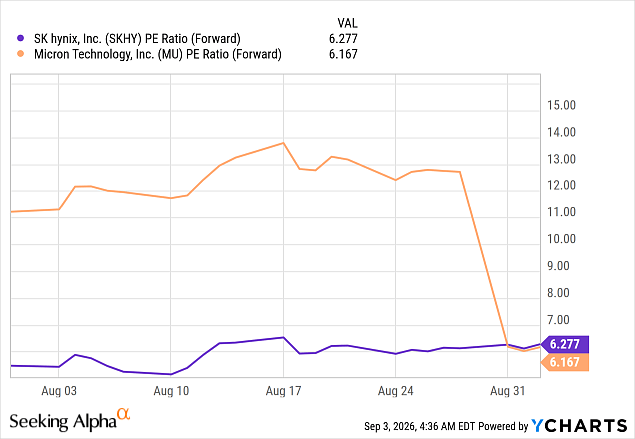
[Original image location: forward-looking valuation comparison between SK hynix and Micron (YCharts)]
Unfortunately, Samsung's memory business is not separately listed, so I did not include Samsung in this comparison. Ultimately, this comparison only includes Micron and SK hynix. However, anyone can clearly see from the chart that both companies have extremely low forward valuation multiples. The reason is simple; there exists an irrational concern in the market that memory prices or shipment volumes will significantly decline by 2027. I believe this concern is unreasonable because statements from company management and capital expenditure forecasts strongly point in the opposite direction.
Global annual data center spending is expected to grow from about $800 billion this year to $1.1 trillion by 2030, and to reach $1.8 trillion by 2050, according to PwC’s predictions.
Given that data center spending before 2030 is expected to exceed $1 trillion, it is clear that the market does not anticipate a significant slowdown in the short term. I find the 2050 prediction somewhat absurd, as no one can see that far into the future. However, I believe the 2030 predictions are realistic and possibly even a bit conservative.
SK hynix announced on Thursday that the company plans to begin mass production of the next-generation HBM4E chips at its Indiana factory in the third quarter of 2029, while the company's CEO stated that the current memory chip shortage is expected to continue until the end of 2030.
Of course, you cannot blindly trust these statements, but if multiple CEOs are discussing a persistent memory shortage, it is reasonable to infer that there is some truth to it. Thus, I believe SK hynix is currently undervalued because the memory shortage is expected to persist, and I think SK hynix will become the best memory company for future prospects. Additionally, I am fortunate that my brokerage allows me to directly purchase SK hynix's GDR and ADR, meaning I do not have to pay an additional ADR premium. However, I also believe that the ADR itself is still worth buying; although the price is somewhat high, its forward P/E ratio is only 6.2 times, which is still extremely cheap.
Risks Facing My Investment Logic
In addition to the obvious risks, such as oversupply occurring sooner than expected, the company also faces execution risks. HBF and HBS have yet to truly prove that they can meet my expectations for these technologies. While the first batch of prototype products looks very promising, there remains uncertainty regarding their ultimate commercial success. However, this is precisely what makes investing so interesting. You need to try to predict which technologies will dominate the market in the future. For this reason, my investment horizon for SK hynix is more than 5 years, not a short-term investment, which is increasingly becoming a market trend unfortunately.
Conclusion
In the long run, I am very optimistic about SK hynix because, in my opinion, there are not many companies that can play such an important role in the development of AI in the future. Currently, this company has almost all the elements I hope to see in an investment: attractive valuation, strong future prospects, high entry barriers, and likely sustained demand for many years to come.
In my view, SK hynix is collaborating with Nvidia to lay the foundation for Agentic AI, which will further enhance the company’s significance. Jensen Huang has an amazing judgment of the future, and in my opinion, it’s not a good idea to bet against him or his predictions.
Therefore, overall, based on the current quality of SK hynix as the HBM leader and its potential to become a leader in the Edge AI space according to my judgment, I give SK hynix a "Strong Buy" rating.
免责声明:本文章仅代表作者个人观点,不代表本平台的立场和观点。本文章仅供信息分享,不构成对任何人的任何投资建议。用户与作者之间的任何争议,与本平台无关。如网页中刊载的文章或图片涉及侵权,请提供相关的权利证明和身份证明发送邮件到support@aicoin.com,本平台相关工作人员将会进行核查。


