What are the real decisive factors worth comparing when the yield differences between different staking products become smaller?
Written by: imToken
After staking 32 ETH into a validator, does this money still count as "yours"?
In today's world where various staking products are abundant, this sounds like an extremely basic question, yet it is often overlooked by everyone.
In the past, when people chose staking solutions, they were used to scrutinizing with a magnifying glass: Which one has an APR that is 0.2% higher? What’s the withdrawal fee, 5% or 10%? Can it automatically compound? When can it be withdrawn?
However, today, with the network-wide staking benchmark yield being suppressed to below 3%, the slight differences in yield on paper from different providers have long ceased to be significant, and compared to struggling for fractions of a percentage point in interest, another question that has always been hidden beneath product interfaces is actually much more important:
After your ETH is staked, who is actually controlling it?
1. The Underlying Logic of Staking: Those who work cannot control the money
To understand non-custodial staking, it’s crucial to grasp a very clever design Ethereum employs at the consensus layer.
Running a validator has never relied solely on a single key; it has split permissions into two distinctly different halves at the protocol level.
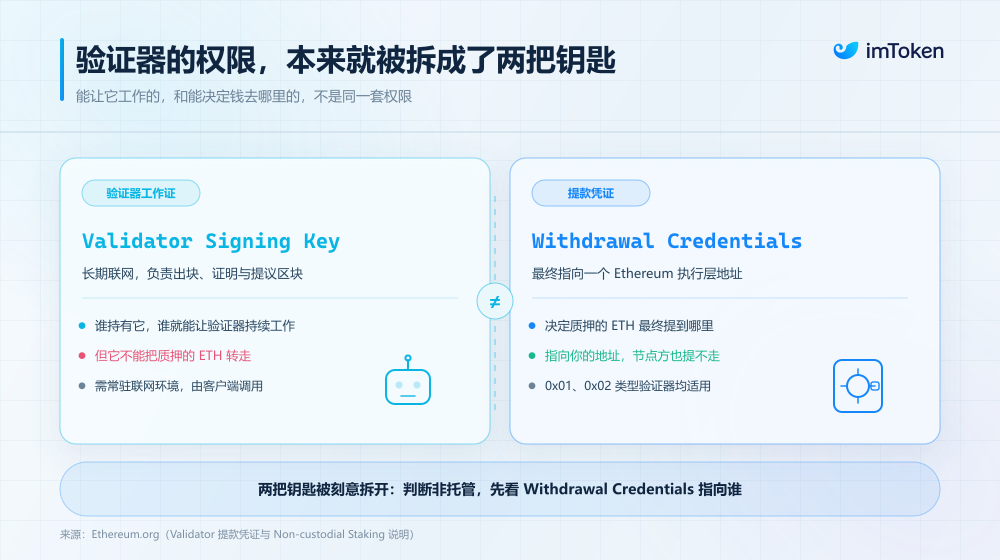
One type is the Signing Key, which is the private key for signing validations.
This key is specifically used to "perform duties", participating in attestations, proposing blocks, and completing various consensus tasks 24/7; it must be directly connected to a server and remain online at all times. Whoever holds this key is responsible for running this machine.
But it can only be used to prove that you are diligently participating in consensus; even if you sign a thousand times with this key, you can never access the principal, and if the machine goes offline or double signs, Ethereum also penalizes this validator’s earnings or principal.
The other type is the Withdrawal Credentials, which represents the control over withdrawal rights.
This is the true "withdrawal password"; the moment staking becomes effective, it is written in stone on the beacon chain, determining where the staked ETH and the generated earnings can ultimately be withdrawn to.
This key can comfortably lie in your cold wallet or mnemonic phrase, never needing to go online throughout your life.
In fact, Ethereum officially clearly distinguishes between the two: the signing key is a "hot" permission that needs to remain online, while the withdrawal credentials represent the "cold" permissions regarding asset ownership.
This means that a third party can operate the validator for users without needing to own the users' ETH.
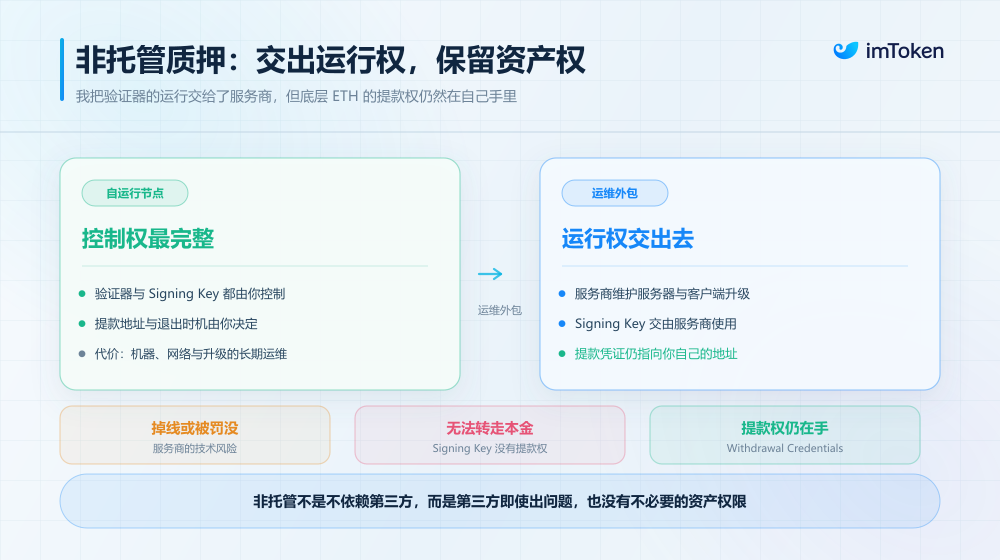
This is also why non-custodial staking like imToken’s works—the node service provider (like InfStones) holds the Signing Key, responsible for data center operations, network defense, and maintaining online status 24/7. It determines how efficiently the node runs and how much block reward it can earn, but searching through the code, it cannot find even a line that allows it to withdraw the staked funds for its own use.
Even after Ethereum upgraded and introduced EIP-7002 (which allows triggering exits at the execution layer), this layer of control has become even more extreme.
In the past, if a node operator became uncontactable or played tricks, although they could not take the money, users often had to wait for the operator to broadcast the exit message using the Signing Key to exit the validator, making them passive. But with EIP-7002, as long as the withdrawal credentials (0x01 / 0x02) are in your hands, you can take your imToken wallet and directly send a command at the execution layer to forcibly shut down this validator and queue for a refund.
In other words, even if the node service provider completely disappears one day, your money will not be stuck on-chain.
This is exactly where "non-custodial" truly requires attention: the entire staking process may involve a third party, but the one responsible for the work does not simultaneously hold the power to withdraw the funds.
2. What can users, wallets, node service providers, and Ethereum each do?
Continuing to break this down, one will find that what seems to be a simple ETH staking actually involves at least four roles.
These are the user, the wallet, the node service provider, and the Ethereum protocol itself, but their permissions are different.
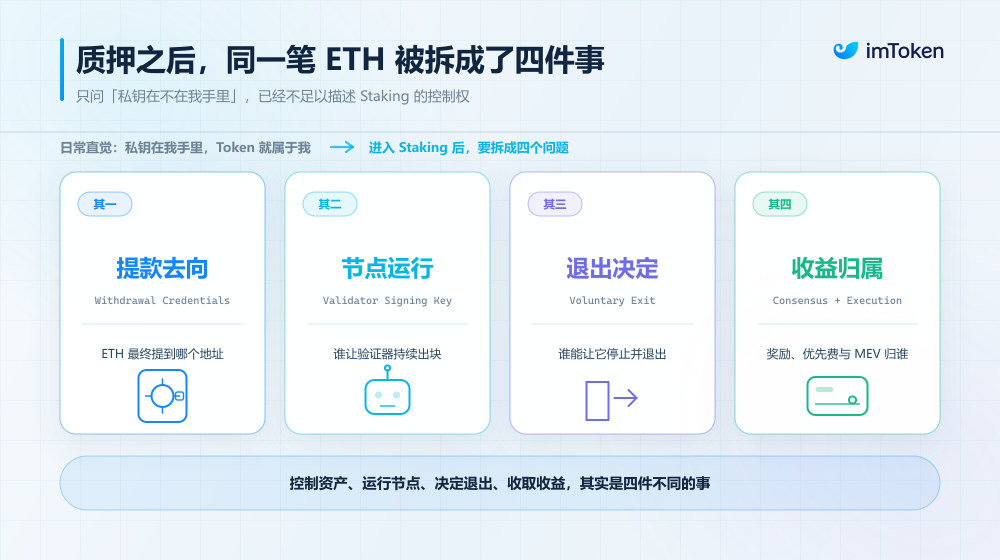
First, the user.
In a true non-custodial architecture, users retain the most important control over their funds.
Using imToken’s non-custodial ETH staking as an example, users have the right to withdraw, and service providers cannot arbitrarily transfer staked assets to their own accounts. The validator's status can also be queried directly on-chain.
This fundamentally differs from what many people usually understand as "handing over crypto to someone to manage", although the ETH no longer lies in the user's wallet balance but has entered the Ethereum Deposit Contract and become part of the validator's balance, it does not thereby become the asset of the relevant node.
The node maintains the Validator, controlling its operational permissions and not the rights to withdraw the assets.
Next is the wallet.
The wallet serves more as the entry point for users to manage this set of permissions rather than being the owner of the staked assets.
It helps users initiate staking, manage addresses, sign operations, check validator status and rewards, but as long as the underlying still follows non-custodial design, the wallet service provider itself will not automatically gain withdrawal rights to the user's assets simply by providing this interface.
Thus, "staking through a certain wallet" and "entrusting ETH to this wallet" are actually two completely different concepts, the determining nature still relies on how the underlying key and withdrawal credentials are configured.
The third role is the node service provider.
This is the part where misunderstanding is most likely to emerge in non-custodial staking. Since users do not run machines 24/7, someone must maintain the validator.
The node service provider is responsible for running the client, staying online, completing verification tasks, and safeguarding the Signing Key used for these tasks, meaning they remain very important. If they frequently go offline, users will lose part of the rewards they should have earned; if a serious infraction occurs, there is a risk of slashing.
So "non-custodial" never means "no risk from service providers"; it just means such risks are mainly limited to the quality of validator operations and yield levels, rather than whether "the service provider can take your 32 ETH away".
The final role is the Ethereum protocol itself.
This layer is often the most overlooked; once ETH enters the validator, none of the parties can transfer it like a normal wallet balance whenever they wish.
It must adhere to the rules established by Ethereum, such as when it can be activated, when it can exit, whether exiting requires queuing, what actions by the validator will result in penalties, and finally when withdrawals can be completed, all determined by the protocol.
The same goes for the 0x02 Compounding Validator launched after Pectra; it enables the validator's effective balance to increase from the traditional cap of 32 ETH to a maximum of 2048 ETH, allowing rewards to continue compounding, but withdrawals and exits still proceed according to the protocol's stipulations.
3. What about Lido? What was sacrificed for liquidity?
After establishing this framework, looking at liquidity staking like Lido becomes very intuitive.
After users deposit ETH into Lido, they receive stETH, and stETH itself still fully belongs to the user and can be transferred, traded, or used in DeFi.
This is also the greatest value of liquid staking, allowing liquidity that was originally locked in validators to be released again.
However, at the same time, the underlying structure of control over ETH has also changed.
Lido aggregates a large amount of user ETH and then allocates it through protocols to create and operate validators with different Node Operators; the Withdrawal Credentials of these validators are not individual Ethereum addresses belonging to each stETH user, but are uniformly set by the Lido protocol, and the underlying withdrawal process is completed collaboratively by the protocol's smart contracts, Oracles, and node operators.
So users hold the staking rights represented by stETH, rather than a Withdrawal Credential belonging to a "validator that is solely their own".
When users want to redeem ETH from the protocol, they need to submit stETH to the Lido Withdrawal Queue, wait for the protocol to complete the relevant exit and fund preparations, and then claim ETH. Lido will generate an NFT representing the right to withdraw for this withdrawal request, and only after the request is completed can users claim the underlying ETH.
However, even though it appears users still hold stETH, and the protocol itself operates through smart contracts, with no centralized entity able to take all users' assets arbitrarily, it does indeed have different trust boundaries compared to non-custodial native staking where each person has their own validator and the withdrawal address directly belongs to the user.
The former comes with a lower barrier to entry, better liquidity, and widespread composability of stETH in DeFi;
the latter sacrifices a portion of liquidity and requires at least 32 ETH but establishes the funding control relationship of the underlying validator more transparently.
In simple terms, Liquid Staking resembles holding a freely transferable "staked asset certificate," while non-custodial native staking is closer to owning a truly personal validator, merely outsourcing its daily operation.
There are no absolute advantages or disadvantages between the two.
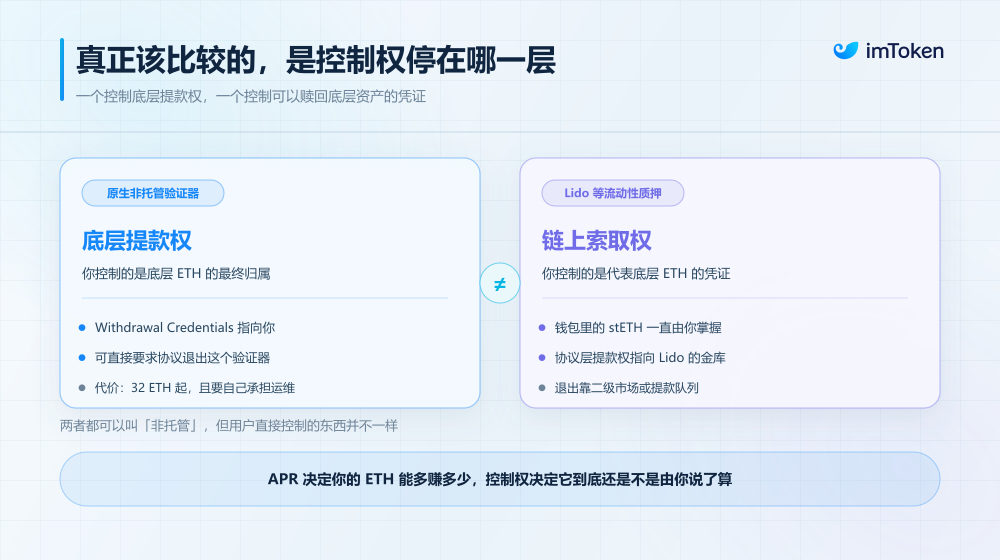
For users with only a few ETH, who need to trade at any time or wish to participate in DeFi, assets like stETH for liquid staking are obviously more convenient.
But if a user holds 32 ETH, 64 ETH, or even more for a long period, and has no strong liquidity requirements, the yield differences are not substantial enough to dictate their choice; at this point, considerations regarding "who controls the assets" will weigh much more heavily in terms of security.
After all, staking rewards change daily, the APR fluctuates with the total network staking volume, and fee rates may also adjust.
Ultimately, where the Withdrawal Credentials point to, who can withdraw the principal, and whether third parties need to cooperate in extreme situations determine the most fundamental trust structure of the entire product.
This may also be an easily overlooked change as ETH Staking gradually matures:
As the yields and experiences of various products draw closer, the real differentiator moving forward may very well revert to a very simple question—who ultimately controls my ETH?
In conclusion
There is no absolute right or wrong in choice.
If you only have two or three ETH, or are keen on playing around with cyclical lending in DeFi, then from the perspective of capital utilization and thresholds, liquid staking tokens like stETH are indeed the more practical choice.
But if your goal is to establish a core long-term position in the Ethereum network, whether it be 32 ETH or more, the situation changes entirely; when the net yield differences of various products shrink to fractions of a percentage point or even just a few basis points, bearing the lengthy contract calls and governance risks for such minimal gains is actually quite low in cost-effectiveness.
In the crypto industry, it is often said, "Not your keys, not your coins."
But placed in the context of staking, it might also need to add a half-sentence: "Not your withdrawal credentials, not your native stake."
免责声明:本文章仅代表作者个人观点,不代表本平台的立场和观点。本文章仅供信息分享,不构成对任何人的任何投资建议。用户与作者之间的任何争议,与本平台无关。如网页中刊载的文章或图片涉及侵权,请提供相关的权利证明和身份证明发送邮件到support@aicoin.com,本平台相关工作人员将会进行核查。


