Original Author: Xu Chao
Original Source: Wall Street Journal
The U.S. non-farm employment report for August will be released tonight. Wall Street expects a slight recovery in employment growth from the negative value in July, but the market logic has suddenly shifted — for investors, a bright data report is not necessarily a good thing, and a poor employment report does not necessarily mean disaster. The core of the data game lies in the Federal Reserve's next interest rate hike path.
The market consensus expects the August non-farm payrolls to increase by 55,000, rebounding from July's decline of 23,000, with the unemployment rate likely remaining unchanged at 4.1%, and the average hourly wage growth expected to be 0.3% month-on-month. Goldman Sachs takes a more cautious stance, expecting only 40,000 new jobs, slightly below consensus. According to J.P. Morgan's market intelligence team, Federal Reserve Chairman Warsh has made it clear at the Jackson Hole annual meeting that the current economy is at full employment, and inflationary pressures remain high, which means that the non-farm data is operating under a "good news is bad news" logic — strong employment will push up bond yields, suppressing U.S. stocks.
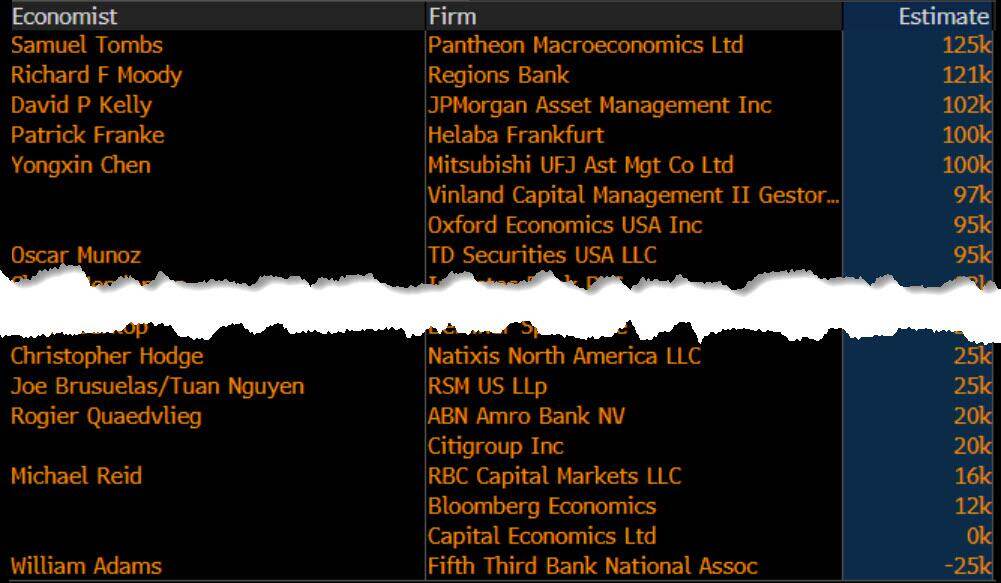
In terms of market impact, J.P. Morgan believes that under the current policy environment, next week's CPI data will have a greater impact on the Fed meeting on September 16 than today’s non-farm report. According to J.P. Morgan, the implied daily volatility of options expiring on the S&P 500 index on September 4 is about 1.1%. According to Bloomberg Chief Economist Anna Wong, if the August non-farm report records negative growth again, "there is no precedent in the modern history of the Fed for the Fed to raise rates after two consecutive months of negative non-farm growth."
Data Expectations: Mixed Signals and Confusion
The leading indicators of the employment market in August show significant divergence, making predictions more difficult than usual.
The ADP reported that private sector employment in August increased by only 38,000, the slowest since January of this year, below the consensus of 47,000, marking the largest recent miss.
Revelio's public labor statistics show that the entire economy added 36,500 jobs in August, a noticeable slowdown from 79,200 in July. The number of initial jobless claims rose to 207,000 during the BLS survey period, higher than the 189,000 in July's survey period. Goldman Sachs’ alternative employment indicators averaged 31,000, down from 65,000 in July. Additionally, the Challenger report indicates that employers announced layoffs of 52,900 in August, a significant increase from the 33,400 in July.
However, layoffs overall remain restrained — the cumulative layoffs for the first eight months of 2026 recorded by Challenger total about 530,000, the lowest for the same period since 2022; hiring plans, however, are at their highest since 2023.
The average initial jobless claims for the month is 204,000, down from 210,000 in July, and the JOLTS layoff rate also decreased by 0.1 percentage points to 1.0%. Furthermore, the previous two months saw a cumulative decline of 83,000 in leisure and hospitality jobs, and a decline of 61,000 in local government education jobs, both of which have room for normalization rebound.
The job vacancy data (comprehensive of JOLTS, Indeed, and LinkUp) remained roughly flat in July, with no significant trending changes observed recently.
Business survey signals are similarly mixed: the ISM manufacturing employment index slightly decreased to 51.2, still in expansion but slowing down; the ISM services employment index increased slightly to 47.8, remaining in contraction territory for the second consecutive month; meanwhile, both the manufacturing and services PMI employment components from S&P Global have strengthened, with the latter recording the fastest employment growth in nearly 18 months.
Expiration of Temporary Protected Status: Potential Downside Tail Risks
Analysts point out a potential policy factor that could mechanistically depress employment data — approximately 300,000 immigrants (mainly of Haitian descent) had their Temporary Protected Status expire at the end of July, which subsequently terminated their work permits in the U.S.
Barclays estimates that about 200,000 of these were still counted as employed during the July non-farm survey, with approximately 25,000 expected to disappear from the August statistics as employers stop including them on the payroll. As the remaining individuals gradually complete eligibility reviews, the cumulative impact will continue to manifest in the following months. Some individuals have already applied for asylum before the deadline, with some receiving approval before their status expired and still retain work eligibility; others may remain temporarily on employer payroll records because the employers have not yet completed work eligibility verification.
According to Bloomberg Chief Economist Anna Wong's assessment, considering the above factors, there is a considerable probability of the August non-farm data showing negative growth for the second consecutive month.
Benchmark Annual Revisions: Employment Data Already Underestimated
In the context of this data release, one must also consider the annual benchmark revision estimates released by the Bureau of Labor Statistics (BLS) in August.
The revisions indicate that as of March 2026, the seasonally adjusted number of jobs was 79,000 lower than the previous estimate, a decrease of about 0.1%. This decline is much smaller than last year’s revision — the baseline revision for March 2025 was as high as 911,000.
Looking closely at the structure, the downward revision of private sector employment was larger, amounting to 178,000, implying that the average monthly growth was actually 24,000, rather than the previously reported 38,000. By industry, retail sector had the largest downward revision (-154,600), while transportation and warehousing saw the largest upward revision (+135,100), and the government sector was still revised upward by 99,000 in the context of federal employee reductions. The final revised data will be officially included in the employment report of February 2027.
Federal Reserve Policy Path: After Non-Farm, CPI is the Real Key
From the perspective of Federal Reserve policy, analysts’ judgments are quite consistent: if non-farm data meets expectations and the unemployment rate remains stable, it will align with the judgment that "the labor market is cooling but not deteriorating sharply," which will keep decision-makers focused on inflation-related policy goals.
The scenario that would truly change the policy logic would be a significant negative growth in non-farm data. Anna Wong clearly pointed out that if August non-farm data is negative again, "there is no precedent in modern Federal Reserve history for raising rates after two consecutive months of negative growth," and this would immediately freeze the market's expectations for rate hikes.
From the market reaction framework, J.P. Morgan believes that with only one non-farm and one CPI data release remaining before the Federal Reserve meeting on September 16, the latter holds more critical weight. A strong non-farm report will drive bond yields up, suppressing the stock market through the self-reinforcing logic of "more jobs → more consumption → further expansion of businesses," and given that Warsh has highlighted the risks of loose financial conditions at Jackson Hole, this transmission mechanism warrants vigilance.
J.P. Morgan has set its "Goldilocks zone" for new jobs at 30,000 to 70,000; within this range, the market is more likely to remain relatively stable.
If Data Exceeds 100,000, U.S. Stocks Will Face Significant Pressure
According to J.P. Morgan, the following are the market reaction paths corresponding to different data ranges:
If data exceeds 100,000, U.S. stocks will face significant pressure, and the 10-year Treasury yield will rise, as the market will fully price in the possibility of a September rate hike; if it falls within the range of 70,000 to 100,000, the stock market will be slightly pressured, with yields rising moderately; a range of 30,000 to 70,000 represents the "Goldilocks zone," with market reaction being relatively neutral; if below 30,000 or recording negative growth, short-term rates will fall rapidly, but the negative scenario may trigger "stagflation fears," complicating the market’s judgment on the Federal Reserve's policy path.
Goldman Sachs expects the average hourly wage growth to be 0.4% month-on-month, higher than the consensus of 0.3%, believing that positive calendar effects will support stronger wage data. Goldman Sachs’ wage tracking indicators show that in the second quarter, hourly wages grew at a seasonally adjusted annual rate of 2.8% and a year-on-year growth of 3.6%, still below the estimated threshold of 4% growth aligned with the 2% inflation target.
免责声明:本文章仅代表作者个人观点,不代表本平台的立场和观点。本文章仅供信息分享,不构成对任何人的任何投资建议。用户与作者之间的任何争议,与本平台无关。如网页中刊载的文章或图片涉及侵权,请提供相关的权利证明和身份证明发送邮件到support@aicoin.com,本平台相关工作人员将会进行核查。


