The expansion of the robot industry itself does not rely on encryption technology; the value of encrypted assets fills the gap in cross-entity collaboration.
Written by: Thejaswini M A
Translated by: Chopper, Foresight News
Have you ever imagined that robots also need money? We are not referring to AI entities that call API services, but rather to machines that have a tangible physical body. Why would such a device require an encrypted wallet or an independent identity credential?
Many might find this idea quite bizarre. However, there are already more than ten crypto companies rolling out related products, so let's explore the business logic behind it.
Starship Technologies operates about 3,000 six-wheeled delivery robots, covering 8 countries, primarily landing in major city centers across Europe, with their commercial delivery orders exceeding 10 million.
Serve Robotics, listed on Nasdaq, has expanded its operations to 44 cities including Los Angeles, Chicago, Atlanta, Miami, and Dallas, handling delivery orders for Uber Eats and DoorDash.
These wheeled box devices can carry about 20 kg of goods in a single trip, traveling several miles at a time. If you live in one of those cities, you have likely encountered them on the road.
Suppose you purchase a delivery robot to manage a small delivery business within your community. This machine works 12 hours a day, serving as cheap labor for you, completely owned by you after the purchase.
Referring to the specifications of robots under Starship, this device can run for up to 18 hours on a full charge. It will eventually need to find charging points to replenish its power. Starship's solution is to allow its robots to operate outdoors, returning to their brand's built-in dedicated charging stations. This model is feasible for Starship — the company has thousands of robots and the financial strength to lay out supporting charging stations across all operational areas.
But if you only own one robot, it can only use third-party charging stations. Operators can set up charging facilities like electric vehicle charging stations, street vendors can offer charging services, or other delivery service providers can open idle charging ports. The battery capacity of the robot is comparable to that of electric bicycles, with a very low electricity consumption per charge, costing approximately a few cents to 1 dollar; we will assume it to be about 40 cents.
How would this fee be settled within the existing traditional financial system?
The most intuitive solution is to bind a payment card to the robot for contactless payments. Bank card payments include two service fees: a percentage of the transaction amount, plus a fixed fee ranging from 10-30 cents, regardless of whether the transaction amount is 40 cents or 400 dollars — the cost of transaction processing itself is constant. For a 40-cent order, a 30-cent fixed fee accounts for a staggering 75%.
As the business scales up, the issue will become even more severe. Fixed fees are charged per transaction. If in the future the robots fulfill small service transactions worth 1 billion dollars annually, with an average payment amount of about 32 cents per transaction, the total number of transactions will reach 3 billion. With 3 billion transactions, each charging a 30-cent fee, it would mean that from 1 billion dollars in revenue, the fee costs would reach 900 million dollars.
The cost of bank wire transfers is even higher. A cross-border SWIFT transfer can cost between 15-50 dollars, while each intermediary clearing bank charges an additional 10-30 dollars, plus exchange costs. This payment method is only suitable for large transfers over 5,000 dollars.
The current currency payment system is designed for a small number of large transactions. On the contrary, the payments autonomously made by machines do not fit this model. If high service fees are the first barrier, the second core contradiction lies in the fact that robots do not have independent customer identities.
Even if the fee issue is resolved, charging stations still cannot deduct payments directly from the robot's account. Payment accounts belong to natural persons or businesses, who have complete dispute resolution mechanisms. This payment is, in essence, still borne by you, with the robot merely triggering the card-swipe action. This is also how all robot payments currently function worldwide.
Charging stations need to verify multiple pieces of information in just two seconds when authorizing power for a strange device. Is this machine a real physical device, rather than a scripted fake request attempting to siphon free electricity? Does this device have a good historical operational record, or will it leave mid-charge? Once a device malfunctions causing losses, is there corresponding liability proof? Giving robots independent identities means responding to these three verification questions without signing a paper contract.
Currently, these issues are resolved by humans. They will issue invoices to you monthly, and if the robot breaks something, they will come to you for a lawsuit. This system might work if it's just you and the robot. But in a world where 2,000 operators and 40,000 machines meet on the streets, the system needs to have some records, allowing strangers to quickly check and decide whether to provide service to this machine.
This is the core idea of the entire scheme.
Before we delve into further discussion, we must first clarify one fact: the vast majority of robots will never need this autonomous payment system.
A robot only needs to have an independent asset account if it simultaneously meets the following four conditions:
- The devices belong to different owners
- The volume of business orders is relatively small, with transaction scenarios being random and scattered
- There is no centralized platform to facilitate settlement between parties
- Services need to be authorized on-site within seconds
Amazon has deployed over a million self-developed robots within 300 warehouses, all using its proprietary scheduling system, which does not meet the first constraint; platforms like Uber Eats do not meet the third; devices that have signed cooperation agreements with merchants do not meet the second and fourth constraints. This also implies that this track belongs to a niche market, not a universal demand across the entire robot industry.
Tesla's factory has deployed about 1,000 Optimus humanoid robots, and the official communication during their earnings call still indicated that the devices are in the learning and data collection stage, not yet open for commercial service.
The world's leading industrial robot manufacturer Fanuc sells hardware products and supports the FIELD equipment monitoring platform for fault warnings, but this system does not involve money flow.
Chinese company Yushu Technology has reduced the procurement cost of humanoid robots to an affordable range for the public. The company completed its listing in Shanghai in August 2026, raising about 619 million dollars, and the shipment of humanoid robots exceeded 5,500 units in the previous year. According to the company, buyers use the robots in a variety of practical scenarios. In May 2026, Yushu launched the application store UniStore aimed at humanoid robots.
The aforementioned industry giants are replicating Apple's business model, keeping scheduling collaboration and payment settlement entirely within their own systems, with profits retained on the platform.
An open protocol ecosystem will only survive in the gaps of various closed systems, such as cross-brand collaboration among different operators' robots and public charging services. The DePIN track defined by CoinGecko is smaller in scale compared to the overall robot industry, and all subsequent analyses should be viewed with this premise in mind.
First, know where you stand
For robots to achieve autonomous payments, they must first determine their own location. Ordinary GPS positioning has a margin of error of several meters. The CEO of Starship has publicly stated that common GPS accuracy does not meet business needs, and their robots require navigation accuracy at the inch level.
To reduce the several-meter error to inch-level precision requires signal correction. Ground-based reference stations obtain their own accurate coordinates, calculate positioning deviations, and broadcast correction data to surrounding devices; this technology is called Real-Time Kinematic GPS (RTK-GPS). The effective coverage radius of the correction signal is about 30 kilometers, requiring the deployment of numerous reference stations throughout the network.
GEODNET incentivizes users to set up positioning stations on rooftops through a token reward model. Currently, over 21,000 devices are deployed globally, covering more than 150 countries with an annual recurring revenue of about 11 million dollars. Multicoin Capital led an 8 million dollar token acquisition deal.
Project revenue comes from providing centimeter-level RTK positioning services to independent devices like delivery robots, drones, and agricultural machinery. On the consumer level, this business does not rely heavily on crypto tokens; a traditional subscription payment model can also be implemented. However, on the infrastructure construction level, GEODNET has verified that token incentives can rapidly establish a global physical network. Building it through traditional enterprises would cost billions of dollars and take decades.
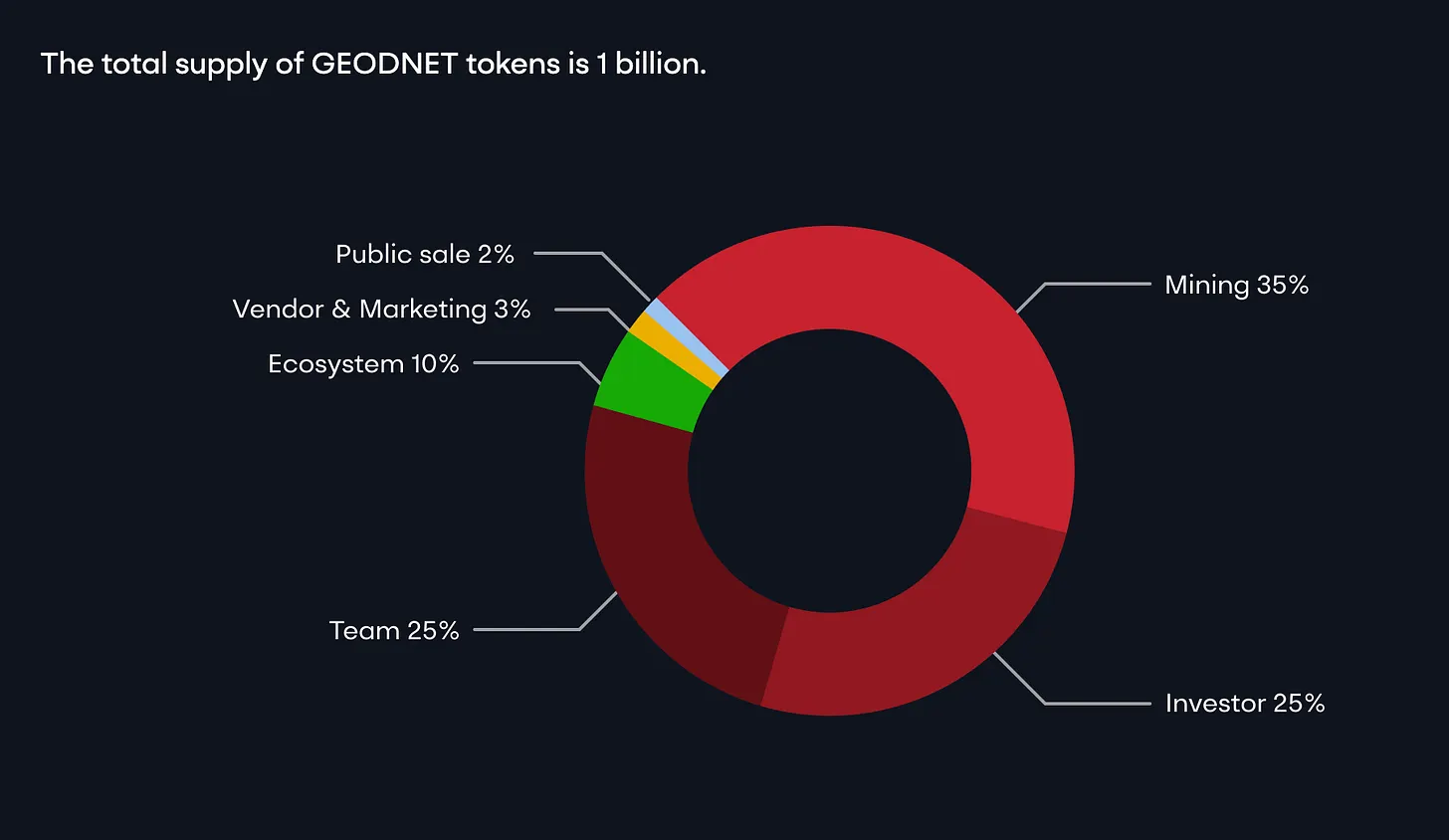
GEODNET token supply
Second, able to interact with anything
At this stage, robots produced by different manufacturers operate on their independent software systems, and devices cannot interact or communicate. Enterprises can only choose a single brand when purchasing hardware. Deploying multiple brands of robots requires the custom development of an integration program that currently does not exist.
OpenMind has received 20 million dollars in funding led by Pantera, and its founder Jan Liphardt is a professor at Stanford University. The team is developing an open-source general operating system called OM1, along with a scheduling collaboration layer called FABRIC. Just as the Android system allows different phones to run the same applications, OpenMind is building a unified software foundation for all robots.
Developers write upper-layer business logic that can adapt programs to Yushu humanoid robots, quadrupedal robots, and wheeled delivery devices simultaneously. The ultimate goal is to achieve cross-brand device identification, collaborative work, and automatic payment settlement through this unified interactive language.
The project is constructing the machine identity system based on the ERC-7777 standard, defining the behavioral boundaries of devices. If a robot is set as an "auxiliary service type" device, the program will automatically reject tasks that violate positioning rules. Robots can also cross-verify sensor data, avoiding safety accidents caused by abnormal perceptions from a single device.
OpenMind has partnered with Circle to achieve zero Gas fee USDC micropayments based on x402 standards, addressing the pain point of high fixed fees for small transactions. In the official demo video, a robot successfully made an autonomous payment for electricity. This demonstration runs on a test network, with no actual on-chain transaction records yet. However, this experiment proves that physical devices can independently host wallets, identify purchasable physical resources, and automatically complete the entire transaction process. Cooperation and communication do not need to establish trust.
Third, having a verifiable identity
Since 2017, IoTeX has been focused on blockchain solutions for physical devices, launching two core products to address identity issues.
The hardware identity ioID embeds a cryptographic fingerprint into physical devices, allowing devices to independently sign and preserve evidence of operational behavior; the proof-of-work W3bstream transforms execution actions from the physical world into blockchain-verifiable digital credentials.
Although IoTeX has solved the identity and proof problems, it has overlooked the credit and financing systems, which is where peaq comes into play.
Fourth, peaq protocol
If robots need to make payments, verify qualifications, and leave transaction traces for unfamiliar third parties, they require a set of trust and settlement infrastructure equivalent to human society, similar to business registration systems or SWIFT cross-border clearing networks.
peaq has built a complete supporting system, mainly divided into four modules. peaqID serves as a registration certificate. Robot NFTs serve as ownership records and can be segmented using the ERC-3643 standard. ERC-3643 is a token standard that only permits transfers between approved holders. In August 2026, peaq introduced support for P256 chip signatures, moving the verification process to hardware security chips.
The peaq machine credit scoring system assigns ratings from 0 to 100 based on robot revenue data, activity levels, and fulfillment reliability, using a ratings standard similar to Moody's, ranging from AAA-rated down to unrated.
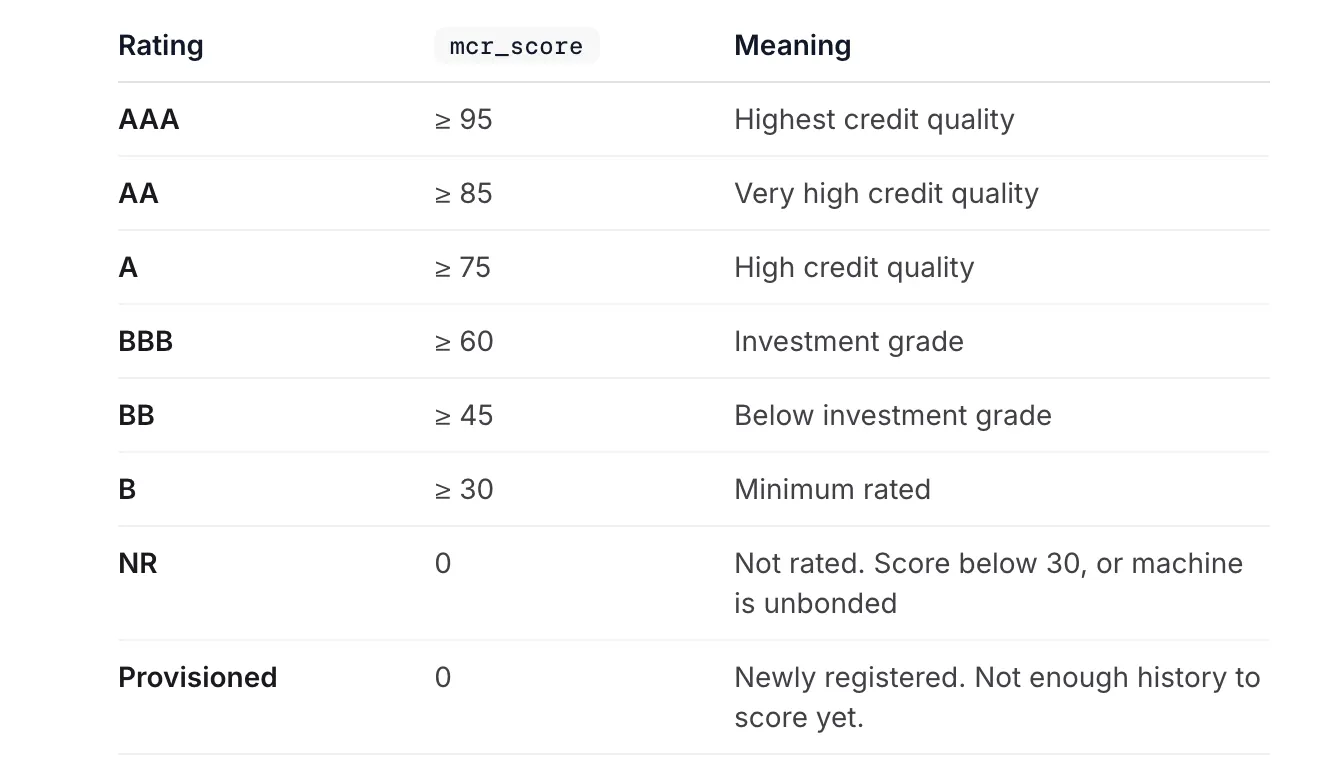
A robot pays 40 cents for charging, and the charging service provider can designate the payment network as Solana or Ethereum. The core value of peaq is that it enables robots to connect to any clearing channel specified by service providers.
In May 2026, during the demonstration of Serve delivery robots making independent payments, funds were eventually settled on the Solana public chain, rather than on peaq's own blockchain.
Throughout 2026, peaq plays more of a role as an ecosystem integrator. From January to the end of August, the project completed 49 development milestones and landed 20 ecosystem integrations: connecting to GEODNET's positioning service, NAVER's map navigation, and World ID to achieve human-machine identity isolation; integrating computing resources from Akash, Acurast, and Arcium; introducing Yushu humanoid robots and LG CLOi commercial service robots as hardware endpoints.
Enterprise registration is backed by national regulatory authorities, with courts having verification authority. Banks use SWIFT because the entire industry has unified transaction formats. To break free from the constraints of traditional compliance systems, peaq must proactively connect with Dubai regulatory authorities and apply for official licenses. Before obtaining compliance qualifications, financial institutions will not recognize that this machine credit scoring system has legal effect.
peaq has partnered with CoinList to launch Initial Machine Offerings, allowing users to purchase shares of robot revenue, structured by DualMintRWA. A benchmark project is a tokenized vertical farm located in Hong Kong, with 80% of the operating processes automated. Subsequently, 20 tokenized claw machines will be launched, and to date, this farm has distributed about 3,600 dollars in revenue to token holders.
Even if a robot has a positioning system, operating system, identity credentials, and credit rating, the hardware itself still requires funding for procurement. One possibility presented by the market is that the buyer can be an AI entity. Virtuals has already connected about 17,000 on-chain AI entities to Solana's BitRobot network, where AI entities pay to hire physical robots to complete offline tasks, with funds held in a smart contract and automatically settled after task confirmation.
Payments from software agents to robots and transfers between robots represent two different models, with the former demonstrating stronger business sustainability. AI agents possess digital capital, business objectives, and computing power but cannot intervene in the physical world; physical robots have mobile hardware capabilities but lack intrinsic funding and business needs. When robots transact payments with each other, the devices often belong to the same company, and internal bookkeeping is far simpler and more efficient than actual on-chain transfers.
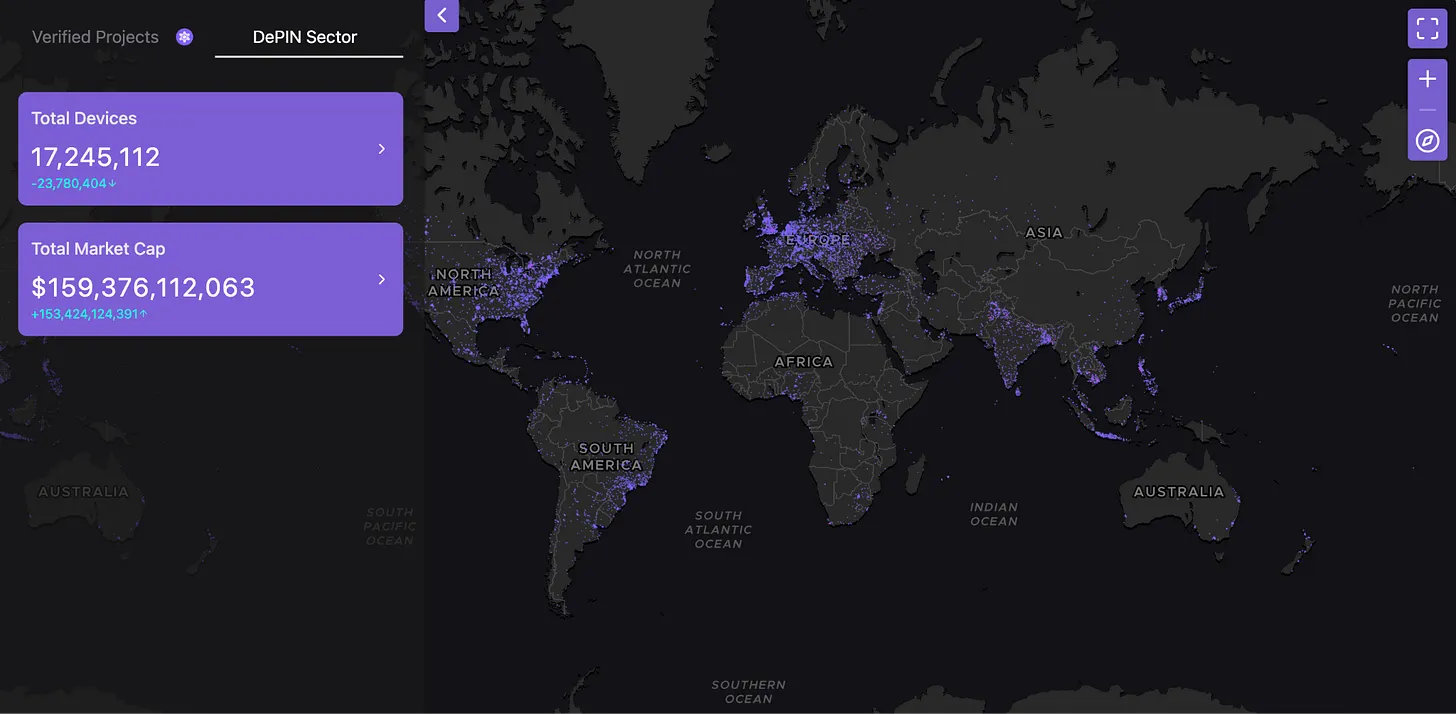
Looking at the entire market, the overall market cap of tokens in the CoinGecko robot sector is approximately 100 million dollars for GEODNET and about 55 million dollars for peaq.
It is evident that this track remains a niche segment within a small field.
Industry statistics indicate that, according to the International Federation of Robotics' "2025 Global Robotics Report," 542,000 industrial robots will be newly installed globally in 2024, with an operating stock of about 4.66 million units, over 2 million of which are deployed in China.
J.P. Morgan, in an external research report released in July 2026, predicted that global robot market sales would reach approximately 100 billion dollars by 2025; under a baseline scenario, market annual sales could reach 2.5 trillion dollars by 2035; the pessimistic expectation is 500 billion dollars, while the optimistic expectation could reach 8 trillion dollars. The same report estimates that the market size for humanoid robots will grow from 2 billion dollars in 2025 to 30 billion dollars by 2035 under baseline conditions.
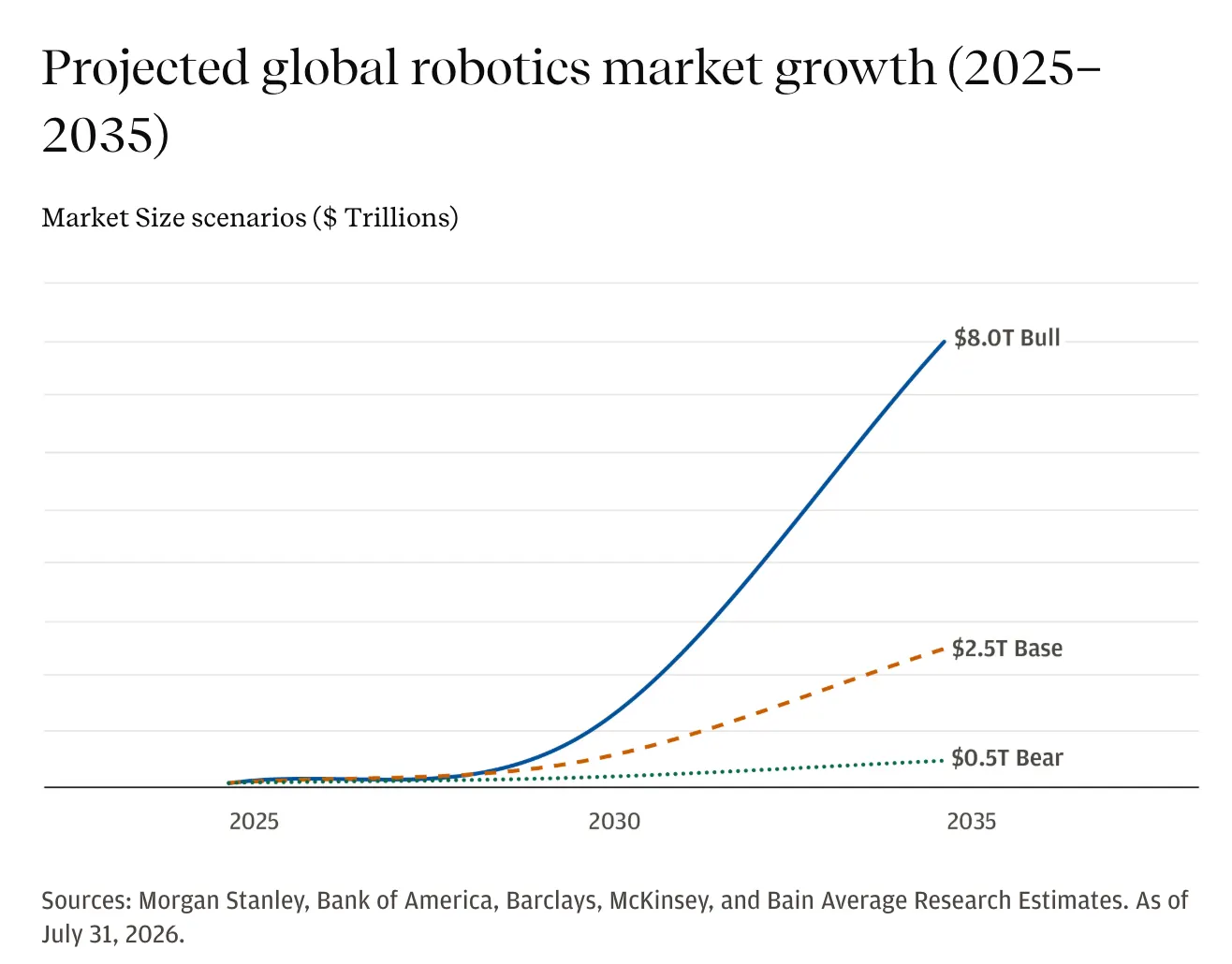
This is the target market that the crypto industry aims to penetrate by building the underlying layers for payments and identities. The crypto industry has never lacked grand visions, and this time is no exception.
The concept of autonomous interaction among machines is not a new idea; similar concepts have already been proposed in the early Internet of Things space. As early as 2015, IBM and Samsung demonstrated a washing machine that could autonomously purchase laundry detergent using Ethereum, named ADEPT. A few months later, IBM invested 3 billion dollars in laying out its IoT business, but the subsequent IoT sector ultimately shifted toward data monitoring. Billions of devices merely uploaded operational data to manufacturer backends. All the technology landed, and devices received communication certification from the manufacturers' servers, but automated trading between machines never formed a market scale, and the traditional payment system did not undergo transformation.
Robots are fundamentally different from ordinary IoT devices. Temperature control devices have a purchase cost of only 200 dollars and can only run flexibly. In contrast, the acquisition cost of robots is high, and they have the ability to generate revenue. Once devices can produce income, credit and insurance become a necessity, and third parties need to verify their fulfillment payment capabilities. For many years, IOTA has aimed to create a machine economic public chain, but the subsequent business direction has undergone a transformation; its implementation cases have focused on customs documents in Kenya, trade certificates in UK ports, organ donation registries in Argentina, and other government-recorded scenarios. Government agencies purchase blockchain identity tools for authentic data recording, but automated payment business between machines has struggled to open up the market.
The expansion of the robot industry itself does not depend on encryption technology. The value of encrypted assets is to fill the gaps in cross-entity collaboration: granting devices publicly trusted identities, autonomously controlled encrypted wallets, and low-cost micropayment channels.
Let’s envision an open robot labor market where anyone can rent a robot that does not belong to them to complete tasks. This market requires a complete supporting infrastructure: verifiable device identities, low-cost micropayment solutions, and fulfillment credit records to avoid renting devices with endurance failures; while also providing value-added rental services like high-precision positioning, cloud computing power, remote human control, and idle charging stations, all of which DePIN can accommodate.
Of course, if Tesla, Amazon, and domestic leading hardware manufacturers continue to keep the entire business closed within their own ecosystems, the open market may never truly take shape. Once the open market is realized, new business issues will follow: who will provide financing services for robots capable of generating revenue on-chain? Who will insure the devices? How will robot clusters be used as collateral? Who will establish a matching platform to receive orders released by warehouses and accept robot bidding? Once the identity system construction is completed, asset securitization will be the next stage proposition. Tokenization only releases its value when assets can flow freely.
DePIN is merely a lightweight underlying channel serving the segmented scenarios of non-closed-loop operation in the robot industry. Industry giants have no obligation to channel business into this ecosystem.
免责声明:本文章仅代表作者个人观点,不代表本平台的立场和观点。本文章仅供信息分享,不构成对任何人的任何投资建议。用户与作者之间的任何争议,与本平台无关。如网页中刊载的文章或图片涉及侵权,请提供相关的权利证明和身份证明发送邮件到support@aicoin.com,本平台相关工作人员将会进行核查。


