Author: Claude, Deep Tide TechFlow
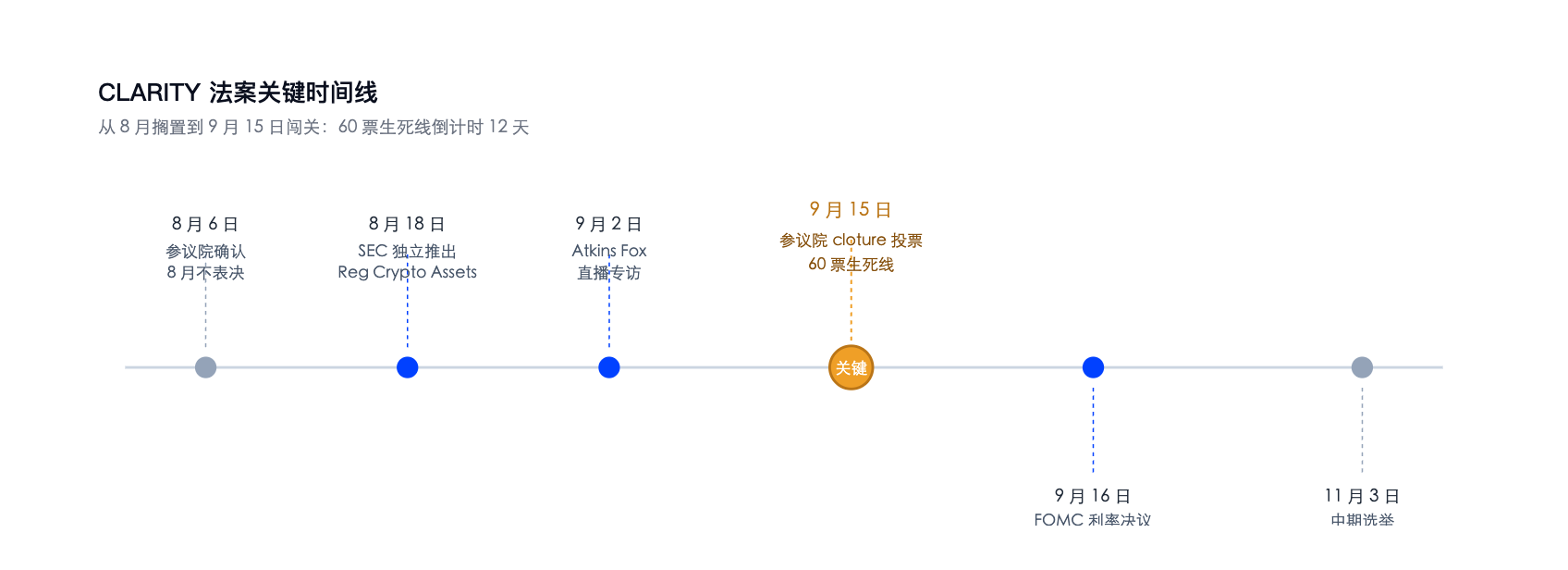
On September 2, SEC Chairman Paul Atkins stated in a live interview with Fox Business that the CLARITY Act will enter procedural voting in the Senate on September 15, requiring 60 votes to advance debate. The bill, numbered H.R. 3633, missed the pre-recess window in August due to disagreements over ethical clauses, stablecoin yields, and whether it can gather the critical 7 bipartisan votes from Democrats remains uncertain. The SEC independently launched the "Regulation Crypto Assets" framework on August 18 and initiated a 60-day public consultation. Regardless of whether legislation passes, the regulatory logic of the U.S. cryptocurrency market has entered a new stage.
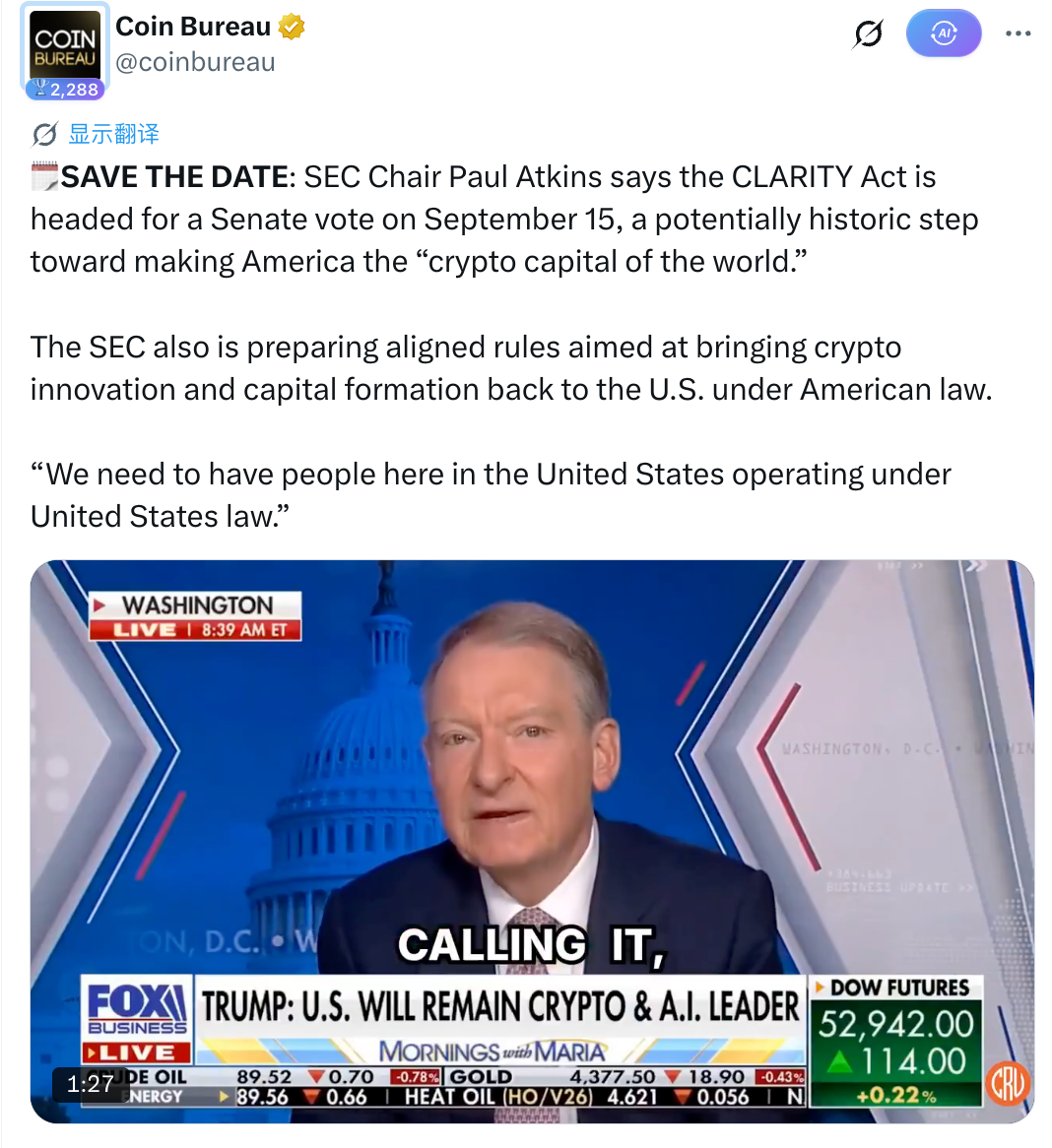
September 15 is just the procedural starting point; the CLARITY Act still has to pass three hurdles
The bill is officially numbered H.R. 3633 and passed the House with bipartisan support of 294 votes to 134 votes in July 2025, and then advanced in May 2026 by the Senate Banking Committee with a vote of 15 to 9. The background is the long-standing blurred boundaries between the SEC and the CFTC (Commodity Futures Trading Commission) in digital asset regulation. Atkins, who took over as SEC Chairman in 2025, has repeatedly stated the need for legislative grounding instead of relying on administrative interpretations.
On September 15 at 2:15 PM ET, the Senate will first vote on the "motion to terminate debate" (cloture motion). This step requires 60 votes to move to the debate on the bill's text, which does not equate to the bill's passage. Atkins expressed his judgment in the September 2 interview: "I anticipate and hope that the CLARITY Act will pass in the Senate and ultimately be sent to the President's desk."
Even if the cloture vote goes smoothly, the bill itself still needs to pass the Senate's final review, the House's reconsideration, and obtain the President's signature. Senate Majority Leader John Thune (Republican from South Dakota) submitted the cloture motion on August 10, keeping the bill until September.
Seven Democratic senators will determine the 60 votes threshold
The bill needs 60 votes to end lengthy debate (filibuster), and currently, Republicans hold 53 seats, requiring at least 7 Democratic senators' bipartisan support to advance.
There are three unresolved core disagreements.
Ethical clauses: Democrats demand conflict of interest rules for government officials holding digital assets exceeding one million dollars. The background is Trump disclosure in 2025 that his family's cryptocurrency business revenue exceeded one billion dollars (covering World Liberty Financial, TRUMP meme coin, etc.). Senators Thom Tillis (Republican from North Carolina) and Ruben Gallego (Democrat from Arizona) have drafted a counter-proposal since the end of July and submitted it to the White House, yet they have received no response to date.
Stablecoin yields: The Senate version prohibits the payment of interest on idle stablecoin balances and only allows rewards based on actual on-chain activity (such as staking). Coinbase has therefore withdrawn its support for the bill, arguing that the relevant clause may restrict its competitive space in the stablecoin business.
Bill expansion: The bill has expanded from the initial 309 pages to 616 pages, incorporating over 100 Democratic demands, reflecting a deeper game of banking protections and regulatory jurisdiction.
The prediction market Kalshi currently gives a 49% probability that the CLARITY Act will be signed into law by the end of the year, while Polymarket's similar contract quotes 16%. The divergence between the two markets reflects different judgments about the September window.
Atkins does not wait for Congress's approval; the safety net rule is already in motion
Regardless of whether legislation is realized, the SEC announced an independent framework "Regulation Crypto Assets" on August 18, establishing exemptions for certain token offerings under securities law and opened a 60-day public consultation.
Atkins clearly stated in the interview: "Even if Congress does not pass the bill, the SEC will advance rules under the current securities law framework." This echoes his statement when the proposal was released in August: "Legislation is still essential for establishing rules that can withstand scrutiny from future regulators, but the SEC can act under existing law first."
The practical impact on market participants is that regardless of the result on September 15, the SEC will begin advancing specific rules after completing the consultation in late October. The legislative and administrative windows will no longer be mutually exclusive but rather operate in sync.
Only 14 working days left for CLARITY in 2026
The Senate will reconvene on September 14, leaving only 14 working days for the bill. November 3 is Election Day, and Congress will enter a pre-election recess again in mid-October. If the bill does not pass the Senate's final review by September 30, it is equivalent to "no hope for this year."
Secondary timelines are also critical: On September 16, the FOMC (Federal Open Market Committee) will announce interest rate decisions. Some institutional traders are simultaneously betting on regulatory good news and monetary easing, which may intensify short-term fluctuations in the cryptocurrency market.
XRP, SOL, DOGE: These spot ETF subjects, along with their identities change
If the bill passes the Senate's final review and is signed into effect by the end of September, fully decentralized digital assets like BTC and ETH will be explicitly classified as digital commodities, regulated by the CFTC, and the SEC will no longer be able to hold them accountable under "unregistered securities." The grandfather clause in the bill defaults to commodities for the spot ETF subjects listed before January 1, 2026 (XRP, SOL, LTC, HBAR, DOGE, LINK), reducing the risk of these six coins being reclassified as securities. The "regulatory uncertainty discount" in institutional asset allocation will also diminish.
There is also the possibility that the Senate version passes but encounters hurdles in the House: the bill may enter a bicameral negotiating committee, retracing the legislative process and the political cost will rise within the remaining window.
The most unfavorable path is the failure of the cloture vote, unable to gather 60 votes. The safety net rules will proceed as planned, but the market's expectations for comprehensive legislation will be dashed, shifting attention to the SEC rules at the end of October. JPMorgan has warned that without a complete framework, tokenization applications may be absorbed by traditional financial infrastructure instead of remaining on public chains.
免责声明:本文章仅代表作者个人观点,不代表本平台的立场和观点。本文章仅供信息分享,不构成对任何人的任何投资建议。用户与作者之间的任何争议,与本平台无关。如网页中刊载的文章或图片涉及侵权,请提供相关的权利证明和身份证明发送邮件到support@aicoin.com,本平台相关工作人员将会进行核查。


