
Author: Nancy, PANews
The continuously trending Robinhood Chain has become the on-chain popular venue, with founder Vlad frequently taking the field to continuously “fuel the fire” for this market condition.
In this frenzy of traffic and funds, some have laid low early, reaping tens or even hundreds of times their returns; some have been sweep buying everywhere, repeatedly paying “tuition” in chasing highs and cutting losses; some decisively chased the leaders and managed to take a slice; while others have repeatedly missed out, falling into anxiety amidst the market rotation; there are also players seeking alternative routes, attempting to carve a piece of the pie by forming LPs in high volatility markets.
Funds continue to pour in, top Meme coins break new highs consecutively
Currently, Robinhood Chain has become the new center for traffic and funds in the Meme market, absorbing a large volume of trading and market attention. As quality on-chain targets continue to emerge, the market cap ceiling keeps being raised, wealth effects keep appearing, further opening up the market's imagination space, and attracting more liquidity.
According to GMGN data, there are currently 3 Meme coins on Robinhood Chain that have reached a market cap of over one hundred million dollars, namely PONS, CASHCAT, and AI.
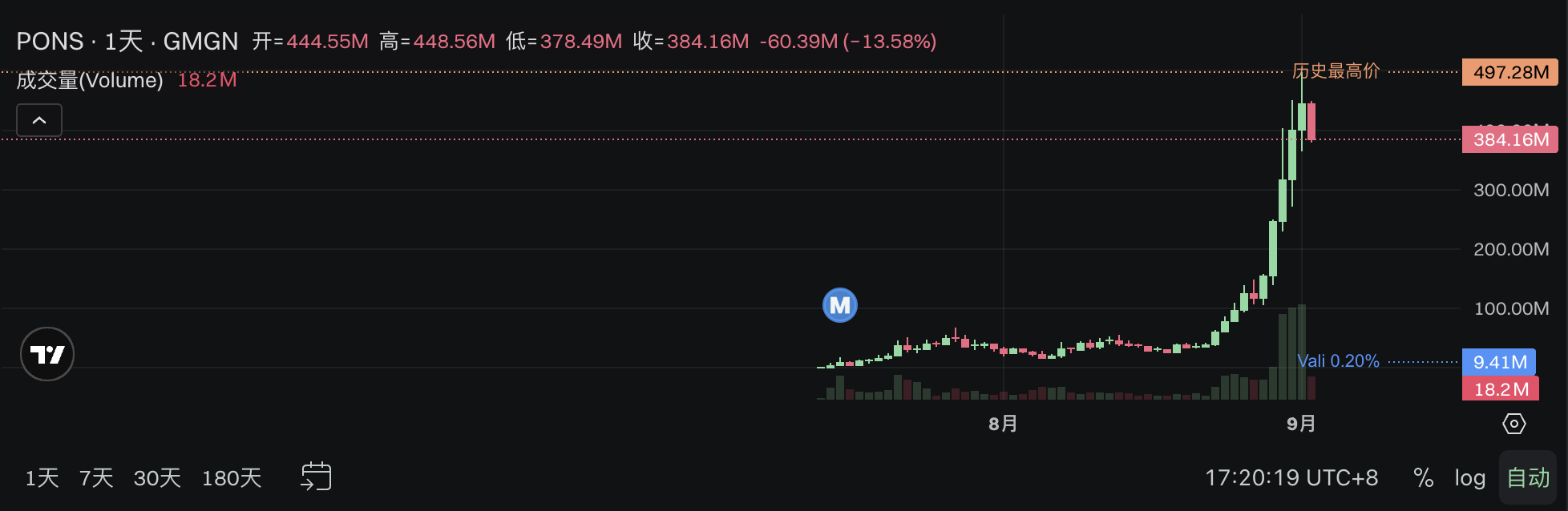
Among them, PONS has the highest market cap, once nearing 490 million dollars, currently retracing to about 380 million dollars, making it the second Meme coin on Robinhood Chain to break a market cap of 100 million dollars. Since its launch on July 13, PONS has grown to become the leading token on-chain in less than two months.
From the price trend perspective, PONS truly entered a noticeable upward channel in late August after experiencing a long period of fluctuation and sideways movement. For early investors, capturing high multiples of profit depends not only on buying early but also on whether they can continuously hold their chips during the long consolidation.
The main value support behind the rise of PONS comes from Robinhood Chain's top Launchpad, Pons. As a platform token, with the continued rise in trading activity and increasing transaction fee income for Pons, PONS is able to share in the growth dividends brought by the platform's ecosystem expansion; coupled with a buyback and burn mechanism, it further provides fundamental support for PONS's price performance.
AI (Artificial Inu) is a recently popular leading Meme coin. Since July 14, its market cap has been rising, peaking at 320 million dollars, currently retracting to about 240 million dollars. Similar to PONS, AI's significant upward trend appeared around the end of August and coincided with sustained market heat.
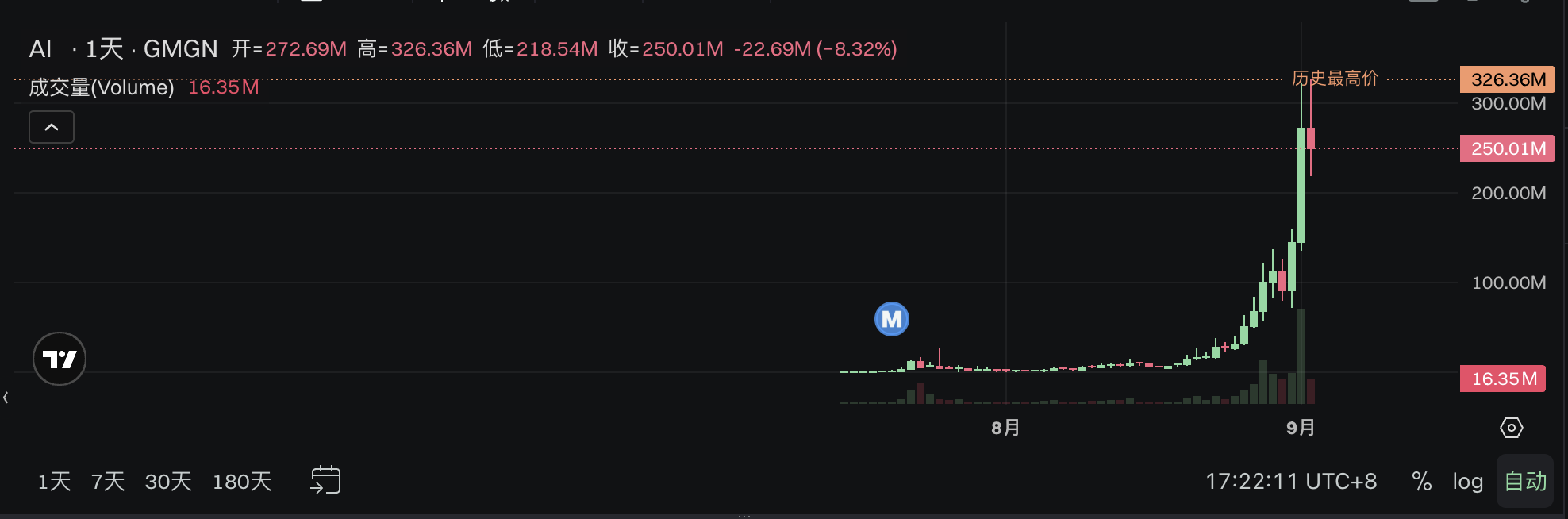
The core narrative of AI comes from “AI + US stock Meme.” It is paired with the tokenized stock NVDA, with transaction fee income deposited into the treasury; at the same time, the fee return mechanism of its launch platform Long.xyz also provides a value capture path for AI.
In comparison, CASHCAT follows a purer Meme route. As a Meme coin derived from the Robinhood mascot, CASHCAT is the first Meme coin on Robinhood Chain to break a market cap of 100 million dollars and has taken the lead in landing on the main Robinhood trading site, possessing a certain first-mover advantage in traffic and brand effect.
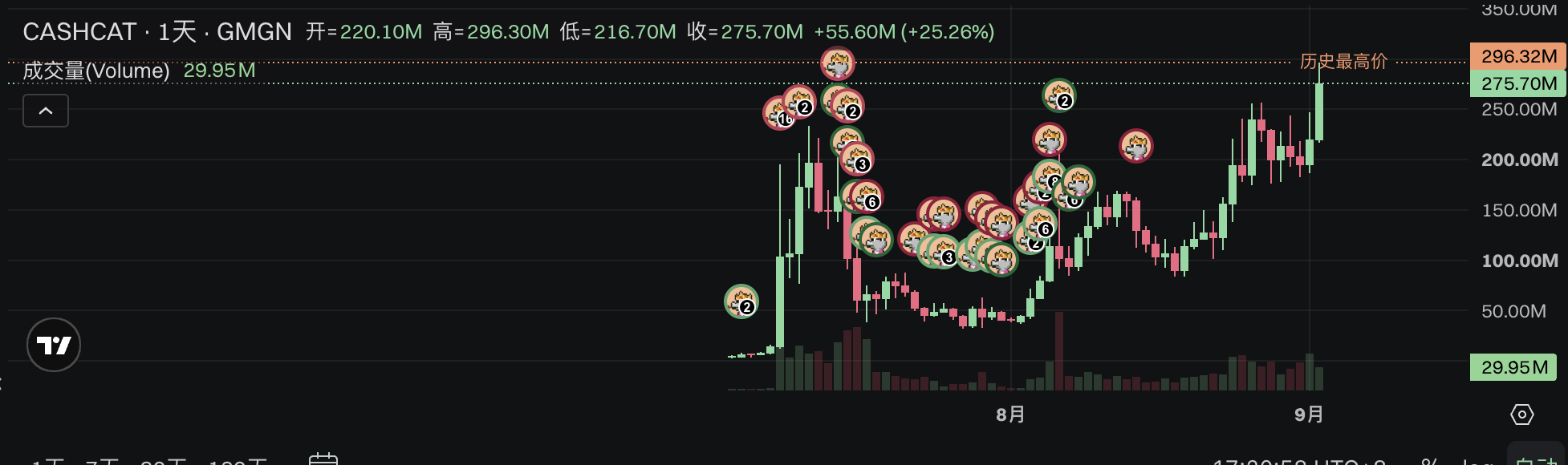
CASHCAT shows a more typical step-like rise. It broke through a market cap of 100 million dollars just 5 days after its launch and subsequently broke through 200 million dollars within just 2 days. Thereafter, CASHCAT underwent several rounds of corrections and sideways movements, but the price lows continued to rise, quickly recapturing lost ground after each round of adjustment and breaking previous highs again after completing chip turnover. Currently, CASHCAT's market cap has reached a historical high of nearly 290 million dollars. This repeated upward price trend indicates that it is gradually forming a new price consensus through multiple rounds of competition and chip exchanges.
Aside from these three top projects breaking a market cap of 100 million dollars, there are currently 5 Meme coins on Robinhood Chain with a market cap in the tens of millions of dollars, namely BONER, microduck, Moo, DELTA, and SPACEHOOD, all of which have recently achieved periodic new highs as well. However, compared to the top Meme coins, these tokens' market cap volatility is relatively greater, with many experiencing close to or deeper than half of their historical peak retracement.
The rise of BONER is mainly driven by the pairing narrative of coins and stocks along with the on-chain short squeeze narrative; microduck combines multiple topics, including the NVDA main trading pair, the Hugging Face named duck-shaped robot, and rumors of a potential NVIDIA acquisition, continuously attracting market attention; Moo's key point comes from its pairing with tokenized Micron (MU); DELTA is given a certain premium by the market due to its positioning as a liquidity infrastructure; SPACEHOOD mainly benefits from the pairing of tokenized SPCX and the attention from Long.xyz's founder.
Overall, the top Meme coins continuously refresh market cap highs, generating wealth effects and expanding imagination space, further attracting traders and liquidity. As market enthusiasm spreads, new Meme coins are also beginning to attract funds through new asset issuance narratives and market trading demands, further extending the market heat. At the same time, market funds are becoming increasingly focused on assets that can fulfill genuine trading needs, possess clear value capture mechanisms, and even have a certain fundamental support.
Veteran DeFi players "return," Robinhood Chain ignites mining fever
On September 1, vfat0 posted a seemingly casual tweet: “Lets do this again then,” along with a link to the Ripe farm page on vfat.tools, where the number of farms listed remains relatively limited. This update quickly spread in the DeFi community, with many veterans exclaiming, “The yield farming enlightenment master is back.”
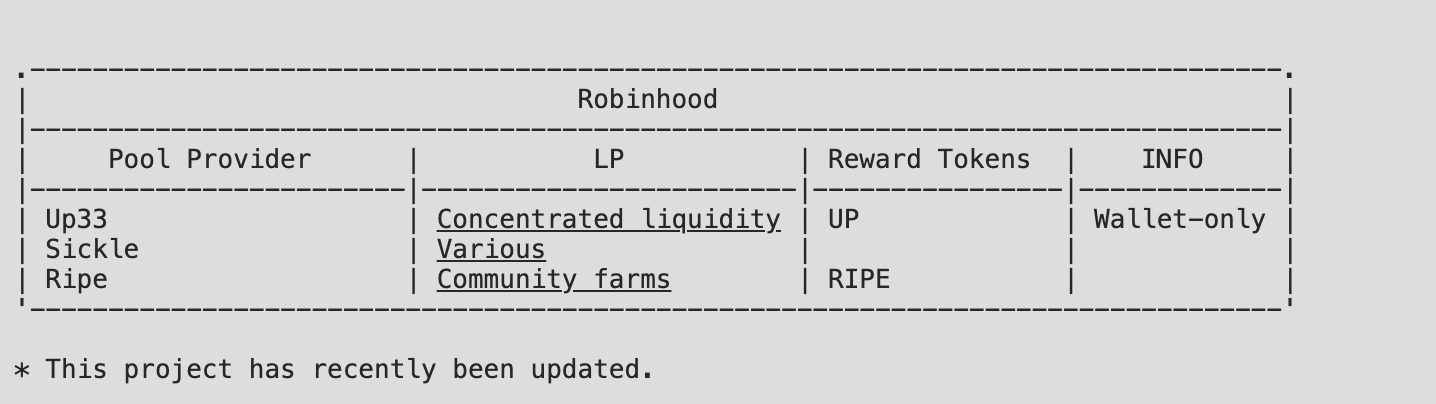
For miners who experienced the DeFi Summer period, vfat.tools is almost a collective memory of a generation. The black-and-white minimalist interface, real-time updated on-chain data, and the centralized display of the TVL, APR, and reward emissions of various public chain farms made it an important entry point for early DeFi players to find farms. More importantly, vfat.tools has always remained open-source, allowing community members to add new farms through PR submissions, and the speed of information updates often outpaces the project's own official dashboard. For the large number of users who had just entered DeFi back then, it was through this simple tool that they first systematically understood what yield farming was, how APR was calculated, and how to find opportunities among the continuously emerging new projects.
Now, with vfat0 turning its attention to Robinhood Chain again, it also indirectly indicates that the on-chain farm ecosystem on this emerging L2 is becoming active enough to even attract veteran players from the early DeFi era back.
In fact, recently, many trading pairs on Robinhood Chain have seen their APYs soaring, with some pools displaying APYs even reaching tens of thousands of percentages, attracting players' attention and participation.
For many players, this may also be a more realistic choice. There are a large number of Meme coins being launched on-chain every day, catching the true golden dog among tens of thousands of new coins every day, and being able to hold on all the way through and eventually cash out profits is itself a very low-probability event. Compared to directly betting on the rise and fall of a certain Meme coin, putting funds into liquidity pools to earn profits through the continuously generated transaction fees seems to be a more stable profit path.
However, these high APYs do not come from a certain stable, sustainable risk-free return. Currently, products on Robinhood Chain that show extremely high APYs mainly fall into two categories.
The first category is liquidity pools primarily based on UniswapV3/V4's AMMs, especially those related to stocks. For instance, pools like RIVN/USDG, RCAT/USDG, USAR/USDG, JNJ/USDG, and RDDT/USDG have recently shown APRs in the thousands or even tens of thousands.
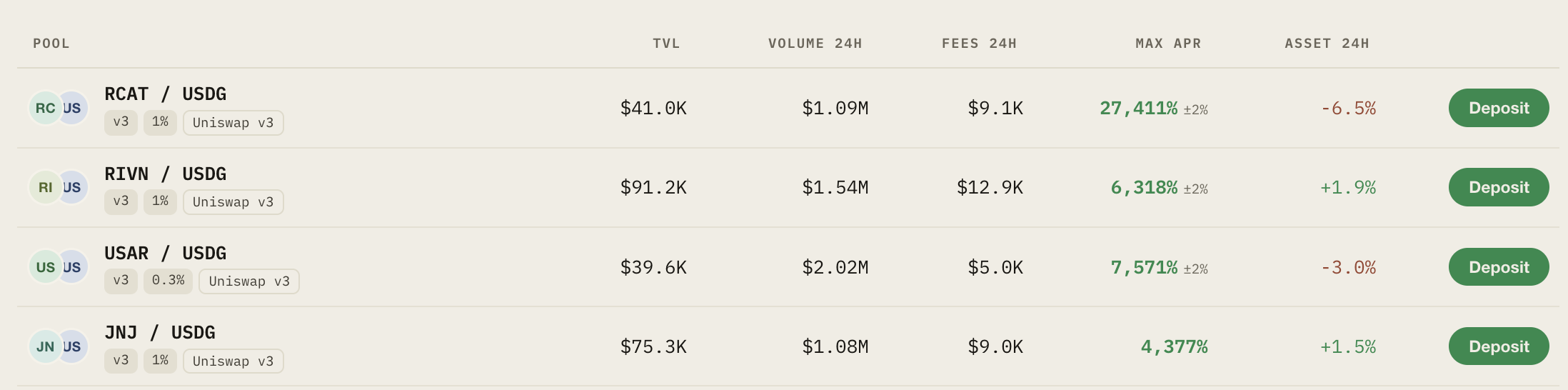
The common point of these pools is that they have relatively low TVL but very high transaction volumes. A pool with a TVL ranging from tens of thousands to hundreds of thousands of dollars, if it can handle several times or even dozens of times its own scale in transaction volume in a day, will naturally generate significant fees relative to the pool's principal. Coupled with the concentrated liquidity mechanism of V3/V4, and some trading pairs having higher fee rates, the annualized yield that ultimately gets calculated will be further amplified.
The second category consists of liquidity mining incentives provided by new protocols like Ripe such as nominal APRs reaching thousands or even tens of thousands of percentage points for LPs like RIPE/NVDA and some unilateral farms. Unlike fee-based returns, this part of the income does not come from real trading but is subsidized by the protocol through token emissions. In other words, while the numbers appear very high, a significant portion of them is actually just liquidity bought by the protocol using its own tokens. Once the emission rate slows down, the number of participants increases, or the incentive token price drops, the nominal APR may quickly shrink.
This also explains why Robinhood Chain has seen such exaggerated yields recently. At the beginning of a new chain's launch, both liquidity and trading demands were in a phase of rapid gathering. Meme, tokenized stocks, and various combinations of trading constantly create new speculative demands, while on-chain liquidity has not fully caught up, causing a concentration of a large number of trades in pools of limited scale. Therefore, at this stage, these ultra-high APYs resemble a short-term liquidity bonus.
More importantly, the APR itself is merely an annualized calculation based on current fee and token rewards, and it does not mean that LPs can print money without risk. When providing liquidity, LPs also need to bear impermanent losses, asset structure changes due to severe price fluctuations, failure of concentrated liquidity ranges, falling incentive token prices, and risks arising from new protocols and smart contracts themselves.
For Robinhood Chain, the Meme wealth effect and high APY can become the first fire to attract traffic and funds, but to keep this fire burning, it ultimately requires genuine trading demand and sustainable ecological value.
免责声明:本文章仅代表作者个人观点,不代表本平台的立场和观点。本文章仅供信息分享,不构成对任何人的任何投资建议。用户与作者之间的任何争议,与本平台无关。如网页中刊载的文章或图片涉及侵权,请提供相关的权利证明和身份证明发送邮件到support@aicoin.com,本平台相关工作人员将会进行核查。


