Will the "September Curse" Reoccur?
Written by: seed.eth
Just past August, Bitcoin strongly struck back at the "summer pessimists."
Bitwise data shows that BTC increased by about 25% in August, achieving the third-best August performance in history, only behind 65.6% in 2017 and 30.7% in 2013. More importantly, this was the first positive return in August since 2021.
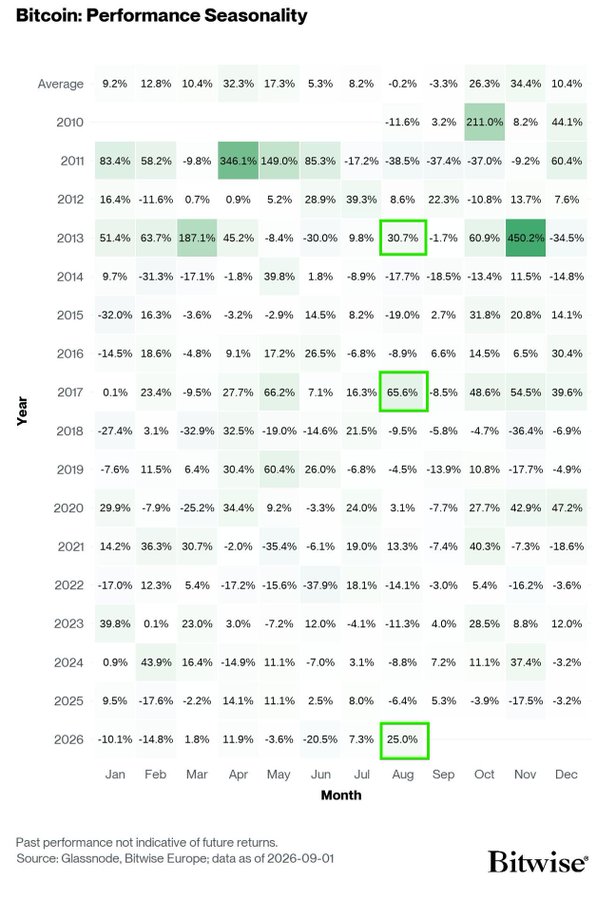
As of September 1, when this article was written, Bitcoin returned to around $77,000, and the August rally has temporarily entered a consolidation phase.
So the question arises: the historically most "difficult" September has begun; can this market trend continue?
Will the "September Curse" Reoccur?
If we only look at historical data, bulls should indeed be cautious.
CoinGlass long-term statistics show that September has consistently been one of the worst-performing months for Bitcoin, with an average historical return of about -3% to -4%. It’s particularly noteworthy that in years when August saw significant increases, September often experienced profit-taking.
Dow Jones Market Data statistics show that since 2014, September has been the worst-performing month for Bitcoin, with an average decline of about 2.2%.
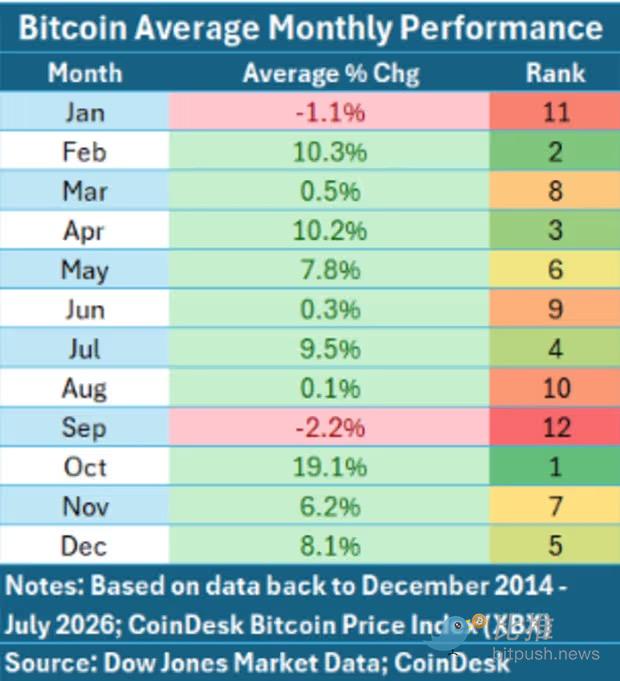
But the issue is that seasonality is just a statistical result, not a market law.
The sample only spans a little over ten years, and today's Bitcoin market cannot be compared to 2014 or 2017 — the impacts of spot ETFs, institutional funds, options, and macro liquidity on prices cannot be explained by past cycles’ experiences.
Therefore, rather than getting tangled in whether September will decline, it is better to consider: will the funding logic that drove the surge in August continue to take effect?
The Real Engine of August was "Dollar Credit Trading"
On August 19, the U.S. Treasury announced that starting September 9, it would raise the liquidity repurchase single-limit for long-term Treasury bonds from a minimum of $2 billion to at least $4 billion, effectively doubling the scale and continuing until November 4.
This matter is significant because U.S. long-term Treasury yields had been steadily rising, tightening financial conditions. The Treasury's expansion of repurchases is seen as a signal to suppress pressure on the bond market and improve liquidity.
Bitcoin subsequently became one of the beneficiaries.
Bitwise's latest September report suggests that fiscal pressure is forcing U.S. policymakers to intervene in financial conditions more frequently, while the release of funds from the fiscal account could improve liquidity in the banking system. Meanwhile, the correlation between Bitcoin and gold has risen to a six-year high, and "currency devaluation trading" has returned to market focus.
Wall Street is also reinforcing this logic.
Bernstein analyst Gautam Chhugani believes that the long-term downward trend in interest rates lasting for 40 years has ended. Government debt levels are rising, concerns about currency purchasing power are increasing, and institutional adoption will continue to elevate the attractiveness of scarce assets. He expects Bitcoin to potentially reach $150,000 again by mid-2027 and around $300,000 by late 2029.
Geoff Kendrick, head of digital asset research at Standard Chartered, also pointed out that the U.S. government's recent interventions in the bond market have reinforced the core investment logic behind Bitcoin's creation — hedging against the risks of fiat currency systems and government policy interventions.
This is why August was not simply a "speculative coin rebound," but more like a macro trade.
What is the Real Risk?
However, entering September, things began to get complicated.
Federal Reserve Chairman Kevin Warsh stated in a speech at Jackson Hole at the end of August that U.S. inflation data is more concerning than employment: the PCE year-on-year remains at 3.7%, and the annualized trend over six months reaches 4.1%, significantly above the 2% target.
As of September 1, with oil prices and global bond yields rising again, market expectations for the Federal Reserve to raise interest rates in September have significantly increased. Reuters reported that market pricing on that day showed that the probability of a rate hike in September has risen to about 68%. The yield on the U.S. 10-year Treasury bond once rose to 4.798%.
And the Federal Reserve's next policy meeting is precisely on September 15-16.
This means that the biggest risk for Bitcoin in September is not the so-called "historical curse," but rather: if oil prices continue to rise, inflation heats up again, and U.S. Treasury yields spike, the Federal Reserve’s tightening of policy could reverse the liquidity trade that occurred in August.
It is noteworthy that institutional funds have not fully withdrawn due to the price increase.
In August, a significant net inflow was re-established in the U.S. spot Bitcoin ETF, drawing significant capital for several consecutive days, with total scale reaching billions of dollars. Farside data shows that BlackRock's IBIT remains one of the main entry points for funds.
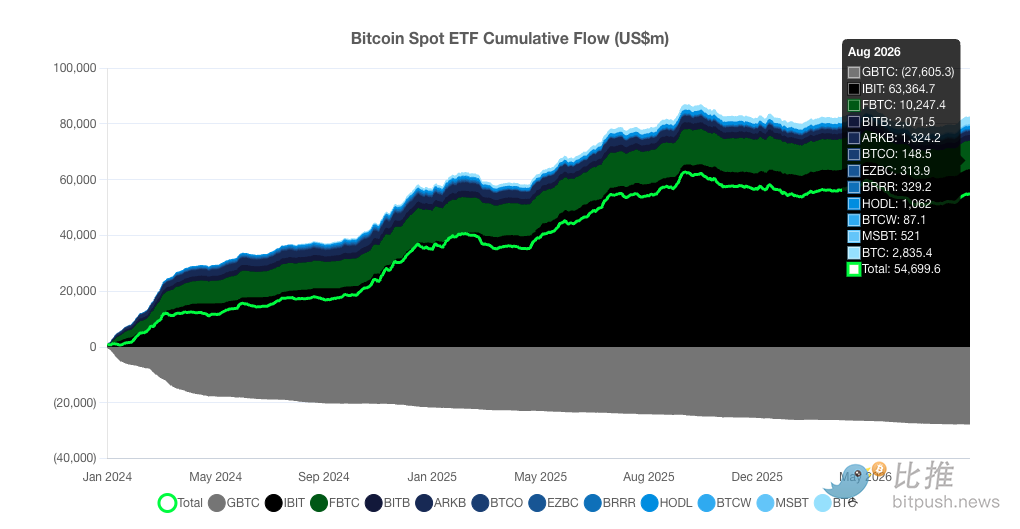
Bitwise found that on-chain structures exhibited changes more noteworthy than price.
Its latest research indicates that Bitcoin has recovered multiple key on-chain cost lines, with long-term holder models and "Risk-On Transition" models both shifting to a risk-seeking state. Bitwise thus believes that signals of "entering a new bull market cycle" have already appeared in the market.
But it also set a threshold: $83,000.
Bitwise points out that the area around $83,000 is not only an important technical resistance level but also roughly corresponds to the average capital cost for ETF investors. Only establishing a solid footing at this position can form a new and higher peak, confirming that the previous downward trend has been completely reversed.
This could be the most crucial support level throughout September.
Three Scenarios for September
Decrypt analyst Jose Antonio Lanz provided three directions.
The first scenario, which currently has a relatively higher probability, is a breakout attempt after high-level consolidation.
As long as the range of $73,000-$75,000 is not effectively broken, if ETF funds continue to flow in and U.S. Treasury yields do not go out of control, Bitcoin is likely to complete a turnover between $75,000 and $83,000, testing $83,000 again.
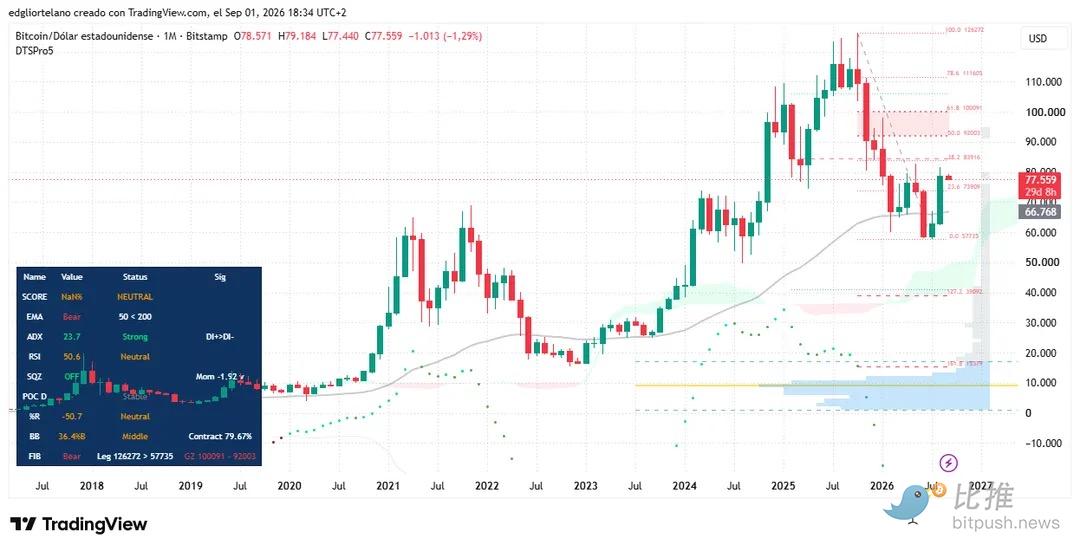
Once it stands firmly above $83,000, the technical structure will visibly improve, and the next phase of the market is likely to redirect its target back to the $92,000-$100,000 range. Jose's monitored technical indicators view $81,500-$82,500 as the initial resistance, with higher-level pressure focused on $92,000-$100,000.
The second scenario is that September continues to undergo a consolidation phase.
After a 25% rise in August, there are massive short-term profits, and with a major event from the Federal Reserve around September 16, the market may well first enter a consolidation range in the low $70,000s to digest overheated sentiment.
The third scenario, which must be guarded against, is this:
If oil prices continue to spike, the Federal Reserve confirms a rate hike, and U.S. 10-year Treasury yields rise further, while ETFs start to experience sustained net outflows, Bitcoin could drop below $73,000, causing the August rally to flip back from "bull market reversal" into a significant short-squeeze.
Analysts have given the next important support level at around $68,900.
In summary, $73,000-$75,000 is the bullish defense line, $83,000 is the bull-bear watershed, and the Federal Reserve meeting on September 15-16 could determine the next directional movement.
If $83,000 is effectively broken through, then the historical "September Curse" may likely be invalidated again, and the 25% increase in August will be confirmed as the start of a new trend.
Conversely, if yields continue to soar and liquidity tightens again, then September may still remind everyone: history becomes history often because the market likes to suddenly teach a lesson to investors at the most optimistic times.
免责声明:本文章仅代表作者个人观点,不代表本平台的立场和观点。本文章仅供信息分享,不构成对任何人的任何投资建议。用户与作者之间的任何争议,与本平台无关。如网页中刊载的文章或图片涉及侵权,请提供相关的权利证明和身份证明发送邮件到support@aicoin.com,本平台相关工作人员将会进行核查。


