After the Jackson Hole meeting, the market has focused its attention on interest rate hike expectations, but Morgan Stanley economist Carpenter pointed out that Walsh's long-standing advocacy for reducing the $7 trillion balance sheet should not be overlooked. It is expected that the Federal Reserve may initiate a balance sheet reduction of over $1.5 trillion next year to partially replace interest rate hikes.
Written by: Long Yue, Wall Street News
In the mountains of Wyoming, Walsh reiterated the Fed's commitment to bringing inflation back to 2%, prompting the market to incorporate more interest rate hike expectations into its pricing. However, Morgan Stanley's Chief Global Economist Seth Carpenter noted in a recent report that this reaction may overlook a key variable—balance sheet reduction.
Carpenter wrote that Walsh's stance on interest rate hikes was unclear in July, where he only indicated that interest rates "may be part of the solution." However, at Jackson Hole, he clarified his position: the policy rate is the "primary tool," and other tools should be "minimized, if not used at all."
But this does not mean that balance sheet reduction will be shelved.
Walsh's Logic: The Balance Sheet is the Source of Inflation
Before becoming the Fed Chair, Walsh gave a more straightforward expression on the use of the two major policy tools in an interview at the Hoover Institution.
According to Carpenter's citation, Walsh explicitly believes that the $7 trillion balance sheet is the fundamental reason for inflation being above target. At Jackson Hole, he listed "money" as one of the core principles of monetary policy operations and further stated that if the "money" created by the balance sheet is withdrawn, interest rates can be maintained at lower levels.
This logical chain is clear: balance sheet reduction → tightening monetary policy → declining inflation → reduced pressure for rate hikes.
Divergence Within the FOMC Intensifies, Real Pressure for Rate Hikes Exists
Morgan Stanley's original baseline prediction was no rate hikes this year, assuming inflation can moderate enough to allow the FOMC to abandon the hike option.
However, Carpenter pointed out that the FOMC makes decisions by vote, and there are currently three dissenting votes in support of a rate hike. If summer inflation data does not convincingly show that inflation is cooling, rate hikes will occur.
"Walsh will not let himself be on the losing side of a vote," Carpenter wrote.
This means that even if Walsh personally leans towards using balance sheet reduction instead of rate hikes, once the majority of the committee favors rate hikes, he will go along with it.
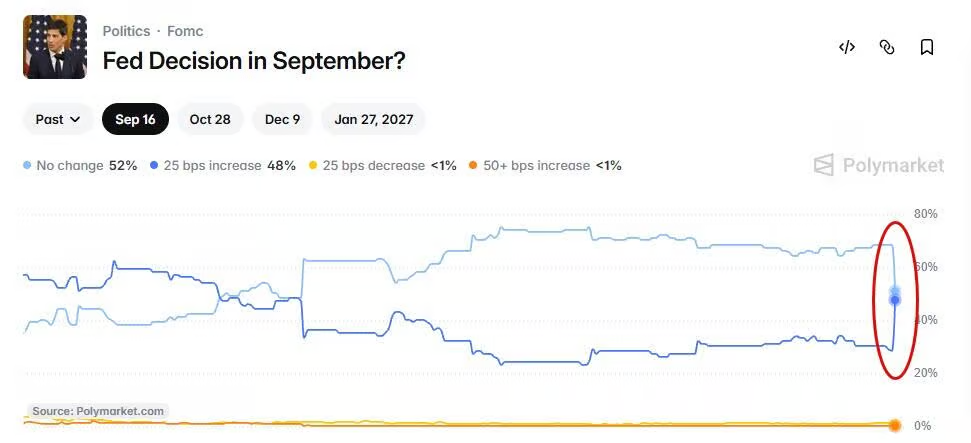
Morgan Stanley's Prediction: Balance Sheet Reduction Next Year May Exceed $1.5 Trillion
Carpenter stated that he indeed believes balance sheet reduction is imminent. A recent report from Morgan Stanley ("Global Economic and Fixed Income Strategy: Fed Balance Sheet Reform: More Reductions, Less Tightening") predicts that the Federal Reserve may initiate balance sheet reductions of $1.5 trillion or even larger next year.
Carpenter also admitted that his judgment on how balance sheet reduction transmits to the economy and ultimately affects inflation differs significantly from Walsh's. However, regardless of the transmission pathways, the conclusion for the market is consistent:
Investors must consider both interest rates and the balance sheet as tools when pricing monetary policy, which will bring additional uncertainty and controversy.
免责声明:本文章仅代表作者个人观点,不代表本平台的立场和观点。本文章仅供信息分享,不构成对任何人的任何投资建议。用户与作者之间的任何争议,与本平台无关。如网页中刊载的文章或图片涉及侵权,请提供相关的权利证明和身份证明发送邮件到support@aicoin.com,本平台相关工作人员将会进行核查。


