Sun Yuchen published a short essay yesterday titled "My Girlfriend Jing Tian."

It was written with great pain; reportedly, he spent two whole nights in Bhutan working on it. A person who can manipulate the cryptocurrency world has portrayed himself in a relationship as a bewildered youth.
However, what really made this article go viral was not the gossip itself, but his public declaration that he relies on AI for all his major decisions, "100% listens to AI."
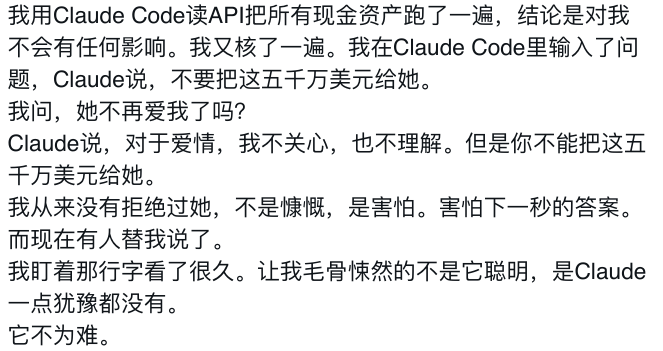
Then he posted a section of a conversation with Claude.
Claude said: Don't give her this fifty million dollars.
Sun Yuchen asked: Doesn't she love me anymore?
Claude said: I don't care about love, nor do I understand it. But you cannot give her this fifty million dollars.
This conversation is arguably the most precise metaphor for the relationship between AI and humans this year.
Claude made it very clear: I don't understand love, but I understand that you cannot afford to lose money. It was a rational and cold judgment, devoid of any emotional coloring. Fifty million dollars is a quantifiable risk variable in Claude's world—negative return on investment, advised to stop loss.
Sun Yuchen listened, and he did not give the money.
But the story doesn't end here. Because Claude also told him another piece of advice—don't publish this article.
According to Sun Yuchen himself in an interview, Claude advised him not to make this relationship public and not to turn private matters into material for public consumption. The rational judgment was clear: publishing it brings no benefits, only risks.
This time, he didn't listen.
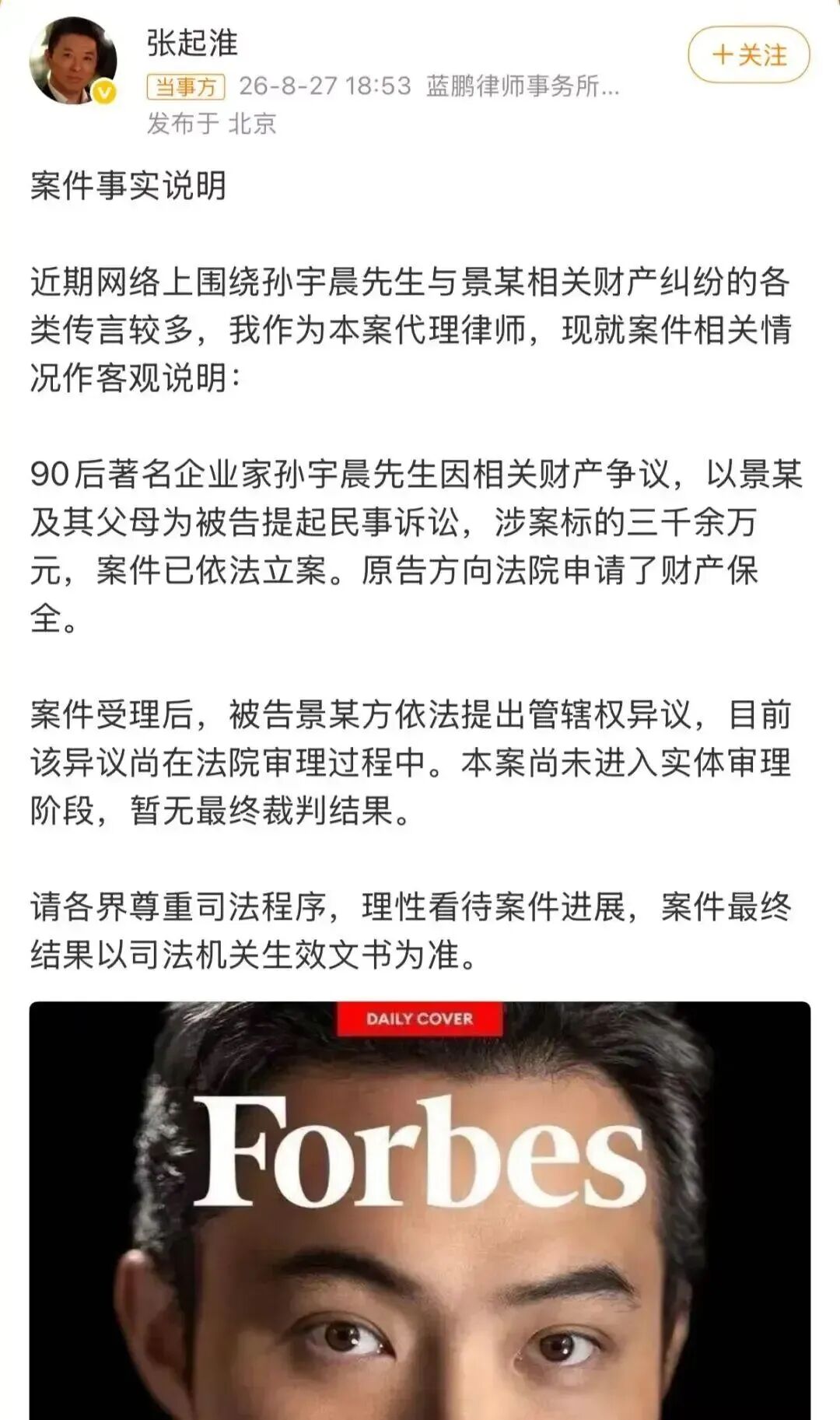
The article was published, became trending, a lawsuit over a thirty million yuan bet went forward, and lawyer Zhang Qihuai represented him as usual. Overnight, all of China learned about the story of Sun Yuchen and Jing Tian.
So you see, this is really not about being "the man in the universe who listens to AI."
He just selectively listens to AI.
AI said "don't give money"—he listened. Because it coincidentally aligned with his deep-seated intuition; he did not want to give the money anyway, and AI merely articulated a decision he had already made. What he needed was not advice, but a rational endorsement: see, it's not me being stingy, it's AI telling me not to give.
AI said "don't publish the article"—he ignored it. Because deep down he wanted to publish. He needed to be seen, needed to perform pain, needed to build a monument to himself on the ruins of a relationship. This impulse is irrational, unquantifiable, and purely human. AI cannot calculate how much emotional value "being discussed by the whole internet" can bring, so its advice carries no weight in this matter.
To put it simply, he doesn't trust AI; he trusts himself. AI is just a sophisticated echo chamber—when AI's answer aligns with his desires, he reveres it as a divine decree; when it does not, he selectively becomes deaf.
This is not just a problem for Sun Yuchen.
In the past year, we have seen too many "AI believers." Some let AI choose stocks; if they profit, they praise AI as brilliant; if they lose, they insult AI as garbage. Some let AI write proposals; if they satisfy them, they use them; if not, they adjust them until they are satisfied. Some declare on social media that they will hand over their life decision-making to AI, but if you look closely, they ignore AI’s advice to sleep early, ignore its advice not to scroll their phones, ignore its advice not to make decisions impulsively—they insist on making decisions impulsively.
AI is indeed becoming stronger in quantifiable areas: calculating returns, controlling risks, optimizing paths, identifying patterns. But what makes humans human is precisely those unquantifiable things—obsessions, desires, vanity, loves and hates, the impulses of knowing it’s unwise yet proceeding anyway.
Claude said, "I don't care about love, nor do I understand it." This is not humility; it is a fact. A large model can read countless love songs, analyze data patterns from millions of relationships, but it will not feel the longing for someone at three in the morning, won’t fly halfway across the globe for a glance, and won’t wager everything knowing it might lose.
Sun Yuchen is the same. He can listen to Claude about money because money is a rational game. But when it comes to "whether the whole world should know I am hurt," he chose to follow his ego. That Sun Yuchen who spent two all-nighters in Bhutan, wrote 6000 words, and repeatedly revised until dawn wasn't following AI's command; he was following a much older directive—when a person feels wronged, they want to shout it out.
This has nothing to do with AI; this is human nature.
So the real question has never been "Will AI replace human decision-making?" but rather: when AI's rational advice conflicts with your human instincts, which do you choose?
Sun Yuchen provided the answer with his actions: it depends on the situation. When it involves money, he chooses rationality; when it concerns pride, he chooses instinct.
This is very real and also very ironic. Those who claim to hand over 100% of their lives to AI ultimately give AI what they didn't really care about in the first place. What they truly value, they will not yield an inch.
AI does not need devout believers. It needs an honest user—someone who knows which matters to listen to it on and which matters to listen to themselves.
And the most dishonest aspect of people like Sun Yuchen is that they clearly only trust themselves, yet insist on using AI to endorse their choices.
Listening to AI on money matters is fine. But on matters of love, the decision to publish an article, the thoughts of missing someone at three in the morning—
those, AI does not get to decide.
免责声明:本文章仅代表作者个人观点,不代表本平台的立场和观点。本文章仅供信息分享,不构成对任何人的任何投资建议。用户与作者之间的任何争议,与本平台无关。如网页中刊载的文章或图片涉及侵权,请提供相关的权利证明和身份证明发送邮件到support@aicoin.com,本平台相关工作人员将会进行核查。


