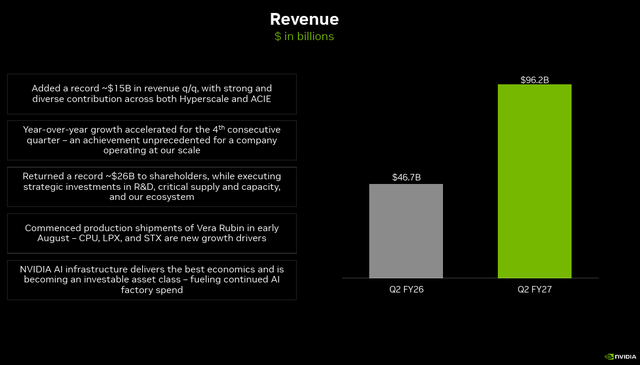
Three months ago, I wrote that Nvidia Corporation (NVDA) had just delivered the best quarterly performance among all the companies I was watching. Now, it has surpassed itself again. NVDA announced its fiscal year 2027 second quarter results, and the numbers are almost unbelievable given the sheer scale. NVDA generated revenue of $96.22 billion, a year-on-year increase of 105.85%, exceeding the management's guidance of $91 billion given in May by $5.22 billion. NVDA achieved a non-GAAP EPS of $2.22, surpassing market consensus expectations of $2.09 by $0.13, and representing a year-on-year growth of 119.80%. Quarterly revenue increased by $14.61 billion sequentially, surpassing the record NVDA set just one quarter ago, making it the fourth consecutive quarter of accelerating year-on-year growth for the company. Typically, a company should not continue to accelerate growth once its annualized revenue run rate reaches $385 billion, but that is exactly what is happening with NVDA now. If that weren't enough, management also provided guidance of $108 billion in revenue for the third quarter and did something NVDA has never done before. Colette Kress gave preliminary figures for fiscal year 2028 and told the market to expect revenue growth of about 70%. She explicitly stated that this is still a supply-constrained outlook, as customer forecasts indicate demand could realistically double, a sentiment confirmed by Jensen Huang during the Q&A session, indicating that actual demand is far greater than 70%, and that supply is the real limiting factor. I went into this earnings report with a question: Whether the capital return logic I proposed in May still holds true this year. After the results came out, I instead thought that the bear logic was dismantled live during this conference call. In this quarter, almost all major arguments against NVDA from bears were directly addressed, while the current valuation multiple still does not reflect the information management has just shared with us.
[Original image position: NVDA stock price and related data (Seeking Alpha)]
Continuing to follow up on my previous articles about Nvidia
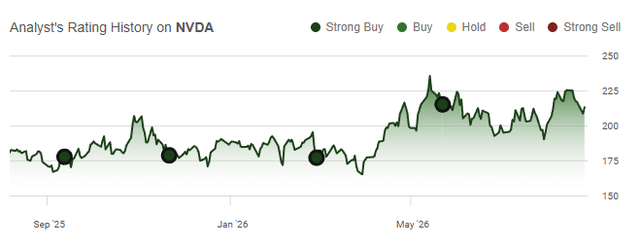
At the end of May, I wrote an article about NVDA in which I discussed why the company raised its dividend by 2,400% and committed to returning about 50% of its free cash flow (FCF) to shareholders, marking the formal start of an extremely strong dividend growth story. In that article, I built a 5-year model, assuming NVDA would grow its dividend by 50% annually while repurchasing and retiring over 8% of its outstanding shares, cumulatively returning over $900 billion in capital to shareholders. My core argument was that the market treated this capital return plan as a footnote, but in reality, it could serve as the beginning of a multi-year compounding cycle.
The second quarter validated this logic faster than I expected. NVDA returned $26 billion to shareholders this quarter, with $20 billion coming from share repurchases and $6 billion from a quarterly dividend of $0.25. Colette Kress disclosed that year-to-date, NVDA has returned 60% of its free cash flow, exceeding the previously committed 50%, and indicated that management plans to further increase and return excess free cash flow after strategic needs are accounted for. The remaining stock repurchase authorization is about $99 billion, and the next $0.25 per share dividend will be paid on October 1 to shareholders of record as of September 10. However, my continued writing on NVDA is not solely because the capital return plan is still progressing as planned, but because the second quarter has greatly expanded the boundaries of the overall investment logic, and I believe the market has not yet truly digested the information revealed in this conference call.
[Original image position: NVDA related capital return and financial data (Seeking Alpha)]
Second quarter results significantly exceeded expectations, and operational progress was better than expected
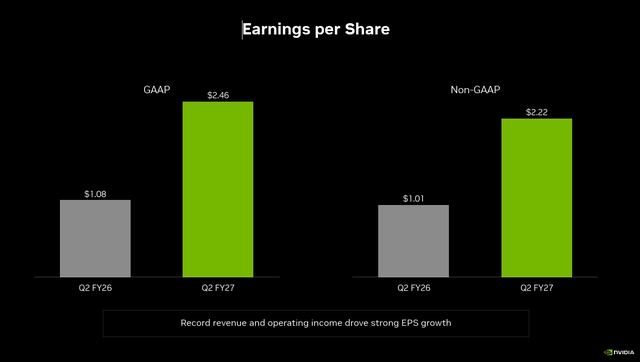
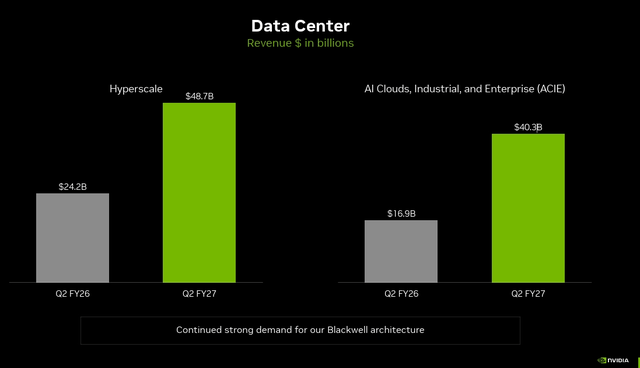
The surface numbers are already impressive, but what truly struck me was the internal structure this quarter. NVDA generated revenue of $96.22 billion, a sequential increase of 17.90%, with both GAAP and non-GAAP gross margins reaching 75%, up 2.6 percentage points year-on-year. The company reported GAAP operating income of $63.73 billion, a year-on-year increase of 124.10%, and GAAP net income of $59.69 billion, a year-on-year increase of 125.90%. NVDA's GAAP EPS reached $2.46, a year-on-year increase of 127.78%. In a company of such scale, it is rare for profit growth to still outpace revenue growth, an occurrence that has almost never been seen in history. According to the second quarter shareholder presentation material, NVDA's data center revenue reached $89 billion, increasing by 18% sequentially and 117% year-on-year. Hyperscale cloud customers contributed $49 billion in revenue under sustained strong demand for Blackwell, while ACIE – which includes AI cloud, industrial, and enterprise customer businesses – contributed $40 billion, a year-on-year growth of 138%. In my view, this is the most significant change this quarter. For the past two years, the bear logic has revolved around one question: What happens when capital expenditures by hyperscale cloud providers slow down? The answer now is that Hyperscale accounts for only 55% of data center business, with the other 45% coming from sovereign nations, NeoCloud, AI-native enterprises, and traditional businesses, and this side of the business is even growing at a compound rate faster than Hyperscale. Meanwhile, Hyperscale itself has not slowed down, as the backlog in the cloud industry has surpassed $2 trillion, with top five hyperscale cloud providers expected capital expenditures to approach $800 billion in 2026 and reach $1.3 trillion in 2027.
[Original image position: Data center business for fiscal year 2027 second quarter (NVIDIA Q2 Deck)]
Networking business also set a quarterly record, with revenue increasing by 18%, where Spectrum-X Ethernet grew 2.6 times year-on-year. Next is Vera Rubin, which is the core story supporting NVDA's growth over the next 18 months. NVDA began shipping Vera Rubin earlier this month, with racks running at CoreWeave, Inc. (CRWV), Google Cloud under Alphabet Inc. (GOOG, GOOGL), Microsoft Corporation (MSFT) Azure, Oracle Corporation (ORCL) Cloud Infrastructure, and Nebius Group N.V. (NBIS). Management has secured procurement orders from all major hyperscale cloud providers, AI cloud platforms, and system OEMs, and expects Vera Rubin to become NVDA's fastest-growing product in history, with the platform accounting for about 20% of data center revenue in the third quarter. Its performance leap is enormous, increasing throughput per megawatt by 30 times compared to Grace Blackwell Ultra, while token costs decrease by 35 times.
New product lines are equally important. NVDA has released Vera, the first CPU designed specifically for AI Agents, which has now gone into full production. The Grace CPU has quietly formed a business generating over $5 billion in revenue in the past 12 months, with management estimating total demand for server CPUs is about $20 billion and expects CPU revenue to more than double in fiscal year 2028. Groq 3 LPX is NVDA's first rack-level LPU system, also now in full production, with a token output capability per second reaching nearly four times that of suboptimal alternatives, expected to begin mass shipping later this quarter. NVDA also announced an expansion of its collaboration with Amazon.com, Inc. (AMZN), with AWS to deploy an additional 2 million GPUs from this quarter until the second quarter of fiscal year 2029, while also deploying Vera CPUs and NVDA's complete Physical AI technology stack aimed at warehouse robots. Edge Computing revenue reached $7.2 billion, a year-on-year increase of 27%, while NVDA is also working with Microsoft to redefine Windows PCs around RTX Spark and DGX Station.
[Original image position: Vera, Groq 3 LPX, and edge computing product progress (NVIDIA Q2 Deck)]
The balance sheet itself also reveals a lot. NVDA's traded equity securities have grown to $42.78 billion, with off-market securities reaching $51.16 billion, thus the company's portfolio has grown from $35 billion at the beginning of this fiscal year to about $94 billion in six months. Inventory increased to $31.58 billion, preparing for the volume output of Vera Rubin; meanwhile, days sales outstanding (DSO) extended to 60 days, primarily due to the company granting longer payment terms to large investment-grade clients, as Colette Kress noted in her CFO comments. NVDA raised about $25 billion in debt financing this quarter, which I see more as a proactive configuration of low-cost capital for financing platforms rather than a warning signal. Management provided guidance of $108 billion in revenue for the third quarter, corresponding to a sequential growth of 12.24%, and they were also very direct about gross margin issues. Due to the higher-than-expected increases in memory prices, the company expects a gross margin of 74% for the third quarter, bottoming out at 71%-72% in the fourth quarter, then recovering to 72%-73% in fiscal year 2028 as the executed price increases take effect. Kress indicated she would prefer to reset market expectations now rather than leave this issue unresolved, and I appreciate this transparency.
Nvidia's key success factors explain why it is winning the AI race
If all factors are simplified, I believe NVDA is winning the AI race because of three structural advantages, each of which directly dismantles a specific bear argument. The first advantage is that NVDA's architecture can run all models. Adoption rates for both closed-source and open-source models are exploding, and NVDA runs both leading closed models like OpenAI and Anthropic, as well as nearly all leading open-source models, meaning NVDA doesn't need to bet on who will win the model competition. An interchangeable platform can handle data preparation, pre-training, post-training, and Agentic Inference, continuously creating value throughout AI's complete lifecycle. This directly dismantled the argument that “the rise of open-source models will weaken demand driven by cutting-edge labs,” as both types of models are actually experiencing explosive growth, and nearly all major open-source models are also running on NVDA hardware. NVDA's moat even extends to areas most investors wouldn't care about at all, such as NVDA GPUs supporting confidential computing that are now running in Apple Inc. (AAPL)'s Private Cloud Compute for confidential inference, while Blackwell has swept all categories in the MLPerf Training 6.0 benchmark, achieving lead in AgentPerf—the industry's first Agentic AI infrastructure benchmark.
The second advantage is a complete AI factory full-stack platform, which is constantly increasing NVDA's value capture per dollar invested in the data center. NVDA's revenue opportunity per gigawatt has increased from about $18 billion in the Hopper era to $25 billion in the Blackwell era, and now to $40 billion in the Vera Rubin era, with the Vera Rubin platform now covering Vera CPUs, Rubin GPUs, NVLink, InfiniBand, Ethernet networks, and Groq LPUs. This is precisely the answer to the bear logic around custom silicon. When Jensen was directly asked about OpenAI's Alpamayo chip, he replied that XPU is essentially a specific inference chip built for a particular cloud or service, while NVDA sells a whole AI factory capable of running any model in any cloud around the world. NVDA has entered the third generation of NVLink 72 rack-level systems, while competitors are still struggling to deploy their first-generation systems; as the installed networks and software stacks grow larger, the cost of replacing the entire system every year continues to rise.
[Original image position: Nvidia AI factory platform and revenue opportunity per gigawatt (NVIDIA Q2 Deck)]
The third advantage is the CUDA ecosystem, which extends AI to markets that a single chip could never reach. Sovereign nations, NeoCloud, and traditional enterprises are not interested in designing custom chips themselves, and NVDA is the only company capable of directly delivering a validated complete AI factory design, connecting to ultimate compute needs through its developer ecosystem. Sovereign AI revenue grew 35% sequentially and over threefold year-on-year. NeoCloud partners expect to reach 8 gigawatts of installed capacity by the end of this year, up from about 3 gigawatts by the end of 2025. Jensen stated that the non-Hyperscale half of the business is currently growing at 100% annually, and the global market for this category of computing is likely to become larger than today’s entire cloud computing market. The enterprise market is also rapidly expanding, with the automotive vertical reaching $8 billion in on-premise revenue in the past 12 months, while financial services, manufacturing, and healthcare combined contributed another $7 billion.
Next is the financing structure, which in turn dismantles the criticism of “cycle financing.” NVDA has already invested nearly $50 billion in cutting-edge AI labs, while management pointed out that this only accounts for a small part of the company's projected free cash flow during the same period. The bulk of the capital expenditures fall to third-party funding since NVDA has established financing platforms with Apollo Global Management, Inc. (APO), BlackRock, Inc. (BLK), Blackstone Inc. (BX), Brookfield Asset Management Ltd. (BAM), The Goldman Sachs Group, Inc. (GS), and KKR & Co. Inc. (KKR), planning to raise over $500 billion in institutional capital for AI infrastructure construction. NVDA will offer take-or-pay commitments for part of facility capacity, providing lenders with a minimum income baseline for underwriting, and in exchange, NVDA can share revenue generated above that baseline. In other words, NVDA can earn twice: once from revenue during hardware sales, and again through ongoing revenue linked to usage. Kress explicitly stated that NVDA is not directly issuing loans, with each transaction independently underwritten by independent capital parties based on their own terms. The computing resources shipped by NVDA are ultimately used by investment-grade clients or supported by investment-grade institutions; the AI labs utilizing NVDA's balance sheet comprise only about a quarter of the company's business next year. Given this platform's highly interchangeable computing resources that can be redeployed if issues arise with a single client, this risk exposure remains manageable. Just OpenAI's existing and planned projects correspond to about 12 gigawatts of NVDA computing resources by 2030, with the first phase of 4.25 gigawatts deployed in the PORTS-Pike site in Ohio utilizing NVDA's computing platform, which is designed for multiple upgrade cycles over the next 20 years.
The demand backdrop further enhances the durability of this trend. In the first half of 2026, global AI venture capital financing has exceeded $400 billion, surpassing the total financing of $265 billion for all of 2025, with about 70% ultimately dedicated to purchasing computing resources. Nearly 20 AI-native enterprises now have an annualized revenue run rate exceeding $1 billion, up from 13 two quarters ago. Jensen noted that the computing resources consumed by Agentic AI workloads are 15 to 100 times what humans input as prompts to the model, and just last month, Agentic AI accounted for the majority of AI workloads for the first time. He also highlighted that the investment capital return cycle for a $50 billion data center has now shortened to under a year. Jensen summarized the entire logic in the earnings press release with one sentence: “Compute is revenue.” Tokens can be profitable, and the true constraint is the computing resources themselves, which is why management can provide a 70% growth guidance while indicating that actual demand is closer to 100%.
Nvidia's valuation does not reflect the guidance just provided by management
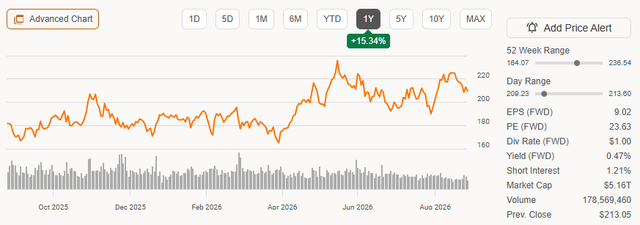
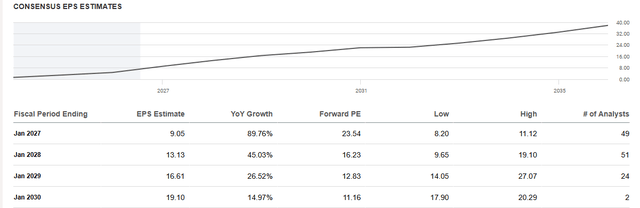
When I look at the latest consensus earnings forecasts from the market, the misalignment is very apparent. Analysts currently expect NVDA to achieve an EPS of $9.05 in fiscal year 2027, a year-on-year increase of 89.76%, corresponding to a current price-earnings ratio of about 23.54 times that year’s earnings. By fiscal year 2028, the consensus EPS is expected to be $13.13, a year-on-year growth of 45.03%, corresponding to the stock price being only 16.23 times earnings. For fiscal year 2029, the market expects EPS to be $16.61, further lowering the valuation to 12.83 times, while two analysts forecasting for fiscal year 2030 expect EPS of $19.10, corresponding to just 11.16 times earnings. NVDA's stock price is currently about $213, corresponding to a market value of about $5.2 trillion. When I wrote about NVDA in May, the forward price-earnings ratio was over 25 times. Therefore, after two consecutive extremely strong quarters, NVDA's forward valuation has actually become cheaper compared to a larger and faster-growing earnings base.
[Original image position: NVDA forward earnings valuation (Seeking Alpha)]
I also believe that the consensus expectations in the market are too low. NVDA has already achieved $177.84 billion in revenue in the first two quarters before fiscal year 2027, and the guidance for third quarter revenue is $108 billion. If fourth quarter growth continues at similar sequential rates as the last few quarters, annual revenue for fiscal year 2027 could reach approximately $405 billion to $410 billion. Management has just provided guidance for about 70% revenue growth in fiscal year 2028, which implies total annual revenue will be around $690 billion. The current market consensus estimates only a 45.03% growth in EPS for next year, while predicting revenue growth of 70%; I find it hard to understand how both of these numbers can coexist. As the executed price increases take effect, gross margins are expected to recover to 72%-73%, while operating expense growth is lower than revenue, thus profits should at least maintain a similar growth rate as revenues. My judgment is that in the coming quarters, the EPS forecast of $13.13 will be significantly raised, and each adjustment will make the current 16.23 times valuation appear even more disconnected. It is hard for me to find a similar configuration elsewhere in the market to buy a company that just provided guidance for 70% revenue growth and is returning 60% of free cash flow to shareholders at about 16 times forward earnings. Even if the valuation multiple does not expand at all, the current consensus already anticipates that NVDA's EPS will grow by over 80% from fiscal year 2027 to 2029, while the stock price should theoretically rise with earnings.
Risks of investing in NVDA
While I hold a bullish position in NVDA and believe the stock price will achieve a higher valuation in the future, there are indeed real risks that could affect my investment logic. The most direct risk is gross margins. The rise in memory prices has exceeded management's previous expectations and is expected to rise further next year, which is why the company predicts that gross margins will bottom out at 71%-72% in the fourth quarter. The recovery to 72%-73% in fiscal year 2028 relies on the executed price increases being able to truly cover cost rises. If memory prices rise faster than these price increases, the recovery of gross margins will not materialize, and EPS forecasts will be cut instead of raised. The second risk is that the balance sheet structure is becoming increasingly complex. Due to large investment-grade clients receiving extended payment terms, DSO has increased to 60 days, with accounts receivable growing from $38.47 billion at the beginning of this fiscal year to $63.06 billion. Due to the significant increase in working capital, free cash flow in the second quarter only reached $21.34 billion, significantly lower than net income, and NVDA also added about $25 billion in debt this quarter. About a quarter of next year's business is related to AI labs, which leverage NVDA's balance sheet through equity investments, take-or-pay commitments, and selective credit enhancements. If the AI financing environment tightens, criticisms of “cycle financing” will become sharper, and these structures will face true stress tests for the first time. Management's response is that these computing resources are interchangeable and can be redeployed, and that the clients themselves are either investment-grade or have investment-grade partner backing. However, this is still the area I will closely monitor in the future. No matter how strong the bull logic appears, anyone investing in NVDA should conduct their own due diligence before allocating funds.
Conclusion
NVDA has just provided the strongest evidence to date that AI infrastructure construction is spreading and not nearing its peak. The company has realized growth acceleration for the fourth consecutive quarter, with half of its data center business now coming from customers outside of Hyperscale; the gross margin decline is accompanied by a clear recovery path; cutting-edge AI lab infrastructure relies on over $500 billion in third-party capital, not merely NVDA's own balance sheet; and the capital return plan has now reached 60% of free cash flow, exceeding the previously committed 50%. More importantly, for the first time in the company's history, management directly provided a 70% growth figure for fiscal year 2028 and clearly communicated to the market that actual demand is closer to 100%. I do not believe that the current stock price, reflecting only a forward price-to-earnings ratio of 16.23 times next year's earnings, can account for these changes, and I believe earnings forecasts will continue to be adjusted upward in the future. The compounding logic I wrote about regarding dividends in May still completely holds, and the growth story wrapped around this logic has grown even larger now. I continue to hold a bullish position in NVDA, and after reviewing this earnings report, I am even more optimistic than before because the bears have lost their strongest arguments.
免责声明:本文章仅代表作者个人观点,不代表本平台的立场和观点。本文章仅供信息分享,不构成对任何人的任何投资建议。用户与作者之间的任何争议,与本平台无关。如网页中刊载的文章或图片涉及侵权,请提供相关的权利证明和身份证明发送邮件到support@aicoin.com,本平台相关工作人员将会进行核查。


