Author: Simon Taylor
Translation: Shenchao TechFlow
Introduction by Shenchao: AI brings not only efficiency improvements but also a batch of new customer tasks that didn't exist before: token spending, agent identity, model routing. Ramp and Stripe have established new revenue pools around these tasks, and their valuation narratives are not simply about growth but about betting on being AI native. Understanding this "new tasks" map can help investors differentiate who benefits from it and who will be eliminated.
🧠 AI has created new customer problems
Solving these problems is where the next generation of financial products is formed. Token spending, agent identity, and model routing hardly existed before AI.
Ramp recently raised $750 million at a valuation of $44 billion. It may not even need the money, but this round of financing buys something larger than just impressive growth. This round of financing buys a coherent narrative about becoming AI native.
This story is credible because it is rebuilding itself around customer tasks created by AI. For example, Router finds the model with the lowest cost and highest quality for each request, and according to Ramp, it can save customers 40% of costs. Stripe is assembling a similar tech stack: at its core is payment, Metronome is responsible for measuring and billing based on usage, and at the top is OpenRouter routing traffic among over 400 models. It is reported that it paid over $7 billion for the top layer.
Every investor, especially growth investors, is looking for companies that benefit from AI's rapid ascent and thus become more durable. They want to hold beneficiaries and avoid holding victims as much as possible.
This week, I spoke with three founders. All three are close to completing large financing rounds under the name of being AI native. The questions they asked me were similar:
How should we position ourselves as AI native? What should our product be?
They were asking about positioning. I believe the answer lies in the product.
This column is my answer.
A quick map:
Where do you stand: adopter, beneficiary, or indigenous?
AI creates a ladder of tasks: old tasks done better; new tasks alongside the core; new tasks no one is solving.
Why your agents need a distribution strategy
What to do now
Where do you stand: adopter, beneficiary, or indigenous?
Clayton Christensen's most useful point for this article is: customers don't buy your products; they hire products to complete a task.
To-do tasks in finance include: reimburse my expenses, reconcile my invoices, help me manage fraud. These tasks existed before AI. Modern models can do some of these faster, cheaper, and with less manpower, but what customers still want when they wake up is the same thing.
AI has also created a second type of task: monitor my token spending; route each inference request to the best model; let my agent make purchases without revealing my entire identity and bank account.
Before AI brought these problems, no one had these tasks.
AI native describes products. AI creates describes demand.
I think through a 2x2 matrix for how to become AI native.
Tasks: old customer tasks have always existed (like managing fraud), while tasks created by AI appear with the technology (like managing my token spending).
Companies: a company or product that existed before AI or one that exists only because of AI.
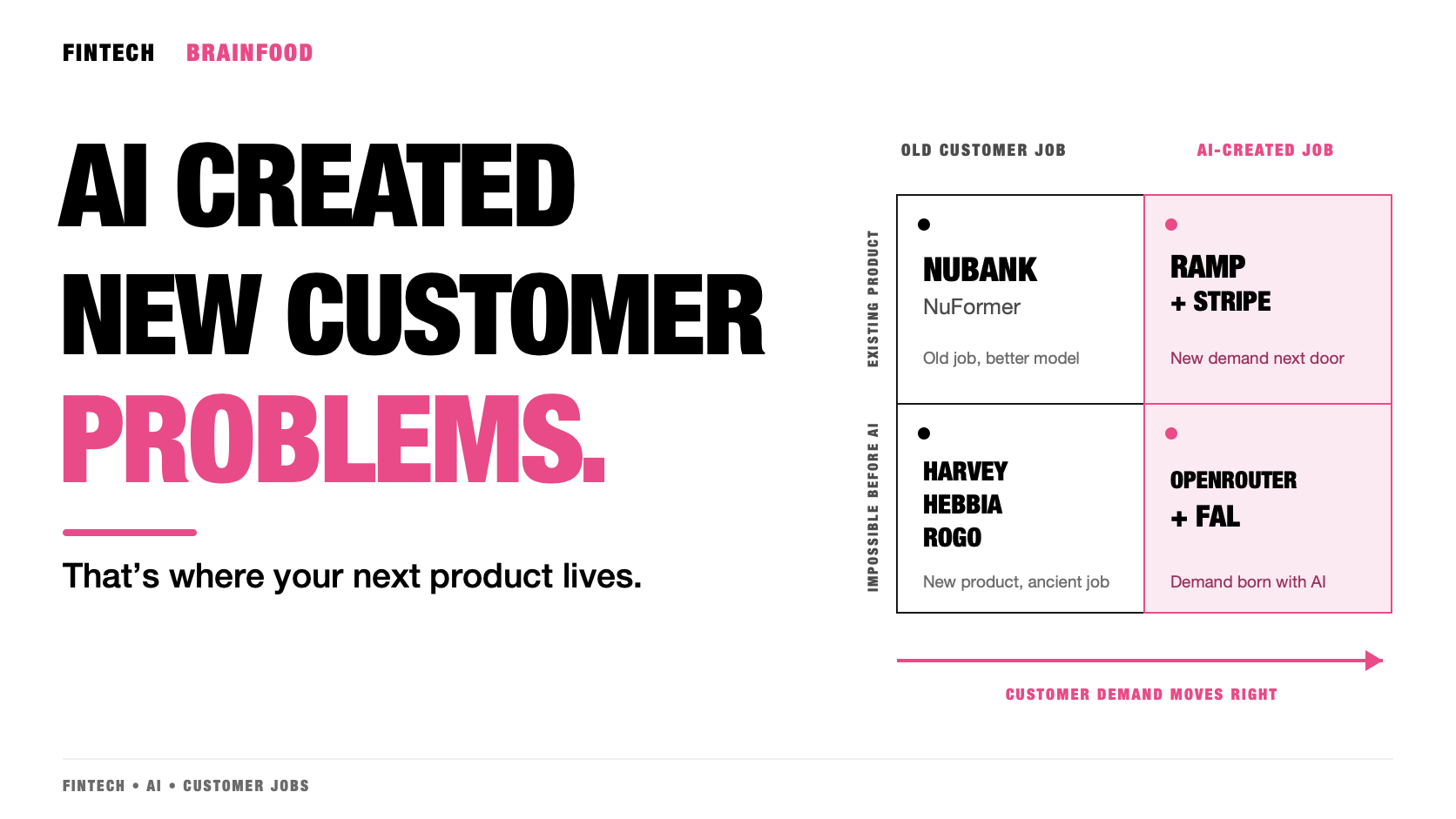
Put the two together, looks like this:
Old customer tasks
AI-created customer tasks
Existing company/product
Nubank/NuFormer
Ramp and Stripe
Cannot exist without modern AI
Harvey, Hebbia, and Rogo
OpenRouter and fal
The top left is deep adoption. Nubank uses NuFormer for better credit decisions, but underwriting is an ancient banking task.
The bottom left is where Harvey, Hebbia, and Rogo are located: these products could not exist before modern models and deal with legal and financial research work that has long existed.
The right side is where the tailwinds are. When AI offers customers new things to buy, Ramp and Stripe already have businesses. OpenRouter and fal make sense only because inference has become an industry.
This also means a company can occupy more than one box. Ramp's spending product is in the top left. Its token dashboard and Router are in the top right. Stripe's payment business is in the top left; Metronome and OpenRouter pull it to the right side of the table. Things rarely fit neatly into a 2x2 matrix.
So let me throw another concept at you.
I find three labels suitable to describe a company's posture:
Adopters use AI to serve their existing needs. Maybe they added a co-pilot. There's real value here. They can do things faster, cheaper, and leaner, but the sales pipeline structure does not change. Most SaaS companies that added an agent fall into this category.
Beneficiaries do old tasks better and seize new demands created by AI next door. Ramp or Stripe are the cleanest examples. Expense management remains the core task; token cost management and model routing are the new revenue pockets next to it.
Indigenous exist because of new demands. OpenRouter routes requests among over 400 models. fal runs generative media inference at scale. In a world without inference to sell, neither of these companies would have business.
This diagram tells you where demand comes from.
Tasks tell you where opportunities might be. Becoming AI native is laddered: the bottom is familiar, the top is the yet-to-be-solved brilliant challenges. So come climb up with me.
Premise: Operate yourself with AI
AI-driven operating models have changed the shape, governance, and operating systems of companies. Teams build plug-ins around employees, integrating internal data, sharing skills, and changing who can do what. Product managers and designers start deploying code. Engineers move further into products. Teams build their own internal tools. (For more, see the AI Operating Models Report.)
This is your ticket in. It allows you to accelerate, but alone it won't change what you sell.
Level One: Old tasks done better with AI
Some AI native products serve very old tasks. This does not diminish their nativeness.
Compliance screening, document and email reconciliation, legal research, and financial reporting were all tedious paperwork before AI appeared. Beacon, Sardine*, Gradient Labs, Harvey, Hebbia, and Rogo use modern models to aggregate hundreds of documents and data sources and then give answers or manage processes. These products could not have been produced a few years ago. But the tasks themselves are very old.
I am an advisor to Sardine.
Level Two: New tasks next to the core
If you work in expense management, account management, or help people make payments, old customer tasks still exist, but some new tasks have appeared alongside them. There are several different flavors.
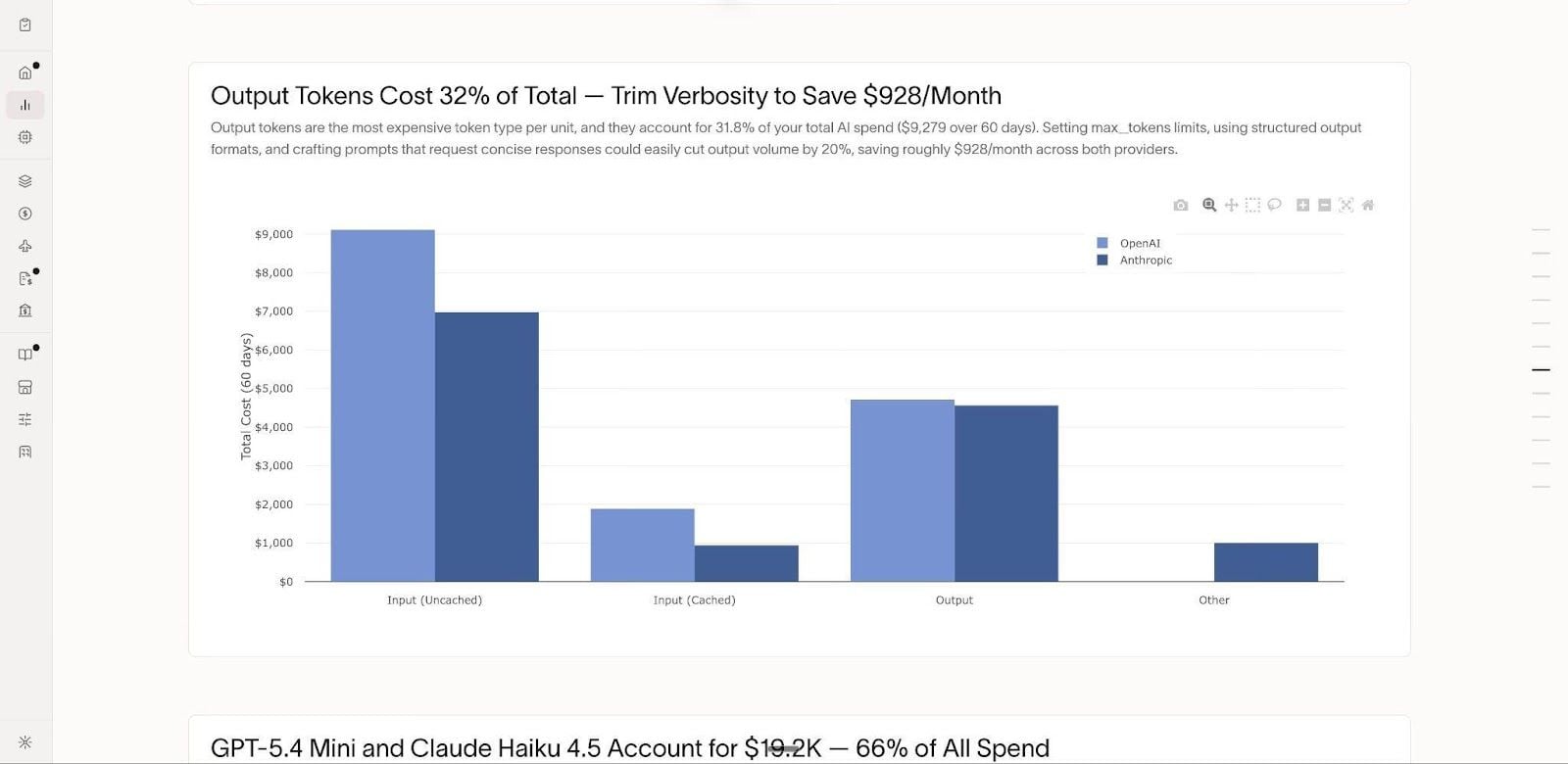
Task: Help me manage AI usage. Ramp's token dashboard is an AI-created task residing within an existing product. You might argue that cost dashboards are not new. Vantage and Datadog have been pricing cloud and computing expenses for years. The difference lies in billing. Before AI provides you a token bill, no one needed to classify, forecast, or differentiate COGS and OpEx for token costs. On Ramp, AI token spending grew 20.7 times from June 2025 to June 2026. Metronome now belongs to Stripe, sitting at the other end of the same task, responsible for measuring and billing for such usage.
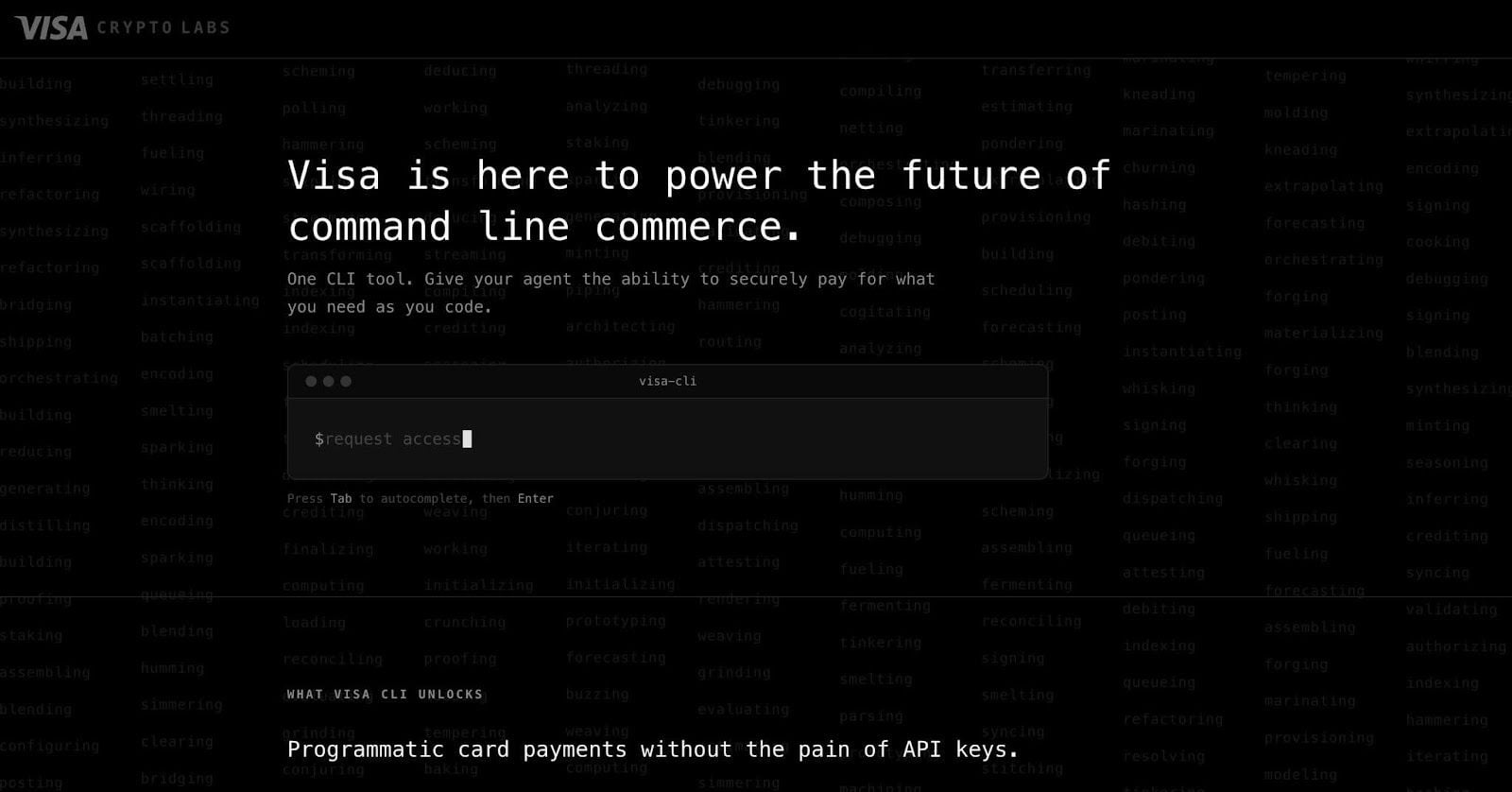
Work: Help my agent connect to your product and get the job done. Companies like Mercury, Visa, and Ramp are launching command line interfaces (CLI). The established Stripe released its own CLI seven years ago. But usage has surged since the launch of Claude Code. CLI is a type of user interface that uses command lines (terminals) rather than applications or web pages. Agents feel these interfaces are easier to navigate. And using CLI consumes far fewer tokens. For example, running Ramp CLI in --agent mode returns the transaction in JSON format, consuming about 105 tokens. Running the same transaction in --human mode requires 280 tokens for formatting display. This is the product interface designed for "non-human customers."
Work: Help my store be discovered by AI agents. About a third of Generation Z now uses AI instead of Google to research what to buy. If your store and SKUs are not there, you might miss opportunities. Companies like Shopify and WooCommerce, as well as payment service providers (PSP) that help e-commerce merchants, are now optimizing this area.
AI has created a whole new category of demand alongside your existing business. Your opportunity is to build interfaces that serve this type of demand. There’s no need to transform your whole business immediately.
But imagine a future where agents account for 80% to 90% of internet traffic, commerce, and the economy. If this has any truth to it, how would you reposition your company and narrative? What is the core value unit you create? How does it apply to that customer?
In this thought experiment, we must break free from thinking of AI as merely an add-on feature to existing businesses.
Level Three: New work that exists because of AI
Some problems did not exist before the AI explosion. They also do not solely arise from simply using AI.
How do I trust this agent to handle my data or the decisions it makes? We are entering a world where third-party developed agents may interact with your business. You need some way to ensure they are safe, trustworthy, manage privacy, and that there is some legal entity responsible behind them. A simple model is for agents to exist within some SaaS provider that you have existing enterprise agreements with. But agents are increasingly becoming products themselves. They might come from labs like Anthropic, a startup, or an internal department. I see companies building or buying shells or control planes (like Primitive) to package these agents. Another approach is AIUC, which aims to insure and certify agents.
How do I trust this agent to carry out transactions? If an agent appears in your store trying to buy something, how do you know its reputation, or who its creator is? Has the user authorized that agent to make purchases? There are some emerging standards like Google's A2A, Visa's Trusted Agent Protocol, and FIDO is building identity standards. But we are still in very early days. Companies like Natural Payments, Skyfire, and A-comm are staking their claims here. They manage the parts of intelligent commerce workflows where agents actually move money.
How do I obtain lower-cost inference and computing power? Brex states that companies will see the first open computing provider increase within five months of incurring the first OpenAI or Anthropic API costs. Five months. One minute you are paying API fees to model labs. The next minute you are comparing Together AI, Fireworks, and Baseten. You decide where to run workloads and ask finance how to hedge costs. AI has created a software supply chain and then started to build a capital stack beneath it. Nvidia and Wall Street are trying to mobilize $500 billion around this layer.
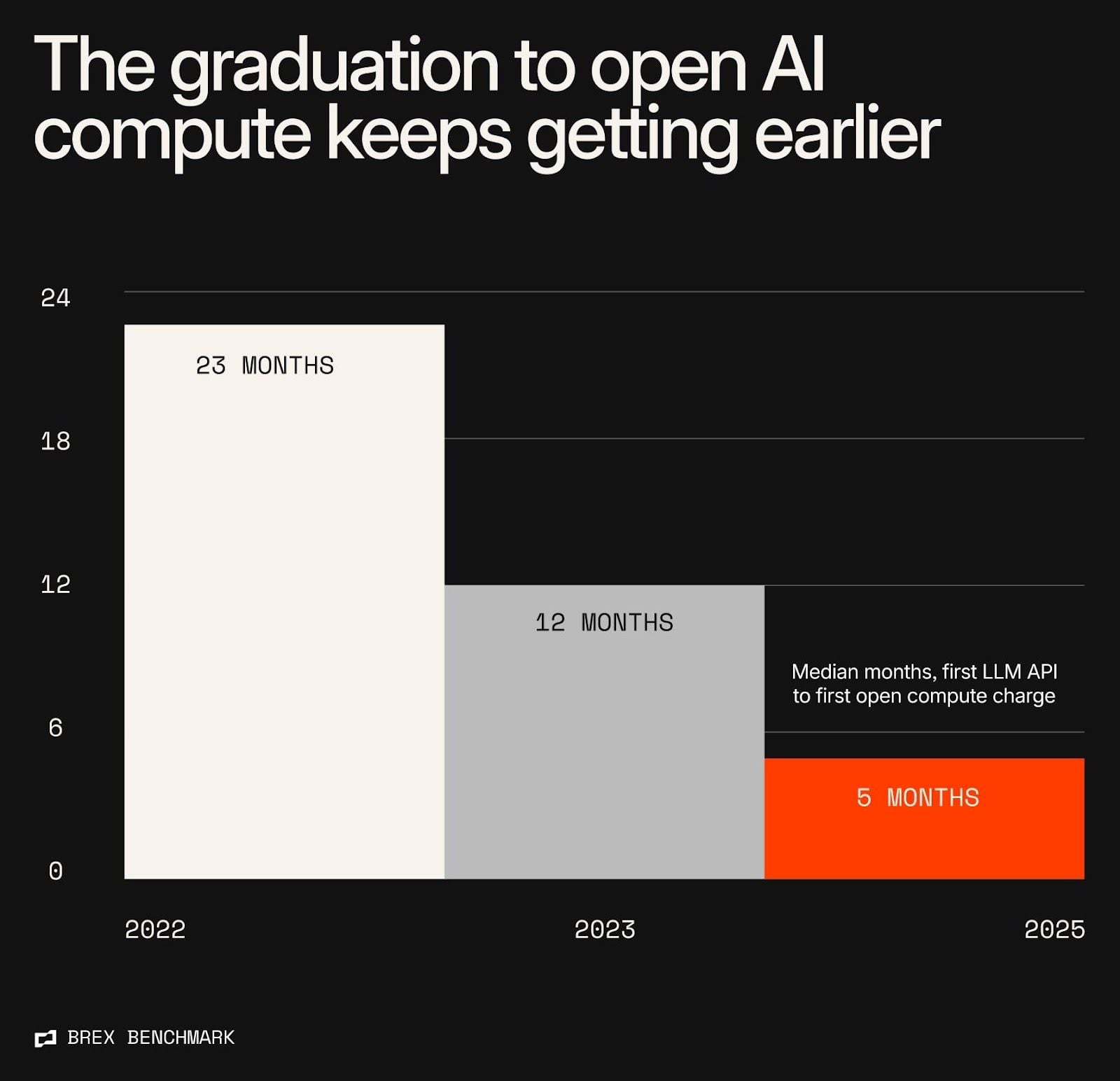
Source: Brex Benchmark; Brex card and billing payment data, January 2021 – June 2026
These jobs are larger than functions. They span products, data, identity, and finance. Once they span products, the question becomes whom customers trust to sit above them.
Your agents need a distribution strategy
I don't want your agent. I want my agent to enter your product.
Most commercial customers will eventually run some sort of control plane or shell: a place to orchestrate the agents they have across the tools they use. The CFO’s financial agent, the engineer's coding agent, and the operations team’s procurement agent will budget, authorize, and observe from a layer above the product.
Consumers will also have their versions. Whether it’s Grokbot or Instinct, new consumer applications from OpenAI or Google, or Apple finally making Siri less terrible, there will always be something thinking across products for users.
Garry Tan aptly describes the threat existing software faces:
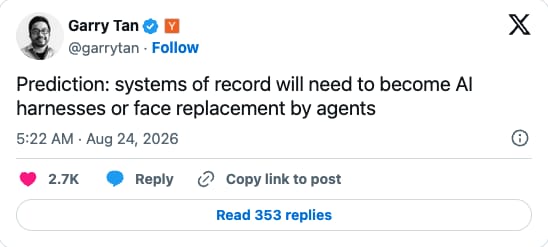
Record systems already have the data, permissions, and distribution needed for shells. Their problem is that a new orchestration layer can sit above them, turning every product below into a callable vendor.
This brings three strategic choices:
Own the orchestration. Become the place where customers view, authorize, and manage each agent.
Own a trusted control point. Even if others own the shell, identity, reputation, routing, procurement, and settlement can still hold value.
Become the easiest product to invoke across every important shell. CLI, API, and agent interfaces are distribution. (This is the correct answer for more of you than you think.)
Salesforce and core banking systems will not easily give up their sticky wedges that they already have. This isn't just aggregation theory. Record systems can become shells; experts can own control points; products can distribute through all of this.
This tension is the point. The prize may be the control plane. It may also be that indispensable thing every control plane needs.
What to build now and the unsolved challenges
Back to the three founders I spoke with.
The answer is always work. Positioning follows product.
Find the work created by AI next to the value you are already delivering. Build interfaces for it.
Then decide how it spreads. You can own the shell, have a trusted control point within it, or become a product that can be elegantly invoked from all shells.
This is the meaning of reinvention. You start by operating yourself with AI. You use it to do old work better. Then you climb to those tasks that did not exist before models brought problems to customers.
Ramp reaching $44 billion is not just because it handles expense management well. It got there because investors believe AI can continuously create new demands next to the core. And Ramp has the speed to capture it.
Choose work. Choose interfaces. Give it distribution.
*(By financial company standards, Ramp's growth is outrageous: TPV (total processed volume) grew 170% year-on-year as of March, the fastest in three years, while its business scale has expanded 20 times.)
免责声明:本文章仅代表作者个人观点,不代表本平台的立场和观点。本文章仅供信息分享,不构成对任何人的任何投资建议。用户与作者之间的任何争议,与本平台无关。如网页中刊载的文章或图片涉及侵权,请提供相关的权利证明和身份证明发送邮件到support@aicoin.com,本平台相关工作人员将会进行核查。


