The Federal Reserve Bank of Cleveland has released the latest academic working paper titled “Do You Even Crypto, Bro? Cryptocurrencies in Household Finance.” This research was co-authored by scholars from Purdue University, the Cleveland Fed, the University of Texas at Austin, and the University of California, Berkeley. The study is based on a long-term, large-scale quarterly tracking survey conducted among American households, revealing the true face of cryptocurrency holders, their investment motivations, consumption behaviors, and the core driving mechanisms of information intervention for retail entry.
1. Retail Portrait: Young, High Income, and High Risk Preference
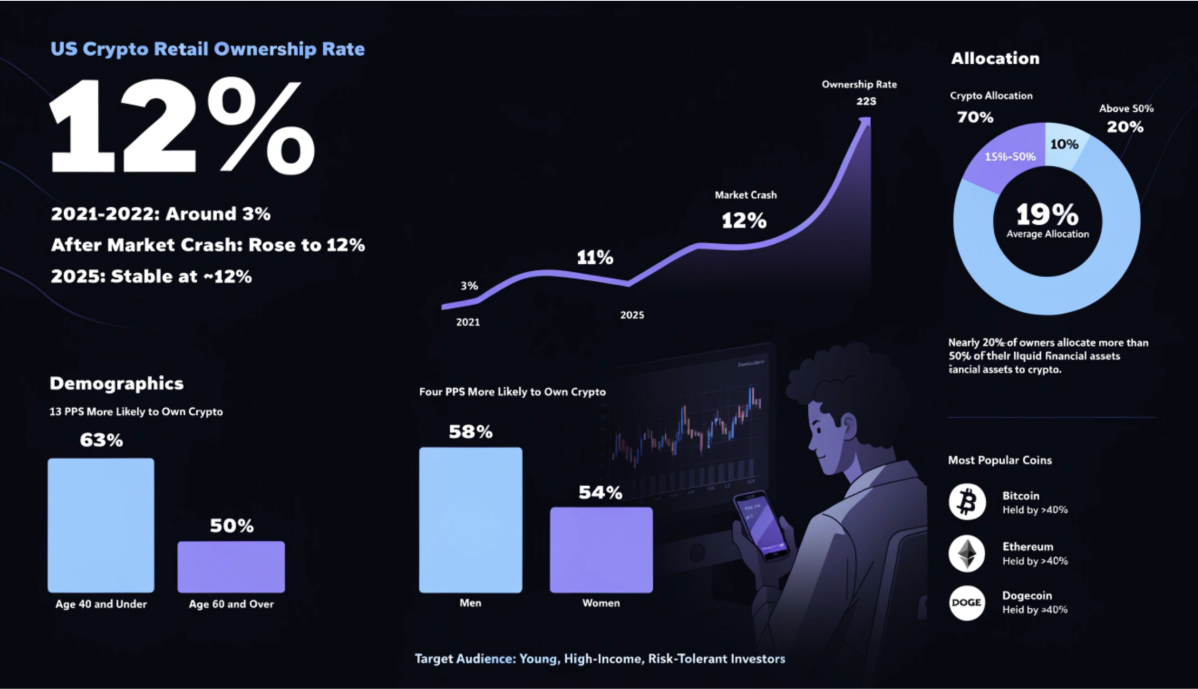
Holding Rate Resilient Amid Fluctuations: The cryptocurrency holding rate among American households surged from about 3% to 11% during the 2021 to 2022 bull market. Surprisingly, even after subsequent price declines, the holding rate increased to 12%. By 2025, as Bitcoin prices surpassed $120,000, the holding rate remained stable at around 12%.
Core Population Demographics: Cryptocurrency holders exhibit highly concentrated demographic characteristics.
Age: Youthfulness is the strongest predictor of cryptocurrency holding. Controlling for other variables, individuals under 40 are 13 percentage points more likely to hold cryptocurrencies compared to those aged 60 and above.
Gender and Income: The proportion of male holders is higher (by 4 percentage points), and holders generally have higher income and daily consumption levels.
Politics and Ethnicity: Those with libertarian or independent political leanings have a significantly higher holding rate, while the probability of holding is relatively lower among white individuals.
Fund Concentration Polarization: Although for the majority of holders, cryptocurrencies constitute only a small part of their financial wealth (70% of holders have positions under 15%), nearly 20% of holders allocate more than 50% of their liquid financial assets to cryptocurrencies. The average cryptocurrency position among holders accounts for 19%.
Currency Distribution: Bitcoin remains absolutely mainstream. However, among cryptocurrency holders, multi-chain/multi-currency configurations are very common, with Ethereum and Dogecoin following closely, both held by over 40% of cryptocurrency holders.
2. Behavioral Truth: Expectations Driven vs. Cognitive Barriers
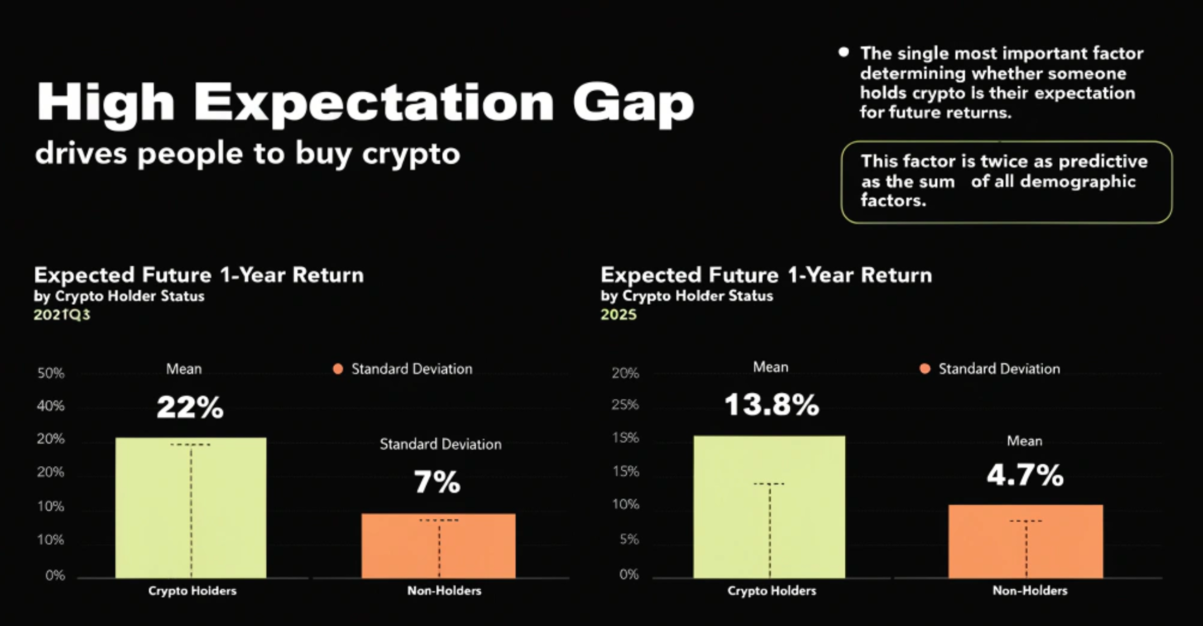
“High Expectation Discrepancy” Drives Buying: The most core factor determining whether people buy cryptocurrencies is expectations of future returns, with explanatory power double that of all demographic characteristics combined. Cryptocurrency holders generally hold extremely high return expectations:
In Q3 2021, holders expected an average return of 22% for the next year (while non-holders only expected 7%).
By 2025, although the expected return for holders had declined, it still reached 13.8% (compared to 4.7% for non-holders).
Additionally, holders have a relatively low perception of cryptocurrency risk (among respondents willing to provide risk assessments, only 45% of holders consider it “extremely high risk,” while the percentage is 63% for non-holders).
“Not Understanding” is the Biggest Barrier for Non-Holders: Among individuals who do not hold cryptocurrencies, the main reason for not holding is not believing it to be a scam, but rather “lack of knowledge” (e.g., “not understanding cryptocurrency,” “not knowing how to buy,” etc.). This indicates that once the cognitive blind spots of potential users are eliminated, there is still significant growth space for the market. The second most cited reason for not holding is the perception that it is a “poor investment” or “too volatile.”
3. Consumption Effect: Wealth Effect or “Lottery-style” Windfall?
The research explores the transmission effect of Bitcoin price fluctuations on the daily consumption of investors (Passthrough):
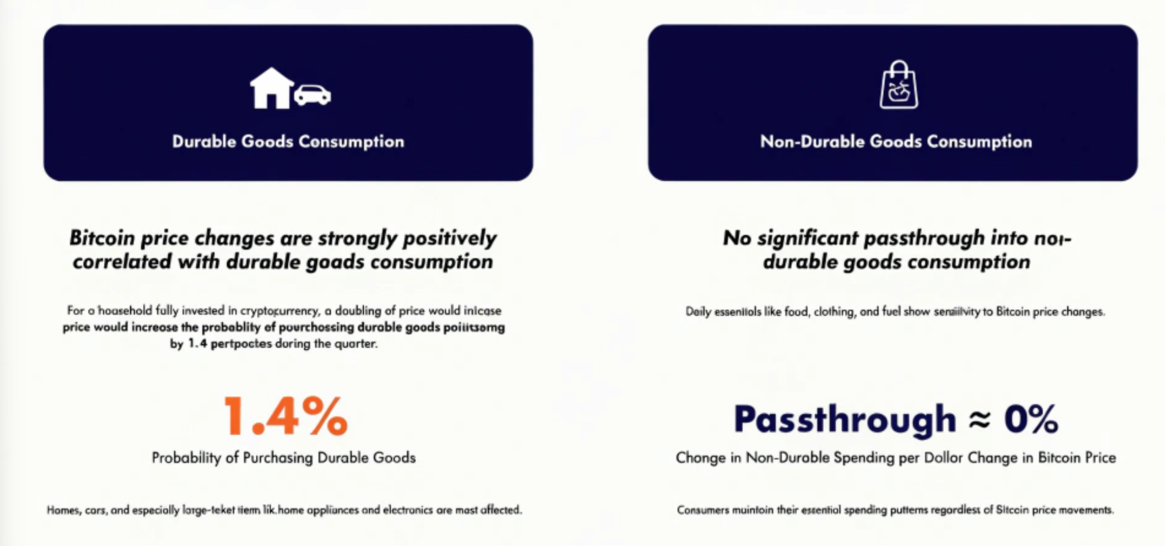
Durable Goods Consumption Significantly Positively Correlated: An increase in Bitcoin prices directly translates into the holders’ purchasing decisions for durable goods (such as houses, cars, especially large items like home appliances and electronics). Data shows that for a household fully invested in cryptocurrencies, a doubling of Bitcoin prices would increase the probability of purchasing durable goods that quarter by 1.4 percentage points.
Non-Durable Goods Consumption Remains Unchanged: Surprisingly, the transmission effect of price increases on non-durable items (daily necessities and expenditures) is almost zero.
Conclusion: Consumption brought about by cryptocurrency gains is characterized by “immediacy” and “one-off” features, not continuing into the next quarter following a price increase. This indicates that American households tend to view the unrealized gains of cryptocurrencies as “lottery winnings” or “gambling income” (i.e., they prefer one-time large expenditures), rather than as “permanent wealth growth” that can be allocated to long-term living expenses.
4. How to Facilitate “Growth Explosion” Through Information Intervention?
This paper conducted a randomized controlled trial (RCT) on respondents in Q2 2025:
Simple and Intuitive Historical Return Information Significantly Boosts Expectations:
The experiment provided a group of respondents with the text information “Bitcoin rose 14.3% in the past year,” resulting in respondents’ expected return for the next year being immediately revised up by 3.2 percentage points; presenting a price trend chart visually raised expectations by 1.2 percentage points.
Expectation Adjustments Directly Converted into Real Buying Behavior:
Respondents receiving Bitcoin return information saw their expected allocation for cryptocurrencies in ideal asset configurations immediately increase by about 2 percentage points (equivalent to a 47% jump from the control group’s average of 4.3%).
Key Conversion Data: In subsequent follow-up surveys, the respondents receiving information intervention had their actual cryptocurrency purchase rate increase by 2.5 percentage points. Considering the benchmark holding rate is about 11%, this implies that simple information intervention unconditionally raised retail actual entry probability by 23%!
Targeting the “Not Understanding” Group is Most Effective:
This information intervention effect is strongest and most significant among those who originally claimed “did not purchase due to lack of understanding.” Those who already held negative biases toward cryptocurrencies (e.g., viewing them as bad investments) are completely immune to this historical return information.
Validated the Bull Market’s “Self-fulfilling” Bubble Mechanism:
This finding causally confirms the self-reinforcing mechanism of cryptocurrency market bull markets (echo chambers): the phase-wise surge information of new assets significantly extrapolates new users' expectations, attracting originally uninformed retail investors to follow suit, thus further driving prices up. This high price volatility and expectation discrepancy will continue to exist as the most significant characteristics of the asset.
免责声明:本文章仅代表作者个人观点,不代表本平台的立场和观点。本文章仅供信息分享,不构成对任何人的任何投资建议。用户与作者之间的任何争议,与本平台无关。如网页中刊载的文章或图片涉及侵权,请提供相关的权利证明和身份证明发送邮件到[email protected],本平台相关工作人员将会进行核查。