
Key Points
- The high costs and long delays of cross-border remittances and emerging market foreign exchange are not due to technological backwardness in any one link, but rather the result of the combined constraints of process review, bank business hours, and thin U.S. dollar liquidity.
- KiiChain's approach is to gather the liquidity of stablecoins from various countries onto one chain, allowing exchange and settlement to operate around the clock. Whether its value proposition holds depends on whether the source markets themselves have sufficient depth.
- It does not eliminate intermediaries nor intends to. Among the eight links, only three have truly disappeared; the other five have changed the executing entities and names while the structure remains the same. This is more akin to organizing existing inefficiencies rather than replacing them.
- Official disclosure indicates a cumulative trading volume exceeding $500 million, with over 350,000 users. However, the more substantial parts of the roadmap remain in the conceptual stage, making early judgment premature.
1. By 2026, the financial system remains unchanged
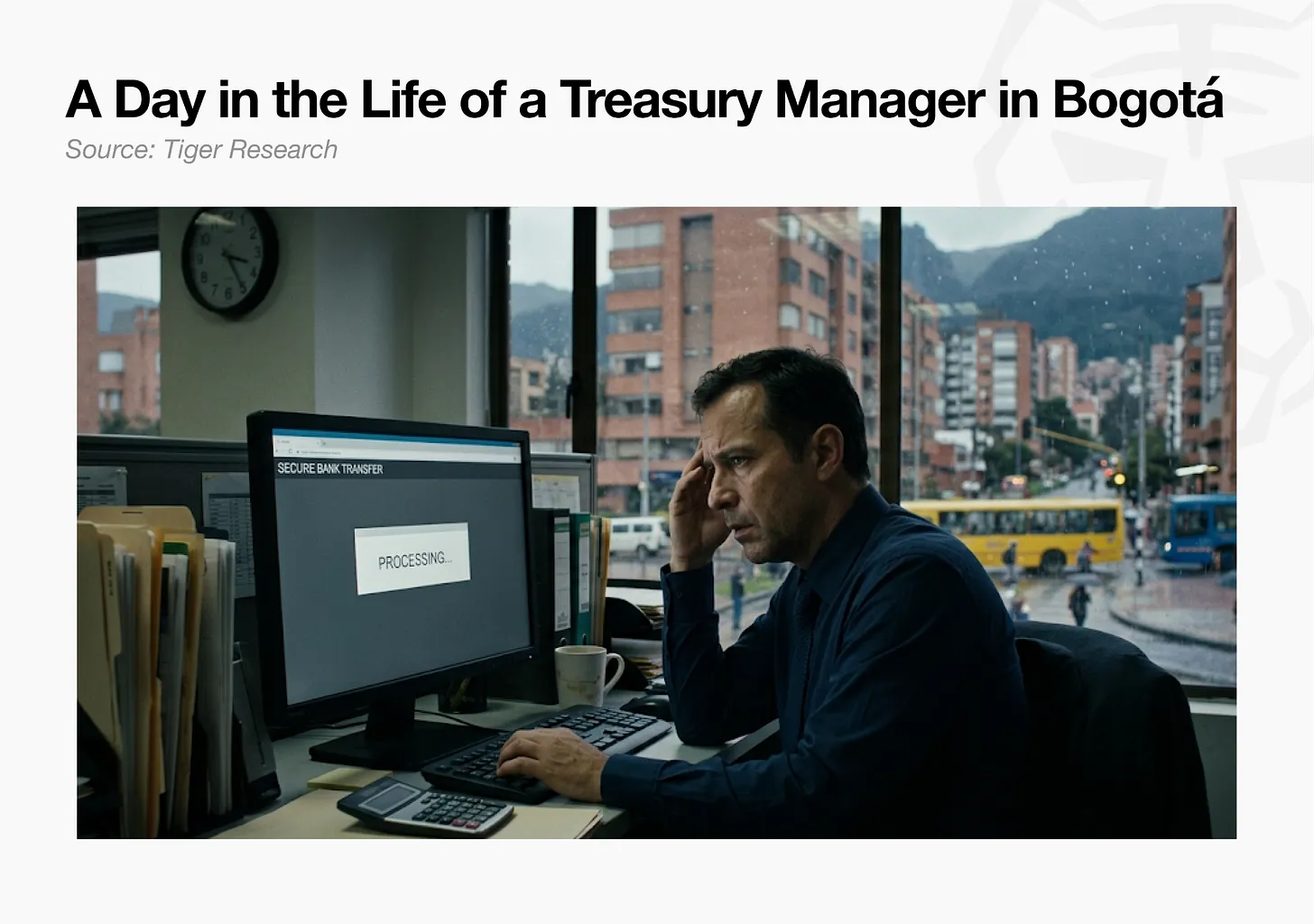
On Friday afternoon, the capital manager of an exporter in Bogotá made a payment to a supplier in the U.S., with the screen showing just a terse "Processing."
Every cross-border transfer involves a complex process. Qualification review, foreign currency account validation, currency exchange, and final settlement—none of these steps can be eliminated. The global financial infrastructure still operates around various inefficiencies: banks in different countries have different business hours, and regulatory systems vary.
News from the other side of the globe can be transmitted to you in real-time. Technology has long since dissolved the boundaries of information and culture, yet the financial infrastructure supporting economic operations remains cumbersome.
This structure imposes heavier pressure on emerging market countries. Their local currencies hold relatively low status internationally, making it difficult to obtain liquidity instantly, resulting in cumulative delays and costs in every transaction link. In some transactions, the U.S. dollar liquidity is insufficient to absorb the reported local currency scale, significantly raising exchange costs and prolonging completion times.
With the problem clearly defined, the next question is: which part of this can the on-chain structure actually solve.
2. Solutions from a group of OTC practitioners
KiiChain's founders Danyel Arenas and Alex Cavallero previously operated digital asset OTC desks in Latin America and managed the market-making fund Inmersion Capital. They aimed to bridge the already thin liquidity between local currencies and the U.S. dollar while completing bilateral transactions under inconsistent bank hours and strict capital controls. This inefficiency was borne by their own funds, shaping the angle they later chose to approach.
KiiChain positions itself as an on-chain foreign exchange layer between stablecoins and real-world assets (RWA). The core idea is simple: concentrate the liquidity of U.S. dollar stablecoins and various local currency stablecoins onto the same chain, allowing exchange and settlement to continue even when bank systems are closed. The company has raised a total of $26 million, with investors including Nimbus Capital.
Notably, this positioning has defined boundaries. What it aims to resolve is the time and friction of settlement, not the origin of liquidity itself. These two matters will be discussed separately later.
3. Four components, each solving something and unable to solve something else
According to official descriptions, four components support this concept: KiiChain App is responsible for the execution of transactions across assets and currencies, Kii Oracle provides decentralized real-time price data, RWA Protocol handles compliance tokenization, and KiiChain Pay connects fiat currencies with on-chain assets.
The component list itself does not explain much. What truly matters is understanding which layer of constraint each touches structurally.
3.1. KiiChain App: Moving RFQ price discovery on-chain
Emerging market currencies are on the fringes of the global financial system, enduring long-term pressures of thin liquidity and settlement delays. Existing foreign exchange trading methods, whether RFQ (request for quote) or CLOB (central limit order book), have failed to address this issue.
The Automated Market Maker (AMM) model commonly used in DeFi is also not applicable. The core of foreign exchange trading is currency exchange and real arbitrage demand, rather than value storage or investment. As a result, liquidity providers are exposed to losses from price fluctuations but find it difficult to earn returns from daily trading flows—this is a flaw inherent in the model.
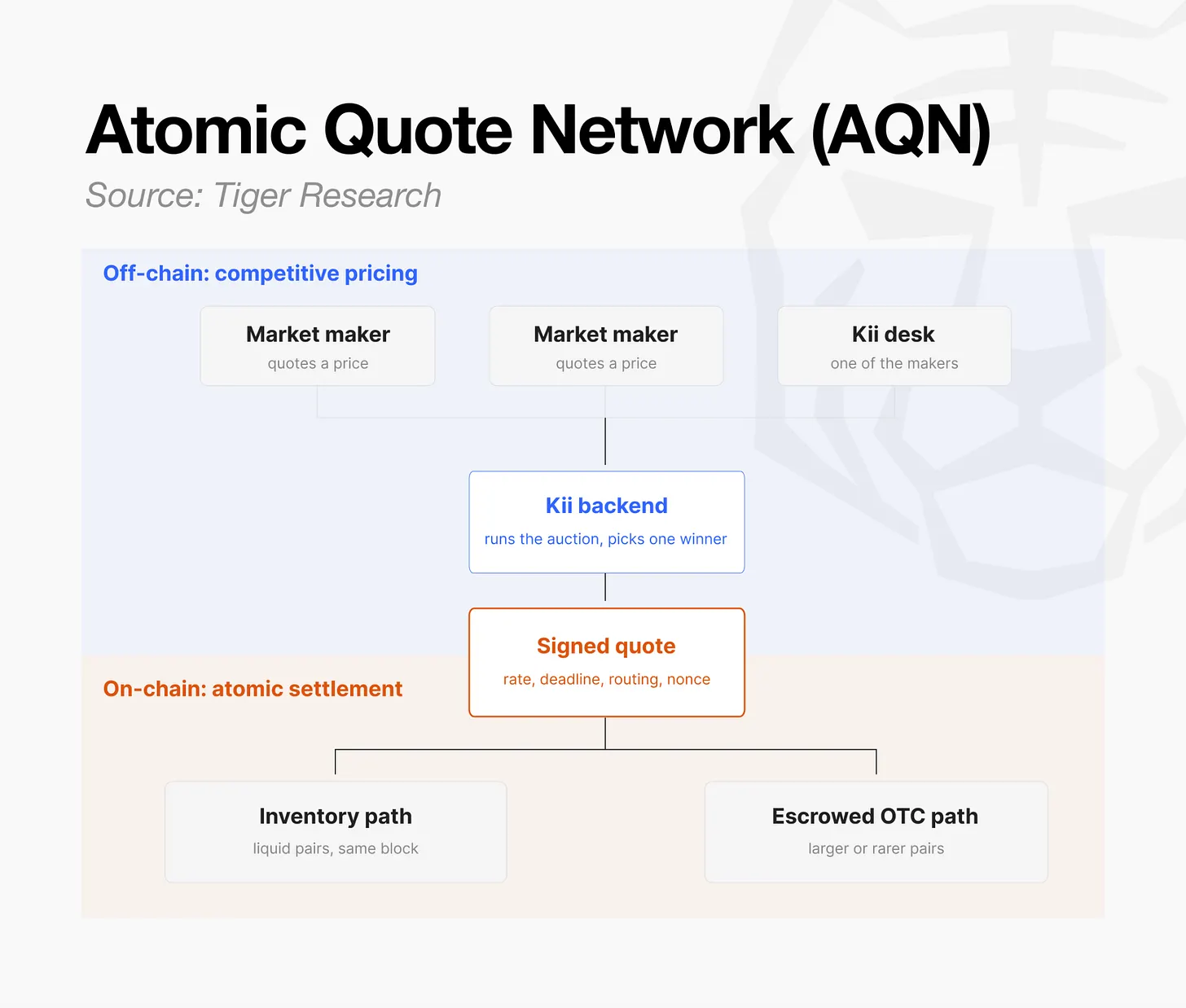
KiiChain App employs what it calls the Atomic Quote Network (AQN) model: the process of searching for optimal exchange rates follows the traditional financial RFQ practice while the actual movement of funds is completed instantly on-chain. Price competitiveness stems from the former, while settlement speed and transparency result from the latter.
This design indeed addresses settlement delays. However, liquidity risk is outside the scope of the model; that is an external variable. Whether AQN can deliver results ultimately depends on the number and capacity of institutional market-making partners, which requires long-term accumulation.
3.2. RWA Protocol: Moving trust from banking relationships to code
Traditional foreign exchange trading cannot directly verify collateral, relying instead on substitutes like letters of credit and correspondent bank accounts for trust between banks.
KiiChain's alternative solution is to tokenize the collateral itself on-chain. The T-REX standard (ERC-3643) programmatically embeds identity and qualification rules into the token, blocking transfers to disqualified addresses directly. Sensitive identity verification is managed by licensed off-chain operators, with only revocable cryptographic authentication credentials recorded on-chain.
Asset types that can be included cover real estate, bonds, and commodities, but regulated financial products can only be distributed through licensed issuers. The form of trust has changed, but the source has not: the entity issuing the certification credentials remains subject to regulatory and legal jurisdiction.
3.3. Kii Oracle: Consensus cannot solve thin sourcing
Price discovery in traditional foreign exchange occurs in the interbank market, dominated by a few large trading banks. Limited access ensures trust, but the cost is that currencies not deeply embedded in this network can only face opaque pricing determined by a few quotes, especially true for emerging market currencies.
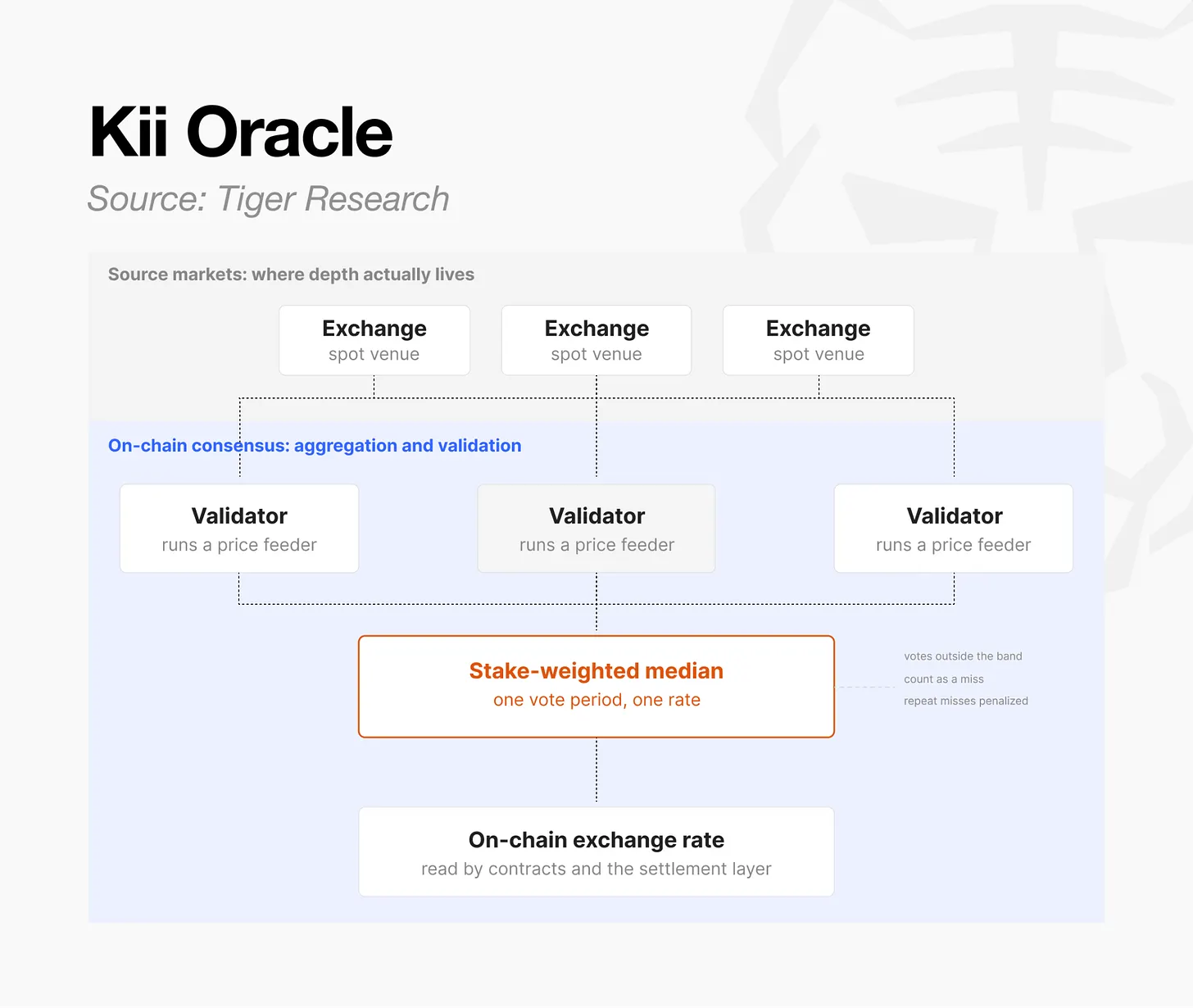
Kii Oracle's idea is to replace closed interbank trust with open consensus among validators. Trusted validators independently collect prices from multiple exchanges, weighting the median based on their staking shares to reach consensus, while values that deviate too far from the preset standard deviation are automatically excluded to prevent manipulation by a few entities using extreme quotes.
This mechanism addresses data fragmentation, belonging to a technical remedy; it does not generate the liquidity depth possessed by the interbank market. When the local currency stablecoin being referenced has thin sourcing, no matter how refined the calculation logic, price distortions and severe fluctuations still exist. Oracles can make dispersed prices more trustworthy, but they cannot thicken a thin market.
3.4. KiiChain Pay: Integrating entry does not equal unblocking bottlenecks
The bottlenecks of traditional foreign exchange settlement concentrate on the nodes for moving funds in and out of the banking system: account opening, compliance review, and business hour restrictions. If a transaction is blocked at the initial stage, speeding up the intermediate processes is of limited significance.
KiiChain Pay packages four channels into a unified API. On-ramp converts fiat currency to digital assets after completing KYC; off-ramp withdraws digital assets to a bank account after completing KYC; foreign exchange (FX swap) is custodial, completed through contracts or service providers; decentralized exchange (DEX swap) completes on-chain exchanges via a LiFi router without needing KYC.
Among these four channels, the first three still rely on external licensed operators, KYC processes, and the operating hours of off-chain service providers. Integration improves accessibility, but the bottleneck itself has not shifted. Only DEX swap truly bypasses the banking link, as it does not involve fiat currency.
There are similar limitations in pricing. The market API adds a layer of spread on the quotes from external liquidity providers, essentially being a markup resale rather than independent price discovery.
4. Among the eight links, three have truly disappeared
Looking at the four components together, KiiChain has not created a financial system devoid of intermediaries but rather a settlement layer where intermediaries can meet without being constrained by national borders or business hours.
Building a system that completely eliminates all intermediaries is unrealistic. Funds flowing within regulatory boundaries must inevitably bear KYC obligations and licensed operating entities.
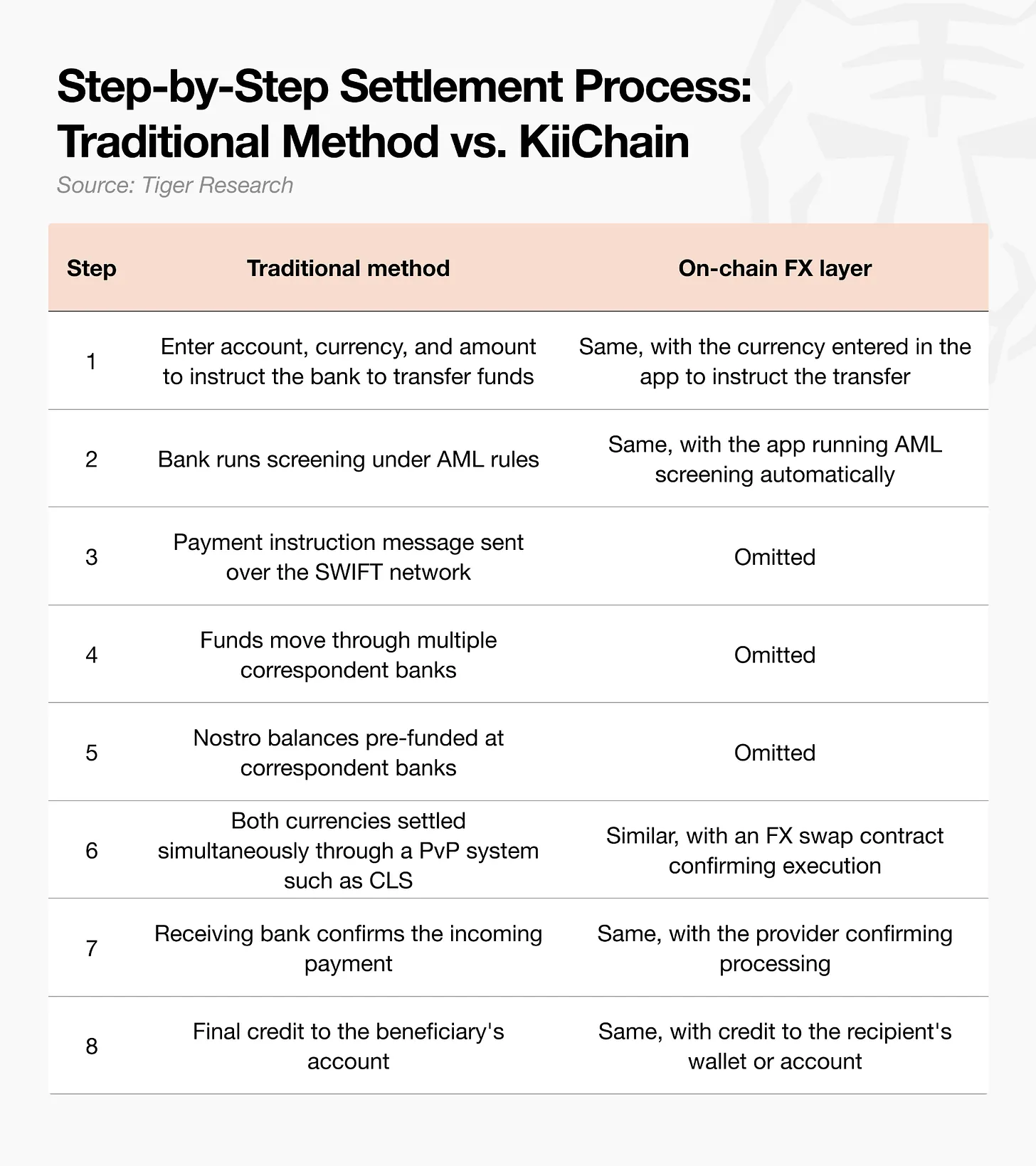
The extent of process compression is therefore limited. Among the aforementioned eight steps, only three have completely disappeared; the remaining five retain their basic structure, with changes only in executing entities and terminology, while the procedures themselves remain.
A more fitting analogy is gathering the scattered exchange points into one place. In the past, exchanging pesos for dollars would require running between different exchange offices in various countries, each with its own business hours. KiiChain’s approach is to bring these intermediaries together on a common chain platform rather than eliminating them. The operational capability to handle settlements still exists; the convenience and speed have improved because all parties interact within the same space, thus physical distance and time differences are no longer factors.
This still has practical value. The liquidity of multiple local currency stablecoins is concentrated on one chain, and the exchanges between digital assets within the platform are automatically executed by smart contracts around the clock. However, the actual entry and exit nodes for fiat currency are still subject to the operating conditions of off-chain service providers.
Therefore, rather than saying this is a dismantling of the intermediary structure, it is more accurate to say that it moves the underlying infrastructure on-chain to refine the stubborn inefficiencies of the traditional financial system. The standard for assessing the value of this matter should be the extent of optimization, rather than the narrative of disruption.
5. Numbers at the starting line
Officially disclosed data indicates: a cumulative trading volume exceeding $500 million, approximately 350 B2B2C enterprise clients, and a user base exceeding 350,000, with user growth maintaining at about 10% per month. These numbers are sourced from the company itself, with no independent metrics available for cross-validation.
Heavier items on the roadmap remain in the conceptual stage: on-chain debit cards, a payment network covering 50 countries, stablecoin deposit products, unsecured loans, U.S. virtual accounts, and AI-driven automatic settlement systems. What is actually being executed today is concentrated on the foundational function of foreign exchange settlement infrastructure.
Transitioning from payment tools to on-chain financial hubs depends on whether ecosystem participants can gather together. The interaction of liquidity partners, multinational corporations, and individual users within the same network will create network effects, providing the premise for a leap to the next generation of financial functions.
Returning to the question posed at the beginning of this article: which part of the emerging market foreign exchange can the on-chain structure address? The current answer is the time and friction of settlement, not the depth of liquidity. The former can be tackled through structural design, while the latter relies on negotiating with market-making partners one by one, expanding market by market. KiiChain has already demonstrated its capability in achieving the former, but the latter remains unanswered.
The path of on-chain foreign exchange is worth pursuing. But how far it goes will be determined by execution capabilities, not by the architecture diagram.
免责声明:本文章仅代表作者个人观点,不代表本平台的立场和观点。本文章仅供信息分享,不构成对任何人的任何投资建议。用户与作者之间的任何争议,与本平台无关。如网页中刊载的文章或图片涉及侵权,请提供相关的权利证明和身份证明发送邮件到support@aicoin.com,本平台相关工作人员将会进行核查。

