Written by: David Christopher
Translated by: Saoirse, Foresight News
The battlefield of Memecoins is filled with smoke, as Pump.fun and Fomo compete for industry dominance.
In the past few weeks, the crypto industry has witnessed a titanic showdown: Pump against Fomo. The arena of their competition is the most popular product in the crypto market – speculative trading.
Fomo has proven how a high-quality consumer experience can create an excellent trading product. It has socialized, made public, and made traceable the trading experience: users can follow traders, view positions, copy trades or reverse trades, and observe the entire trading process in real-time.
This product design has driven rapid growth on the platform. Riding the wave of renewed market speculation, Fomo has become the core arena for participating in the Memecoin boom on the Robinhood Chain, with weekly trading fees and the number of traders skyrocketing.
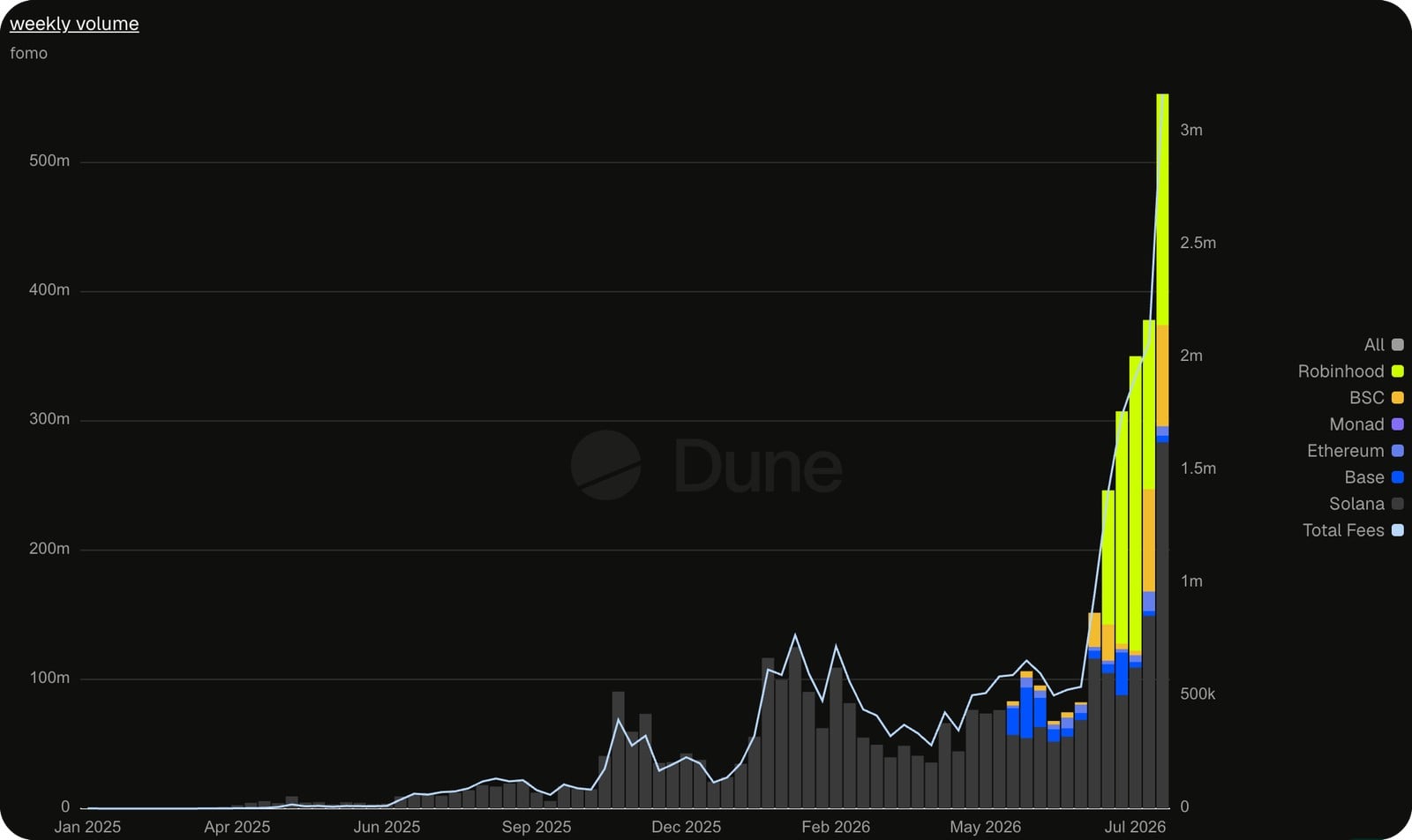
This Dune chart displays Fomo's weekly trading volume: starting slow growth in early 2025, experiencing explosive growth after May 2026, with the Robinhood Chain becoming the driving force behind the increase in trading volume, while the platform's total fees reached an all-time high.
However, Solana remains the stronghold for speculative trading in the crypto market, with Pump.fun positioned at the core of this race, unwilling to share the market pie.
Fomo relies on the underlying infrastructure of Pump.fun, achieving rapid growth through a superior front-end interface, essentially acting as an intermediary between Solana's speculative infrastructure and ordinary speculative users. Mentioning "intermediary" is not derogatory. Fomo has created a product that users need, continuously generating fees, enough to prove that users are willing to pay for this experience.
But ultimately, most of the features built by Fomo could theoretically be replicated by Pump.fun. Right now, we are witnessing a scene where Pump.fun continuously adds numerous new social features to its application, striving to become the "homepage entry" for speculative trading.
This places the two platforms in a delicate position: they are partners at the underlying infrastructure level but direct competitors in the user-facing front-end market. Fomo holds user traffic, while the infrastructure supporting trade execution mostly belongs to Pump.fun.
Now, Pump.fun seeks to capture both the infrastructure and user-end markets simultaneously.
To achieve its goals, Pump.fun is making significant efforts. Allegedly, the platform has offered conditions to poach top traders from Fomo with contracts worth tens of thousands of dollars per month, enticing them to move their trading activities to Pump.fun. This action is not illegal and doesn't even qualify as an industry scandal. Essentially, a well-funded platform is spending money to attract core users with existing traffic.
In addition, Pump.fun has introduced a zero-fee policy for its front-end. It can afford to subsidize this because the platform has already achieved profitability through bond curve mechanisms and PumpSwap; this front-end subsidy model is something Fomo cannot replicate.
Many market participants have criticized Fomo for charging fees, but this perspective overlooks the core issue: what exactly are users paying for.
Users pay for a complete trading experience: finding notable traders to follow, viewing their positions, tracking trading profits, receiving market alerts, and completing all operations through an interface that significantly lowers the barriers to cryptocurrency trading.
Fees are Fomo's primary source of income, and the entire user experience constitutes its main business. Pump.fun can offer similar features for free because its foundational business has already provided stable revenue for it.
In my view, there are two key points worth deep consideration in this matter.
First, this is another classic case: mature crypto infrastructure projects begin to vertically integrate upward to compete for end-user traffic. Uniswap on the Robinhood Chain is experiencing a similar storyline. After becoming the core trading infrastructure on-chain, Uniswap started promoting its own issuance launchpad, no longer serving simply as a foundational tool for other platforms. Pump.fun has adopted the same strategy on the Solana chain: it has taken control of the underlying infrastructure for speculative trading and now hopes to further dominate the consumer end facing ordinary users.
Second, I believe the key to the eventual victory of either Pump.fun or Fomo hinges on trust.
Being at the center of the Memecoin speculative race, whether the evaluation is objective or not, Pump.fun has a mixed reputation in the crypto circle. Moreover, the rumors of the platform’s heavy recruitment of traders further damage its own image.
In contrast, Fomo launched later and carries less historical baggage; its product design aims to make trading activities more transparent and traceable, focusing on social trading.
However, the value of social trading entirely depends on the credibility of the signals released by traders. A trader can publicly buy with one wallet and quietly sell with another; they can build positions ahead of time and then announce trades, ultimately dumping tokens to profit from followers. While blockchain achieves data transparency, it cannot guarantee the trustworthiness of the traders themselves.
Ultimately, where users choose to trade will depend on which platform can maximally ensure the authenticity of the displayed information. Once traders collude, use multiple concealed wallets to hide trading behavior, and capitalize on followers, users will cease to trust trading signals. Once trust collapses, the value of the social trading layer fiercely contended by both platforms will disappear.
It will be worth watching what means the two platforms adopt to maintain user trust in the future.
免责声明:本文章仅代表作者个人观点,不代表本平台的立场和观点。本文章仅供信息分享,不构成对任何人的任何投资建议。用户与作者之间的任何争议,与本平台无关。如网页中刊载的文章或图片涉及侵权,请提供相关的权利证明和身份证明发送邮件到support@aicoin.com,本平台相关工作人员将会进行核查。


