On one side, there is a strong voice of anger:
“Regular investing is a foolish behavior. Have you ever seen a stock god or an investment master who does regular investments in your lifetime? Buffett, Druckenmiller, Marks, Templeton... they always wait for others to cut their losses while they go all in. When Lehman collapsed, Marks had to buy hundreds of millions every day. In 1992, Soros and Druckenmiller, and Paul in 1987. Were those masters not waiting for others to cut losses while they went all in? If you are going to do regular investments, remember to invest a portion only during significant drops, not blindly buy without regard for market movements. The best regular investment should be to buy a portion when VIX spikes. Countless experts have said, at the bottom, go all in; do not add positions, and do not trade frequently. Regular investment is entirely a false proposition, regular investing for 20 years can lead to your cost price being hit in a day.”
On the other side, there is a completely opposite observation:
“I have yet to see anyone outperform regular investment. Some people with several million are investing but lose themselves in something like Hynix; there are those with just hundreds of thousands who daydream about getting rich. The ones who do regular investments, without ever monitoring the market, live a comfortable life without pressure, and when they look back at the end of the year, their returns beat those who actively monitor the market. Regular investment can outperform 80% of amateur investors. Aside from fools and stock gods, there are ordinary people. Not everyone can grasp the bottom. What is the difference between blind bottom-fishing and foolishness? With your following of over ten thousand, if you had habits and funds like Buffett, you could time the market; otherwise, it is regular investment. Regular investment does not depend on the size of the principal, but on strict discipline.”
Both sides are partially right and partially wrong.
The real question is not “Is regular investment good or bad?” but rather: Who does it solve problems for, and what problems does it fail to solve? Let’s set aside emotions and clarify the matter with data and logic.

1. Two Voices on Twitter
Proponents (Most common in daily discussions)
Many believe regular investment is most suitable for ordinary people:
- It can smooth out volatility and reduce the pressure of “buying high and selling low.”
- It is suitable for holding broad-based assets like Bitcoin, Nasdaq 100, S&P 500 for the long term.
- Those who truly earn long-term and maintain a good mindset are often those who stick to regular investments and do not monitor the market; those trying to imitate masters to time the market are more likely to lose control.
- Regular investment can help ordinary people outperform most amateur investors who operate actively.
During bear markets or turbulence, such voices are especially common: “It’s normal to see paper losses during steep declines, but it is effective long-term.”
Critics (Prompted by recent hot topics)
Some directly say “regular investment is a foolish behavior”:
- True stock gods and masters (Buffett, Druckenmiller, Howard Marks, Soros, etc.) almost never buy mindlessly by time; they wait until others panic and sell.
- Pure calendar-based regular investing is inefficient. The truly valuable regular investment should be “invest more in downturns” and “buy when VIX spikes,” rather than investing the same amount regardless of market movements.
There are many counterarguments: Ordinary people are not masters, and blind bottom-fishing is just as dangerous as blind regular investing. Regular investment addresses the issues of “not knowing where the bottom is” and “not being able to hold,” essentially focusing on discipline, rather than stock selection or bottom-fishing strategies. For most people, a mechanical regular investment can already outperform about 80% of amateur stock pickers.
2. Lump Sum vs. Regular Investment: What Do the Numbers Say?
When you already have a sum of money:
- Multiple studies (like Vanguard, covering markets in the US, UK, Australia, and globally across decades) show that lump-sum investing outperforms staged regular investment in about 2/3 of the periods. The reason is simple: the stock market rises much more frequently in the long term than it falls; the earlier the money enters the market, the higher the chances of capturing risk premiums.
- The advantages of regular investment mainly manifest in the worst-case scenarios: reducing maximum drawdowns, shortening the time to recover losses, and decreasing the likelihood of significant early losses.
Conclusion: If you have cash and can accept volatility, prefer lump-sum investment; if you cannot psychologically endure “buying just before a drop,” regular investment is a practical compromise to reduce regret. Keeping cash long-term waiting for a “perfect moment” historically has worse success rates.
3. Examining Real Differences with Gold and S&P 500
Gold Case (Using approximate historical prices)
Assuming you have $12,000.
- 10-Year Period (Approx. August 2016 to August 2026) Starting price approx. $1,330/ounce, ending approx. $4,340. Lump-sum ending value approx. $39,150 (+226%). Regular investment ending value around $3,000–4,500 less. → In a major bull market, lump-sum is clearly superior.
- 5-Year Period (Approx. August 2021 to August 2026) Starting price approx. $1,810, ending approx. $4,340. Lump-sum ending value approx. $28,770. Regular investment earns about $1,300–2,800 less. → Again, in an upward trend, lump-sum leads.
S&P 500 Financial Crisis Case from 2008 (Textbook Level)
Total funds $12,000.
Lump-sum: Bought entirely on October 9, 2007 (approx. 1,565 points), about 7.67 shares.
Regular investment: Started at $1,000 monthly from October 2007 for 12 months, final approx. 8.875 shares, average cost approx. 1,352 points.
Key node comparisons:
- Lowest point in March 2009 (676 points): Lump-sum lost about 56.7%, regular investment lost about 50%. Regular investment lost about $815 less.
- End of 2009: Regular investment is close to breakeven, while lump-sum is still in deep losses.
- End of 2012: Regular investment has gained about 5.5%, while lump-sum is still slightly in loss.
- October 2017 (about 10 years later): Regular investment ending value is higher by about $3,100 (about 15.7% more).
Regular investment had a clear advantage during this crisis: smaller maximum drawdown, recovering losses 1.5–2.5 years earlier, and higher ending value after 10 years. The core reason is that consistent buying during declines adds about 15.7% more shares.
Summary of Patterns
Scenarios where regular investment can outperform are almost always found when entering near a phase peak followed by significant and prolonged downturns.
In a consistently rising or upward oscillating market, lump-sum almost always wins.
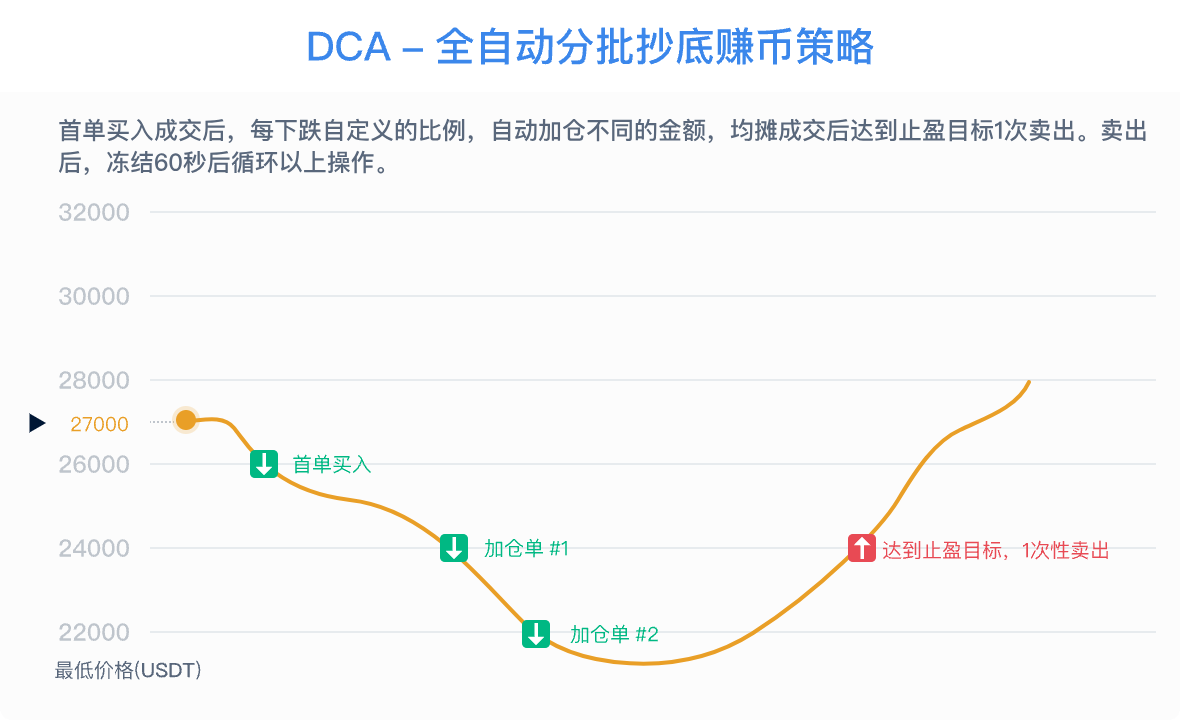
(Source - AiCoin DCA Strategy)
4. Who is Suitable for Regular Investing? Who Isn't?
Suitable individuals who are likely to make money historically:
- Ordinary people with stable cash flow, a 5–10 year investment horizon, and no consistent timing ability.
- Individuals who can strictly adhere to discipline (continuing to invest even during drawdowns of 20%–30% or more).
- Those whose goal is “to slowly become rich, outperform inflation and most retail investors,” not quick riches.
- Acknowledge the self as “an ordinary person aside from the foolish and stock gods.”
Unsuitable or likely to lose individuals:
- Those pursuing short-term windfalls, who enjoy leverage/high volatility stocks, and whose funds need to be used quickly.
- Individuals lacking discipline, stopping when seeing declines and adding positions when seeing increases.
- Professional or semi-professional investors who already have an advantage in timing, valuation, and macro judgment.
- Those who treat regular investment as a “pass to invest in a single stock or assets that might permanently depreciate.”
5. How to Choose Projects Suitable for Regular Investment?
The underlying requirements for regular investing are: targets that trend upward long-term, will not go to zero, have sufficient diversification, and low costs.
Priority order:
1. Broad-based indices first: S&P 500, total market, global equities, CSI 300, CSI 500, etc.
2. Low cost, high liquidity: Keep fees to within 0.05%–0.5%.
3. Diversification and risk matching: Use broad-based for core holdings; use moderate growth or themes for satellite holdings, but avoid single industries as main holdings.
4. Avoid: Single stocks, high-leverage products, actively managed funds with high fees, short-term themes, and illiquid niche indices.
Highly volatile assets (like Bitcoin spot ETFs) can be regularly invested in, but it must be clear that significant long-term drawdowns may occur, and position sizes must be strictly controlled.
6. As of 2026: How to choose people and projects?
In the long term, lump-sum is mathematically superior. However, in reality, the advantage of regular investment lies in behavioral protection and risk control—many people who can truly persist often choose regular investments.
More suitable for regular investments: Individuals with average mental resilience, stable cash flow but without large sums of spare cash currently, unwilling to time the market, risk-averse, or those just starting to invest with limited time and energy.
Currently particularly suitable for: Those who feel gold is already expensive, US stocks are overvalued, but still want to participate in long-term uptrends.
More suitable for lump-sum investments: Stable-minded individuals who can accept significant losses, have large sums of spare cash that won’t be used in the short term, have clear long-term confidence in assets, and possess some investment experience.
More suitable assets for regular investment: Highly volatile and cyclical assets (broad-based stock indices, gold, Bitcoin, etc.); assets you think are “possibly overpriced now but positive long-term.”
More suitable assets for lump-sum investment: Broad-based assets trending upward long-term with relatively controllable volatility; core positions you have thoroughly researched and decided to hold long-term.
Practical compromise: Large sums can be invested 70%–80% as a lump sum, with the remaining 20%–30% invested regularly over 6–12 months.
7. Practical Tips for Regular Investment
The long-term difference between frequency (weekly vs monthly) is very small and usually negligible (annual differences are mostly between 0.1%–0.5%).
Best principle: Align with your income rhythm. If you are paid monthly, choose monthly; if bi-weekly, choose bi-weekly. Being able to stick to a “suboptimal frequency” for 10 years is far better than not being able to persist with a “optimal frequency” for 3 years.
More important than frequency are these skills:
1. Automation is the first priority— set up automatic deductions to combat human nature.
2. Set amounts to be “painless but noticeable”— it is suggested to use 20%–40% of your monthly surplus (first leaving enough for emergencies). It can be adjusted annually as income grows.
3. Choosing the right targets is 100 times more important than frequency.
4. “Adding to positions during major declines” is an advanced technique (not necessary)—set rules in advance for temporary increases during drawdowns of over 20%–30% or when VIX spikes.
5. Regularly review but don’t frequently act— reviewing once a year is sufficient.
6. Psychological preparation— treat regular investment as mandatory savings, and when downturns occur, tell yourself “I’m buying more shares at a lower price,” aiming to persist through a complete bull-bear cycle.
Lastly, a few hard truths
Regular investment is not the “best investment method,” but for most people, it is the most sustainable and reasonably optimistic approach behaviorally.
It invests in discipline and time, not the size of the principal. Whether you can keep buying during a drawdown is the dividing line.
Top experts wait for panic to invest heavily because they have advantages; ordinary people who blindly imitate “going all in” often end up “going high and cutting low.”
The real gap has never been about “lump-sum or regular investment,” but rather:
Selecting the right long-term upward assets + Maintaining commitment for long enough + Automating as much as possible.
History does not guarantee the future, but human behavioral biases certainly repeat.
First, clarify which category you belong to, then decide how to invest. Slowly becoming rich is also a form of wealth.
免责声明:本文章仅代表作者个人观点,不代表本平台的立场和观点。本文章仅供信息分享,不构成对任何人的任何投资建议。用户与作者之间的任何争议,与本平台无关。如网页中刊载的文章或图片涉及侵权,请提供相关的权利证明和身份证明发送邮件到support@aicoin.com,本平台相关工作人员将会进行核查。