Author: Artemis Analytics
Translation: Deep Tide TechFlow
Deep Tide Guide: After Figma's earnings report, the stock price plummeted 17%, but analysts believe the market is wrong—As product engineers rise and AI agents take over design workflows, Figma's TAM (Total Addressable Market) is much larger than Wall Street expected. This is no longer a story of "selling a few more designer seats," but a fundamental transformation in the entire software production method.
On August 5, 2026, Figma (NYSE: $FIG) released its Q2'26 earnings report. A quick review:
- Revenue $370.1 million (up 48% year-over-year)
- Net dollar retention rate 136%
- GAAP gross profit $309.6 million; GAAP gross margin 84%
- GAAP net loss $112.2 million, primarily driven by stock-based compensation costs $147.6 million
- 15,964 paying customers with annual contracts over $10,000 (up 34% year-over-year)
- 1,635 paying customers with annual contracts over $100,000 (up 46% year-over-year)
The data is strong, but Figma's stock dropped 17% after the earnings report. I was curious about what happened and, after digging deeper, realized:
I believe Figma will become the design layer for all software creators and AI agents.
Before the emergence of AI, the workflow was simple:
Designer → Figma → Engineer → Code → Software
Now the workflow has transformed into:
Designer / Engineer / PM / Product Engineer / AI Agent
↓
Figma / Design System
↓
Software
The following three points support my perspective.
1. The Rise of Product Engineers
The term "Product Engineer" was promoted by Sherif Mansour, Jean-Michel Lemieux, and Gergely Orosz, shaping our understanding of the role today.
What is a Product Engineer?
Product Engineers are those who write code, understand customer pain points, and help shape products.
AI has simplified software development. As the cost of writing code decreases, engineers are starting to take on more product and design work. These boundaries are becoming blurred.
I believe this is important for Figma because historically, engineering teams have been much larger than design teams. One of Figma's largest customers now has more engineering seats than design seats, and this will become more common in the future.
I was curious if people were searching for "Product Engineer." Google Trends confirmed my thoughts. The term has seen significant searches over the past few years.
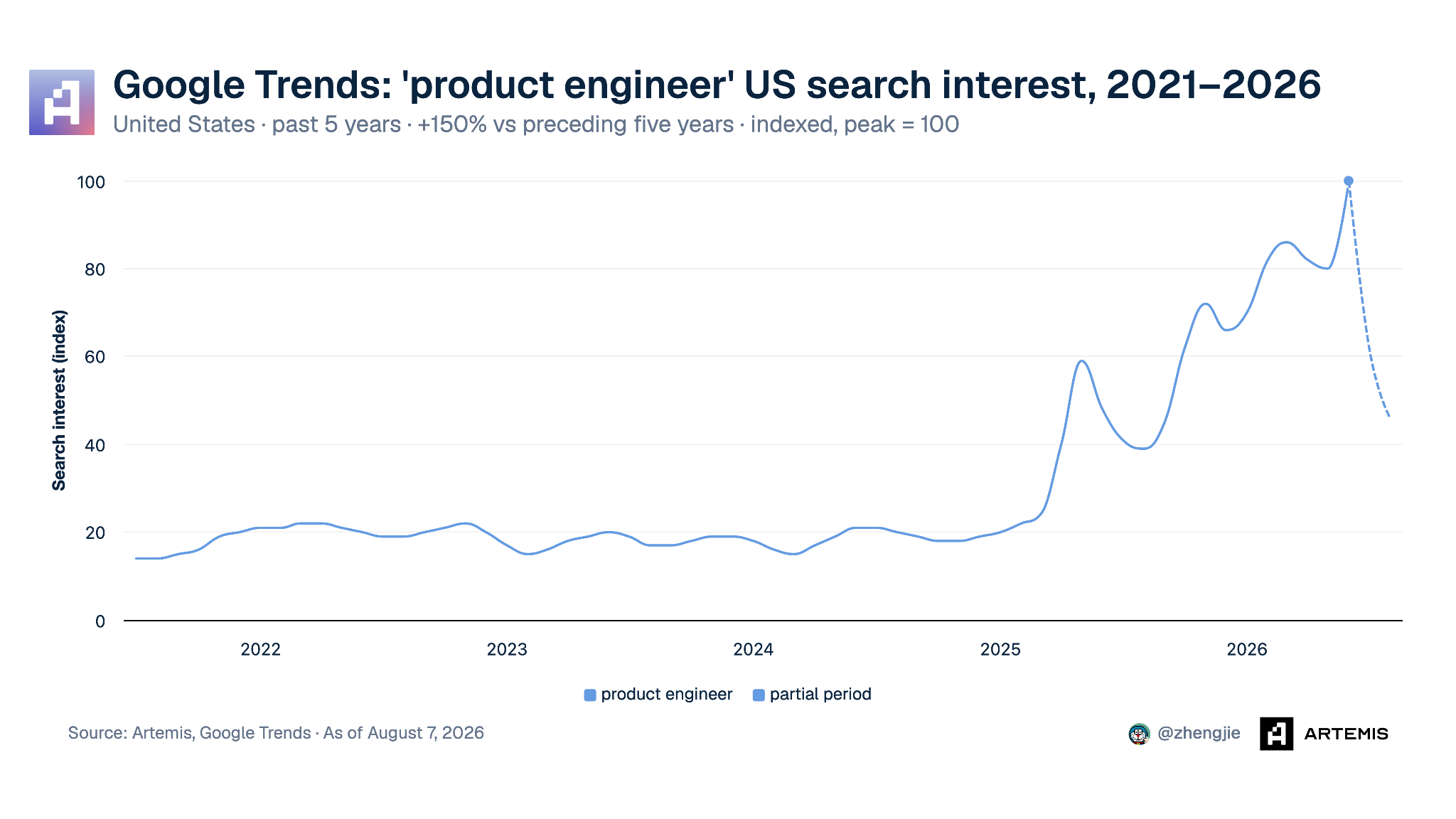
If this trend continues, I believe Product Engineers will become one of Figma's key growth drivers.
2. Every Employee Will Have an Agent (Figma Agent)
In 2026, everyone is talking about AI agents. Figma's next expansion direction is from humans to agents.
Traditionally, SaaS monetization was simple:
Cost per seat ✕ Number of seats
I believe in an agent-based world, every employee will have one or more agents working on their behalf. These agents will help iterate products (edit components, turn designs into code). These operations will naturally consume reasoning and computing resources.
The future SaaS business model will be:
(Cost per seat ✕ Number of seats) + (Consumed credits ✕ Cost per credit)
I believe Figma will continue to charge those using the product (seats) and will also charge for the work completed through the product (agents).
3. Margin Expansion
AI is expensive. Computing power and reasoning are costs for any business that wants to enable AI.
When Figma launched Figma Make, the gross margin dropped from 90% to 80% because reasoning became part of the revenue cost. In Q2 '26, the non-GAAP gross margin rebounded to 85% as Figma started charging for AI usage via credits.
I (like everyone on Wall Street) thought what would become a cost for Figma actually turned into an additional source of revenue.
I genuinely believe that as Figma continues to charge for its AI product suite (Figma Make, Figma Agent, Figma Weave, and Figma MCP), their profit margins will continue to expand.
AI Tools like Claude/OpenAI Will Replace Figma
The biggest risk to this argument is that these AI tools become so good that the entire "design to code" workflow collapses. If users can describe the look and feel of a product in natural language and deliver it end-to-end, Figma might be done.
Mitigating factor: I think this is still far from reality (or won't happen in the short term). Figma already has customers. Customers are familiar with the current tools and have built workflows around it. Additionally, years of design systems have been embedded in Figma, which is a massive moat.
Why Did the Market Price It Wrong?
Figma's stock price has dropped 80% since its first closing (July 31, 2025, $115.50).
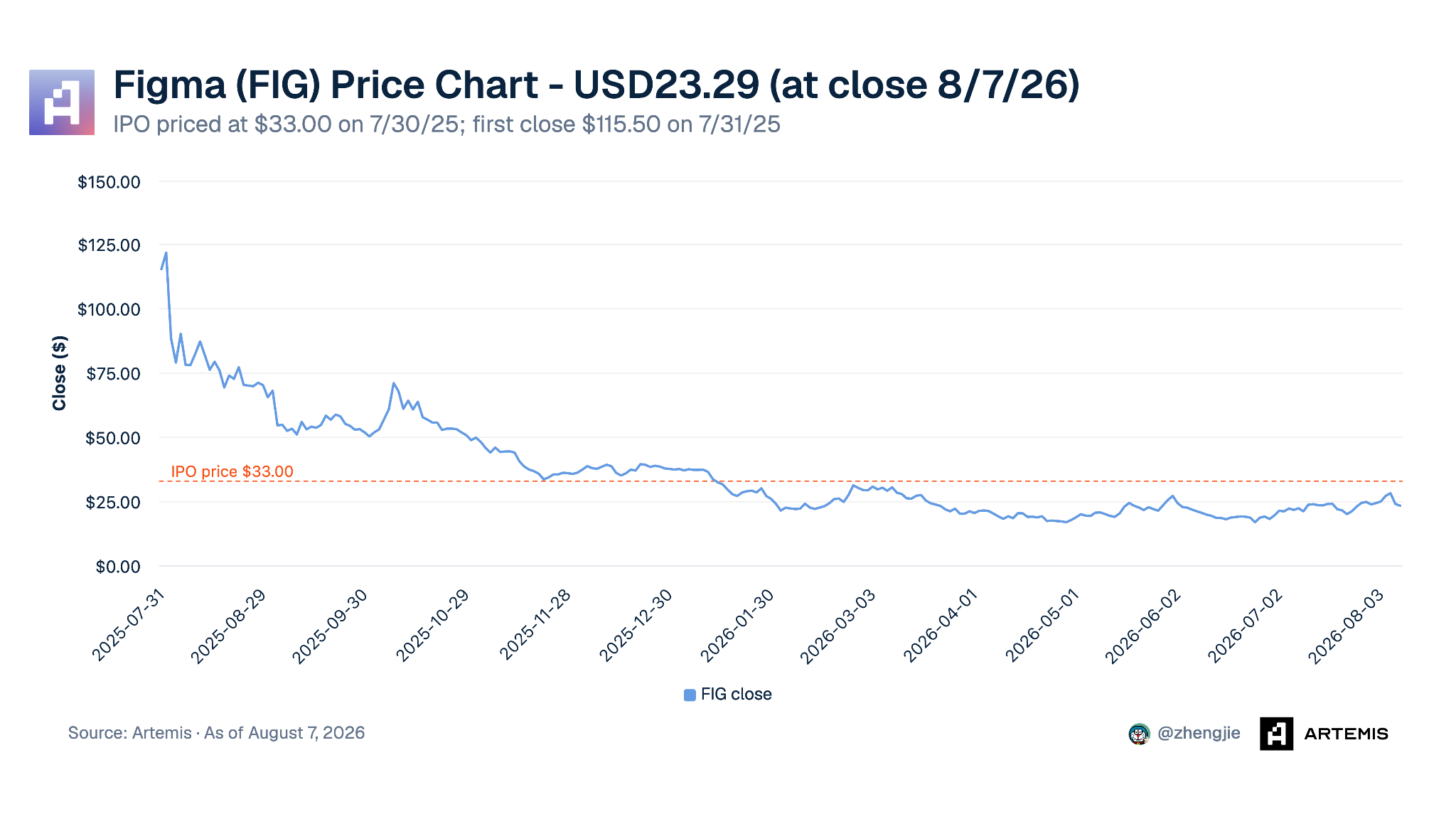
In my view, three things indicate that Figma is mispriced:
Q2 '26 revenue continued to grow 40% year-over-year (indicating that even if Claude tools explode, people are still using Figma)
NRR (Net Dollar Retention Rate) is 136% (seat expansion is still very high, and the market is extremely pessimistic about software stocks)
EV/ARR is trading at 7.3 times, close to historical lows (not cheap, but considering Figma's growth rate, I find the pricing reasonable)
The market still sees Figma as a software company serving designers.
I believe this misses a larger opportunity.
As role boundaries continue to blur (with the emergence of new roles: Product Engineers) and agents help build software, Figma has the opportunity to become the true design layer connecting everyone.
The bull market narrative is no longer just about more designers paying for more seats:
More creators using Figma
More agents operating through Figma
More AI usage monetized on this basis
When this happens, Figma's TAM will be much larger than what the market is pricing today.
免责声明:本文章仅代表作者个人观点,不代表本平台的立场和观点。本文章仅供信息分享,不构成对任何人的任何投资建议。用户与作者之间的任何争议,与本平台无关。如网页中刊载的文章或图片涉及侵权,请提供相关的权利证明和身份证明发送邮件到support@aicoin.com,本平台相关工作人员将会进行核查。


