Author: David, Shenchao TechFlow
It has been a long time since Silicon Valley collectively used the term "Mafia."
The last time was more than twenty years ago. In 2002, eBay spent $1.5 billion to acquire PayPal, and a group of young people who experienced the company grow from 0 to 1 suddenly achieved financial freedom overnight, then scattered.
The subsequent story is well known, Musk founded Tesla and SpaceX, Peter Thiel created Palantir, Hoffman formed LinkedIn, Chen Shijun and Karim started YouTube...
Silicon Valley called them the PayPal Mafia.
The term is not derogatory; it is a certification, certifying that you come from a winner and have the ability to recreate another winner.
This term has been quiet for a long time. Its conditions are too harsh: a company that wins enough, a concentrated distribution of wealth, and a group of well-traveled people who have not yet been worn down. Google did not spawn a mafia, nor did Meta. Until recently, it has begun to be frequently used for another group of people.
Those who left OpenAI and Anthropic.
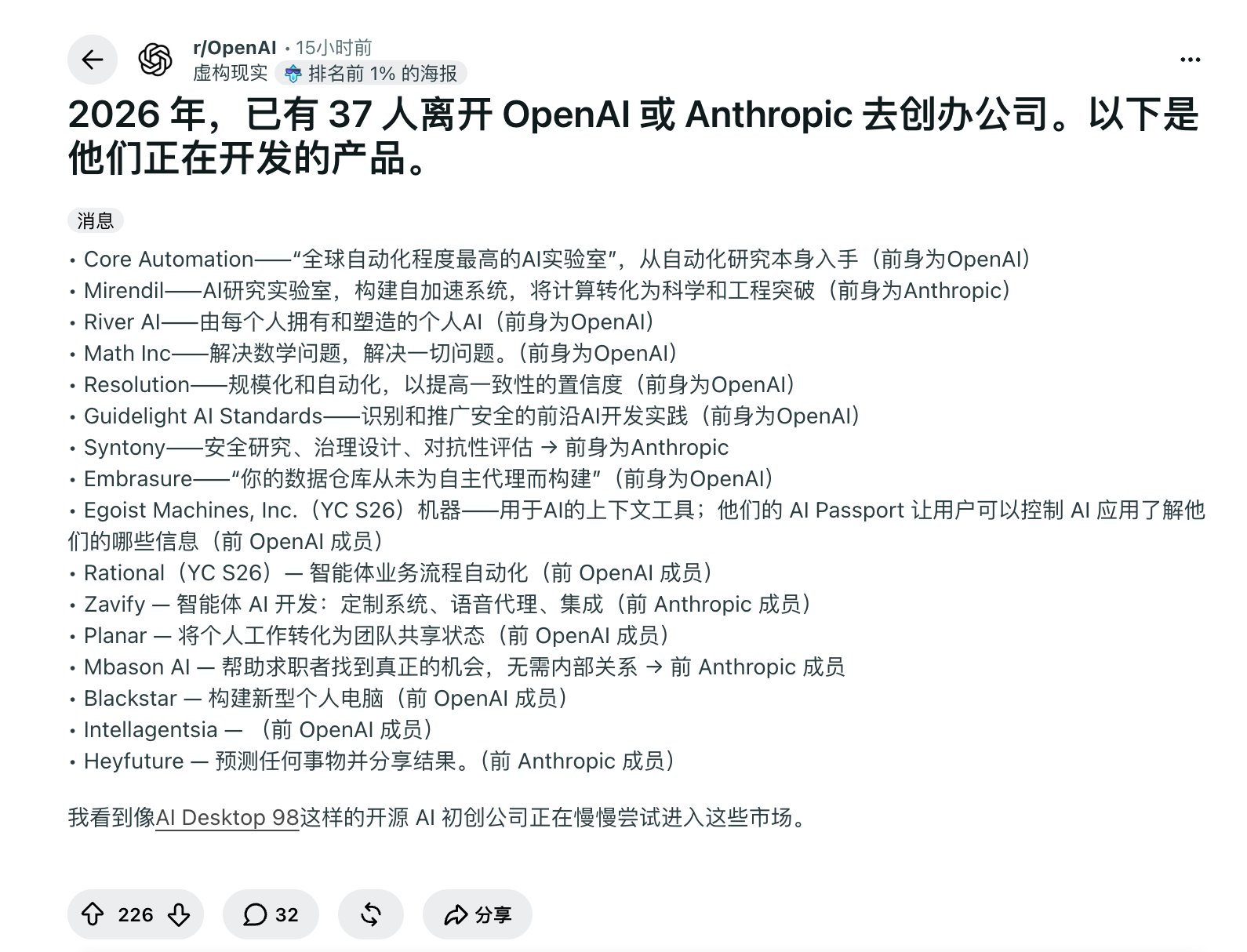
Just over half a year into 2026, the number of people who have left these two leading AI companies to start new ones has grown long enough to compile a lengthy list:
Former OpenAI research vice president Jerry Tworek founded Core Automation, former Anthropic researcher Behnam Neyshabur and others formed Mirendil, and among the recently departed researchers, some are working on verifiable mathematics, some are creating truly personal AI, while others want to reinvent personal computers from a hardware perspective...
This path has already been walked once. Anthropic itself was founded by people who left OpenAI five years ago and is now valued at $380 billion, becoming the biggest headache for its former employer.
The list is still growing. These individuals are all using their respective expertise to trim the branches and leaves of the AI tree.
When the mafia begins to establish itself outside the big models
First, let's look at a question. Why are almost none of the people who left OpenAI and Anthropic in 2026 pursuing the creation of big models?
The answer is very pragmatic: there is no room left on the trunk. Training a cutting-edge model can easily cost billions of dollars, and OpenAI, Anthropic, and Google themselves are engaged in intense competition. Starting a company to compete directly is like asking for death.
However, the stronger the model, the larger the surrounding empty space becomes.
The models today are smart enough that the bottleneck in the industry is no longer “whether it can.” When this group of people gathers together, you will find that they are in fact focusing on “getting the work done” and using their expertise to fill the gaps that the big models have yet to extend into.
For instance, can AI actually be applied to work? Once the work is up and running, trustworthiness becomes another issue. If it is trustworthy, can it be controlled becomes yet another problem.
These layers of troubles are overlooked by large companies, and some are even unsuitable for them to answer themselves. The companies on this 2026 list are almost all growing in these few areas of empty space.
The most radical area of empty space is allowing AI to research itself.
Former OpenAI research vice president Jerry Tworek and several colleagues founded Core Automation, creating an automation research lab that lets models read papers, generate hypotheses, and run experiments.
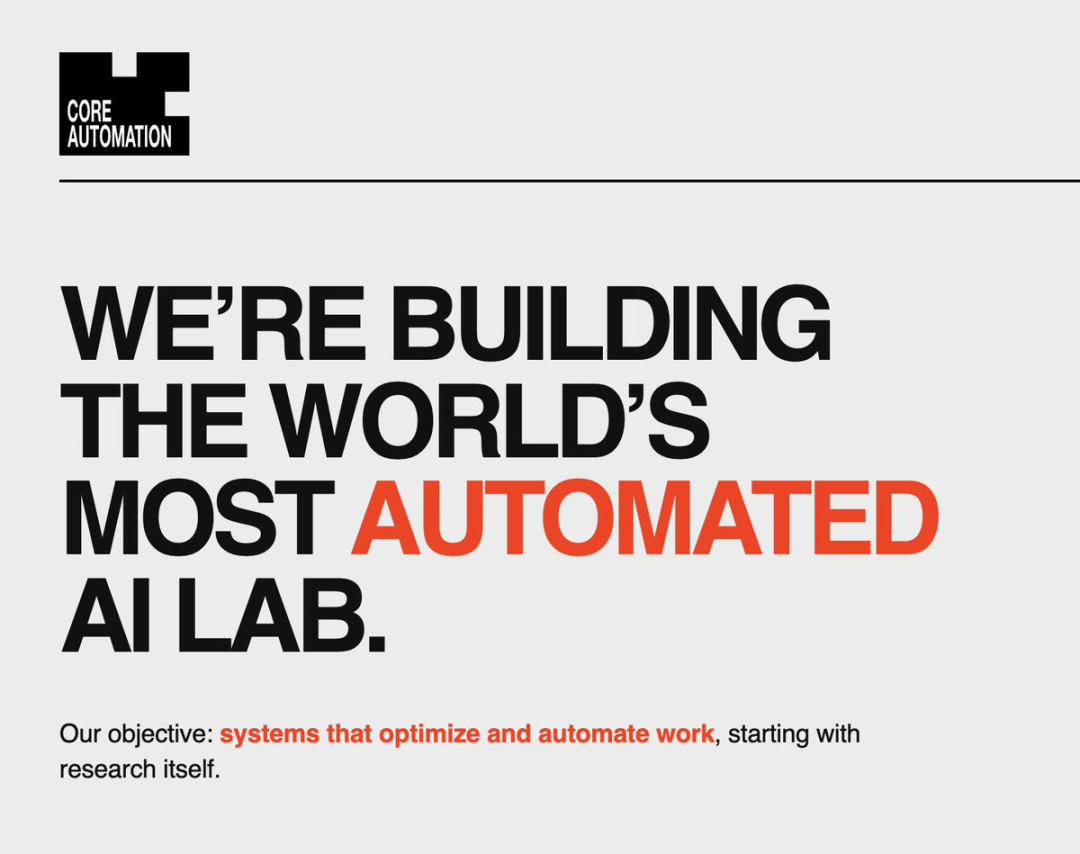
The judgment behind this is quite cold: the bottleneck in AI progress is no longer algorithms but the number of people conducting research.
Meanwhile, Mirendil, founded by former Anthropic researcher Behnam Neyshabur and others, just secured $200 million to create a self-accelerating system for models to improve themselves. The role of humans has shifted from being the subjects of research to that of overseers.
Once the work starts, new troubles arise: how to confirm it’s being done correctly.
Hence, another area of empty space focuses on AI trustworthiness.
In most fields, verifying an answer provided by AI is far more expensive than generating an answer. Math Inc is focused on this most costly link; the former OpenAI researcher Jesse Han founded it with the goal of transforming mathematical proofs into forms that machines can verify line by line.
Mathematics is one of the few fields where accuracy can be thoroughly verified; getting verification to work here may enable the transfer of the same capability into other industries. Once AI starts making decisions on behalf of humans, proving its correctness will probably be more valuable than getting it to act.
Next is turning intelligence into the "everyday."
A model can answer questions, but modeling duties requires a whole set of dirty work: calling tools, breaking down tasks, remembering context, carrying out a task from beginning to end... This also requires the support of auxiliary tools.
Rational and Zavify, both founded by former employees of OpenAI and Anthropic, are focusing on agent workflows to delegate business processes to agents for enterprises;
Coincidentally, former xAI co-founder Igor Babuschkin started River AI, which aims to create truly personal AI that is shaped by individuals.
Among this group is an oddity: former OpenAI Codex engineer Daniel Edrisian is working on Blackstar, which aims to redesign a personal computer for the AI era, starting from the hardware.
Once all the work is underway, someone has to oversee it.
There is a subtle opportunity here. When AI companies claim "our models are safe," no one believes them; athletes cannot serve as judges. Thus, safety has become an independent business, mostly conducted by individuals who directly researched AI safety in both laboratories.
What they are doing can be summarized in human terms: one aspect is finding fault; Syntony, formed by the former Anthropic team, aims to induce AI to make mistakes, trick it into crossing boundaries, and reveal the system’s flaws before bad actors can strike.
Another aspect is scoring; Resolution, created by former OpenAI researchers, studies how to confirm that an AI is indeed acting according to human intentions and assigns degrees to this assurance. There’s also setting standards, from Guidelight, also founded by former OpenAI employees, defining what practices are considered safe in the industry and pushing everyone to follow suit...
This group of companies does not touch the upper limits of AI capabilities; they guard the baseline of AI. The more capable models become, the better their business may thrive.
If you ask what distinguishes this "AI Mafia" from the PayPal Mafia, the answer is probably diversification vs. convergence.
The people who left PayPal were involved in various fields: payments, social media, aerospace, intelligence analysis, as it was an era full of opportunities;
this new group of mafia members is much more convergent in direction because the areas of empty spaces for AI are few; the group with the deepest understanding of models has voted with their feet to indicate the next bottleneck position.
Why now?
A key prop in the PayPal Mafia script was a concentrated liquidity event. eBay’s acquisition allowed a group of people to receive funds and regain their freedom simultaneously, thereby establishing the mafia's influence.
The props for the 2026 AI industry are in place.
Last autumn, OpenAI arranged a round of old stock transfers, enabling employees to cash out a total of $6.6 billion, with the company’s valuation reaching $500 billion. An even larger event is on the horizon; both OpenAI and Anthropic are preparing for an IPO, possibly this year. For early employees, the eve of an IPO is the best time to leave, with paper wealth about to turn into real cash; if they delay, they will be tied down by golden handcuffs for a few more years.
With the money in place, the race for talent has already begun.
Silicon Valley VCs have formed a routine of monitoring the departure channels of the two large laboratories. OpenAI's first sales leader, Aliisa Rosenthal, has switched careers to become an investor, openly stating she wants to leverage her former colleagues’ networks to find projects, while former consumer products head Peter Deng has also joined the venture capital firm Felicis.
Mira Murati, mentioned in the previous chapter, does not have a product that can bring in $2 billion, yet Mirendil received $200 million upon its debut... money is chasing people at an exaggerated pace.
The risks for the leavers are actually easy to calculate; the worst outcome is merely returning to a big company for a million-dollar annual salary.
The cost of congestion
Currently, the dozens of companies established by the AI mafia are crowding into just a few areas of empty space, with equally intelligent, well-connected, and financially secure competitors standing on every path.
Another way to express congestion is that most will lose.
The story of the PayPal Mafia is compelling because we only remember Tesla and LinkedIn, forgetting the dozens of companies that fell during the same period. This current list may be similar; in a few years, the ones we can name may not exceed five.
There is also a more insidious problem. The business of these new companies either involves getting AI to work or watching AI work, with clients and prospects tied to a single premise that the model's capabilities must continue to advance rapidly. If this premise slows down, many areas of empty space will simultaneously vanish.
Yet even when considering all these factors, this list is still worth keeping.
The true legacy of the PayPal Mafia is not a few companies, but a principle: when the most important talent of an era begins to leave the same place, following them generally does not go wrong.
The people from twenty years ago defined the latter half of the internet. Today, this group is gathered beneath the AI tree.
The direction in which a tree grows is known first by those who have planted trees.
免责声明:本文章仅代表作者个人观点,不代表本平台的立场和观点。本文章仅供信息分享,不构成对任何人的任何投资建议。用户与作者之间的任何争议,与本平台无关。如网页中刊载的文章或图片涉及侵权,请提供相关的权利证明和身份证明发送邮件到support@aicoin.com,本平台相关工作人员将会进行核查。


