Written by: Rita
The total capital expenditure of the four major hyper-scale vendors plus SpaceX will reach $1.15 trillion by 2027.
This figure is 20% higher than market expectations in July. A year-over-year growth rate of 47% means that even in the most optimistic AI narrative, the arms race among cloud giants is still accelerating. However, Morgan Stanley believes that the market is genuinely underestimating 2028. The consensus of $1.15 trillion for 2027 has already caught up, but the 11% growth rate expectation for 2028 is the weakest link in the entire forecasting curve.
Morgan Stanley's European Software and Services team redefined the boundaries of computing power investment in this week's weekly report with a set of data. Why is capital expenditure still on the rise? The judgment framework provided by Morgan Stanley is: the diversification of model ecosystems is reinforcing the demand for computing power. Closed-source models, open-source weight models, hybrid deployment—more choices mean more demand for computing and storage. Morgan Stanley explicitly states in the report that the capital expenditure forecasts for hyper-scale vendors will continue to face upward pressure.
Below, we will dissect Morgan Stanley's judgment logic from four dimensions and what this means for the computing power industry chain.
$1.15 trillion is not the ceiling
Microsoft, Google, Amazon, Meta, and SpaceX together will see their total capital expenditure reach $1.15 trillion by 2027.
With a year-over-year growth of 47%, this is about half of the growth rate for 2026. The base for 2026 is already quite high, but 2027 is still expanding at nearly 50%. Since July, the forecasts for 2027 by just the four cloud vendors (excluding SpaceX) have been raised by 20%. Morgan Stanley's head of Internet research, Brian Nowak, pointed out in the report that as the number of tokens processed monthly grows exponentially, cloud revenue accelerates, data center commitments expand, and supply chain vendors emphasize increasing demand and extended visibility, the capital expenditure forecasts for hyper-scale vendors will continue to face upward pressure.
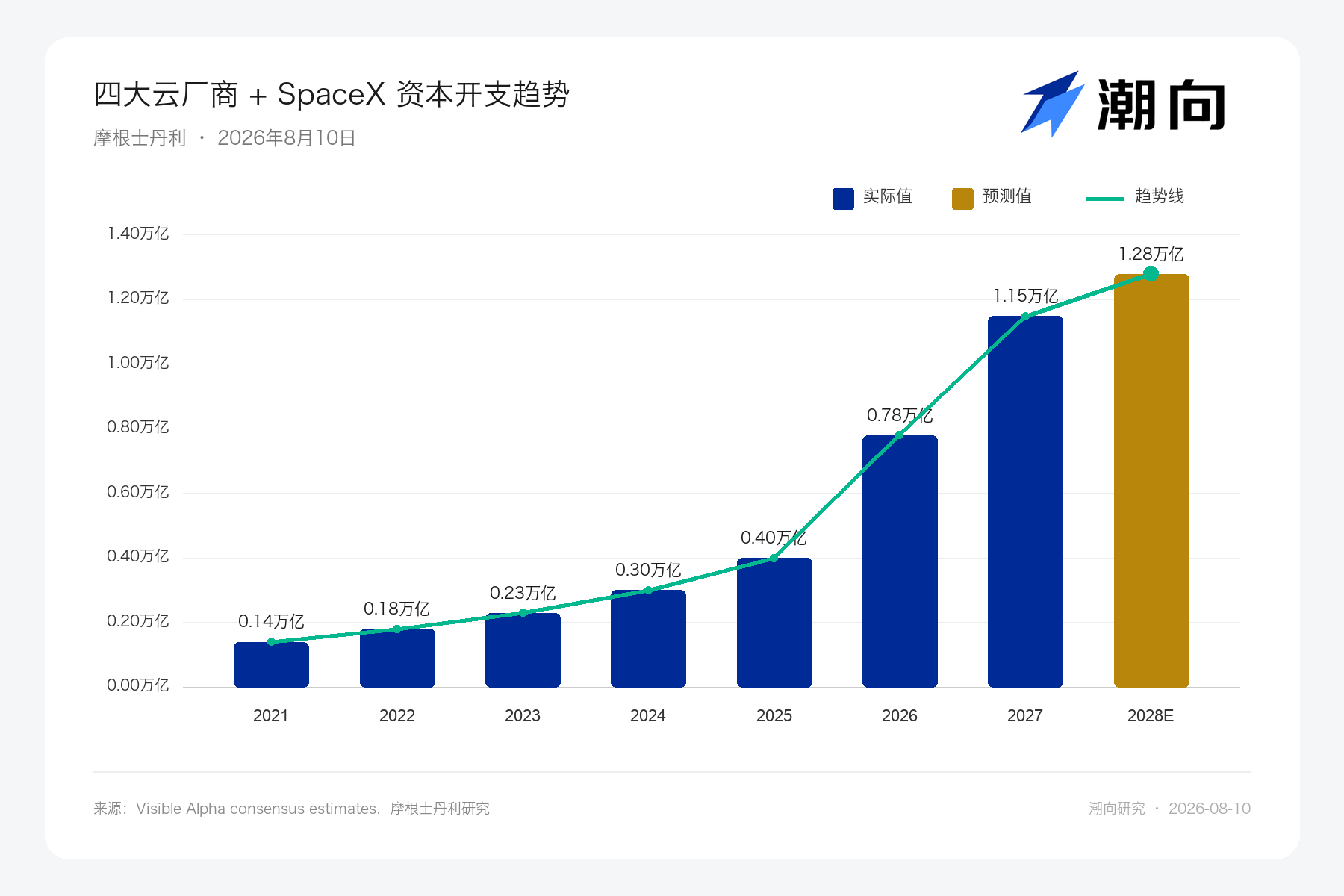
This forecast comes from consensus data from Visible Alpha as of August 7, 2026. Morgan Stanley has not adjusted its model, but the consensus figures themselves are already catching up with Morgan Stanley's judgments. The market has fully priced in the growth for 2027; how long the 11% growth expectation for 2028 can hold is the real issue.
Open-source models are feeding back computing power demand
Will open-source models dilute the computing power demand of closed-source models?
The answer from Morgan Stanley is no. Stephen Byrd, the global head of thematic and sustainable research, released a dedicated report this week, which categorizes the AI model competitive landscape into three scenarios: closed-source winning, hybrid coexistence, and open-source reaching frontier performance. Morgan Stanley's judgment leans towards a combination of scenario two and scenario three. Open-source weight models facilitate competition and can accelerate the diffusion of AI. The Jevons Paradox is coming true; efficiency gains are actually stimulating greater demand.
A key piece of data: 60% of enterprises are now using open-source weight models in their technology stacks, primarily in specific scenarios that require speed, security, or high-frequency calls. What are these models running on? Still computing power. Lower-cost inference means unlocking more application scenarios, more scenarios mean more tokens, and more tokens mean more computing. Morgan Stanley uses the cases of Wix and Thomson Reuters to support this logic. Wix significantly reduced AI inference costs with its self-developed models, raising its non-GAAP gross margin from near zero at the beginning of the year to about 60% in the second half. Thomson Reuters' proprietary model, trained on less than 10% of legal content, achieved results comparable to frontier models while being significantly less costly than third-party models.
Cost reductions have not suppressed computing power demand; on the contrary, they have made more business segments willing to engage with AI.
Business sentiment is being transmitted step by step from cloud vendors
Revisions of capital expenditure forecasts are not isolated events.
Morgan Stanley's research report also covers software and service companies such as SAP, IONOS, and Legora, with a consistent underlying theme: investment in AI infrastructure is transforming from the financial metrics of cloud vendors to the performance guidance of every company in the supply chain. Cloud vendors' data center commitments are expanding, and component suppliers' visibility into demand is increasing; this is the microfoundation for Morgan Stanley's judgment that capital expenditure forecasts will continue to rise.
European web hosting company IONOS was upgraded to an overweight rating by Morgan Stanley this week due to a combination of customer growth momentum and pricing effects, predicting that the group's revenue growth rate for 2027 will accelerate to about 8.6%. AI product innovation (such as AI receptionists) is viewed as an incremental aspect that the current forecast has not fully reflected. An AI product from a mid-sized European cloud service provider has already started driving growth curves, making it even less reasonable for leading cloud vendors to slow down their capital expenditure.
The SAP dealer AI survey provides another piece of evidence. 33% of dealers report that customers have adopted paid AI, while 53% of clients are still in the pilot phase. 87% of dealers expect AI to increase customer SAP spending in the next 12 months. 80% of dealers believe that SAP's AI migration tools will enhance customers' willingness to migrate to S/4HANA. The stimulus of AI on cloud vendors is not a long-term story but is already reflected in dealers’ order expectations.
2028 is the real weak link
Back to the $1.15 trillion figure.
The market consensus has already increased by 20% since July; however, the core message conveyed by Morgan Stanley is: this number may still not be enough. The report mentions verified facts such as accelerated cloud revenue, the expansion of data center land and power commitments, and extended order visibility from supply chain vendors, rather than predictions. Based on these facts, Morgan Stanley's judgment is that capital expenditure forecasts will continue to face upward pressure.
$1.15 trillion is now the bottom, and the top for the future is still far from being reached. The market consensus leaves nearly half a growth rate decline for 2028, but Morgan Stanley believes this assumption is not solidly supported. Cloud vendors’ data center commitments already cover beyond 2028, and the visibility of orders in the supply chain is also being extended simultaneously. The 11% growth expectation for 2028 could likely be underestimated.
The Morgan Stanley report also touches on a longer-term variable: the three scenario worlds of open-source models. If open-source models achieve frontier performance (scenario three), computing power costs will further decrease, and the speed of AI adoption will exceed all current linear forecasts. By then, the $1.15 trillion figure for 2027 may only appear as a stopping point.

Disclaimer
This article is a整理 and interpretation by潮向研究 of a third-party brokerage research report (Morgan Stanley, August 10, 2026), combined with publicly available market information. The ratings, target prices, profit forecasts, and related judgments quoted in the text are solely the opinions of the brokerage's analysts, which represent the position of their respective institutions, do not represent the views of潮向研究, and do not constitute any investment advice.
Investment involves risks, and decisions should be made independently. This article should not be used as a basis for buying or selling any securities.
免责声明:本文章仅代表作者个人观点,不代表本平台的立场和观点。本文章仅供信息分享,不构成对任何人的任何投资建议。用户与作者之间的任何争议,与本平台无关。如网页中刊载的文章或图片涉及侵权,请提供相关的权利证明和身份证明发送邮件到support@aicoin.com,本平台相关工作人员将会进行核查。


