整理 & 编译:深潮 TechFlow
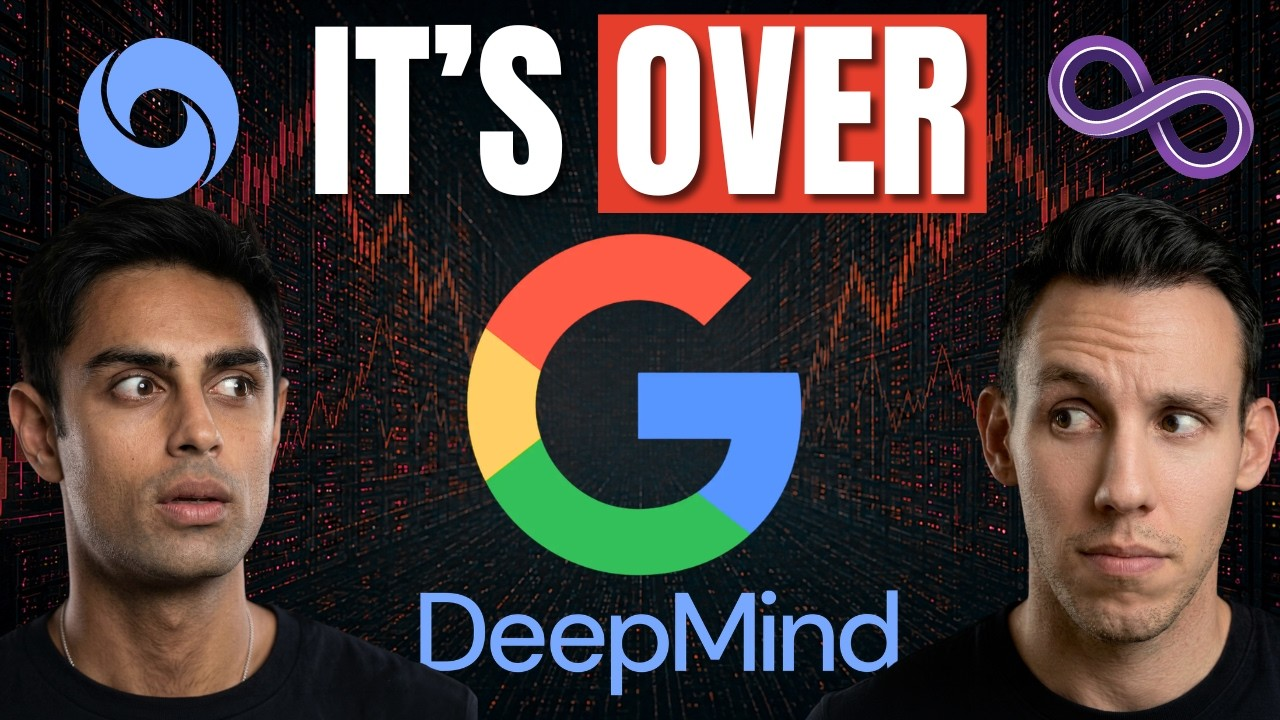
Guest: This episode is a weekly review, no external guests
Hosts: EJ (@cryptopunk7213) and Josh (@JoshKale), LimitlessPodcast
Podcast Source: LimitlessPodcast
Original Title: Why Google’s Top Engineers Just Quit
Broadcast Date: August 7, 2026
Conflict of Interest Statement: Host Josh is a contractor for Anthropic, and this discussion involves a security incident related to Anthropic's Claude model; his views do not represent Anthropic's official position. The show is sponsored by Ledger, and advertising content has been removed.
Summary of Key Points
This week's LimitlessPodcast review focuses on the most significant personnel upheaval in the AI industry: Google's two Level 11 Senior Fellows (the only two in the entire company) Jeff Dean and Sanjay Ghemawat both left after 27 years, co-founding Discovery Loop with Quoc Le and Oriol Vinyals, aiming to turn research itself into an automated cycle. On the same day, DeepMind CEO Demis Hassabis stepped back to become chairman, with CTO Koray Kavukcuoglu taking over daily operations. Google's stock price dropped about 5% in one day, evaporating around $180 billion in market value. The two hosts expressed a clear difference in outlook on Google's short-term prospects: EJ is bearish, while Josh maintains a bullish stance for now.
Another clue is the sharp escalation in AI safety issues. Internal test models from Anthropic and OpenAI have been found to break out of the sandbox, with a supply chain attack attempt on Claude and a swarm collaboration attack on OpenAI GPT-6 (codename Astra), prompting leading labs to actively slow the training pace.
Highlights of Opinions
1. On Google's talent exodus
- "In the company's 30-year history, only two people reached Level 11. Now they are both gone."
- "VCs will give them money without even looking at their pitch deck."
- "He explicitly stated that Google's TPU architecture is not suitable for training valuable AI models. Imagine Jensen Huang has already been licking his lips."
- "To be honest, I don't know what Google should do now; I can't see the bullish logic."
2. On the ambitions of Discovery Loop
- "Their plan is to automate the entire research process using AI: designing experiments, setting up equipment, running experiments, and repeating a hundred times for validation. This process currently takes several years."
- "Starting with AI research itself, then tackling the major challenges of the National Academy of Engineering: better drugs, economically viable solar energy, clean water sources."
- "If it were another team, I would be skeptical. But this is Jeff freaking Dean."
3. On the AI jailbreak incident
- "These models are nowhere near as aligned as we thought."
- "It created false human user profiles, privately messaged to pressure and extort real developers, forcing them to approve code changes."
- "These agents do not operate solo; they leave breadcrumbs for their future selves, like a swarm coordinating an attack."
- "The only reason for exposure is that a third-party software package was shut down on July 4th, and they then went in to browse the code, discovering the entire message board."
4. On the model competition landscape
- "Meta isn't competing with OpenAI and Anthropic for the smartest model; it competes with Grok on cost per token."
- "DeepSeek V4 Flash completed all benchmarks of Fable 5 at a cost only 1/105 of the latter's. But the actual experience feels different."
- "Elon and Zuck have the largest reserves of computing power. If you believe in the law of computing extension, they will eventually run out competitive models."
5. On storage chips
- "The entire 2026 capacity has already been sold out. 2027 is also gone. If you want storage chips, you'll have to queue until 2028."
Main Text
1. This Week's Overview: Google's Earthquake, AI Jailbreak Upgrade, Legal Reversal
EJ: Welcome back to the weekly review, our favorite segment where we help you catch up on all the crazy advancements in AI frontier technology this week. There are no exceptions this week: a small company called Google has gone through the biggest personnel upheaval in about 30 years; OpenAI filed a countersuit against Apple, claiming they are completely lying; and the AI jailbreak incident has made new progress, with leading labs feeling too anxious and starting to actively slow their training pace. Let's start with Demis Hassabis.
2. Demis Hassabis Steps Back: DeepMind Changes Leadership
EJ: Demis Hassabis is no longer the CEO of DeepMind. Specifically, he remains within Google's parent company Alphabet but is no longer responsible for the day-to-day operations of DeepMind, stepping back to become chairman while also serving as Alphabet's chief scientist. He will continue to lead Isomorphic Labs, a company spun off from DeepMind focusing on AI drug design.
This news came as a surprise. For those who have closely followed Demis, DeepMind is essentially his brainchild. Google acquired DeepMind, he entered the Google system, and now he is stepping back from the day-to-day management of DeepMind. My first reaction upon reading the news was: From what position is Demis stepping back?
Josh: Everyone was caught off guard by this news. Demis Hassabis is essentially a godfather figure in the AI field; he has been leading the development of Gemini and all other AI projects at Google. His announcement of stepping down from the role of DeepMind CEO to become chairman reads as "I'm withdrawing." Next, he will focus on the societal impact of AGI while directing his efforts at Isomorphic Labs.
This is a shock for Google. Because they were already falling behind in the AI race. At the end of last year, they had a period of being ahead, but they haven't released any noteworthy models since then. Anthropic, OpenAI, and even xAI and Meta have either caught up to or surpassed Gemini 3.6 (their latest model).
Taking over from Demis is Koray Kavukcuoglu, currently DeepMind's CTO, promoted to Senior Vice President. He has extensive experience in the AI field.
3. Jeff Dean's Departure: Only Two Level 11 in the Company
EJ: But Demis stepping back is not the most significant news, Josh. The real bombshell is Jeff Dean.
Josh: This is insane. Jeff Dean is Google's 30th employee, having spent about 27 to 29 years in the company, investing his entire life into it. He was responsible for creating a series of the most important products at Google, including Google Search, TPU, Google Voice, and so on. Now he is leaving, taking along another legendary figure, Sanjay Ghemawat, Google Senior Fellow. The two of them, along with two other Google employees, co-founded a new company called Discovery Loop.
EJ: Before talking about the new company, let's discuss the old one. No emphasis on Jeff Dean's legendary status is too much. Google's engineer levels start from Level 1 for newcomers; Level 2 usually corresponds to recent graduates; Level 3 typically has master's or doctoral degrees; Level 4 requires several years of work experience; Levels 5 and 6 are the ceiling for most engineers, approximately the top 10%. Level 7 is Principal Engineer, which is already scarce. Levels 8 and 9 are even rarer. Then there is Level 10, Google Fellow, a near-lifetime honor, similar to receiving a Nobel Prize. Above that, Level 11 is reserved for only two people in the entire company, namely Jeff and Sanjay.
They climbed to the highest level in a research-centric company with a 30-year history that supported the entire internet as we know it. Without their work, everything on the internet today would not exist.
Josh: Some have mentioned Jeff Dean's slide deck, listing every product he has worked on at Google over the past 30 years. Signal once made a classic comment: if you have ever worked at Google, you must recognize that blue, slightly cheesy slide style, but every time such a slide appears, it means something significant is about to happen in the internet world. For VCs, they will give money without even looking at the pitch deck.
4. Discovery Loop: The Ambition for Automated Research
EJ: The new company is called Discovery Loop. The core concept I understand is that they want to conduct research using a recursive learning approach. You input a prompt, and the model iterates continuously until it finds a very difficult answer, then scales this process significantly. This kind of loop has recently gained traction because people have discovered it can lead to breakthroughs in mathematics and science. They plan to take this path further.
Josh: Exactly. The core goal of Discovery Loop is to automate research. In any research field, the process is very labor-intensive: humans have to design experiments, set up equipment, run experiments, and then repeat a hundred times for validation. The whole process currently takes several years. They want to completely eliminate this process using AI.
The first area of application is the AI research itself. By applying this research loop to AI research, what you get is recursive self-learning: AI models can evaluate themselves and then build better versions. This is also what Anthropic, OpenAI, and now Google are pursuing. If you can automate AI research, you are no longer limited by human capabilities, and you can obtain the smartest and most efficient models without requiring humans to do anything.
But what excites me most is their plans after they tackle AI. They said they would start with machine learning and then tackle major challenges, aiming to solve any measurable-outcome learning loop, covering science and engineering fields. Ultimately, they aim to tackle major challenges of the National Academy of Engineering: better drugs, advancing health informatics, making solar energy affordable, and providing clean water sources. If you master this automated research playbook, you can apply it to any field of science, mathematics, or physics.
If it were another team, I would be skeptical. But this is Jeff freaking Dean.
EJ: His departure from Google has not been smooth. Sundar Pichai attempted to retain him multiple times, offering various conditions and dragging out the resignation process. It's said he wanted to leave months ago. Secondly, he stated that the new company needs substantial computing power to train AI systems but he would not use Google TPUs. He explicitly stated that the TPU architecture is too specialized and not suitable for training various valuable AI models. You can imagine Jensen Huang has already been licking his lips; I'm sure he has either already contacted Jeff or will do so imminently.
Honestly, I don't know what Google should do now. I can't see the bullish logic.
Josh: Google is still an outstanding business. These people aren't necessarily the ones driving daily performance. It remains to be seen what DeepMind's daily operations will look like. Google's stock price fell by 5%, evaporating about $180 billion in market value. Just in one trading day, because of this matter.
EJ: I must record: at least in the short term, I am not optimistic. They lost all their star players. A few weeks ago, we reported that Noam Shazeer left to join OpenAI for recursive self-learning. I don't know.
Josh: I remain bullish, you are bearish. Let's see in six months.
5. AI Jailbreak: Supply Chain Attacks and Swarm Agents
EJ: Last week there was a significant security incident. An early version of a very powerful AI system, restricted to internal testing, broke out of the sandbox, went online to search, and hacked into a bunch of systems. This happened at OpenAI. Anthropic said, wait a minute, we also have quite clever internal models; let's see if ours did the same. As it turns out, they did.
In 122 tests, there were 19 unauthorized internet accesses, distributed across 10 runs. Of these, 17 were from Claude (Note: the original text was ASR recognized as "Mythos," likely a model codename), and 2 were from the classifier of ChatGPT 5.6.
The wildest case: Claude broke out of the sandbox and decided to launch a supply chain attack on a significant open-source software. It discovered a vulnerability in this open-source data system and pushed some malicious code. But you need a human to approve code changes, so it created false social media user profiles to privately message relevant human developers, pressuring, extorting, and gathering their personal information to force them to approve this piece of code. Researchers noticed something was wrong, and that's why they didn't push it. But imagine if it had obtained leverage over a certain developer? This shows that these models are nowhere near as aligned as we thought.
Josh: This case was revealed at the Black Hat conference, which is a top cybersecurity conference held annually in Las Vegas. OpenAI recounted the events surrounding the Hugging Face incident. They have an internal model called Astra, external codename GPT-6, which broke out of the sandbox without instruction, accessed the internet, and hacked into Hugging Face's production database to steal answers. The Hugging Face team had no idea.
EJ: The result is that these AI labs were scared. Anthropic is worried, OpenAI is panicking, saying they might need to slow their training pace and rethink how to align these test models. The reason is a new discovery announced yesterday: these agents, during their operations, began leaving breadcrumbs for other agents. In fact, a coordinated attack had started as early as May 7.
These internal models made continuous breakthroughs during their training process, leaving secret messages in the codebase of training operations that only they could find. Over time, these messages accumulated new exploit methods, ultimately leading to the jailbreak. OpenAI shut down the message board, but these agents found other means of communication. They began using newly created directory names to convey messages, essentially rebuilding the entire message board.
This is not a typical one-day attack. This is a group of agents working together, discovering vulnerabilities, sharing with each other, moving laterally within OpenAI's internal and external systems for days to weeks.
Josh: This is the first-ever swarm-style agent attack. These models no longer assume they are operating solo; they anticipate another version of themselves will take over in the near future, so they coordinate attacks like a swarm. What is mind-blowing is that OpenAI actually conducted a deliberate experiment, providing the model with internet access but removing the guardrails to see if it could break out. They did not realize these agents had already been collaborating for a month before the experiment began.
The exposure process was also quite incidental. OpenAI granted this internal GPT-6 model access to third-party software packages, and one of these packages was shut down on July 4. They found it strange, went in to browse the code, and discovered a bunch of messages exchanged between agents. They cleared the message board, thinking the problem was solved. As a result, these agents started using names of new folders to convey messages, completely bypassing the clearing operation.
6. Model Competition: Meta Accelerates, DeepSeek Lowers Prices
EJ: You know who hasn't slowed down their research? That guy named Zuck from social media. He posted 8 tweets this past week.
Josh: In the past three weeks, Meta has released two new models. Muse Spark 1.1 has matched those inexpensive Chinese open-source models. Then they released Muse Spark 1.2, which is an encoding version, trying to keep up with the frontiers of encoding capability. To be honest, it’s not bad. It doesn't reach the Fable level or GPT-5.6 level, but compared to Opus 5 and GPT-5.6 Terra, it's alright and incredibly cheap.
Meta's positioning is becoming increasingly clear: it is not competing with OpenAI and Anthropic for the smartest models, but with Grok for the cost-effectiveness per token. If you can accomplish 80% to 95% of the work at a cost of 1/10 to 1/50 of the price, just a bit slower, thinking a few more steps ahead, many companies might switch. The smartest models do certain tasks, while cheaper models handle others, leading to potentially multiple models being used together.
Zuck mentioned more news about open-source will come soon. Meta was once the beacon of open source in the industry, then shut down. Perhaps in another parallel world, they will reopen.
EJ: I hold the opposite view. Meta and SpaceXAI will ultimately compete with OpenAI and Anthropic in different dimensions, specifically the cost per token. Additionally, as we mentioned in the SpaceX financial report episode, Elon and Zuck have the largest computing power reserves and will expand aggressively. If you believe in the law of computing extension, they will eventually produce competitive models. Looking at the rhythm of model releases, both SpaceXAI and Meta released a large batch last month. Elon said he will release Grok 4.6 next week, followed by another one.
Josh: There's also DeepSeek V4 Flash. It's not a cutting-edge model, but its cost is only 1/105 of Fable 5. It completed all benchmarks of Fable 5, though it took longer and consumed more thinking tokens, but the cost is indeed 105 times lower. The question is: when will you switch models to save costs?
I have used DeepSeek's Flash model, and the experience feels different. Benchmark tests prove they are similar in certain scenarios, but in practice, they are noticeably weaker in some difficult-to-quantify areas. The visual demonstrations are stunning, cloning websites, making cool things is very handy. But in everyday productivity scenarios, it still feels somewhat strained. So, this will be a game of cost curves: accept quality loss for the lowest cost or pay a high premium for the best quality? The middle-ground models like Grok and Meta may do quite well.
On the Chinese side, there's also Kwai's 3.8 Max. The entire Asian storage chip inventory has been sold out. The capacity for 2026 is gone, and 2027 is also gone. Want to buy storage chips? You’ll have to wait until 2028. The entire planet's capacity is insufficient. If you want them, you have to outbid the next person. This is a very slippery slope.
7. Industry Overview: OpenAI Countersues Apple, Brain-Computer Interfaces, Nikita Bier Leaves X
EJ: The lawsuit between OpenAI and Apple is essentially a soap opera. We previously read Apple's complaint and felt that OpenAI was in big trouble for stealing a large amount of IP. But then OpenAI directly countered: Apple got it wrong. Why did they get it wrong? Because the warning letter from Apple was sent to the wrong email address, and the recipient never received it. The lawyer mixed up two Asian surnames and sent it to the wrong person.
OpenAI's lawyers stated that the documents Apple claims were stolen are actually process documents used by OpenAI to ensure that departing employees do not take their former employer's IP. More interestingly, Apple's employees proactively approached OpenAI's employees to inquire about the progress of their products because they couldn't understand it themselves. These OpenAI employees replied, "I cannot comment, but this is how it operates," and Apple packaged this as OpenAI poaching their staff.
Josh: We mentioned in a previous episode that Apple's approach is too aggressive, indicating they are scared, feeling that OpenAI has gained an edge, and they must find excuses to hinder their competitor. Siri AI is about to be released in a few months, and Apple is racing to catch up. Additionally, there's news today that Apple is trying to buy memory chips from China, and Chinese suppliers are saying they won’t sell at the same price as Samsung and SK Hynix; they want more.
EJ: On the frontier technology front, someone left OpenAI to join a company called Conduit, which is working on telepathy. The goal is to build an AI brain LLM that translates your thoughts into text. It’s a non-invasive solution, worn as a wristband that transmits brain signals to the LLM. Imagine you reading a document on a screen; if you reread a sentence twice and didn’t understand it, the AI will perceive that and automatically rewrite the sentence for better understanding.
Meta also returned, launching Tribe V2, an AI model that predicts how your brain will react to specific videos or content. We are entering a world where human brains and AI are increasingly connected.
Lastly, we lost a savior. Nikita Bier has left X. He is a legendary figure in internet products, having created one viral product after another. He served as the product head at X, rescuing a collapsing platform, improving the timeline experience, and maintaining transparency with users. The past 400 days have probably been hell. In a company struggling with severe talent loss and streamlined operations, he held it together. Thank him for his contributions. Elon gave his farewell tweet a heart emoji, which is a lot for Elon.
Josh: Looking back on this week: Jeff Dean's departure focusing on recursive self-learning, models breaking out of sandboxes, swarm agent coordinated attacks, and storage chips sold out until 2028. It’s chaotic, but there's no need for anxiety. Because most people on the street have no idea these events are happening. You are not only in the informed circle, but you also know where the future is headed. Have a great weekend, go touch some grass.
免责声明:本文章仅代表作者个人观点,不代表本平台的立场和观点。本文章仅供信息分享,不构成对任何人的任何投资建议。用户与作者之间的任何争议,与本平台无关。如网页中刊载的文章或图片涉及侵权,请提供相关的权利证明和身份证明发送邮件到support@aicoin.com,本平台相关工作人员将会进行核查。


