Original Title: "After the Liquidation, Capital Instead Flows to 'AI Stock God'"
Source: Wall Street Insight Dong Jing
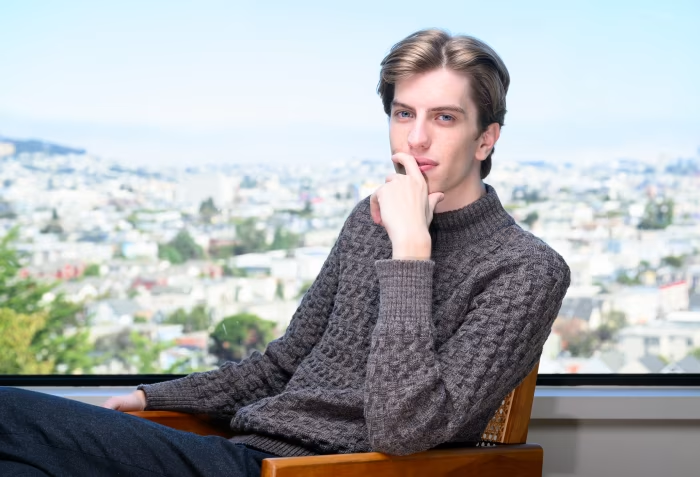
Leopold Aschenbrenner's hedge fund Situational Awareness has "liquidated," but this crisis has not deterred investors; instead, it has sparked a new wave of enthusiasm in Silicon Valley.
According to a report by Bloomberg on August 8, insiders revealed that just days after the fund's "liquidation," a large number of Silicon Valley investors proactively contacted Situational Awareness to express their willingness to invest more. Sequoia Capital partner Pat Grady publicly stated that he will be an important figure in Silicon Valley for the long term.
Wall Street Insight Article previously reported that Aschenbrenner himself admitted his mistakes in a letter to investors, announced the elimination of all leverage, and characterized this crisis as "an expensive but invaluable lesson." Previously, in response to margin calls from financiers, Situational Awareness urgently sold most of its stock positions to Citadel, owned by Ken Griffin, at a discount of over 10%. The fund currently has a remaining asset portfolio (including private equity investments) valued at approximately $10 billion. Despite suffering a severe blow, the fund still recorded about an 80% positive gain this year.
This incident exposed the deep rift between Silicon Valley and Wall Street. Wall Street views this as a classic case of an AI hot figure paying the price for excessive leverage; while the reaction from Silicon Valley is completely opposite—many investors see it as an opportunity to "buy the dip," continuing to support the former OpenAI researcher turned investor. Currently, Situational Awareness has informed investors that it will not accept new funds for the time being, but the enthusiasm from the outside world has not waned.
Silicon Valley Support: Hero Narrative Overpowers Risk Warnings
The experience of the fund's liquidation has not become a stain in Silicon Valley; rather, it has reinforced Aschenbrenner's "heroic persona."
Logan Bartlett, managing director of venture capital firm Redpoint Ventures, stated directly: "There is a hero archetype here. Leopold was punched, but it sparked unity among everyone." Senior venture capitalist Elad Gil even publicly announced his first application to invest in Aschenbrenner's fund.
Sequoia Capital partner Pat Grady said during an interview with Bloomberg Television on Thursday regarding the turmoil at Situational Awareness:
"Our judgment is that he will be an important figure in Silicon Valley for the long term."
Gygmy Gonnot, a part-time professor at NYU Stern School of Business and managing director of Focus Investment Group, provided a structural explanation for this divergence:
"Silicon Valley rewards those who make correct judgments in transformative technology directions, while Wall Street rewards generating substantial risk-adjusted returns while preserving principal."
Wall Street Skeptical: The Old Problem of Leverage and Concentration
For Wall Street, Situational Awareness's near-collapse is not surprising; it is a recurring old story in the hedge fund industry.
From the collapse of Long-Term Capital Management (LTCM) in the late 1990s to the liquidation of Archegos Capital Management, excessive borrowing has been almost a common footnote to every disaster.
It was reported that Bob Sloan, founder of S3 Partners, directly pointed out on Bloomberg Television on Tuesday:
"Make it clear, this is a super-concentrated position, a super-crowded position, and also a super-high leverage position."
From the beginning, some institutions on Wall Street have held a cautious attitude towards Aschenbrenner's fund. Unlike similar funds, the investors in Situational Awareness are primarily wealthy individuals and family offices from the San Francisco Bay Area, rather than the pension funds and sovereign wealth funds that typically invest in mature funds.
According to previous reports by Bloomberg, Barclays Bank's main brokerage division refused to make Situational Awareness a client weeks before the fund's collapse, citing overly concentrated exposure to a single industry.
It was reported that, according to insiders, Morgan Stanley also refused to provide its prime brokerage services at the beginning of the fund's establishment, citing Aschenbrenner's lack of experience. However, these insiders indicated that Morgan Stanley later changed its position and plans to make the fund a prime brokerage client in the coming weeks.
Goldman Sachs, JPMorgan Chase, and Bank of America provided leverage to Aschenbrenner's fund.
The AI Track: A High-Volatility, High-Return Game
The AI-focused hedge fund sector that Situational Awareness is part of is inherently a field of high volatility and high returns.
Competitors like Value Aligned Research Advisors boast a team with many veterans from BlackRock and Hudson River Trading, managing over $26 billion in assets as of the end of June. According to an investor document seen by Bloomberg, the company’s AI fund's return rate was approximately 194% for the year up to June, far exceeding the near 10% increase in the S&P 500 index during the same period.
Last month’s AI stock sell-off had a wide-ranging impact, and even the largest hedge funds were not spared. Bloomberg reported that multi-strategy giant Millennium Management fell 2.1% in July, Point72 Asset Management declined 3.3%, and the relatively concentrated Altimeter Capital Management hedge fund plummeted 11% last month.
It is noteworthy that some funds with similar holdings to Situational Awareness have already sensed the risks ahead of time. It was reported that an insider revealed that one fund built a hedge position in advance due to concerns that Aschenbrenner's fund would be forced to liquidate.
Post-Deleveraging: Rebuilding Path Requires Wall Street
After the crisis, Aschenbrenner faces the core challenge of how to find balance again between two entirely different worlds.
In his letter to investors, he stated that he has eliminated all leverage from the fund and is no longer relying on bank prime brokerage to amplify bets—at least for now. He wrote:
"These are expensive scars, but I am committed to ensuring they will become invaluable lessons for our institution and me on our path forward."
However, if he wants to replicate the high returns of earlier this year, Aschenbrenner ultimately still needs to convince Wall Street to provide leverage to him again. This means he must find a sustainable path between the fervent support from Silicon Valley and Wall Street's stringent requirements for risk management.
免责声明:本文章仅代表作者个人观点,不代表本平台的立场和观点。本文章仅供信息分享,不构成对任何人的任何投资建议。用户与作者之间的任何争议,与本平台无关。如网页中刊载的文章或图片涉及侵权,请提供相关的权利证明和身份证明发送邮件到support@aicoin.com,本平台相关工作人员将会进行核查。


