Author:Gelong
A fund changing its name sounds quite ordinary.
But "Double Long SK Hynix" becoming "Up to Double Long SK Hynix"—adding the word "up to" may mean the hopes of thousands of holders for recovering costs have been extinguished.
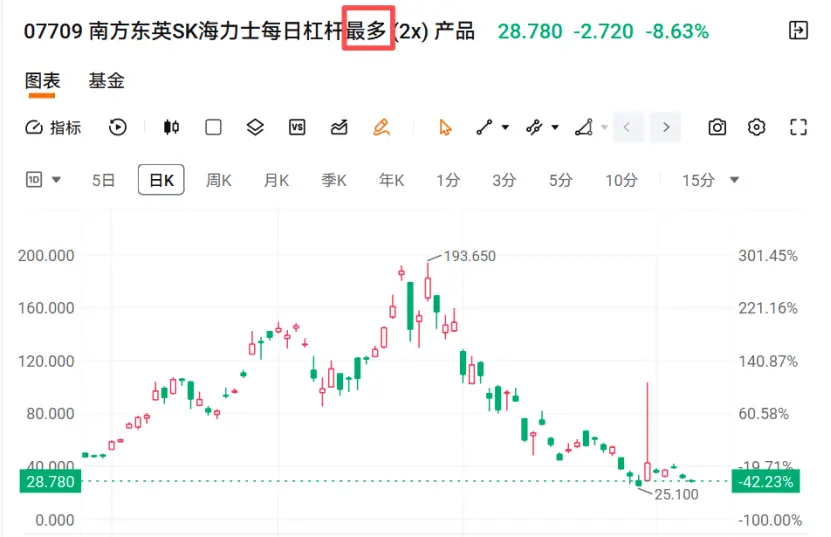
07709 is the Southern Eastern Double Leveraged ETF, tracking South Korean semiconductor giant SK Hynix.
When it was listed in October 2025, the issue price was only 7.8 HKD. Just as the AI wave swept the globe, SK Hynix, as a core supplier of HBM chips, saw its stock price soar. This product also surged crazily; by June 2026, its price soared to 193.65 HKD, an increase of more than 10 times, and its scale exceeded 130 billion HKD, becoming a hot potato in the market.
However, leverage has always been a double-edged sword.
In late June, SK Hynix’s stock fell back from its peak, and the double long 07709 plunged off a cliff. It experienced a maximum decline of nearly 87%, dropping from 193.65 HKD to around 25 HKD, wiping out the market value of billions. As of the time of writing, the latest price of 07709 is 28.6 HKD.
Just as the holders anxiously awaited and hoped for a rebound of the underlying stock to bring them back to break-even, the fund company Southern Eastern took action.
On July 27, it announced that from August 3, the product would switch to a "flexible leverage structure"—the leverage multiple would no longer be a fixed 2 times, but could be dynamically adjusted between 1.1 times and 2 times.
In simple terms: in a good market, it will try to give you 2 times, while in a bad market, it will quietly drop to 1.1 times.
Objectively, during a market crash, reducing the leverage ratio can decrease the ETF's decline, protecting investors; however, the issue is that if the market rebounds, reducing leverage will slow down the recovery for suffering investors, consuming more time and capital costs, and so on. Especially considering the decline in South Korean stock indices, SK Hynix, and Samsung Electronics' stock prices have retracted so much, and Morgan Stanley has reported that the deleveraging phase of South Korean stocks has entered its final stage, with valuations returning to value for money.
Of course, this change has a specific background, as the Hong Kong Securities and Futures Commission released new regulations on leveraged products on July 24, allowing products to adjust their target leverage in extreme market conditions. From a procedural standpoint, the fund company may not have violated regulations.
But just because it is compliant, does it mean it is reasonable?
When the market is rising, "double" is the attractive brand for attracting funds; when the market falls, "double" turns into "up to double," which can shrink at any time.
The same product, the same group of holders, experiences treatment that varies drastically between rising and falling.
This operation, while not illegal, has in fact rewritten the rules of the game, touching upon the core and most sensitive issue in the fund industry, as well as in the financial market and commercial society—contractual spirit.
When a fund company in Hong Kong changes investment targets, performance benchmarks, or diversification restrictions that harm investors' original expectations, it constitutes a significant change to the fund contract that cannot be unilaterally modified by the management.
The proper procedure for modifying rules is as follows:
1) The fund company and trustees must report to the Hong Kong Securities and Futures Commission (SFC) in advance, obtaining regulatory pre-review opinions;
2) Send a circular to all holders and hold a holders' meeting;
3) A special resolution must be passed: a favorable vote of over 75% of the shares present is required for it to take effect;
4) A notification period of at least 30 days must be given to provide holders with time to redeem and exit;
5) The contract amendment only formally takes effect upon final approval by the SFC.
Did this company follow these procedures when making such significant changes to the product? Did it get the consent of the fund holders' meeting? If there are procedural issues, should fund holders unite to seek compensation for their losses?
More intriguingly, this fund charges an annual management fee of 1.60%, accumulating about 356 million HKD since its listing.
When the net value skyrocketed, management fees increased correspondingly; when the net value plummeted, management fees were still collected as usual.
Now that the rules have changed, the fund company has successfully avoided liquidation risks, continuing to earn steadily, while holders who entered at high prices might have lost even the final hope of waiting for the underlying stock to rebound and leveraging for a turnaround.
In simple terms, this name change essentially sacrifices the potential for holders to recover their costs, in exchange for the fund company’s own survival.
This structural misalignment, where the manager consistently profits while holders incur losses, is the most horrifying aspect.
Theoretically, if the fund company anticipated that the stock price would rebound, it could readjust the leverage back to 2 times, but this requires a very high level of operability, needing precise predictions; if the fund company truly had such capabilities, why did it fail to successfully predict the significant retraction over the past month?
The chill in this situation is not merely about K-line charts, but rather a brutal story concerning rules, contracts, interests, and trust.
免责声明:本文章仅代表作者个人观点,不代表本平台的立场和观点。本文章仅供信息分享,不构成对任何人的任何投资建议。用户与作者之间的任何争议,与本平台无关。如网页中刊载的文章或图片涉及侵权,请提供相关的权利证明和身份证明发送邮件到support@aicoin.com,本平台相关工作人员将会进行核查。


