Key Takeaways
- Michael Saylor says ChatGPT helped Strategy create $15B in 2025.
- Strategy tied AI and bitcoin together as future digital capital tools.
- Saylor expects AI and bitcoin adoption to accelerate over the coming years.
Speaking with Steven Bartlett on The Diary of a CEO podcast, the Strategy executive chairman described AI as a tool for solving problems that traditional finance had never encountered. He opened the discussion with a simple message: “Bitcoin is digital capital. AI is digital intelligence.” Together, he stressed, the technologies are reshaping business, markets, work, and long-term wealth.
Saylor’s biggest claim centered on Strategy and the digital asset treasury (DAT) firm’s effort to continue raising capital after exhausting more traditional financing options. According to him, the company had already become one of the world’s largest issuers of convertible bonds to fund additional bitcoin purchases. That approach eventually reached its practical limits.
Rather than abandon its strategy, Saylor said the company turned to the generative AI model ChatGPT to explore an entirely new type of financial security. The result was STRK, a preferred stock structure designed to bridge the gap between debt and equity while supporting additional bitcoin purchases. Saylor said no comparable instrument had previously existed.
“We used AI to make $15 billion last year,” Saylor explained to Bartlett. The Strategy founder further added:
“The AI gave us a solution to the problem that no one had ever encountered before in the history of the world.”
He explained that lawyers and investment bankers initially resisted the idea because they had never seen such a structure before. AI instead generated alternative approaches that ultimately helped the company create a product capable of attracting billions of dollars from investors.
Throughout the interview, Saylor repeatedly linked bitcoin and artificial intelligence together. He described bitcoin as the world’s first form of digital capital while calling AI the next major leap in digital intelligence.
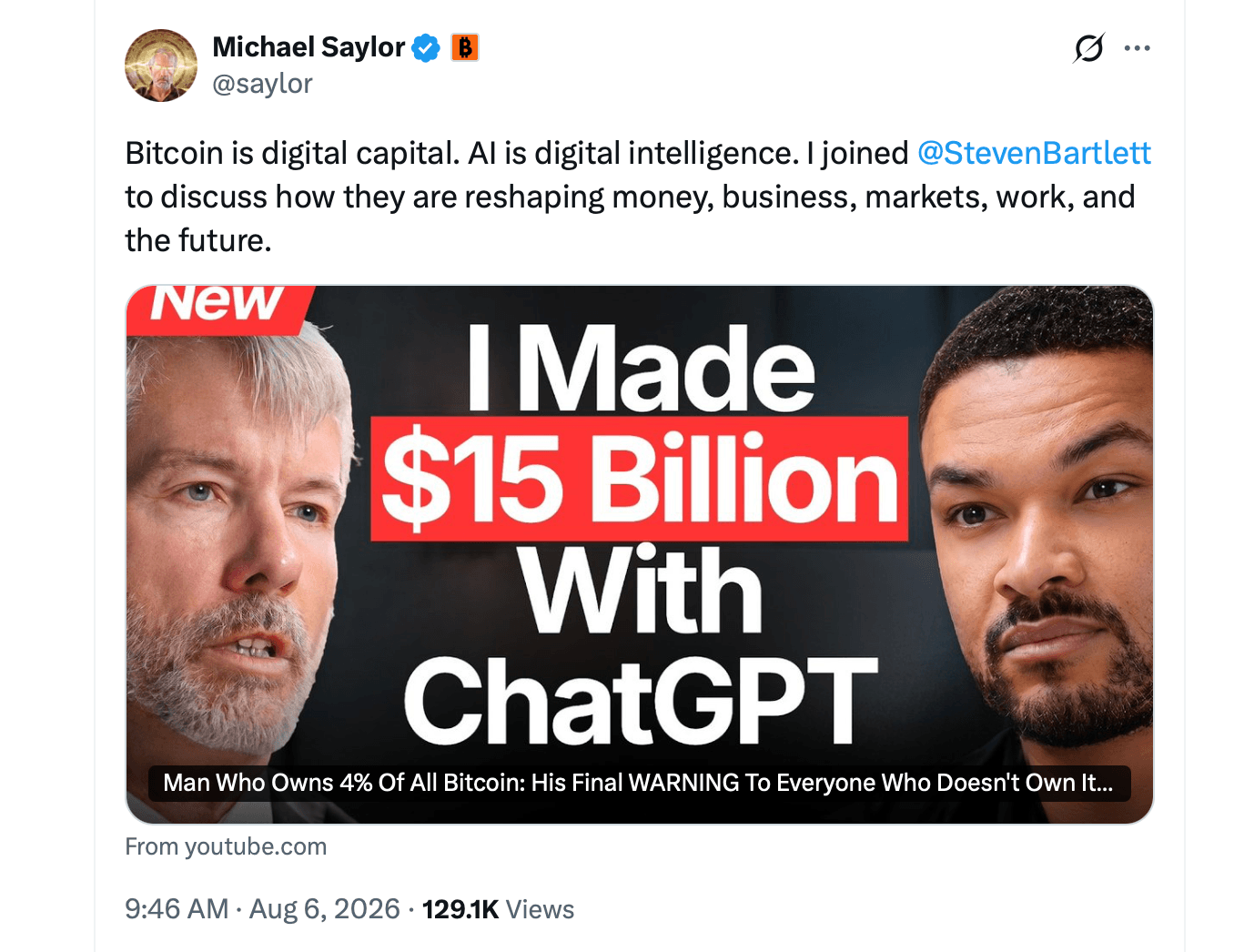
Image source: X
According to Saylor, both technologies solve different problems. Bitcoin allows individuals and businesses to own wealth that can be transferred globally without relying on multiple financial intermediaries, while AI dramatically expands human productivity by helping people solve increasingly complex problems.
He argued that entrepreneurs should stop competing directly against AI and instead use it to create products and services that previously seemed impossible.
Saylor told The Diary of a CEO podcast show host:
“Don’t try to outwork the robots. What you want to do is ask the AI to do something that’s never been done before.”
The conversation also revisited one of Saylor’s long-standing themes: preserving purchasing power.
He argued that inflation steadily erodes the value of fiat currencies over long periods, pointing to historical examples that he believes show the U.S. dollar losing purchasing power across generations. He contrasted that with the world’s scarcest assets, such as stocks, commercial real estate, gold, and bitcoin, all of which he described as better long-term stores of value than holding cash.
Saylor also challenged conventional advice surrounding homeownership. While acknowledging that residential real estate can appreciate, he argued that ongoing property taxes, insurance, and maintenance reduce long-term returns in many jurisdictions. Commercial real estate, he said, often performs better because those costs can frequently be offset through rental income.
For Saylor, bitcoin offers a different advantage. Unlike physical assets, he detailed, it can be transferred across borders in seconds without requiring approval from multiple banks or governments, making it especially valuable during periods of economic or political uncertainty.
Much of the discussion shifted from investing to artificial intelligence’s broader economic impact.
Saylor predicted AI will automate many forms of knowledge work, including accounting, legal research, and document preparation. That does not mean people will stop creating value, he argued. Instead, future careers will increasingly revolve around directing AI rather than performing repetitive work themselves.
He encouraged young people to study technologies still climbing the innovation “S-curve” instead of industries that have largely matured. Learning how to work with AI, he said, will likely prove more valuable than mastering tasks that software will soon perform automatically.
He also pushed back on the idea that AI will eliminate the need for money. Responding to comments from Elon Musk about a future of material abundance, Saylor argued that while technology may make everyday goods cheaper, scarce assets will continue to exist, ensuring wealth and capital remain important.
Saylor framed both bitcoin and artificial intelligence as technologies still in the early stages of adoption. He believes businesses that combine digital capital with digital intelligence will create entirely new financial products and business models over the coming years.
Whether those predictions prove correct remains to be seen. What is already clear is that Strategy continues to expand and change its bitcoin-focused corporate strategy while Saylor increasingly presents AI as the tool that could accelerate the company’s next phase of growth. The interview suggests he views the combination of bitcoin and AI not as separate trends, but as two technologies likely to define the next generation of finance and entrepreneurship.
免责声明:本文章仅代表作者个人观点,不代表本平台的立场和观点。本文章仅供信息分享,不构成对任何人的任何投资建议。用户与作者之间的任何争议,与本平台无关。如网页中刊载的文章或图片涉及侵权,请提供相关的权利证明和身份证明发送邮件到support@aicoin.com,本平台相关工作人员将会进行核查。


