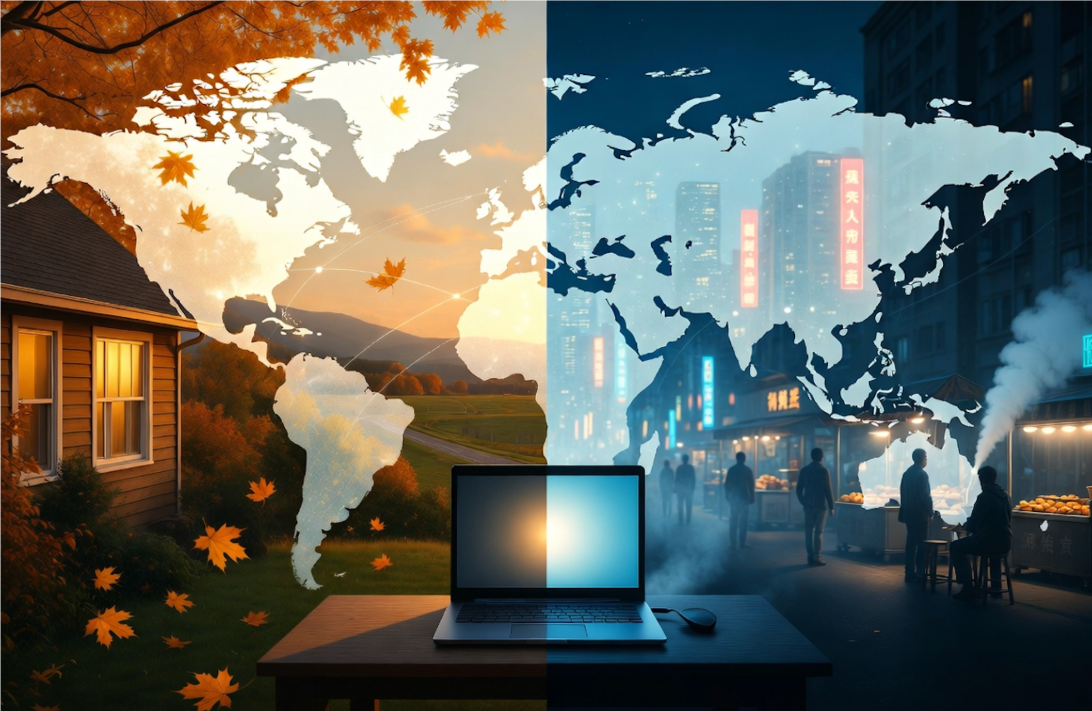
Some people belong to one place their entire lives.
Some, however, treat the whole world as a backdrop that can be switched at any time, while carefully leaving themselves with two real anchor points.
I am a global digital nomad. When the computer is on, income can come from any time zone; yet my body is not in a rush to drift to the next trendy city. The way I choose is slower and more conscious—half a year in the U.S., half a year in China. It's not about escaping, but about holding both movement and rooting in hand at the same time.
I spend most of my springs and autumns in the U.S.
The trees in the suburbs suddenly turn red one day, fallen leaves accumulate on the lawn, and someone is trimming a hedge in the distance. Days are diluted into slow motion. Driving out, the scenery outside the window is endless roads and an uncrowded sky. At night, when I return home, the lights are warm yellow, and when the door closes, the world becomes very small and quiet. You start to get used to making appointments, to slicing time into chunks, and then seriously passing through them. Work still happens remotely, but here’s a rhythm that helps you learn how to coexist with yourself.
In summer and winter, I return to China.
The air immediately becomes thick. The steam from takeout, the voices in the subway, the neon lights at rush hour, and a bowl of hot soup available at midnight. Time here gets compressed, yet becomes abundant. Walking on the street, you encounter countless people living earnestly. That density can sometimes be exhausting, but other times, it makes you feel—I'm still alive, and living very concretely. The internet remains smooth, clients are still online, yet the touch of life gently sets aside the word "digital," reminding you: people ultimately need to be caught by real human interactions.
The consumption on both sides is, in fact, two attitudes towards desire.
In China, a good meal, a basket of fresh fruit, a comfortable massage often don’t require much hesitation. Affordable, not cheap, but rather life is permitted to be a little easier. In the U.S., many things are expensive, but the price is clear. It's costly due to labor, due to regulations, and due to that feeling of being “taken seriously.” You slowly learn to distinguish which desires are worth paying a high price for and which only need to be satisfied. The geographical arbitrage that digital nomads are best at transforms here into more nuanced daily choices.
Friends can also be divided into two types.
In China, a circle of friends is like a densely woven net. Some are always available, some know how your parents are doing, and some can sense your unspoken troubles at the dining table. Relationships have warmth, and they carry weight. American friends, however, are more like scattered lights. Not in frequent contact, but during a conversation, they suddenly illuminate a corner you never thought about. They are not in a hurry to dive into your life, yet seldom give you pressure. Moving can make people easily lonely, and these two kinds of relationships provide one with a feeling of being caught, and the other with a sense of respect. Both are needed, and both are precious.
Eating is the most honest memory.
The taste of China is the hands of a mother, the street corner's fireworks, that bite of fruit ripened just in season. When you close your eyes, you can even distinguish the origin of the chili and the fish from which river. The dining table in America resembles a quiet exhibition. Steaks are grilled to the desired doneness, and vegetables have their own sweetness. Chinese food there is often rewritten, yet because of this, you rediscover how irreplaceable the "taste of home" is. Having eaten on both sides, you finally understand why people need two different kinds of fullness.
Healthcare is the part of life that one is least willing to face and yet is unavoidable.
Chinese hospitals sometimes resemble battlefields, but they also make one feel—pain can be swiftly dealt with as part of daily life. Registration, examination, obtaining medication, the process is clear, and costs are relatively moderate. In America, healthcare feels like another mountain. Expensive, slow, yet at certain critical moments, it can offer you a higher ceiling and more detailed options. The truly wise digital nomads don't blindly believe either side, but know when to go where. Health is never the product of a singular system, but rather the result of maintaining clarity about both sides.
As for investment and asset allocation, it ultimately reflects an attitude towards the future.
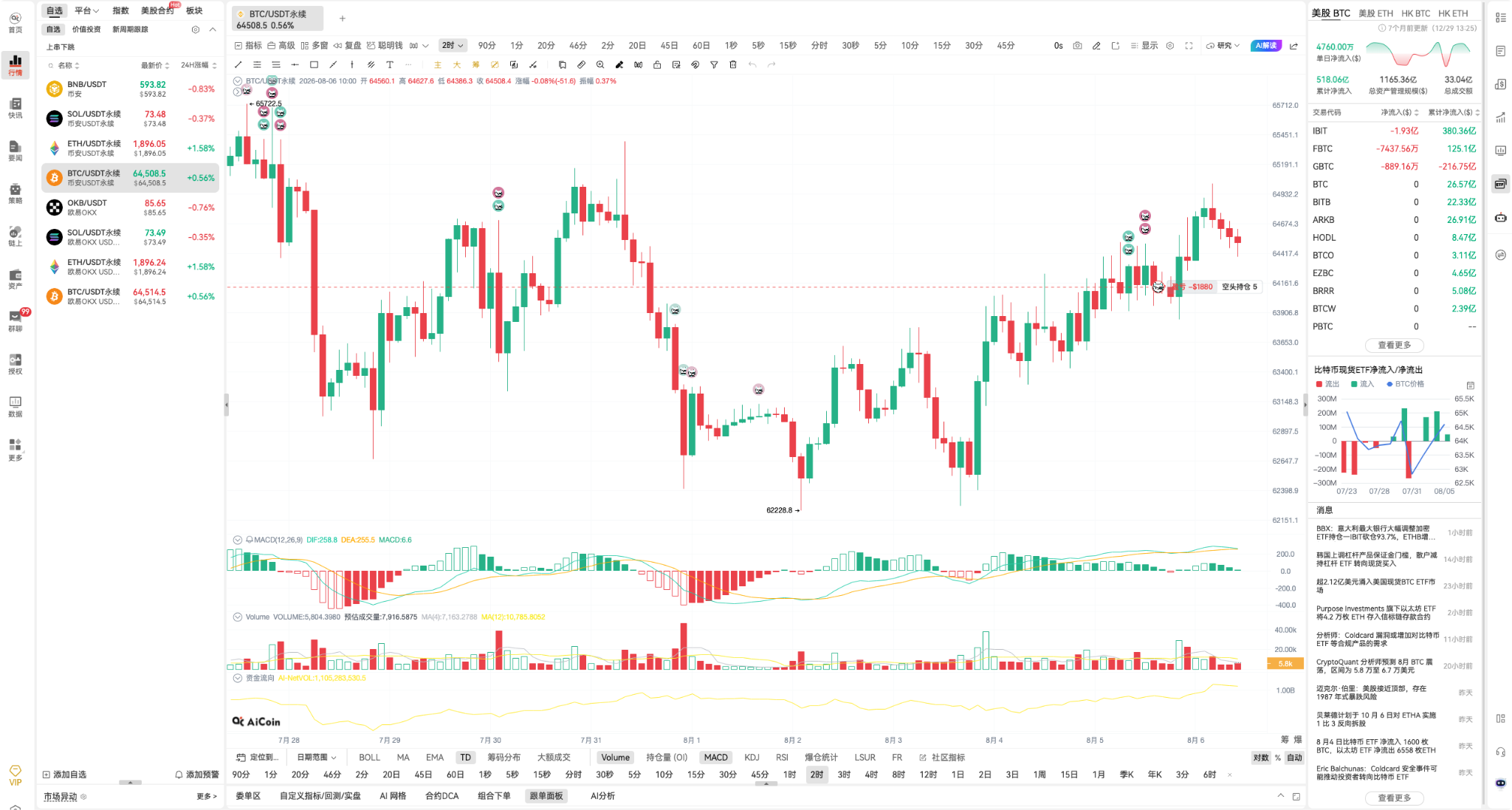
The U.S. teaches you to view the world through a longer time frame, with relatively transparent rules, allowing for more relaxed asset allocation. China, on the other hand, connects you to the breath of the land and industries, sensing those changes that are happening. As a global digital nomad, your perspective naturally spans oceans, with assets often scattered across different markets. At this moment, tools become exceptionally important. I am accustomed to using platforms like AiCoin, enabling me to switch and view the global crypto market and main investment data at the touch of a button—real-time trends of Bitcoin, Ethereum, mainstream assets, capital flows, on-chain data, all presented clearly on the same interface. Without needing to shift between different time zones or websites, I can quickly grasp the overall situation. It’s like a portable global dashboard, allowing those in motion to maintain their calm and synchronization with the market.
The most profound aspect of the digital nomad lifestyle is not how many countries you visit but how it forces you to re-answer several questions:
- Is home necessarily a fixed address?
- Does work have to be trapped in an office to have value?
- Is a sense of security derived from a stable environment, or from one's own ability to monetize?
For some, it is an escape from internal competition; for others, it merely changes anxiety into another form. Those who truly travel for the long haul are often not those who see travel itself as the destination but those who already possess a steady output, treating movement as a tool rather than an escape.
In the end, this lifestyle is not suitable for everyone. It is suitable for those who already possess a certain level of professional capability, who can endure loneliness, and who genuinely enjoy "deciding their own pace." For more people, it may just be an experiment at a certain stage of life—to confirm what they truly want, whether it is absolute freedom or a kind of warm stability.
Freedom has never been without constraints, but rather understanding what type of constraint one is willing to pay a price for.
On the path of being a digital nomad, there are many beautiful sights; however, those who can truly stay are only those who learn to coexist with themselves.
True security may stem from this clarity of not putting all eggs in one basket and using the right tools to simplify complex information.
Between half a year and half a year, there are no absolute winners.
There is only one person, slowly becoming whole in two kinds of light.
You begin to understand that home does not have to be a fixed address, but rather a place where you can settle yourself.
You start to accept that perfection is never a singular completeness, but a balance between two forms of imperfection.
You even begin to appreciate this back and forth—because each departure makes coming back more precious; each return means the next departure is no longer rushed.
Life is short.
If one can simultaneously possess the freedom of movement and the warmth of rooting,
If one can work in a digital world yet live in a real one,
then perhaps, that is already a profound blessing.
It is not arbitrage.
It is seriously living oneself into two seasons while maintaining a view of the larger world.
免责声明:本文章仅代表作者个人观点,不代表本平台的立场和观点。本文章仅供信息分享,不构成对任何人的任何投资建议。用户与作者之间的任何争议,与本平台无关。如网页中刊载的文章或图片涉及侵权,请提供相关的权利证明和身份证明发送邮件到support@aicoin.com,本平台相关工作人员将会进行核查。