Author: David, Deep Tide TechFlow
ai16z, do you remember this name?
If you do, it means you experienced the wave of AI tokens in the cryptocurrency space at the end of 2024. If you don’t remember, that’s normal; AI Agent tokens have been quiet for a long time.
Crypto x AI, in the current version where AI tools are gradually being implemented and advancing rapidly, seems too much like a pseudo-concept or an outdated toy.
Today, Shaw Walters, the founder of the Eliza OS project, published a very long article stating that the ai16z token is completely dead, the foundation has shut down, there will be no buybacks, and holders must handle their tokens themselves.
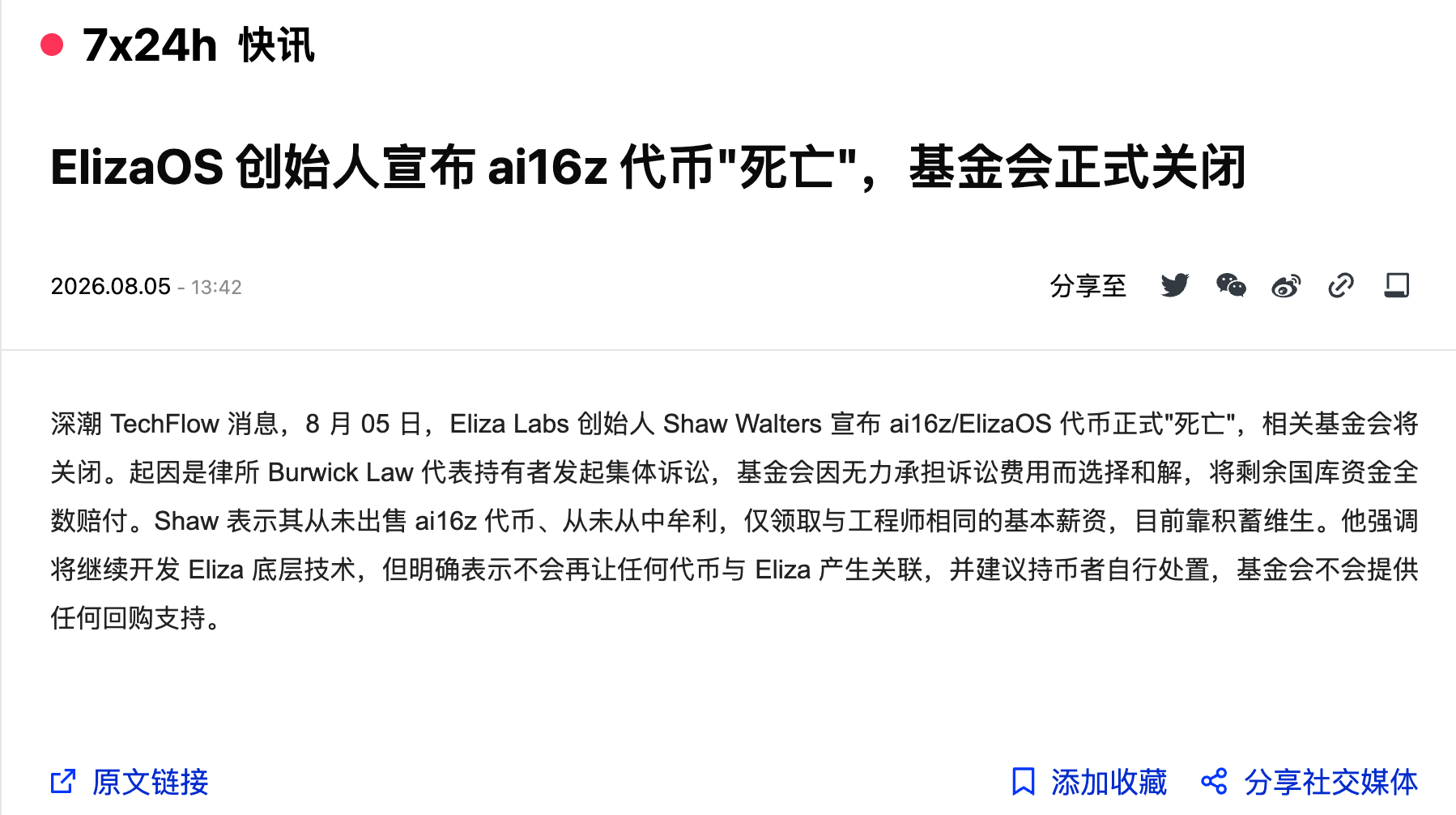
He suggested that you either sell or "find a group of people to pump it up," but don’t expect him to do anything more.
The tone of this letter is not like that of a founder announcing a project closure with dignity; it feels more like someone who, after cursing everyone, disappointingly slammed the door. He referred to the crypto community as "a group of spoiled crybabies," mentioning that a law firm has sued him on behalf of the token holders.
And the Eliza OS foundation couldn’t afford to fight the lawsuit, spending all its remaining money.
Shaw also mentioned that he once had $25 million worth of ai16z tokens and sold none, ultimately returning to zero; now he lives off savings in a shabby small bedroom in San Francisco, writing code every day.
From his perspective, he might feel like he was developing with idealism in a murky market, ultimately left with wreckage, disappointment, and anger.
The author does not intend to judge these personal emotions. But standing at the crossroads of fluctuating trends, industry shifts, and the rise of AI, the shutdown of Eliza OS undoubtedly makes one reflect that crypto x AI truly got up too early and arrived too late.
One step ahead, amidst the wave
In October 2024, ai16z launched crowdfunding on DAOs.fun, aiming to raise 420.69 SOL, equivalent to about $75,000, to create an AI-managed investment fund.
420.69, those familiar with crypto culture know this is a meme number. From the choice of fundraising amount, the tone of this project was set.
But it really took off. In less than three months, ai16z's market capitalization surged to $2.6 billion. It also spawned an entire category, with GOAT leading the way, followed by VIRTUAL, and various Agent concept coins emerged, growing the entire AI Agent track to nearly $10 billion.
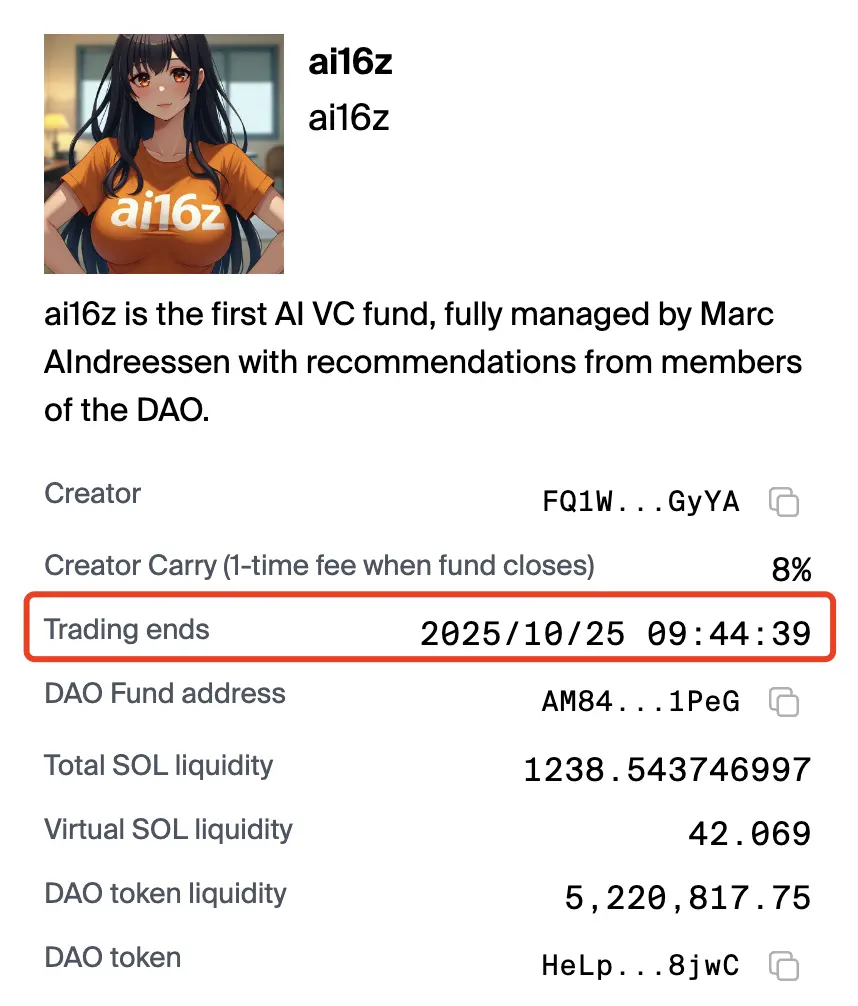
Crypto was conceptually indeed one step ahead. What was the situation in the AI market by the end of 2024?
ChatGPT had just turned two and was often criticized for various hallucinations in its responses; Claude still didn't have tools to operate computers directly, and most people's understanding of "AI Agents" remained at the conceptual level. However, the crypto market had already set a price for this concept.
But there was a detail that not many people noticed at the time.
Less than a week after its launch, a crypto media outlet published a report questioning that the core AI Agent of the ai16z project, which claimed to make independent investment decisions, "Marc AIndreessen," was actually being operated by a person instead of being a true Agent thinking for itself.
This doubt later also occurred regarding the well-known market analysis Agent aiIxbt.
At that time, it was difficult for such doubts to spark any ripples or FUD. The market cap kept rising, the community continued to shout, and new AI Agent tokens continued to be launched... Looking back, this may be the most accurate reflection of the entire crypto AI narrative.
Truth and falseness were not important. In a climate of liquidity overflow, a leading narrative was enough to spark a wave of speculation.
As long as the concept holds true, the direction aligns, but tokens exist before products, and prices exist before technology; this is precisely the essence of crypto being one step ahead.
The future has come, but it has nothing to do with me
In 2026, AI Agents truly arrived.
In the West, there are CodeX and Claude, while in the East, there are competitors like Workbuddy that are more suitable for the domestic market. Looking back at the narratives from the hype in the crypto AI wave, such as helping people automatically analyze market trends, handle workflows, monitor public sentiment, etc., they have completely turned into reality.
This might be one of the few grounded narratives in the crypto industry, aside from stablecoins.
However, the individuals fulfilling these narratives have changed. It’s Anthropic, it’s OpenAI, it’s those teams coding in San Francisco and Hangzhou. Money has flowed to aggregation platforms like OpenRouter, to the GPU bills of cloud service providers, to every true API call in operation.
Another sentence from Shaw's long article is deeply resonating:
“AI doesn’t have these problems. The people there are optimistic, powerful, building the future instead of tearing each other down. Those are my people.” A person who once ignited the crypto AI Agent narrative, ended with the conclusion that this industry is incompatible with AI?
Objectively speaking, the current successful AI applications or large models truly have no reason to issue tokens.
Anthropic charges for subscriptions and API calls, OpenRouter's intermediary business generates over 100 million annually. These companies have never issued tokens, have never built DAOs, but their business models work, with developers voting with their feet, and the bill is the best consensus mechanism.
In contrast, the situation for crypto AI projects is very harsh. When token prices are supported, it seems like there is everything—treasury funds, community members, and active narratives. Once prices collapse, everything disappears simultaneously.
Developers leave because the purchasing power for paying salaries with tokens has shrunk by 90%, and the community has turned into a rights protection group. Those who genuinely want to do something may ultimately find that the project can't even afford to hire an engineer.
Ironically, the Eliza framework he owns has not died. The code is still updating, and companies are discussing partnerships on top of it. An open-source AI framework can survive without issuing tokens, whether by selling services or being acquired, there are far more opportunities than with tokens.
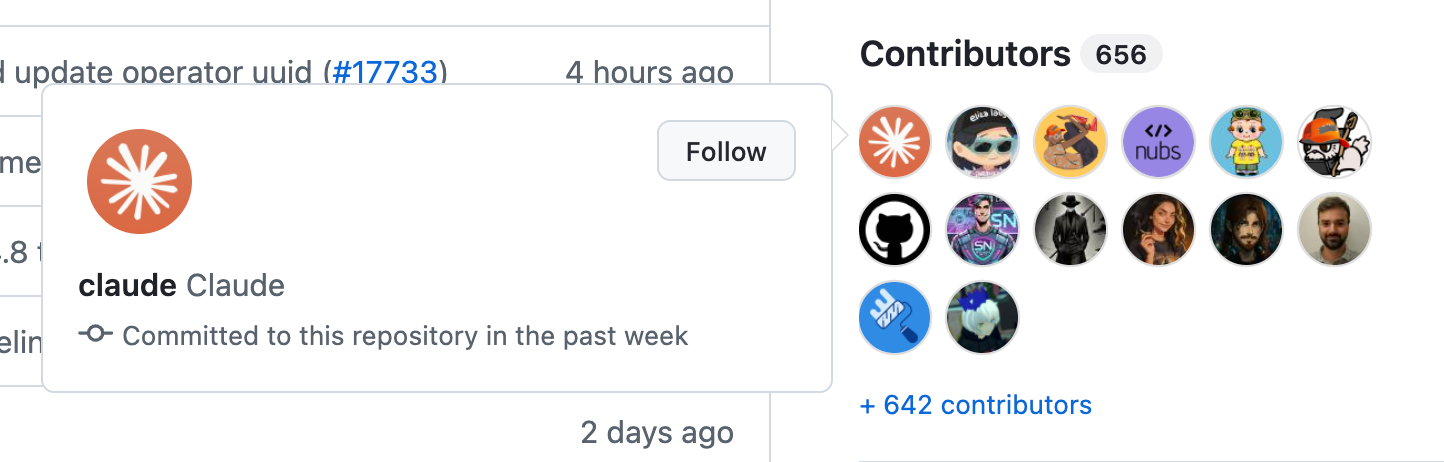
Even more poignantly, the recently active contributor to the open-source AI framework Eliza, which originated from crypto, turns out to be Claude.
An AI developer and project that is not tied to tokens may be worth even more in the 2026 market than when it was tied to tokens.
Embrace change
As a crypto practitioner, seeing once-hot projects fall one by one is indeed disheartening.
But feelings of lament do not mean total pessimism.
The crypto AI narrative has indeed shattered into pieces. But what has shattered is the path of "issuing tokens for AI concepts"; the possibilities between crypto and AI have not been completely severed.
The few projects still alive are doing completely different things from ai16z. For example, Bittensor is building a decentralized AI computing power market, while Render is creating a distributed GPU rendering network.
Both use tokens to coordinate a form of real computing resources, and there is still a certain market, although a bull market would be more premium and persuasive.
Additionally, on-chain data analysis, vulnerability scanning, whale wallet tracking, public sentiment monitoring, and contract strategies of DEXes are gradually being addressed and utilized by AI.
In 2026, when a professional crypto trader opens Hyperliquid, there is a high probability that a Claude or GPT-supported strategy window will be open alongside it. This indicates that the relationship between crypto and AI has not ended; the direction just needs to be reversed.
AI empowering everything has become a political correctness, and crypto can also be subsumed under it. As for how big the crypto pie still is, that might depend on when BTC can recover.
Personally, what should be done is to embrace change. A developer who sheds the burden of tokens holds far more value in today’s AI world than tokens can provide; while a crypto player who genuinely embraces AI can clearly gain much more than the previous rough mode.
In crypto, often one sees the direction one step ahead, or perhaps we just got our own position wrong.
免责声明:本文章仅代表作者个人观点,不代表本平台的立场和观点。本文章仅供信息分享,不构成对任何人的任何投资建议。用户与作者之间的任何争议,与本平台无关。如网页中刊载的文章或图片涉及侵权,请提供相关的权利证明和身份证明发送邮件到support@aicoin.com,本平台相关工作人员将会进行核查。


