Key Takeaways
- Kalshi led July with $38.65B of the $54.09B prediction market volume.
- FIFA World Cup helped lift fees to $327.67M and 365.9M transactions.
- Kalshi held $1.30B of $1.91B open interest as markets watch post-Cup demand.
Prediction markets allow people to buy and sell contracts tied to the outcome of future events rather than purchasing traditional financial assets. Traders can speculate on everything from elections and economic data to sports championships, with prices shifting as expectations change.
The World Cup, one of the world’s largest sporting events, created an ideal environment for rapid trading activity as every match generated new opportunities.
The numbers logged in June and July, from Dune.com’s prediction marketplace dashboard, illustrate just how dramatic the increase became. Total prediction market notional volume reached $54.09 billion in July, up from $49.95 billion in June, representing an increase of roughly 8.3% in a single month.
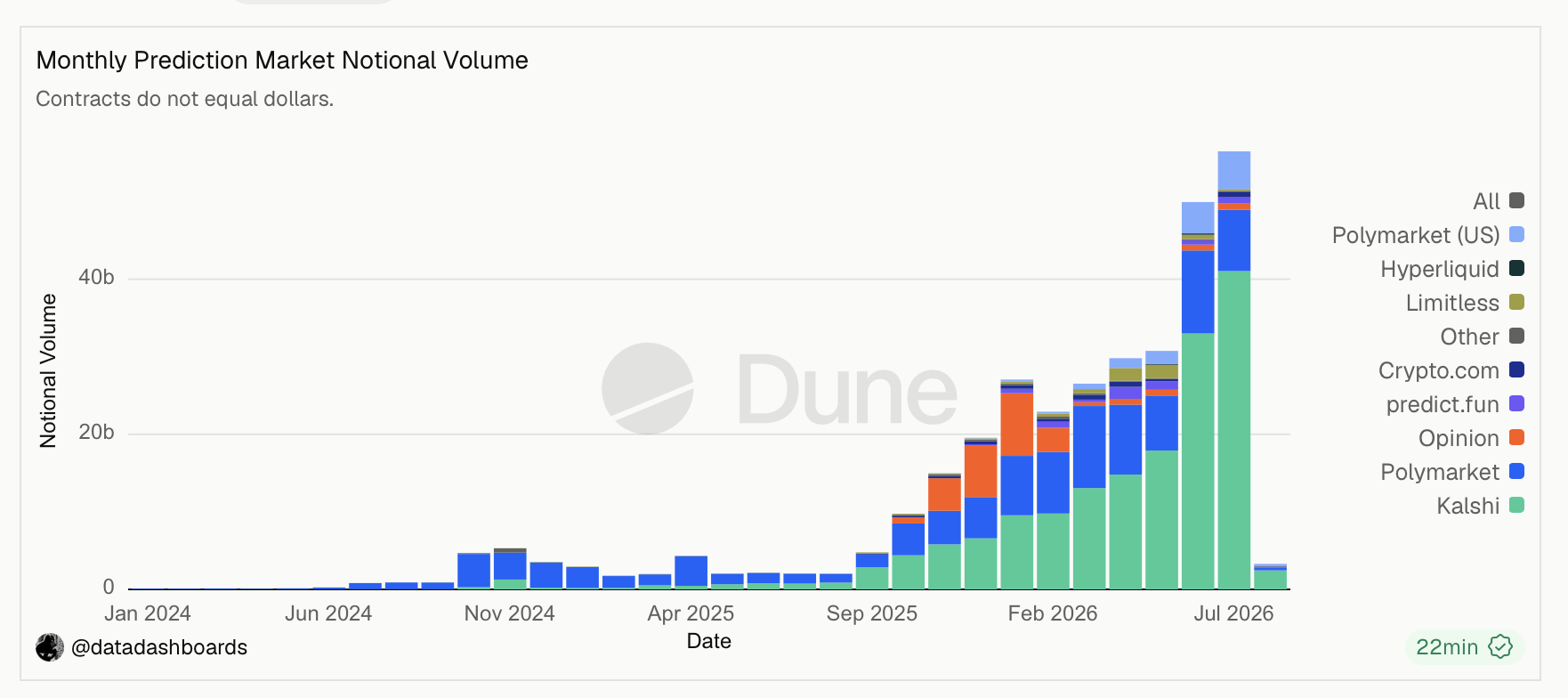
Image source: Dune Analytics
Kalshi dominated the market, processing $38.65 billion, or approximately 71.5% of total volume. Polymarket generated $7.89 billion, while Polymarket (US) added another $4.86 billion, giving the combined Polymarket ecosystem nearly $12.75 billion, or about 24% of monthly activity. Opinion, predict.fun, Crypto.com, Limitless, and smaller platforms accounted for the remaining share, highlighting how concentrated the industry has become between Polymarket and Kalshi.
Higher trading activity naturally translated into higher platform revenue. Estimated prediction market fees climbed to approximately $327.67 million during July, Dune.com stats show.
Kalshi again led the industry, generating roughly $252.92 million, or about 77% of all estimated fees. Polymarket produced $39.72 million, while Polymarket (US) collected $29.52 million. Predict added $4.44 million, Limitless generated just over $1 million, and Opinion contributed about $50,000. The fee breakdown closely mirrored trading activity, reinforcing Kalshi’s commanding position.
Growing interest was equally evident in transaction counts. Platforms processed nearly 365.92 million transactions during July as traders continuously adjusted positions throughout the tournament.
Kalshi handled 246.73 million transactions, representing roughly 67.4% of total activity. Polymarket recorded 62.03 million, while Polymarket (US) processed 38.13 million. Together, the two Polymarket platforms accounted for roughly 100 million transactions, or about 27% of all market activity. Predict.fun contributed another 16.74 million, while the remaining platforms handled comparatively small volumes.
The World Cup also encouraged traders to keep more money committed to open positions. Open interest, which measures the total value of active contracts that have not yet settled, approached $1.91 billion during early July.
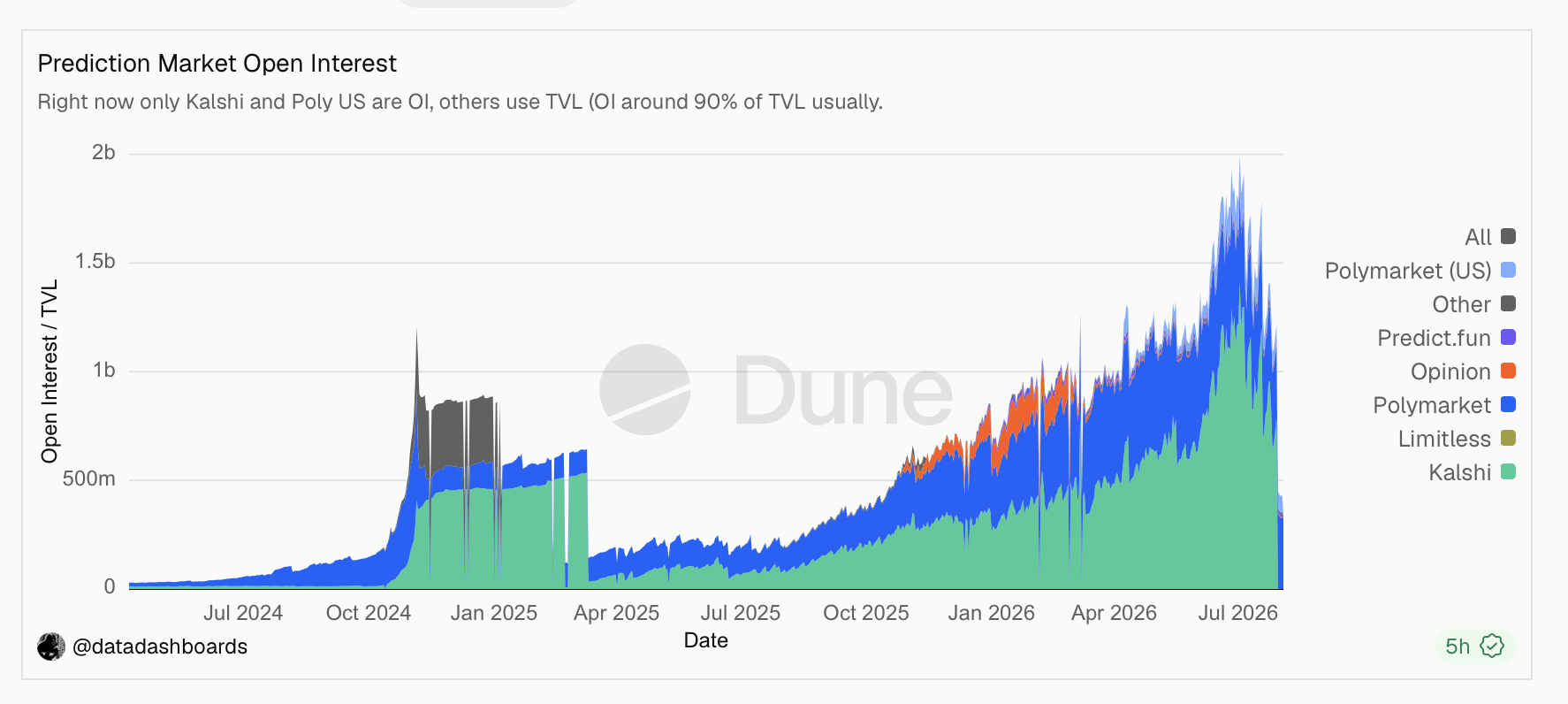
Image source: Dune Analytics
Kalshi held approximately $1.30 billion, equal to about 68% of total open interest. Polymarket accounted for $419.21 million, while Polymarket (US) contributed another $154.30 million. Predict.fun held $23.76 million, with Opinion, Limitless and other platforms representing only a small fraction of outstanding positions.
Unlike financial markets, prediction markets thrive on uncertainty and constant information. Every goal, injury, referee decision and tournament upset immediately changes the perceived probability of future outcomes, encouraging traders to revise positions throughout the competition. The World Cup’s nearly monthlong schedule created a continuous stream of tradable events that kept activity elevated from the opening match through the final.
The tournament also broadened participation beyond traditional prediction market users. Sports fans who might never trade contracts tied to inflation or elections suddenly had familiar events to follow, increasing liquidity and drawing additional capital into the ecosystem.
The World Cup demonstrated that global sporting events can dramatically expand prediction market participation far beyond election betting and other subjects, producing gains across nearly every industry metric. Whether those elevated levels persist after the tournament concludes will become one of the sector’s biggest questions.
Investors and platform operators will now watch upcoming sporting calendars, major political events, and regulatory developments to determine whether prediction markets can retain their expanded user base or whether activity gradually returns to pre-tournament levels. With the World Cup ended, prediction market open interest has cooled significantly.
免责声明:本文章仅代表作者个人观点,不代表本平台的立场和观点。本文章仅供信息分享,不构成对任何人的任何投资建议。用户与作者之间的任何争议,与本平台无关。如网页中刊载的文章或图片涉及侵权,请提供相关的权利证明和身份证明发送邮件到support@aicoin.com,本平台相关工作人员将会进行核查。


