Author: Bob Elliott
Translation: Deep Tide TechFlow
Deep Tide Intro: After the financial crisis, regulators successfully tamed banks but allowed leverage to seep into the retail market in more hidden forms—leveraged ETFs, options platforms, broker wealth management lending, all pointing towards the same target: US stocks. These dispersed leverages are difficult to quantify, but each has reached historical extremes; once they reverse, the amplifying effect will far exceed that of a traditional credit crisis.
Hidden Transfer of Leverage
A senior journalist asked me yesterday how I view the leverage risk in today’s financial system, compared to when I predicted massive losses in the banking system before the financial crisis. Given the current frenzy in the stock market, this question is particularly apt.
After nearly two decades of effort, regulators have fundamentally eliminated the issue of concentrated credit risk exposure in highly leveraged financial institutions. Compared to pre-crisis, this has been a tremendous success in enhancing financial stability. Today, the risk of systemic important banks failing, even large regional banks failing, is basically zero.
But what has replaced that old-style concentrated leverage is something far more hidden and widely dispersed. The leverage in today's financial system is more retail-oriented and focused on stock leverage, rather than traditional lending to the real economy.
Today, we can see leverage being offered to investors everywhere to amplify returns. Leveraged ETFs, retail options trading platforms, securities lending through bank wealth management platforms—countless ways exist. If you are an investor seeking leveraged returns, there are myriad methods, far exceeding the old-style margin loans available only to a few qualified investors. And all of this focuses on one thing—amplifying stock returns.
As the stock market shifts from strong to crazy, most investors have exhausted their cash by going long; the only remaining way to increase exposure is through both explicit and implicit leverage structures. Current prices reflect the surge in leverage within the financial system over the past few months. The challenge is that higher prices may require more leverage than is currently in place.
As someone who has witnessed several leveraged liquidations up close and studied more cases, it is always difficult to determine exactly when a reversal will occur, but it will eventually come. Just as all this leverage has been effective in pushing up asset prices, once it reverses, it will exacerbate the downturn.
But unlike before the financial crisis when it was only necessary to track 10-20 financial institutions, the ubiquity of leverage today makes it more difficult to see how far it has gone and how far it needs to go to completely unwind.
Leverage in Data
Today, it is somewhat difficult to fully understand the various forms of leverage supporting stock buying. However, several more well-known areas are indeed significant drivers. The trouble is that looking at each individually is not that substantial, but adding them together represents a widespread use of leverage by investors.
One of the most well-known is the leveraged ETF, which has surged particularly in the semiconductor sector with the recent frenzy. It is important to remember that the nominal exposure of these products is 2-3 times these figures, as this only reflects the assets under management of these products.
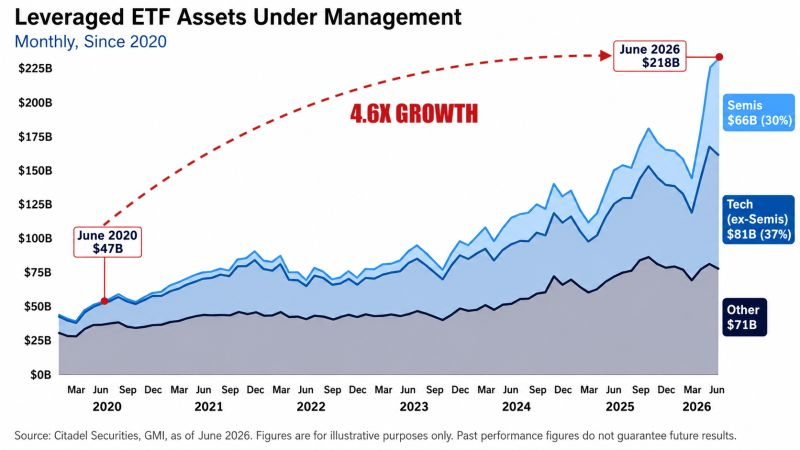
Image: The scale of assets managed by leveraged ETFs, increasing from $47 billion in June 2020 to $218 billion in June 2026 (a growth of 4.6 times); by sector, semiconductors account for 30%, technology 37%, and others 33%. Source: Bob Elliott
However, retail investors are finding many other ways to obtain leverage. Securities lending in bank wealth management departments is viewed as a key source of profit, which is quite significant.
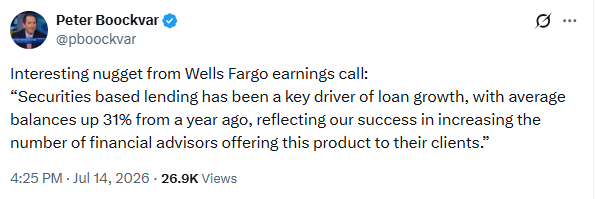
Image: The scale of securities lending in bank wealth management departments (considered a key source of profit). Source: Bob Elliott
As traditional lending to the real economy has essentially faded in recent years, this type of lending from banks has surged, injecting hundreds of billions of dollars into the asset market.
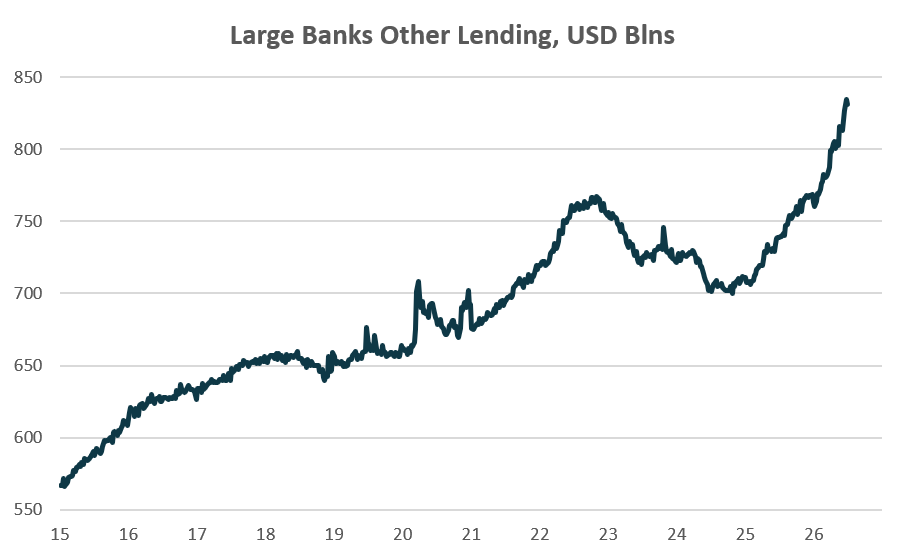
Image: The scale of lending injected by banks into the asset market (surging in recent years, reaching hundreds of billions of dollars). Source: Bob Elliott
The increased use of options also provides implicit leveraged positions for the US market. As Bloomberg recently emphasized, this is one of the important drivers of market divergence in the US in recent years.
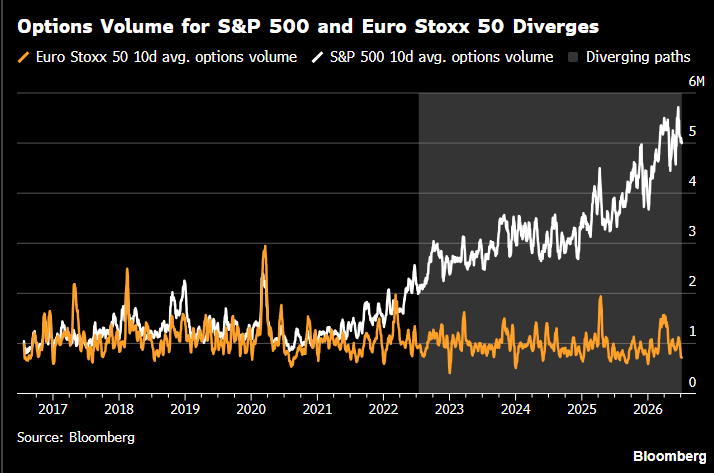
Image: Implicit leveraged positions provided by the use of options for US stocks. Source: Bob Elliott
All this financial engineering is on top of traditional margin lending by brokers, which is at a historical high and has injected hundreds of billions of dollars into the stock market over the past year.
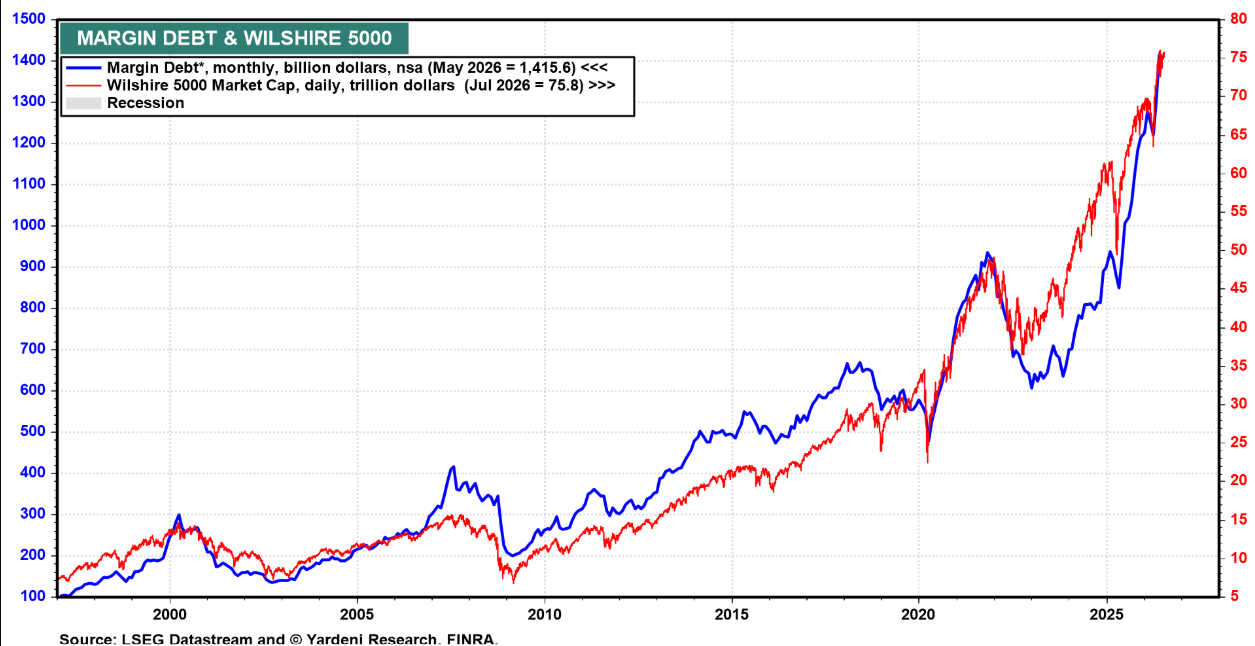
Image: The scale of traditional margin loans by brokers (at a historical high, injecting hundreds of billions of dollars into the stock market over the past year). Source: Bob Elliott
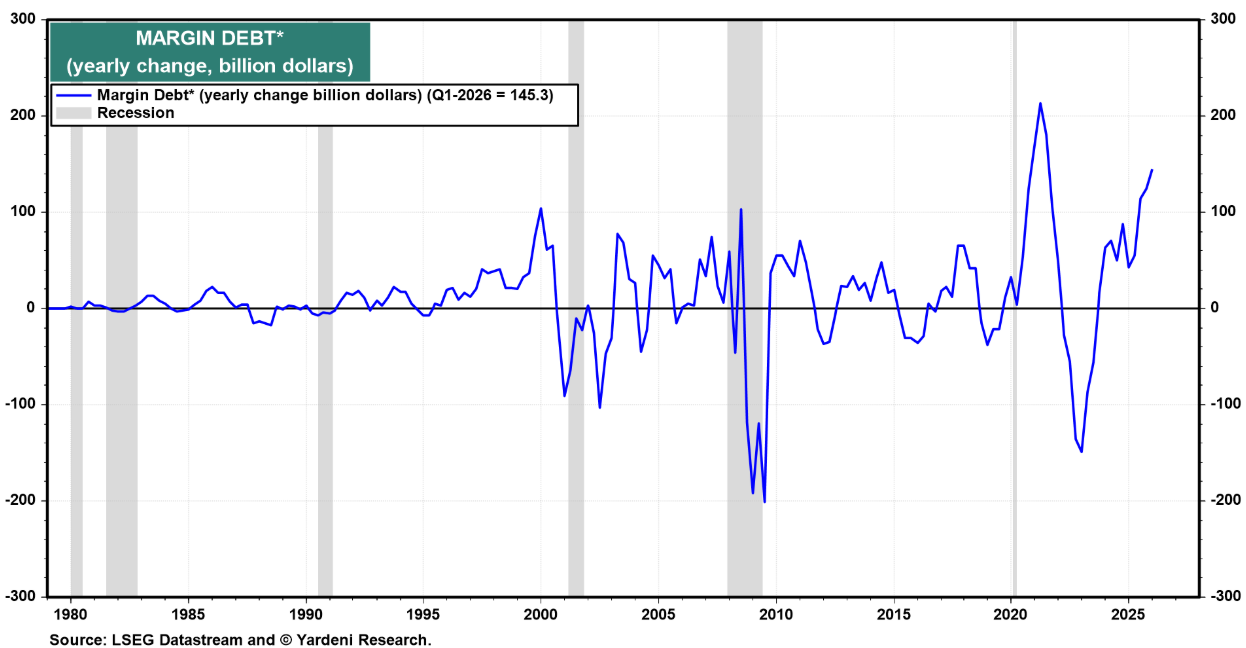
Image: Margin debt-related indicators (at extreme levels synchronized with broker margin loans). Source: Bob Elliott
Moreover, it is not just retail players; hedge funds are also increasing leverage on net equity exposure to keep pace. Hedge fund beta levels on stocks have surged, and the bank prime brokerage business has also surged, which is not included in the more consumer-driven numbers above.
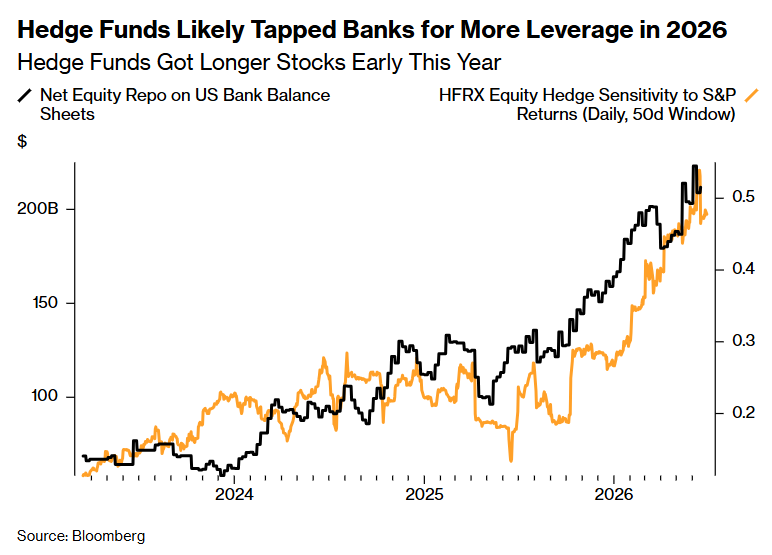
Image: Hedge fund net equity exposure leverage and the scale of bank prime brokerage business (surging simultaneously). Source: Bob Elliott
Conclusion: A House of Cards
The shift of leverage from concentrated financial institutions to widespread distribution and retail-oriented approaches makes it far more difficult to sum up the numbers in a direct manner. As macro analysts, we feel that we are continually tracking the pockets of leverage here and there… well, it’s everywhere. Everywhere we look, it is at extreme levels relative to history.
The current asset prices reflect the leverage that has been built through all these channels. While it is difficult to know the exact limits, there is an increasing sense that it is a house of cards, easily toppled by a slight breeze.
免责声明:本文章仅代表作者个人观点,不代表本平台的立场和观点。本文章仅供信息分享,不构成对任何人的任何投资建议。用户与作者之间的任何争议,与本平台无关。如网页中刊载的文章或图片涉及侵权,请提供相关的权利证明和身份证明发送邮件到support@aicoin.com,本平台相关工作人员将会进行核查。


