Last week, the global capital markets welcomed the most destructive "Super Earnings Week" of the year.
Four major trillion-dollar technology giants—Microsoft, Apple, Amazon, and Meta—along with electric vehicle leader Tesla, densely delivered their latest quarterly reports. As the liquidity "canary" for global risk assets, the cryptocurrency market experienced intense bull-bear turmoil and capital fluctuations before and after the earnings announcements.
Many novice investors who are new to investing cannot help but ask: How do the financial statements of traditional tech giants selling software, selling phones, and engaging in cloud computing transcend market barriers and directly determine the ups and downs of Bitcoin (BTC), Ethereum (ETH), and various altcoins in our hands?
This article will use real grounded data as an anchor point, deeply dissecting the hardcore data and underlying reasons behind the giants' earnings reports, thereby penetrating the capital transmission chain and analyzing the far-reaching impact of the earnings season on the cryptocurrency circle.

1. Five Giants' Earnings Reports: "Hardcore Magnifying Glass": Data Analysis and Underlying Reasons
In the market logic of cryptocurrencies, the earnings reports of traditional tech giants are by no means a pile of cold financial numbers; they are absolute barometers for global liquidity, risk appetite, and AI capital expenditures (CapEx).
1. Microsoft: Rapid Growth in Cloud Computing, but AI "Burn Rate" Sparks Panic on Wall Street
- Core Financial Data: Microsoft's latest quarterly revenue reached $64.727 billion, a year-on-year increase of 15%; net profit reached $22.036 billion, a year-on-year increase of 10%. Among these, the most closely watched segment, Intelligent Cloud (including Azure), generated revenue of $28.52 billion, an increase of 19%. The revenue growth rate for Azure and other cloud services reached 29%, with 8 percentage points of growth driven directly by AI services. However, what shocked Wall Street the most was its capital expenditure: quarterly capital expenditures soared to $19 billion, up nearly 78% year-on-year!
- Underlying Reasons: Microsoft is at a critical explosive phase of comprehensive intelligent transformation. To solidify its leading position in generative AI (partnering with OpenAI), Microsoft is globally purchasing Nvidia GPU computing power chips on an unprecedented scale, pouring money into building data centers and power infrastructure. Although AI is bringing substantial revenue to the cloud business, the extremely high capital expenditures are significantly eroding short-term free cash flow, leading capital markets to begin doubting whether its return on investment (ROI) can be realized in the short term, resulting in a significant post-earnings drop in stock price.
2. Meta: Profits Hit Hard, Capital Expenditure Lower Limit Raised Again
- Core Financial Data: Meta's second-quarter revenue reached $39.071 billion, a year-on-year increase of 22%; net profit reached $13.465 billion, a year-on-year increase of 73%. Behind the seemingly impressive net profit, its free cash flow showed significant fluctuations from high levels. The most concerning issue for the market was that management clearly raised the 2024 full-year capital expenditure guidance from the original $30-37 billion to $37-40 billion and clearly warned that capital expenditures in 2025 will increase significantly. At the same time, the Reality Labs department responsible for the metaverse and hardware R&D incurred a quarterly loss of $4.488 billion.
- Underlying Reasons: Zuckerberg is betting Meta's entire destiny on open-source large models (Llama series) and AI infrastructure construction. Meta's capital expenditure growth rate far exceeds that of its advertising business. To support the operation of tens of thousands of H100 chip arrays, Meta is draining its cash flow reserves. What Wall Street fears the most is not that Meta is unprofitable, but that it is mindlessly pouring profits into a long and uncertain AI hardware arms race.
3. Amazon: AWS Profit Margin Shines, but Capital Expenditure Devours Cash Flow
- Core Financial Data: Amazon's net sales for the second quarter reached $147.977 billion, a year-on-year increase of 10%; net profit reached $13.485 billion, a year-on-year increase of 100%. The AWS cloud services division generated revenue of $26.3 billion, a year-on-year increase of 19%, with operating profit margin rebounding to a strong 35.5%. However, Amazon spent $17.62 billion on capital expenditures, including data centers and equipment in the second quarter, and made it clear that spending will further increase in the second half, with total capital expenditures expected to exceed $60 billion.
- Underlying Reasons: AWS must fully face the challenges from Microsoft Azure and Google Cloud. Amazon is continuously allocating cost savings from its e-commerce business to support the development of AI infrastructure and custom chips (Trainium/Inferentia). The huge hardware and electricity expenditures are suppressing Amazon's future free cash flow growth expectations, causing institutional funds, which initially expected a spike in free cash flow, to choose to take profits.
4. Apple: Service Business Reaches New Highs, But Maintains Extreme Restraint on AI Spending
- Core Financial Data: Apple's third fiscal quarter revenue reached $85.777 billion, a year-on-year increase of 5%; net profit reached $21.448 billion, a year-on-year increase of 7.9%. Among them, revenue from services (App Store, iCloud, Apple Music, etc.) surged to a historical high of $24.213 billion, a year-on-year increase of 14.1%. Unlike Microsoft and Meta, which are pouring hundreds of billions into building infrastructure, Apple's capital expenditures remain at a very low level of over $2 billion, with its massive cash flow (operating cash flow of $28.9 billion for the quarter) mainly used for stock buybacks in the open market (buybacks of $26 billion in the quarter) and dividend distributions.
- Underlying Reasons: Apple has adopted an AI strategy (Apple Intelligence) that is vastly different from that of Microsoft and Meta. Apple is not in a hurry to develop large foundational models or purchase a multitude of chips to build supercomputers; instead, it relies on its 2.2 billion active device ecosystem to combine edge-side AI with lightweight cloud AI and depends more on third parties (such as OpenAI) for underlying computing power. This "light asset, heavy cash return" stable financial route certainly provides a strong cushion against risks but also somewhat reduces its pull effect on macro risk capital.
5. Tesla: Core Automotive Margin Under Pressure, But Bitcoin Assets Remain Unsold
- Core Financial Data: Tesla's total revenue for the second quarter was $25.5 billion, a year-on-year increase of 2%; however, operating profit plummeted by 33% to $1.605 billion, with the automotive business's gross margin (after deducting regulatory credits) falling to 14.6%, far below the peak of over 25%. Free cash flow shrank to $1.34 billion. Meanwhile, the figures that the crypto market is most concerned about show a strong level of certainty: The accounting value of digital assets on Tesla's balance sheet is $18.4 million, and it has not bought or sold any Bitcoin for several consecutive quarters, maintaining a total holding of 11,509 BTC.
- Underlying Reasons: Tesla is facing a severe reality with intensified global competition in electric vehicles and profit margins squeezed by price promotions. Musk is betting the company's future entirely on FSD (Full Self-Driving), Robotaxi, and Optimus humanoid robots, which also brings substantial investment in computing infrastructure (computing power clusters). In the face of cash flow pressure, Tesla still chooses to retain Bitcoin on its balance sheet, which fully demonstrates its strategic positioning of BTC as a long-term reserve asset rather than a short-term speculative tool.

2. Three Transmission Chains: How Do US Stock Earnings Deeply Tear Apart the Crypto Market?
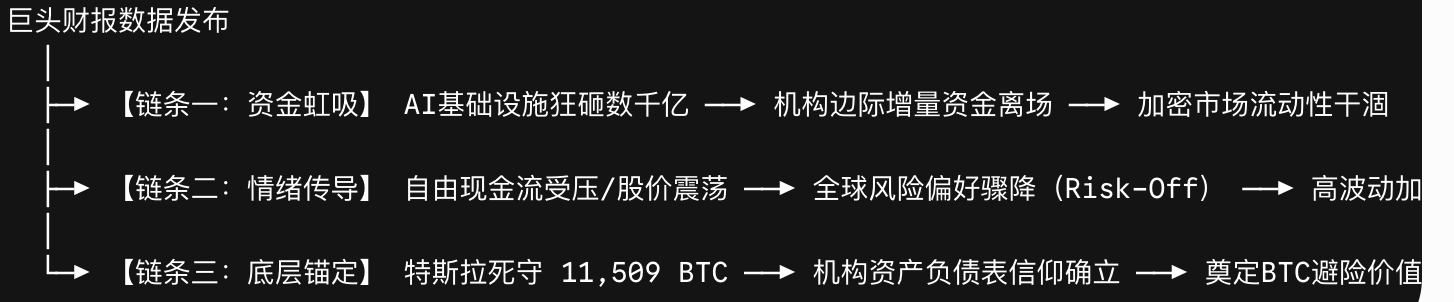
Understanding the data details of the giants' earnings reports, we can clearly outline the three logical chains through which US stock earnings transmit to the cryptocurrency (Crypto) market:
Chain One: Capital Absorption Effect ("Giants Dry Up Liquidity") The liquidity in financial markets is limited in quantity and seeks risk-return ratios. Microsoft, Meta, and Amazon's capital expenditures in a single quarter of hundreds of billions indicate that a large amount of global institutional capital is being attracted to these traditional AI infrastructures with tangible business income and substantial asset backing. When US stock giants show strong demand for AI infrastructure construction, traditional fund managers are more inclined to allocate funds to Nvidia, TSMC, Microsoft, and other "AI shovel sellers," or to invest in high-yield US Treasury bonds with highly certain annual returns. Marginal incremental funds that originally belonged to the cryptocurrency market (especially small chains and altcoins) are mercilessly "siphoned off" by the tidal wave of the giants' capital expenditures.
Chain Two: Risk Appetite (Risk-On / Risk-Off) Transmission and Impact Companies like Meta and Microsoft have suppressed short-term free cash flow due to excessive capital expenditures, raising doubts on Wall Street about the "AI investment return ratio," leading to significant post-market stock price fluctuations. This turbulence can swiftly worsen macro financial market risk appetite. When Wall Street traders receive risk control warnings and decide to reduce the volatility of their asset portfolios, they first sell off cryptocurrencies with rich liquidity that trade 24/7, rather than US Treasuries or gold. Any negative news for US tech stocks can trigger equivalent or even amplified turbulence in the crypto market.
Chain Three: Asset-Liability Representation Effect ("Pillar of Stability") Despite the decline in profit margins and pressures on the automotive business, Tesla unwaveringly retains its 11,509 BTC. This data provides a "psychological support" at the bottom for the entire crypto market. It proves that Bitcoin is no longer viewed by traditional companies as a purely speculative offshore asset that can be "cut and sold at any time" as it was in 2017 or 2021, but has become a line of defense alongside cash and short-term Treasury bonds on the balance sheets of giants. This demonstration effect directly disrupts the market's biggest fear of an "enterprise selling wave."
3. Market Divergence: How Are Major Cryptocurrencies Affected by the Earnings Storm?
The liquidity redistribution triggered by US stock earnings does not apply to all cryptocurrencies "in one fell swoop." Different crypto assets have displayed drastically different fates in this round of turmoil:
1. Bitcoin (BTC): Digital Gold and Macro Anchor
- Impact Mechanism and Performance: Tesla's unchanged position provides strong bottom support, but the decline in macro risk appetite leads to short-term fluctuations following US tech stock movements.
- Trend Qualitative Assessment: Long Strong, Short Volatile. The macro hedging and institutional asset reserve attributes further consolidate; severe short-term retracement does not alter the medium to long-term trend.
2. Decentralized Computing and AI Sector (TAO, RNDR, AKT, NEAR)
- Impact Mechanism and Performance: The giants' earnings reveal an extreme demand for cloud computing and GPUs, strongly validating the logic of decentralized rendering and computing power leasing.
- Trend Qualitative Assessment: Counter-Trend Explosion and Strong Fundamentals. Funds are transitioning from purely speculative hype to genuine business projects aligned with traditional AI computing demand.
3. Fundamental Smart Contract Layer Public Chains (ETH, SOL, AVAX)
- Impact Mechanism and Performance: They are most significantly impacted by the withdrawal of incremental funds from US stocks, as public chains lack new ecological breakout points to digest liquidity depletion.
- Trend Qualitative Assessment: Wide-Ranging Fluctuations and Follower to the Index. Heavily pressured by funds, requiring signals of macro interest rate cuts and ETF fund inflows to wait for recovery.
4. Pure Concept and Altcoins (Non-Business MEME Coins, Low-Quality Altcoins)
- Impact Mechanism and Performance: With the onset of institutional risk-off sentiments, liquidity first retreats from projects without fundamental support.
- Trend Qualitative Assessment: Continuous Decline and Severe Bloodletting. Lacking cash flow and practical scenarios, these are at risk of going to zero due to liquidity exhaustion.
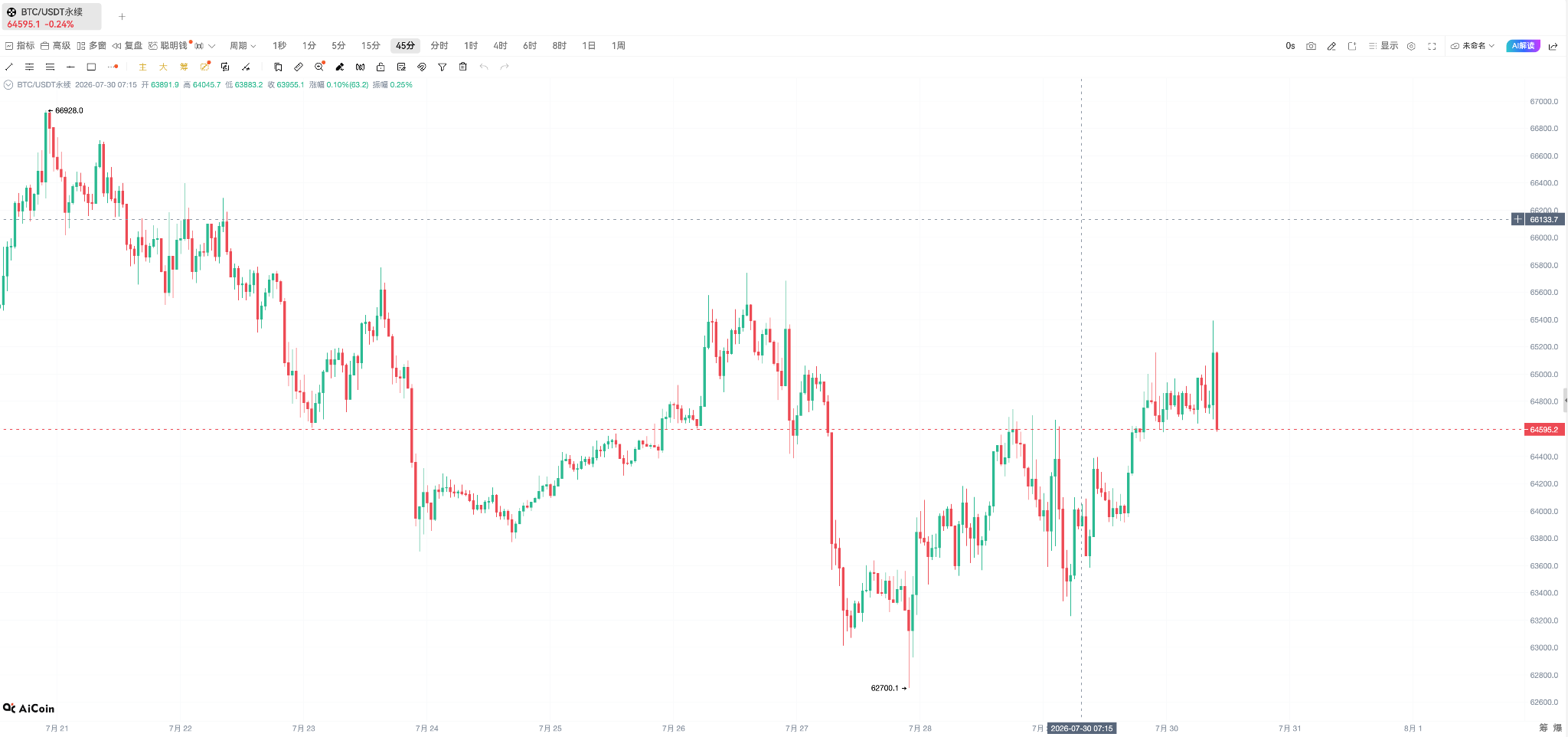
4. Trading Mindset in the Eye of the Storm: How Can Novices Avoid Severe Liquidations?
In the face of the highly correlated and increasingly volatile environment of US stocks and cryptocurrencies, investors must quickly adjust their trading mindset and strategies:
1. Completely Abandon the Illusion of "Crypto Decoupling"
It must be understood deeply: The cryptocurrency market has never been an island. With the landing of spot ETFs and traditional multinational giants incorporating BTC into their balance sheets, cryptocurrency market liquidity has tightly intertwined with US tech stocks and Federal Reserve interest rate policies. Closely monitoring the earnings reports of giants, macro interest rates, and Wall Street's capital expenditures is essential for every qualified investor.
2. Strictly Control Leverage to Prevent "Two-Way Liquidation" on Earnings Day
Before and after the release of US stock earnings (especially after the market and during the next day’s opening), the 5%-10% volatility in tech stocks can transmit to the cryptocurrency contract market, often amplified into 20%-50% wild spike events. During a concentrated earnings week, any high leverage (over 5 times) is tantamount to giving money to the big players. The market is prone to experiencing "liquidation of longs under negative news, followed by quick spikes to eliminate shorts," resulting in two-way liquidation trends.
3. Shift from "Air Hype" to "Fundamentals and Narrative Anchoring"
The earnings reports of US giants showcase an extreme pursuit of "real profits, cash flow, and core technology infrastructure" to the global capital. This logic also applies to the crypto market. Investors should timely eliminate "air altcoins" that lack users, revenue, and ecology, directing their attention toward top-tier assets capable of satisfying actual AI computing demand (DePIN) and those with high token burn rates or strong institutional holdings.
4. Maintain "Cash is King," and DCA Rather Than Going All In
When US stock giants see their stock prices decline due to excessive capital expenditures, dragging the crypto market down, it often signals not the end of the world, but a process of market bubble deflation and value bottom reshaping. Keeping 30%-50% of stablecoin cash flow (USDT/USDC) on hand and not betting on one-sided moves or going all in at once, allows for the flexibility to gradually bottom-feed quality assets when macro risk appetite retracts, seizing "golden pits."

🎁 AiCoin Exclusive Registration Benefits Are Here!
Register through the AiCoin exclusive link to receive a permanent 20% rebate at OKX
👉 Register OKX now:
https://jump.do/zh-Hans/xlink?checkProxy=true&proxyId=2
📢 Join the AiCoin community to stay updated on new tokens from exchanges and earning information
Official Telegram community:
AiCoin Chinese Twitter:
OKX Benefits Group:
https://aicoin.com/link/chat?cid=l61eM4owQ

The concentrated earnings period of US stock giants is a process of global macro funds re-evaluating and reshuffling risk assets. The giants' massive AI capital expenditures not only drained short-term market liquidity but also validated the future of decentralized computing power and technology narratives at the underlying logic level. A clear understanding of the real flow of funds behind the financial data, while safeguarding a risk baseline without high leverage, is crucial for achieving steady asset appreciation amid the intertwining storm of US stocks and the cryptocurrency sphere.
The content of this article represents the author's personal views and does not reflect the stance of this platform. The views, conclusions, and suggestions in the text are for investors' reference only and do not constitute any investment advice related to this platform. Markets have risks; investment needs caution.
免责声明:本文章仅代表作者个人观点,不代表本平台的立场和观点。本文章仅供信息分享,不构成对任何人的任何投资建议。用户与作者之间的任何争议,与本平台无关。如网页中刊载的文章或图片涉及侵权,请提供相关的权利证明和身份证明发送邮件到support@aicoin.com,本平台相关工作人员将会进行核查。