Written by: Jamie Redman
Translated by: Blockchain in Plain Language

In 2026, Saylor's Strategy Remains Significantly Ahead
Strategy, the world's largest corporate holder of bitcoin founded by Michael Saylor, still leads with 843,775 bitcoins on its balance sheet. At current prices, this amounts to approximately $5.8 billion, spread across a company that now almost entirely finances further bitcoin purchases through the issuance of debt and equity.
However, in 2026, the scale of a company's bitcoin holdings has diverged into two completely different stories compared to its stock price movements. Mining companies are rebounding, while treasury companies are being punished.
The following top ten list, compiled from data by bitcointreasuries.net, lists the ten companies with the largest bitcoin holdings as of July 25, 2026.
Top 10 Corporate Bitcoin Holders
- Strategy (MSTR): 843,775 BTC
- Twenty One Capital (XXI): 43,514 BTC
- Metaplanet (MPJPY): 43,000 BTC
- Mara Holdings (MARA): 36,303 BTC
- Bullish (BLSH): 24,300 BTC
- Strive (ASST): 19,921 BTC
- SpaceX (SPCX): 18,712 BTC
- Coinbase Global (COIN): 16,492 BTC
- Riot Platforms (RIOT): 15,680 BTC
- Cleanspark (CLSK): 13,924 BTC
The lead of Strategy is unshakeable. Its holdings of approximately 843,775 BTC are over 19 times that of the second place holder, Twenty One Capital. Saylor began buying bitcoin for the company, which was then known as Microstrategy, in 2020, at a time when it seemed unconventional for a Nasdaq-listed software company to convert its treasury assets into bitcoin.
Five years later, this decision has reshaped the company. The current trading performance of Strategy largely reflects a high-leverage bet on bitcoin prices, which explains why the company's stock still dropped 40% in 2026, even as its bitcoin holdings continued to increase. This year, Strategy abandoned its long-held "never sell" policy, which makes this change particularly noteworthy after years of considering each bitcoin purchase as a permanent hold.
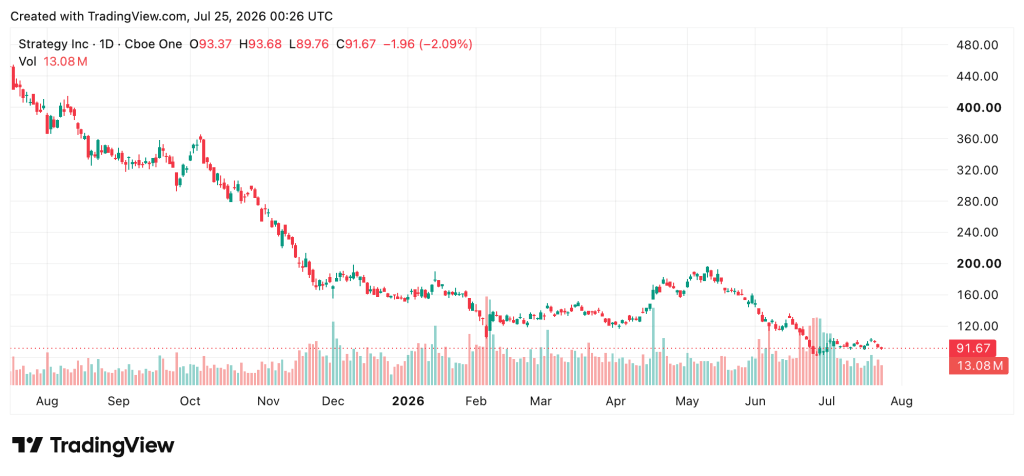
Stock performance of Strategy (MSTR) as of July 24, 2026
The company sold 32 bitcoins for the first time in late May to fund preferred stock dividend payments, marking its first net sale of bitcoin in years. A few weeks later, between late June and early July, it sold another 3,588 bitcoins, realizing about $216 million to fulfill stock-related obligations and replenish cash on its balance sheet. Even after these transactions, Strategy remains the world's largest corporate bitcoin holder and retains a significant advantage, indicating that these sales reflect capital management rather than a deviation from its long-term bitcoin strategy.
Mining Companies Win in the Stock Market
Step aside from the original total bitcoin amount, as a clearer pattern emerges from stock prices. Mining companies are performing strongly, while those only holding bitcoin as treasury assets are not.
The reasons are straightforward. First, mining companies can accumulate bitcoin at production costs often below current market prices, giving them an advantage that most corporate buyers cannot match. Second, many publicly listed mining companies have invested in building artificial intelligence (AI) infrastructure over the past few years, creating a second line of business that helps diversify income beyond bitcoin mining.
For example, Riot Platforms has risen 73% year-to-date, performing the best among the top ten holders. Cleanspark's stock has increased by 39% as it expands mining data centers and battery storage projects in North America. Mara Holdings has risen 31%, continuing to expand its mining footprint while maintaining a bitcoin holding of 36,303 BTC.
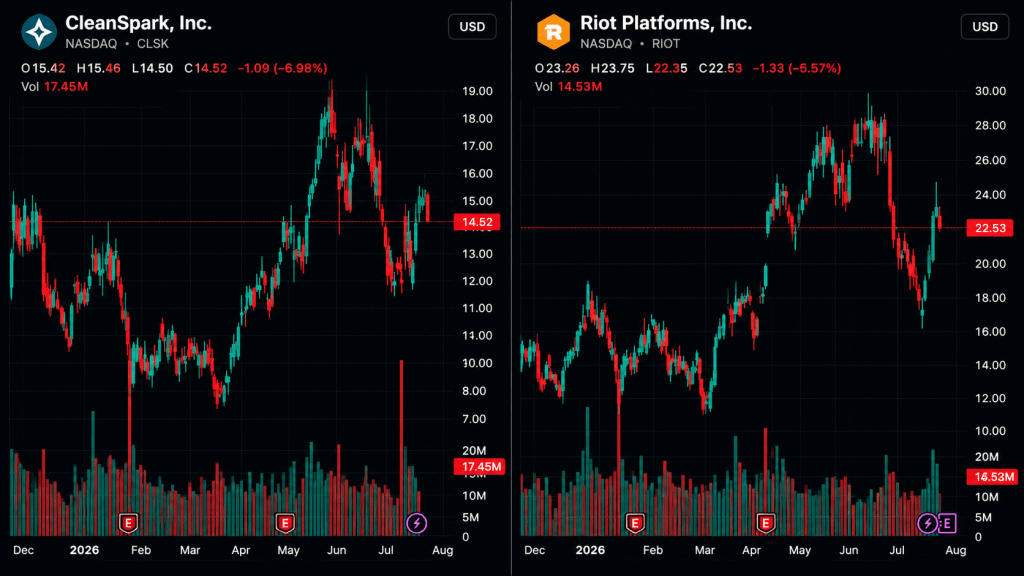
Charts of Cleanspark and Riot, data from tradingview.com
Twenty One Capital (XXI) was established in March 2025 but has quickly become the second-largest corporate bitcoin holder. This Austin-based company received backing from cryptocurrency powerhouses, including Tether, initially led by entrepreneur Jack Mallers, who departed last week. Its entire business model revolves around providing direct exposure to bitcoin prices for stock market investors without the software or mining operations other listed companies possess.
Metaplanet, a Tokyo-listed company transformed from hotel development, has seen its stock decline by 49% as of July 25, 2026. The company still holds 43,000 BTC, ranking third on the list, but its stock price movements closely mirrored those of bitcoin. As of Friday's close, Twenty One Capital, despite having the second-largest reserve on the list (43,514 BTC), has decreased by 48% this year.
Investors appear to reward those companies that can produce bitcoin and provide AI infrastructure over those simply purchasing and holding BTC, especially when these holding companies rely on issuing new stocks or debt to continue increasing reserves. Mining companies have years of experience, and some can control their production costs. In contrast, treasury companies depend on capital markets remaining open and willing to finance their additional procurement as stock prices drop and dilution risks increase.
The two names in the middle of the list illustrate how severe this year's differentiation has been. Bullish, a Cayman Islands trading platform operator listed through a SPAC agreement in August 2025, holds 24,300 BTC, but its stock has dropped 37% due to low cryptocurrency trading volumes and losses related to negative equity.
Strive, a Dallas asset management company built around bitcoin treasury, holds 19,921 BTC and has experienced a relatively mild decline of 24% since the beginning of the year. These two companies highlight that even within the group of treasury companies, the extent of decline largely depends on how each company finances its bitcoin purchases and how much debt is incurred behind that strategy.
Coinbase and Riot Platforms sit closely on the holdings list but tell starkly different stories on the stock price chart. Coinbase, a San Francisco trading platform founded by Brian Armstrong, holds 16,492 BTC, but its stock has fallen 31% this year as industry trading volumes cool. Riot Platforms holds slightly fewer bitcoins at 15,680 BTC, but due to its core business of producing new coins rather than merely holding them on its balance sheet, its stock has surged by 83.4%.
SpaceX Joins the List After Historic IPO
SpaceX's position on this list differs significantly from where it was during its initial public offering (IPO). The company completed its IPO on June 12, 2026, at an issue price of $135, raising approximately $85.7 billion, setting the record for the largest IPO in history, surpassing Saudi Aramco's listing record in 2019. The stock began trading on Nasdaq under the ticker SPCX, opening at $150, and briefly drove SpaceX's market capitalization over $2.6 trillion during a spike to $225.64 on June 16. However, this surge did not hold.
By mid-July, the stock price fell below the IPO issue price, and as of the close on July 24, the trading price was around $115, about 15% lower than the issue price and down 45% to 50% from the June high. SpaceX disclosed in its IPO filing that it holds 18,712 BTC, valued at about $1.45 billion at that time, and even as its stock price has dramatically cooled since its debut, this holding remains ahead of Coinbase, Riot Platforms, and Cleanspark on the bitcoin holdings list.
A Tokyo Hotel Company Transitions into a Bitcoin Treasury
The story of Metaplanet is the most distinctive entry on this list. Founded in 1999, the company has spent most of its history developing and managing hotels in Japan. It only began accumulating bitcoin in recent years and announced plans to hold the asset long-term on the Tokyo stock exchange. This transformation has made Metaplanet the third-largest corporate bitcoin holder globally, with 43,000 BTC, although its stock has similarly struggled under wider bitcoin price fluctuations in 2026. Its bitcoin treasury holdings have reached a level unattainable by other publicly listed companies in Japan.
How This Model Spreads
Strategy's approach has not remained unique for long. Once Saylor proved that public companies could specially raise funds to purchase bitcoin and allow their stock prices to be valued at a premium compared to these holdings, other companies began to emulate the model. Some companies (like Metaplanet and Twenty One Capital) built entire business models around the same concept. Others (like the mining companies on the list) added bitcoin purchases on top of businesses that could already produce the asset. This initial difference helps explain why, despite every company on the list being exposed to the same underlying bitcoin price risk, the group has diverged into such dramatic winners and losers this year.
What the Future Means
This differentiation between mining and treasury companies may continue to shape how investors treat bitcoin concept stocks for the remainder of 2026. Self-mining companies can control production costs and scale up when conditions are favorable. In contrast, companies that simply purchase bitcoin rely on capital markets to remain open, and when stock prices drop and dilution risks increase, these financing channels can quickly tighten.
As it stands, the ten companies on this list hold more bitcoin than most government entities. Their joint decision on whether to continue purchasing, start selling, or change strategies will continue to influence the cryptocurrency market and their own stock prices, with implications that extend far beyond July 2026. For everyday market observers watching bitcoin from the sidelines, the stocks of these digital asset treasury (DAT) companies provide a window into how publicly traded companies manage large bitcoin treasuries and how the market responds to these strategies.
Whether this risk brings returns will ultimately come down to the same dividing line that delineated this list today: the distinction between companies that produce bitcoin and those that merely buy bitcoin.
免责声明:本文章仅代表作者个人观点,不代表本平台的立场和观点。本文章仅供信息分享,不构成对任何人的任何投资建议。用户与作者之间的任何争议,与本平台无关。如网页中刊载的文章或图片涉及侵权,请提供相关的权利证明和身份证明发送邮件到support@aicoin.com,本平台相关工作人员将会进行核查。


