Options Mini Class (Five) Why Put Spread is More Suitable Now than Directly Buying Put for the Volatile US and Korean Stocks
Many friends know that I have been shorting SK Hynix recently. In fact, it's not just shorting; I have also considered how to obtain more stable returns through options, especially after the margin and options were introduced on @BITstocks_CN. I used some leverage through margin to try directional trading and option spreads.
Particularly for stocks like SK Hynix, it is not uncommon for them to rise or fall by over ten percent in a single day. The greater the market volatility, the more people buy puts, and naturally, the price of puts will increase.
So at this time, continuing to be bearish and directly buying puts may not be the most cost-effective option. Because not only do you need to judge that SK Hynix will decline, but you also need to predict how much it can drop before the options expire to cover the premium.
Therefore, if you think SK Hynix will continue to fall, you can try using a Bear Put Spread, which is a put spread strategy.
So what is a Bear Put Spread?
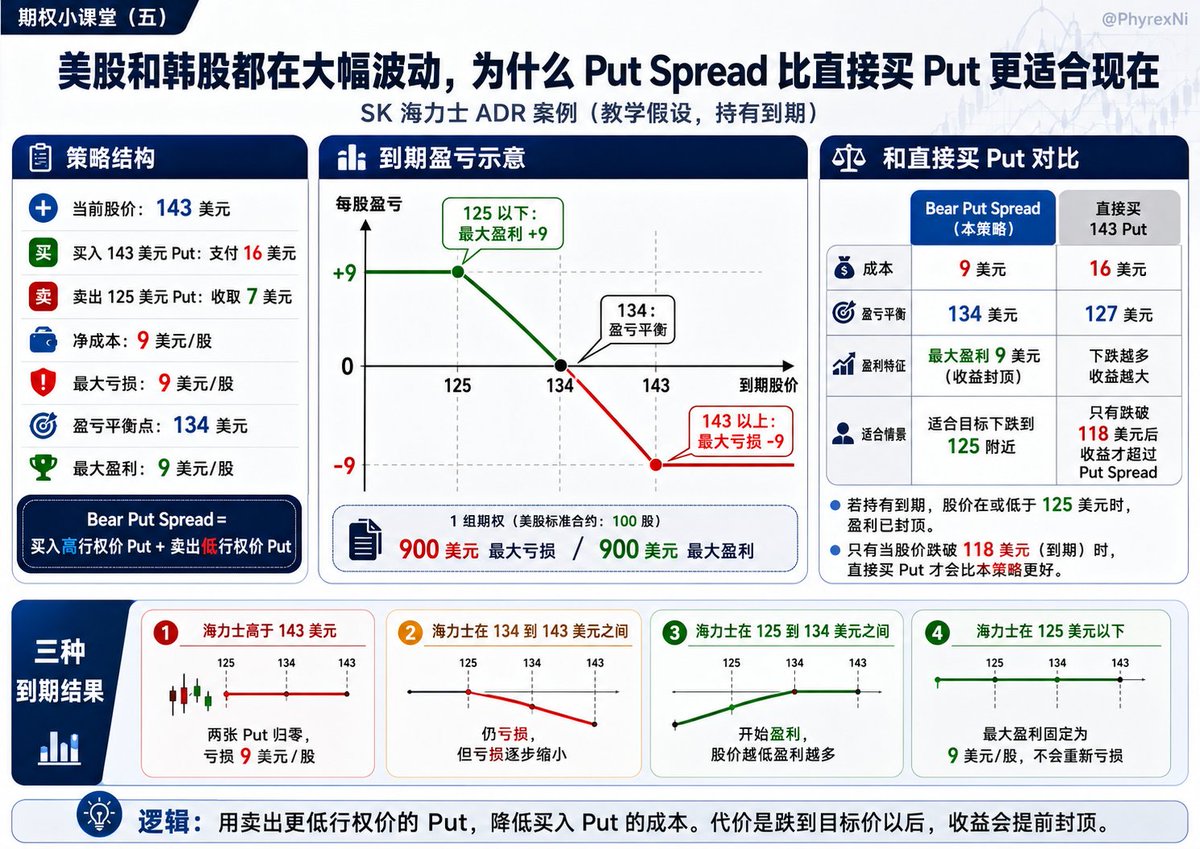
A Bear Put Spread is generally referred to in Chinese as a Put Spread, and it is not a single option but rather a combination of two puts with different strike prices traded together. You buy one put with a higher strike price and simultaneously sell one put with a lower strike price. Both puts must be for the same stock, have the same expiration date, and the same quantity, differing only in their strike prices.
For example, SK Hynix ADR is currently at 143 USD.
If I believe SK Hynix will continue to drop but expect it will fall to around 125 USD within a week.
At this time, you can buy one put with a strike price of 143 USD and sell one put with a strike price of 125 USD.
Assuming that buying the 143 USD put costs 16 USD in premium, and selling the 125 USD put brings in 7 USD in premium, the effective cost of the entire combination is:
16 - 7 = 9 USD.
This means that the maximum loss per share for the entire combination is 9 USD.
In other words, originally, buying the 143 USD put required paying 16 USD for a decline insurance. Now, by selling the 125 USD put, you receive 7 USD back, so you only need to pay 9 USD in the end.
But those 7 USD are certainly not free.
If SK Hynix falls below 125 USD, the subsequent gains will not continue to increase.
Because after SK Hynix falls below 125 USD, the purchased 143 USD put will continue to profit, but the sold 125 USD put will start to lose money, with the changes on both sides offsetting each other.
At expiration, there will mainly be three outcomes.
First, if the price of SK Hynix is above 143 USD.
Both puts become worthless, and my maximum loss is 9 USD per share.
Second, if SK Hynix falls to 134 USD (below 143 USD, above 125 USD).
The purchased 143 USD put is worth 9 USD, while the sold 125 USD put still holds no value.
The 9 USD option value perfectly covers the initial 9 USD cost, so the entire combination breaks even.
The breakeven point for this Put Spread is 134 USD, meaning if SK Hynix falls below 134 USD, I will be in profit.
Third, if SK Hynix drops to 125 USD or lower.
The 143 USD put is worth at least 18 USD, and after deducting the initial 9 USD cost, I can earn 9 USD per share.
However, after SK Hynix falls below 125 USD, the profit will not continue to increase.
For example, if SK Hynix falls to 115 USD, the purchased 143 USD put is worth 28 USD, but the sold 125 USD put will incur a loss of 10 USD.
Combining the two options, the total value remains 18 USD.
After deducting the initial 9 USD cost, the final profit is still 9 USD, but if SK Hynix continues to drop, at what price will I incur a loss?
The answer is never.
As long as both puts have the same quantity, the same expiration date, and are held until expiration, after SK Hynix falls below 125 USD, whether it drops to 115 USD, 100 USD, or even lower, this Bear Put Spread will not turn into a loss.
The profit will only be fixed at 9 USD per share.
The principle is simple; there is an 18 USD difference between 143 USD and 125 USD.
After SK Hynix falls below 125 USD, both the purchased 143 USD put and the sold 125 USD put will be in-the-money, and the value difference between the two puts will always be 18 USD.
The combined value at expiration is fixed at 18 USD; after deducting the initial 9 USD cost, the maximum profit is 9 USD.
So the complete profit and loss range for this Bear Put Spread is:
If SK Hynix is above 143 USD, the maximum loss is 9 USD per share.
If SK Hynix is between 134 USD and 143 USD, there will still be a loss, but the loss will gradually decrease as the stock price falls.
If SK Hynix is between 125 USD and 134 USD, it begins to be profitable; the lower the stock price, the more profit.
If SK Hynix is below 125 USD, it reaches the maximum profit of 9 USD per share, and thereafter, the profit will not increase further, nor will it turn into a loss.
Summary
Overall, if I believe SK Hynix might experience a collapse far exceeding market expectations, dropping directly below 118 USD or even lower, then directly buying a Put would yield more profit.
But if I think SK Hynix will fall, with the main target around 125 USD, then the Bear Put Spread is naturally more suitable, as it has lower costs and a higher breakeven point.
The advantage of Bear Put Spread is that by selling a put with a lower strike price, it reduces the cost of purchasing insurance and also lowers the requirements for the extent of the decline. The trade-off is that after hitting the target price, the subsequent gains will be capped.
Therefore, Bear Put Spread is more suitable for investors who believe the stock will continue to decline but can roughly determine the downward target.
免责声明:本文章仅代表作者个人观点,不代表本平台的立场和观点。本文章仅供信息分享,不构成对任何人的任何投资建议。用户与作者之间的任何争议,与本平台无关。如网页中刊载的文章或图片涉及侵权,请提供相关的权利证明和身份证明发送邮件到support@aicoin.com,本平台相关工作人员将会进行核查。


