Author: Jae, PANews
In the past month, a number of noteworthy new products and infrastructure upgrades have emerged in the DeFi space.
From privacy trading to RWA compliance, from fixed-rate lending to on-chain trading experiences, multiple leading protocols are exploring key aspects of on-chain financial development, attempting to address core issues that have long constrained the scalability of DeFi.
All these evolutions point towards a common trend: the focus of DeFi competition is gradually shifting from the early growth model centered around liquidity and yield, towards long-term construction of financial infrastructure capabilities.
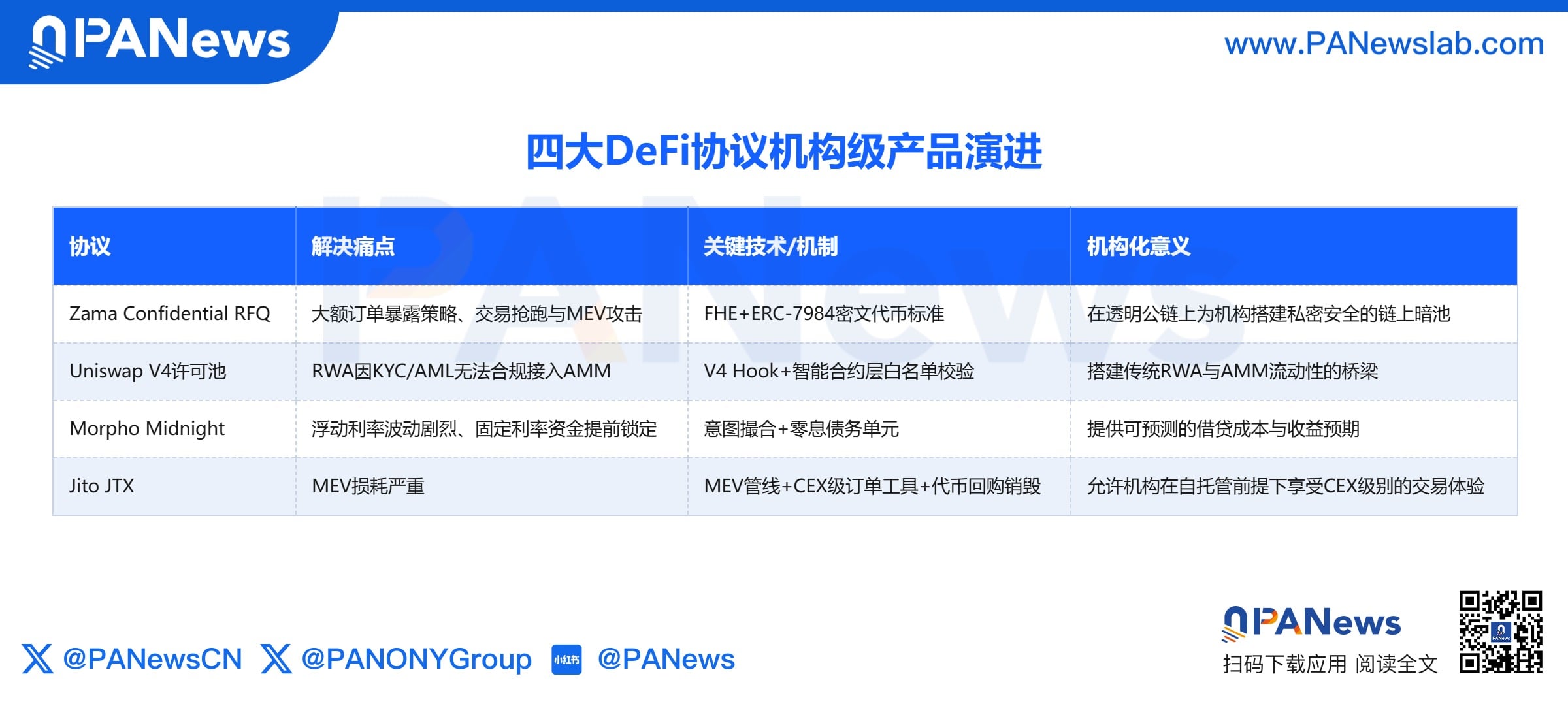
This article will review the latest developments of four major DeFi protocols: Zama, Uniswap, Morpho, and Jito, and will analyze the industry significance and potential challenges behind their product innovations.
Zama Confidential RFQ: FHE Exploration of On-Chain Large Transaction "Dark Pools"
Transparency is one of the most commendable characteristics of blockchain, but it is also a double-edged sword. Publicly verifiable ledgers ensure trustworthiness, but also lay bare large transactions. As soon as a large order hits the public chain, it can be targeted by MEV (Maximum Extractable Value) bots, leading to frontrunning and sandwich attacks, which consume most of the trading profits and even expose trading strategies.
Traditional financial markets have dark pools to resolve such issues, whereas on-chain there has always been a lack of genuinely trustless privacy trading solutions.
On July 24, the privacy computing protocol Zama announced the launch of the Confidential RFQ (Request for Quotation) based on Fully Homomorphic Encryption (FHE), providing a solution for large on-chain transactions similar to traditional financial dark pools.
The protocol adopts the ERC-7984 encrypted token standard, allowing institutions and professional market makers to conduct large on-chain transactions through "Sealed-bid Auction" methods. Throughout the entire inquiry and matching process, transaction size, buy/sell direction, asset type, and even slippage settings remain encrypted, preventing network nodes and trading counterparties from knowing the complete parameters of the order before quoting.
The secret lies in FHE (Fully Homomorphic Encryption), which allows mathematical computations on encrypted data without needing to decrypt it to verify the validity of transactions. This means that future on-chain trading may be able to simultaneously ensure privacy protection and verifiability, allowing large institutional orders to be executed securely on-chain.
However, FHE is still facing two major hurdles before large-scale application can be realized.
Performance Bottlenecks: The computational overhead of FHE encryption is significantly higher than that of plaintext transactions; even with years of algorithm optimization, the computation delays and gas consumption on the Ethereum mainnet remain significantly higher than that of ordinary transactions. It is still uncertain whether it can support large-scale high-frequency inquiries.
Regulatory Games: Traditional financial dark pools are already under heavy regulatory scrutiny, and the appearance of on-chain dark pools may trigger reviews by financial regulators in various countries regarding anti-money laundering and market manipulation.
Therefore, finding a balance between on-chain privacy protection and regulatory transparency requirements will remain an ongoing issue that needs to be addressed in the future for large-scale applications of privacy computing.
Uniswap V4 Permissioned Pools: Exploring Compliance Paths for RWA Into AMM
The tokenization of real-world assets (RWA) is widely regarded as the next high-growth market in the cryptocurrency industry, but compliant assets such as U.S. Treasuries, U.S. stocks, and institutional funds have been stuck in the awkward position of “having assets but low liquidity” on-chain. An important reason is that traditional financial assets need to meet KYC/AML compliance requirements, while DeFi AMMs (automated market makers) inherently emphasize "permissionless and anonymity".
On July 23, decentralized exchange Uniswap partnered with Securitize, Superstate, and Dowgo to launch a new Hook standard on Uniswap V4: Permissioned Pools, aiming to pave the way for the trading of tokenized U.S. Treasuries, U.S. stocks, and funds on AMMs while balancing the composability of DeFi and the compliance and safety of TradFi.
The Hook is the most important innovation of Uniswap V4, allowing developers to insert custom logic at various execution points of a trade. The essence of permissioned pools is that they embed whitelist verification logic into the underlying contract: asset issuers maintain control over the whitelist. When users initiate trades or provide liquidity, the Hook will automatically verify the compliance eligibility of the wallet addresses involved, and addresses that do not pass certification will not be permitted to interact on-chain.
This means that compliance regulations have shifted from “frontend prompts” to “code constraints”. In the past, compliance often relied on frontend webpages to set KYC thresholds, but any technically savvy hacker could bypass the frontend to directly call the underlying smart contract. Now, the legal risks associated with circumventing the frontend will be eliminated, providing traditional financial assets with a compliant channel to enter the on-chain composable ecosystem.
The flip side of this is a concession on liquidity depth and the inherent spirit of DeFi.
Liquidity Fragmentation: Permissioned pools are completely isolated from public permissionless pools; funds cannot share depth across pools, creating new liquidity islands.
Centralization Risks: The control of the whitelist rests with issuers or third-party compliance service providers, leading to a de facto single point of control. Once compliance nodes are attacked or frozen by regulators, the liquidity of the funds within the pool will be directly impacted.
As RWA moves towards large-scale implementation, every player will need to make trade-offs and find balance between compliance and decentralization.
Morpho Midnight: Installing "Fixed Rate" on DeFi Lending
In traditional financial markets, fixed-rate bonds are one of the largest foundational assets. Yet in the DeFi market, dynamic interest rate models based on utilization curves have consistently dominated. For institutional investors, treasury managers, and arbitrage traders who require precise calculations of funding costs, the unpredictability of interest rates has always been a significant barrier to entry. This not only complicates fund management but also restricts the further expansion of DeFi lending products.
On July 21, the lending protocol Morpho announced the launch of its fixed-rate lending product, Morpho Midnight, on the Base chain, as a supplement to its floating rate pool Morpho Blue, specifically designed for fixed-term, fixed-rate credit markets, attempting to fill the long-missing critical piece in the DeFi credit market.
Midnight does not adopt the dynamic interest rate mechanism, nor does it rigidly impose a fixed interest rate on the frontend or liquidity pool; instead, it builds a matching system based on "intent" and discounted bonds: lenders and borrowers complete their matching through tradeable Credit/Debt units. Essentially, these units are zero-coupon bonds on-chain, locking in the expected return and repayment obligations at the moment the trade is executed, also providing institutional investors, corporate treasury management, and arbitrage traders with predictable funding costs and return expectations.
This design also addresses the common problem of low capital efficiency in fixed-rate agreements. Previous products in the same category often required funds to be locked in advance while waiting for matches, leaving unexecuted funds idle. Midnight adopts a posting model, allowing lenders to keep their posted funds in the floating rate pool to continue earning returns while waiting to be matched, essentially allowing them to "earn active returns while waiting for fixed-rate execution," significantly improving capital efficiency. Additionally, deployed on the Base network with lower gas consumption, this further reduces the secondary transfer costs of lending units, allowing users to close positions or adjust portfolios at any time based on market conditions without having to hold until maturity.
However, fixed-rate lending also faces challenges on its road to becoming mainstream financial infrastructure.
Liquidity Fragmentation: Markets with different maturities and collateral types are isolated from each other, and in the protocol's cold-start phase, if the depth of orders in various subdivided markets is insufficient, it may lead to widened bid-ask spreads, thereby increasing trading costs.
Higher Cognitive Barriers: The understanding threshold of the product is higher than that of traditional lending pools; users need to grasp the logic of bond discounts/premiums, implied annual yield calculations, and secondary market settlement rules, requiring users to have a higher level of financial understanding.
This means that Midnight is more like a tool for professional players rather than a simple lending product for regular users. From a longer-term perspective, it represents an attempt for the DeFi credit market to evolve towards a more mature financial system.
Jito JTX: Bringing CEX into Self-Custody Wallets
In the past few years, Jito has established an important position in the ecosystem with the largest LSD (Liquid Staking Derivative) protocol on Solana and MEV infrastructure. Now, it chooses to extend downstream, turning its attention to the battleground of trading terminals.
Jito has launched a self-custody trading platform JTX designed for professional traders, with the selling point being: an experience equivalent to centralized exchanges (CEX) with on-chain self-custody asset security.
The true competitive advantage lies in the underlying technology. Jito infuses its technical capabilities accumulated in Solana block construction (Block Engine) and MEV pipelines into the trading frontend. This means that orders on JTX will receive better trade ordering, lower failure rates, and significantly reduce common issues found on ordinary DEXs such as sandwich attacks, excessive slippage, and trades being stuck. If this model succeeds, on-chain trading may further bridge the experience gap with CEXs.
More notably is its token economic design: 80% of the platform's trading fees will be used to repurchase and destroy JTO, creating sustainable cash flow and deflationary support for the token, strengthening the value capture ability of the protocol token.
However, JTX faces challenges in breaking through the trading terminal space.
Ravenous Competition: On the Solana chain, Jupiter occupies the vast majority of traffic due to its aggregator advantage, while products like Photon and Axiom have their supporters, and pump.fun along with various Telegram trading bots have also captured a significant amount of retail traders. Transitioning from infrastructure to frontend products, JTX faces severe challenges in user acquisition and retention.
Network Stability Doubts: Solana has historically experienced multiple instances of network congestion and outages. Under extreme conditions, whether JTX’s trading system can maintain execution quality remains to be tested.
Therefore, the significance of JTX may not only be the introduction of a new trading entry point but also in exploring a new on-chain trading paradigm, namely whether infrastructure providers can further evolve towards user terminals.
Conclusion
It is clear that recent developments in the DeFi space are covering multiple key aspects of on-chain financial development. This means that the future focus of DeFi competition will not just be higher yields, larger liquidity scales or shorter-term market incentives, but will revolve around the capability of financial infrastructure.
Privacy protection determines whether funds are willing to enter the on-chain environment, compliance capabilities decide whether traditional assets can achieve scalable liquidity, interest rate certainty affects institutional capital allocation efficiency, while trading experience determines whether users are willing to stay on-chain for the long term.
Of course, the evolution of DeFi infrastructure still faces numerous challenges. Technical performance, regulatory requirements, liquidity fragmentation, and user habits will all become limiting factors for the next stage of development.
However, it cannot be denied that DeFi is gradually shedding its position as an early financial experiment and is continuously evolving towards a more mature and complete on-chain financial infrastructure.
免责声明:本文章仅代表作者个人观点,不代表本平台的立场和观点。本文章仅供信息分享,不构成对任何人的任何投资建议。用户与作者之间的任何争议,与本平台无关。如网页中刊载的文章或图片涉及侵权,请提供相关的权利证明和身份证明发送邮件到support@aicoin.com,本平台相关工作人员将会进行核查。


