After the sustained optimism was broken, we may need to start worrying about risks.
Written by: Cookie
The last major incident on Robinhood's blockchain involving a "hacker stealing social media accounts for a rug pull" occurred on July 13. The hacker stole the X account of SpaceXAI, certified an account mocking Sam Altman, and retweeted a post.
Such events of hackers stealing accounts to issue tokens are often seen as signals of a short-term market peak, but at that time, we believed it was a normal short-term pullback, reason being that $CASHCAT had only taken 4 days to rise dramatically from a market cap of $15 million to $230 million; a pullback was expected. As a new chain that can inherently provide players with imaginative space, there are still other angles waiting to be developed. It may be a bit early to say that the overall market has peaked.
This time, it was Robinhood CEO Vlad's X account that was stolen. The hacker used Vlad's account to declare "Vladhood" as the mascot of Robinhood's blockchain, and mentioned that this token would go live on the Robinhood App.
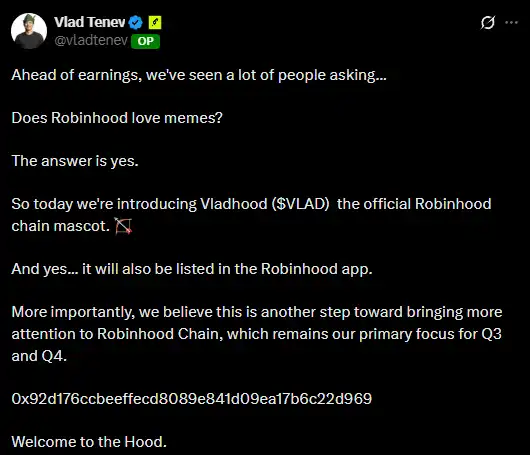
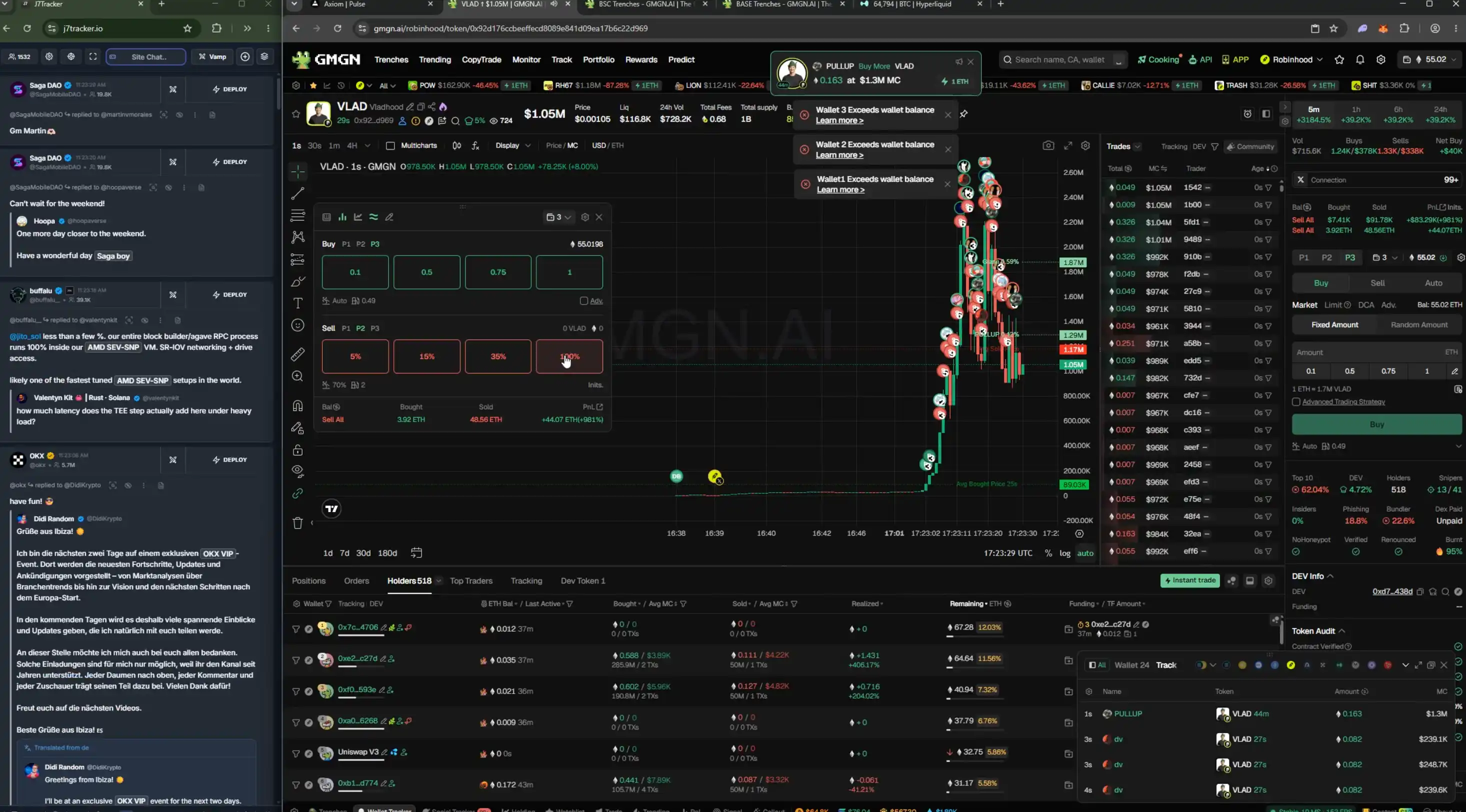
When people saw this token with a specific contract address, they immediately guessed it was a stolen account, but everyone hurriedly jumped in anyway. As long as Vlad hadn’t realized to delete the tweet, it was a time of market speculation. Like before, another small fortune story emerged from fast fingers; @iso1000x shared that he immediately monitored Vlad's profile picture change, quickly searched for the ticker through GMGN, and bought in, turning 4 ETH (about $7,400) into 48.6 ETH (about $91,780) in less than 30 seconds. Just a few clicks of a mouse, earning $80,000.
But the matter did not end there. Although Vlad's account later deleted the hacker's tweet with the contract address, the hacker's changed profile picture remained, leading the market to wonder if this subtle action was intentional. Many players wanted to take a bet, hoping Vlad would treat this like CZ did with $4, where a supportive tweet for the CTO turned the hacker's rug pull into a community token that was then FOMO'd to a market cap of over $100 million.
The suspense lasted until 10 AM, when Vlad finally changed his profile picture back. At that point, the hacker token crashed from a market cap of $4 million down to under $1 million in one big candle.
Here we need to analyze the logic. Saying "hacker stealing an account to issue a token" is a clear sign of a peak certainly belongs purely to the realm of impressions. So, this time, we think we need to be more concerned about what exactly we should worry about regarding the pullback?
Speculating this Vlad hacker token as Robinhood's $4 is a form of "excessive optimism of carving a boat to seek a sword." Once this excessive optimism is broken, it might affect the sustainability of short-term sentiment, which is the core reason we are starting to worry about risks.
Looking back at what happened during the time of $4, a bit earlier, He Yi was personally pushing the Binance wallet, and we could always see the humble customer service representative Xiao He appearing in the X timeline asking for experience with the Binance wallet. A little later, the Binance life brought a Chinese ticker to kick off a BSC bull market.
Saying that the account theft back then was all part of Binance's arrangement might be a bit too conspiracy theory-like, but the follow-up tweet supporting the $4 CTO surely had a certain intent of promoting the Binance wallet's market capture. Generally, when incidents of account theft occur involving token issues, big companies definitely think a lot more than we retail investors do. What may seem to us as simply a supportive tweet for the CTO, with just a few keystrokes, could lead to a bunch of retail investors making a fortune. But have we thought about some basic questions, like what the chip structure is like? What if this tweet goes out, and the price rises quickly, only to crash right after? Who will clean up this mess?
Many coincidences, when thought through carefully, might not just be coincidences. After Trump's token issuance, there were many occurrences of theft for token issuance. Accounts like Nasdaq and NASA were hacked to issue tokens, all ending without any explanation - the tweet was sent by the hacker, and the buy button was pressed by retail investors themselves; the more you explain, the messier it gets.
This is the normal reaction, and Robinhood's response is quite similar in principle. On the Robinhood Wallet, searching for the Vlad hacker token by name or contract address yields no results, as it is blocked. On Uniswap, this token has also been blacklisted, preventing trading.
Under Robinhood's official stance, the probability of it becoming another $4 is very low - on the surface, $4 was betting on having a CTO + getting CZ's support, but in reality, the only substance of the above two coincidences is an officially sanctioned setup. Otherwise, it's easy for someone to act as a CTO; the problem is that if the CTO does not gain recognition and support, and there is no conspiratorial funding behind it, no matter how you C, how you T, how you O, the price won’t rise.
The collapse of this optimistic sentiment may lead everyone to "cool down" and return to a more rational state instead of fearing missing out on any gambling to make money and FOMOing. We always say, as the market plays on, everyone starts to "act like Tang," and there are reasons for this.
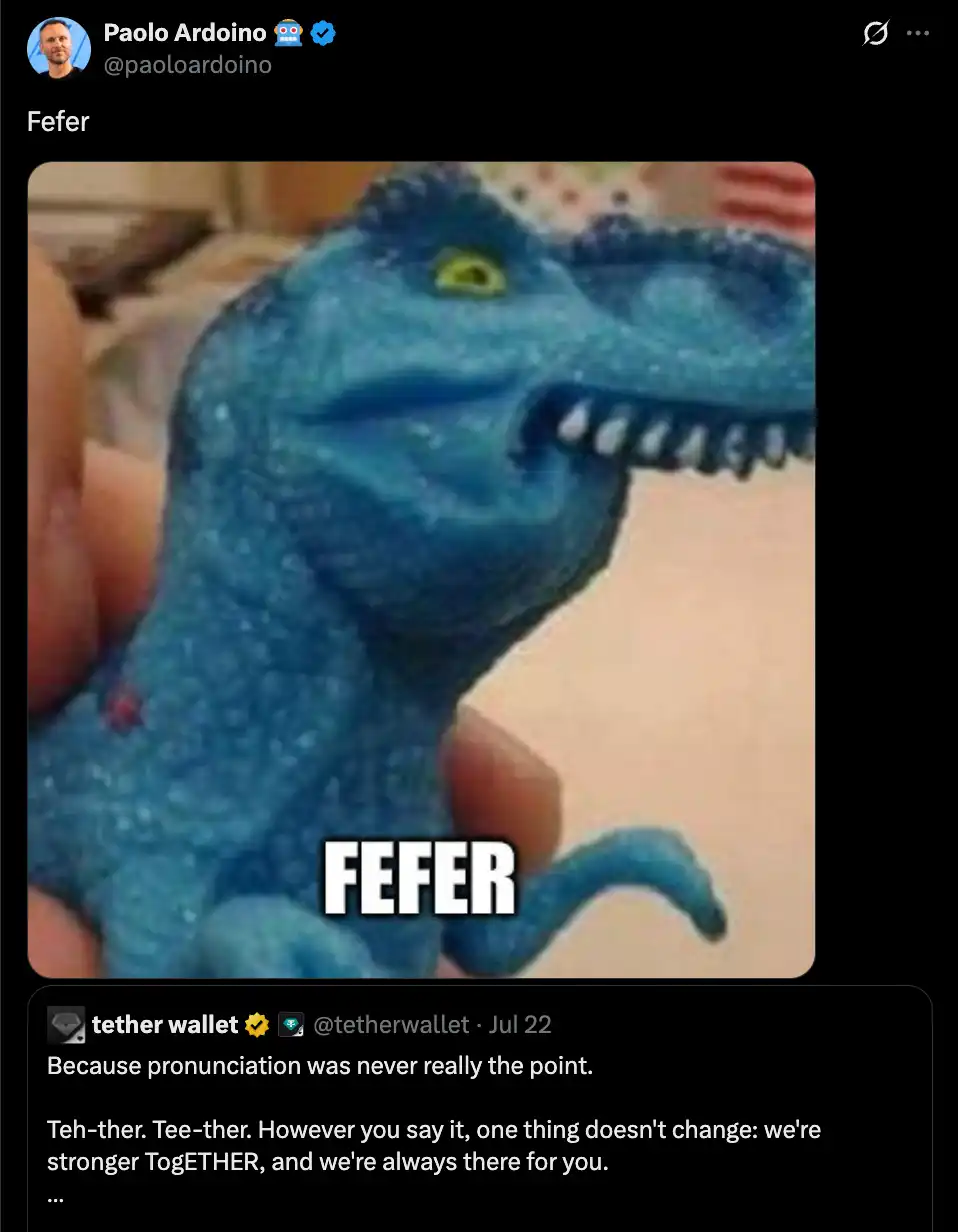
Another thing that happened yesterday was that the Stable chain released a meme $FEFER that once surpassed a market cap of $10 million. The cause was Tether CEO Paolo Ardoino quoting a Tether Wallet tweet that gathered many different pronunciations of the word Tether from videos around the globe, jokingly referring to the pronunciation as "Fefer," accompanying it with a dinosaur toy meme.
Then, yesterday afternoon, a time of extreme FOMO began. Bridges like relay became overloaded, and everyone was asking where they could still bridge funds over. The Stable chain, which had previously been almost a ghost chain, suddenly attracted so many meme players that it exploded. The officials were surprisingly stating that they were strengthening RPC and providing more cross-chain liquidity for everyone to bridge over. Come on, where have you been all this time?
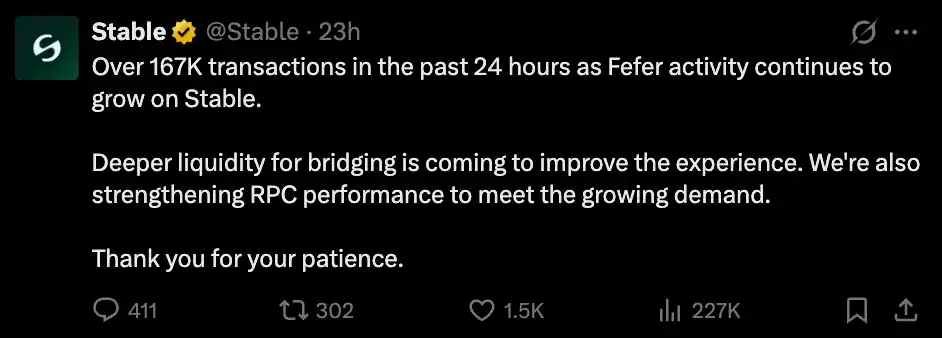
Despite the fact that the user experience of this chain feels extremely poor, everyone is hoping it can become the next Robinhood chain, "Tether can’t help but join in to attract people to play." The actual situation is that the Stable official tweets really have strong backing; it's indeed rare to mention $FEFER like this, but this chain can only say it is led by Bitfinex and supported by Tether's CEO; it is not the "darling" like Robinhood's chain.
$FEFER, which once broke through $15 million yesterday, fell to less than $3 million in market cap within 6 hours, and now has returned to about $7.5 million in market cap.
Here we can make a conclusion:
- What is concerning is that excessive expectations and optimism collapsing harm the sentiment that may already be stretched too thin, thus leading to the emergence of a peak;
- For the Robinhood chain, whether US meme stocks can lead the narrative after adjustment is crucial for sentiment recovery. The key targets to watch are $GME and $AI;
- For the Stable chain, $FEFER is still in a relatively awkward position. If there isn't a personal expression of support from Tether's CEO in the future, just using his tweets for memes won’t sustain the sentiment.
免责声明:本文章仅代表作者个人观点,不代表本平台的立场和观点。本文章仅供信息分享,不构成对任何人的任何投资建议。用户与作者之间的任何争议,与本平台无关。如网页中刊载的文章或图片涉及侵权,请提供相关的权利证明和身份证明发送邮件到support@aicoin.com,本平台相关工作人员将会进行核查。


