Author: Zhou, ChainCatcher
Recently, an analysis of SK Hynix's cross-market arbitrage has been circulating on X. A trader recounted making over 600,000 USD from Hynix's cross-market spread since June, although the positions and profits in his review can't be verified from public data, his description of the market structure and mechanisms has no major flaws.
Meanwhile, ChangXin Technology is set to be listed on the A-share Science and Technology Innovation Board next Monday, and the pre-IPO perpetual contracts are already rolling out on-chain. This is the largest IPO project in the capital market recently after Hynix's ADR, and many investors are discussing whether they can transfer Hynix's strategy to ChangXin.
He profits from rule differences
SK Hynix has at least five prices operating simultaneously today— Korean spot, Nasdaq ADR, Hong Kong leveraged ETF, perpetual contracts on centralized exchanges, and HIP-3 contracts on Hyperliquid. Their anchor objects, settlement currencies, and trading hours vary, GodpanSen exploited the pricing differences between these.
Let's look at how he did this specifically. According to his post, he really focused on Hynix after Binance launched the contract in June. Before that, there was only one contract curve on Hyperliquid, and only after Binance entered the scene were there two prices to compare.
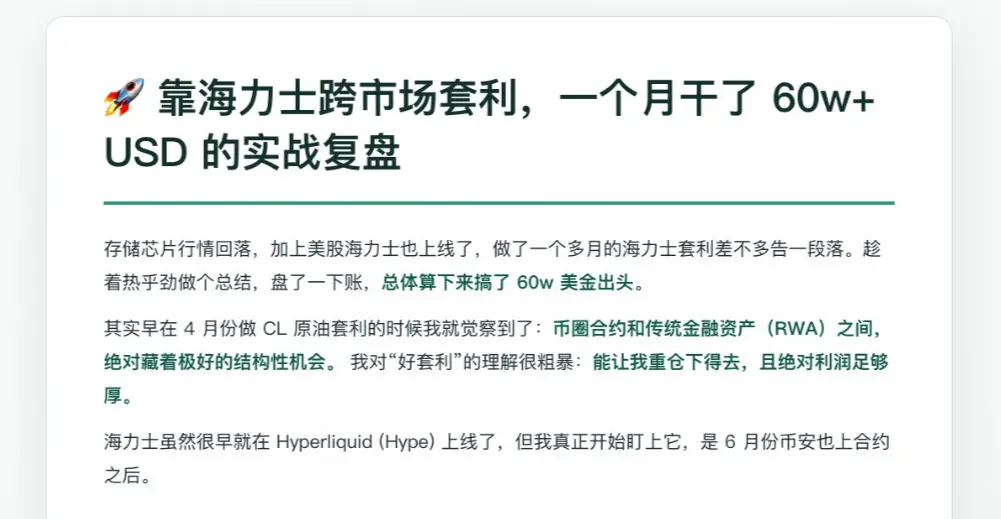
First, he mentioned that one weekend, he found that the Hynix contract on Binance was 30 USD more expensive than on Hyperliquid. He concluded that the price difference stemmed from different funding fee rules across exchanges, and as long as the funding fees paid before closing were less than this 30 USD, he would profit. He built a position of 1000 shares. When the stock opened on Monday, the price difference narrowed, netting him 15,000 USD after deducting funding fees.
Next was the main position. Cryptocurrency users generally find it difficult to buy Korean stocks directly; retail investors can only go long on the contract side. He claims that sometimes the premium on a single share topped 40 USD. So he bought the Korean spot using his IB account while shorting the high-premium contract, offsetting both sides, without betting on the stock price. He waited for the price difference to revert while collecting the funding fees paid to the shorts, earning over 120,000 USD in this segment.
The third point is taking advantage of the different funding fee mechanisms across exchanges. He noted that for a long time, the prices on Binance were higher than on OKX, and OKX was higher than Hyperliquid. A backtest showed that, except during the pre-market and post-market surge periods, OKX's weekly funding fee was nearly 1 percentage point higher than Binance's. Thus, when the prices were close, he moved the position to OKX, earning 170,000 USD in funding fees, while estimating that the same position on Binance would yield only around 100,000 USD.
He attributed the reason to OKX not having its own algorithm, but rather directly taking a weighted index from Hyperliquid and Binance. This was not mentioned in OKX's official documentation, which only stated that the index is based on multiple price sources, with some components smoothed by EMA.
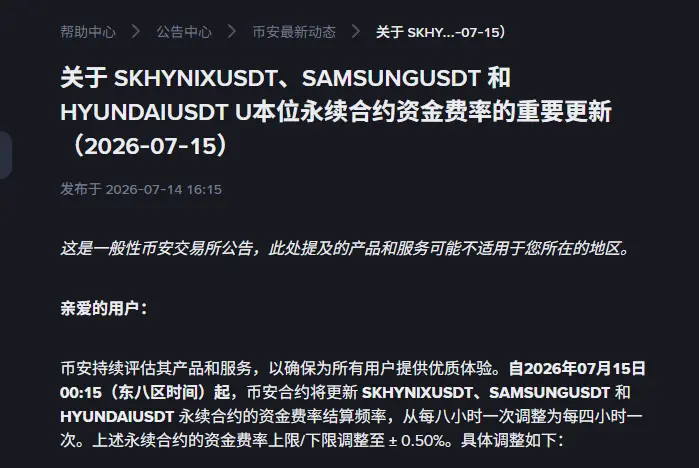
The fourth point is betting on rule changes, that is exploiting rule bugs. During a few days when Hynix's stock price plunged, the Binance contract was over 40 USD higher than the stock price. According to standard calculations, the funding rate over eight hours should be over 1%, but Binance set a maximum limit to lock the rate at 0.5%, whereas Hyperliquid settles every hour, resulting in a price difference of 30 USD.
GodpanSen judged that this situation would not last long, shorting Binance and going long on Hyperliquid, with nearly 10 million USD in position and an average price difference of about 25 USD per share. He claims that on that afternoon, Binance changed its funding rate to settle every four hours, causing the price difference to decrease. He closed out in two transactions, netting over 150,000 USD.
However, this segment seems inconsistent with Binance's public announcement. According to Binance's announcement on June 1, the upper and lower limits of the funding rates for these three perpetual contracts were set at ±2% at launch, narrowing to ±0.50% at 00:15 on July 15, while changing the settlement frequency from eight hours to four hours. He described the rate being locked at 0.5% before the rule change, which does not match the announcement; what he encountered was more likely the actual cap rather than the announced limit.
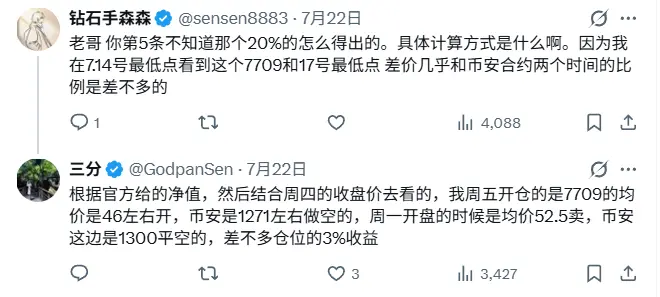
Lastly, there’s the leveraged ETF. He stated that on the Friday when Korean stocks were closed and Hong Kong stocks were open, the 2x leveraged Hynix ETF dropped more than 20 points in a single day, equivalent to a more than 10% drop in the spot stock, while the crypto contracts only fell by 5%. He bought the discounted ETF while shorting the Hynix contract on Binance, waiting for the Korean stock to revert when it opened on Monday.
The hedging ratio he calculated was 100 shares of ETF to 1.19 shares of the spot stock, but he actually hedged on a 1-to-1 basis, intentionally leaving about 20% of his position unhedged. Ultimately, he bought 480,000 shares of the ETF and shorted 5,000 shares of the contract. When the spot stock only fell by 5% on Monday and then rose, he closed out, taking away over 200,000 USD.
Finally, he mentioned that when buying Korean spot with IB, he borrowed Korean won for convenience, while the cryptocurrency contract's underlying asset is tied to the USD value of the stock, effectively creating a hidden exposure to the KRW/USD exchange rate. He opened positions just as the KRW hit a recent low; over the past month, the won appreciated significantly, resulting in a loss of 60,000 USD just from the foreign exchange component when closing the accounts.
The mechanism is perfect, but the operation is difficult
In summary, his operations mainly involved three strategies.
First is moving the price difference between two contracts. The same underlying asset exists at different exchanges, leading to price differences primarily from the different rules on funding fees. As long as the funding fees paid during the holding period are less than the price difference, one can profit. For these positions, both legs involve contracts, and what the trader is actually hedging is time rather than the asset.
Second is buying spot and shorting contracts, holding neutral to earn funding fees. However, being directionally neutral does not mean being risk-neutral. The funding fees are variable; being positive in the long term is merely the result of retail investors mainly going long. If the shorting pressure on the contract side prevails, the rates can turn negative, converting the shorts into the ones that pay instead of receive fees.
The third is capturing mismatches during market closures. Hynix simultaneously has Korean stocks, Hong Kong leveraged ETFs, Nasdaq ADRs, and cryptocurrency contracts traded 24/7, each with non-overlapping trading hours. This type of operation requires that the prices genuinely revert, rather than continue moving in one direction. Additionally, the leveraged ETFs also incur daily rebalancing costs; the longer the holding period, the bigger the tracking error, making it suitable only for short windows like spanning one weekend.
This mechanism seems very perfect, but in practice, achieving it is extremely difficult.
This operation requires seamless connections between various trading channels; Korean stock accounts, foreign exchange channels, brokerage quotas, and margin accounts at multiple exchanges are all essential. Additionally, traders need to be very sensitive to the differences in rules, including the funding rate calculation cycles, fee cap limits, index formulation methods, and when these differences will be exacerbated.
Moreover, his last two strategies have already departed from purely capturing price differences; one bet on whether Binance would change the funding fee cap, while the other bet on the Hong Kong ETF discount returning on Monday, both requiring directional judgments on price trends and platform behaviors.
GodpanSen states that arbitrage can only use 20-30% of the position; the capital required to support these actions becomes a significant barrier.

Many users express that even if they follow along, it's still difficult to capture the complete profits. Furthermore, the actual risk differences between different arbitrage methods can be quite large, especially with the incorporation of rule changes and directional judgments, which already bear a strong game-theoretic nature.
Similarly high premiums, how is ChangXin different?
However, the market is always profit-seeking, and many investors have begun turning their attention to the upcoming ChangXin Technology listing.
Currently, Hyperliquid has already launched ChangXin's perpetual contract CXMT-USDC. As of the time of writing, the contract currently reports at 6.3896 USD, approximately equivalent to 43.26 RMB, down about 25% from its high point, still about five times the issue price. Based on a total share capital of 66.881 billion shares post-issue, the implied market value is around 2.94 trillion RMB.
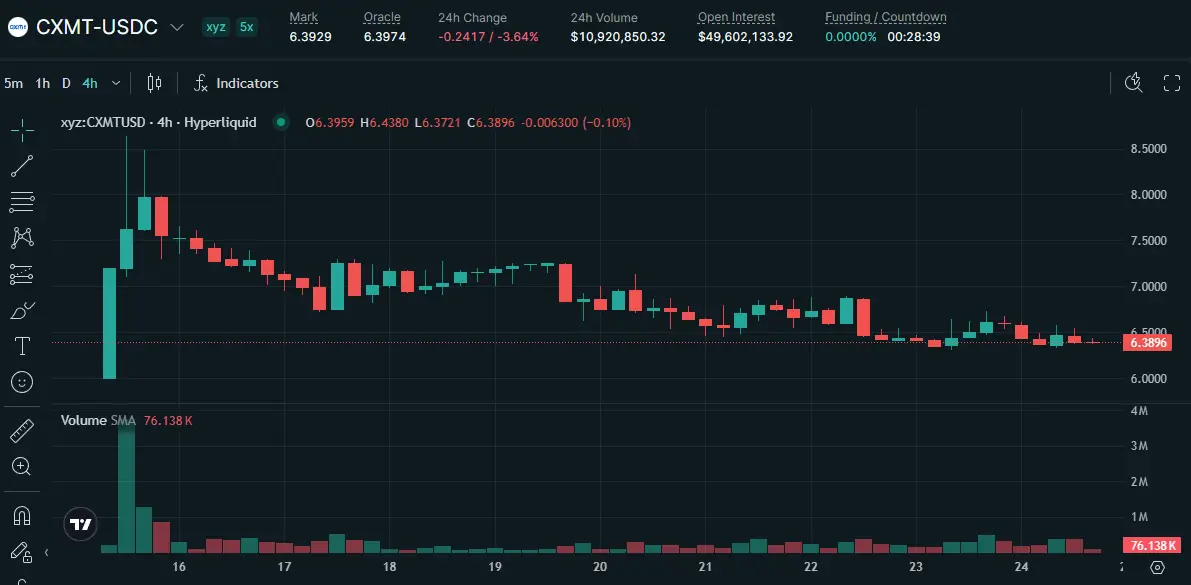
The premium is a magnitude higher than that of Hynix at the time, but the arbitrage potential may not necessarily be.
Hynix exists simultaneously in Korean spot, Nasdaq ADR, Hong Kong leveraged ETFs, and contracts at multiple exchanges. Each of the three methods employed by GodpanSen requires at least two curves; moving price differences needs two contracts, neutral charging requires both spot and contracts, and capturing mismatches requires ETFs and contracts.
However, before its listing, ChangXin only has one curve on Hyperliquid, and currently, multiple on-chain positions have begun establishing short positions. These positions lack a leg in spot to hedge against, betting on the price converging downwards after the listing, rather than arbitraging between two prices.
After listing, the Science and Technology Innovation Board has a 500,000 RMB asset threshold combined with QFII quota restrictions, preventing most overseas investors from accessing the direct stock. This obstacle is similar to cryptocurrency users being unable to buy Korean stocks directly.
The real difference lies in the price limit circuit. According to the Shanghai Stock Exchange rules, new stocks listed on the Science and Technology Innovation Board do not have a price limit for the first five trading days, after which there is a ±20% limit. Once the stock price is locked at the upper or lower limit, the convergence mechanism will be directly cut off.
Another point is that in the arbitrage mechanism of going long on the stock and short on the contract, on the ChangXin side, it involves converting RMB to USD to USDC; the RMB cannot be freely exchanged, and there are onshore and offshore price discrepancies, while QFII funds' entry and exit also have quota and remittance restrictions.
As for the contract price differences between exchanges, this layer can be replicated, provided that various exchanges subsequently launch ChangXin's stock perpetual contracts and second and third curves emerge. The trading time mismatch applies the same way.
However, this strategy has now been made public and even widely circulated, which means information discrepancies have become thinner, and the speed at which price differences are flattened has accelerated.
Have market opportunities increased?
With market diversification and fragmentation, such seemingly easily accessible arbitrage opportunities appear to have increased, but in reality, they impose a greater test on traders' cognition and execution capabilities.
When the same asset is divided into spot stocks, depositary receipts, leveraged ETFs, and contracts on multiple platforms, differences in index calculations, settlement cycles, fee caps, and trading hours continually create price differences.
The gap between seeing price differences and capturing them is bridged by cross-market accounts, channels, margin scheduling, and risk control execution; any missing link can deform the action.
It's worthwhile to consider that these trades seem to profit from certainty, yet the risks are largely hidden beyond the prices.
In early arbitrage, it was largely betting on the rules themselves. When new markets are first opened, the rules often haven’t yet been refined, and price differences arise from the mechanisms' roughness rather than pricing errors. The discussions surrounding Polymarket arbitrage over the past two years fall into the same category.
These types of opportunities have a clear half-life. As mechanisms are perfected, market depth increases, and more participants enter, the price differences that can be captured will become increasingly thin. For professional traders, differences in rules may indicate arbitrage opportunities. For ordinary retail investors, the same rule differences may become sources of risk.
On the other hand, leverage is an invisible killer. Yesterday, economist Fu Peng from New Fire Technology also mentioned that capital market pricing reflects expectations, which can significantly lead reality and fundamental conditions. Current realities such as capacity shortages and full order books cannot derive a persistent rise in stock prices, as stock prices are trading the future.
He noted, that many young traders in the Korean market made substantial profits the previous day, only to face large losses the next day. The issue does not lie in business operations or supply and demand along the industrial chain; it stems from the excessive accumulation of leverage in the market.
This holds true for arbitrageurs as well.
免责声明:本文章仅代表作者个人观点,不代表本平台的立场和观点。本文章仅供信息分享,不构成对任何人的任何投资建议。用户与作者之间的任何争议,与本平台无关。如网页中刊载的文章或图片涉及侵权,请提供相关的权利证明和身份证明发送邮件到support@aicoin.com,本平台相关工作人员将会进行核查。


