I do not think perpetual contracts, stablecoins, or prediction markets will bring crypto back.
Author: knimkar
Translated by: Baihua Blockchain
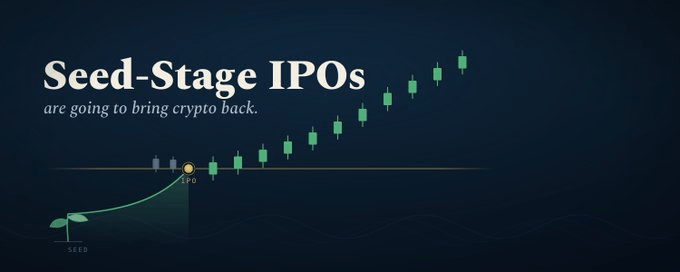
I do not think perpetual contracts, stablecoins, or prediction markets will bring crypto back. The so-called "crypto return" really depends on the emergence of assets on the chain that people believe they can make money from and cannot buy anywhere else. It's that simple.
I believe the most likely path to achieve this again is an upcoming trend: I call it "Seed Round IPO." That is: with the help of @MetaDAOProject's Ownership Coins, and combining decision markets, to establish a publicly traded market for early-stage companies.
My judgment is based on the following beliefs:
1/ I expect that more people will try to start businesses in the future because AI models are drastically reducing the time and cost of creating things. This is self-evident.
2/ For many - even most - companies, obtaining distribution capability is the hardest thing. In this close-combat scenario, Ownership Coins provide founders with a new distribution tool: Tokens. Anyone who has been in the crypto industry knows how powerful the "user-owner" mechanism is. A person who already likes your product will become an extremely enthusiastic supporter if they can also share in the upside. Cynical crypto practitioners might say, "We've already seen how ICOs ended." But there is a huge difference between what Ownership Coins represent and what those past Tokens represented.
3/ I believe that the continuous expansion of the equity fundraising market will increasingly make public market participants uncomfortable. Traditional equity IPOs now look more and more like harvesting events (see SPCX structure). It's just moving the BN ICO to the New York Stock Exchange. The discussion around "retail investors cannot participate in OpenAI / Anthropic" has been repeated too often - at least without those outrageous SPVs, retail investors cannot get in - so I will not elaborate further.
4/ Today's retail investors already have access to a large number of highly volatile "gambling financial products": 0DTE, mobile casinos, sports betting, prediction market-style sports betting, and perpetual contracts. They have long been trained to chase high-variance outcomes. Rather than continuing to play those purely negative EV games, I can completely envision a shift: retail investors putting their money into companies they like and use, and they may even have some advantage here - because they are already heavy users.
Current securities laws make it impossible for early-stage companies to be publicly traded. Ownership Coins and decision markets offer a workaround: they allow capital formation to continue while retaining some investor protection. MetaDAO is increasingly proving this point.
In summary, I believe Ownership Coins can meet the growing demands of the entrepreneurial community (corresponding to 1/ and 2/ above), and also provide investors, especially retail investors, with a unique opportunity (corresponding to 3/ and 4/).
Remember, the two strongest drivers of crypto adoption, in order, are:
A/ Upside (see Bitcoin)
B/ Allowing people access to financial products they truly want but could not obtain before (see Tether, Hyperliquid)
In my view, MetaDAO and Ownership Coins have already provided the solution for B/: enabling access to "Seed Round IPOs" of early-stage companies. Now, we are just waiting for the market cap of a single Ownership Coin to exceed 100 million to 1 billion dollars, thereby meeting the conditions for A/.
As long as MetaDAO produces a sufficiently large result, I believe the funding methods for early-stage companies will change.
If you think this sounds unlikely, consider: IPOs themselves are evolving, beginning to include retail allocations, and I believe this trend will only continue. What I want to say is: this trend will subsequently spill over to seed-stage companies. You can understand it as a more mature version of the ICO craze of 2017.
I can't wait any longer. We are really coming back.
Appendix: Yes, yes, I know you want to say "adverse selection"
I admit that the history of crowdfunding and launchpads is not pretty, and adverse selection issues always emerge in various forms; I also admit that what I am saying now is "this time it's different." But I genuinely feel that this time it is different. Below, I will respond to some common objections to Ownership Coins one by one.
Adverse Selection [1]: Good founders will take the traditional VC route, only bad founders will go for Seed Round IPOs.
That's right, this is the biggest risk. Leading VCs do not just pick winners; they also create winners. I believe you will see "good VCs" participating in Seed Round IPOs in the future, and the issuance of MetaDAO is increasingly clearly moving in that direction (VC + retail). So I believe the truly high-quality Seed Round IPOs may show a pattern of coexistence between brand VCs and retail investors. IPO underwriting is already a mature process; we are just placing companies at an earlier stage.
Adverse Selection [2]: Good founders will not want to allow decision markets to limit their decision-making power.
This issue requires a longer discussion, but to put it simply, I believe that over time, we will gradually find a balance point for decision markets that is friendly to investors while also being friendly to founders. MetaDAO has been continuously adjusting the design of decision markets based on feedback (for example, proposals submitted by the team now have a slight advantage). I am not sure what the optimal parameters for decision markets should ultimately be, but I believe this direction can be gradually fine-tuned.
Adverse Selection [3]: The equity market is larger and has a much higher ceiling than the Token market. Excellent founders will not want to limit their upside potential.
Of course, but I believe that as long as the assets are good enough, market participants will buy in, regardless of whether it is equity or Token. Bitcoin has already grown into a trillion-dollar asset; Hyperliquid has also become a large asset, and so on. Again, "upside" itself is a powerful and incredible driving force.
Adverse Selection [4]: Good founders will not choose to make their assets publicly traded because that would distract them.
The benefits of the "user-owner" relationship may outweigh the distraction costs of having a publicly traded asset. At least from my perspective, this is not an obvious conclusion: whether there is a publicly traded asset will significantly change the final outcome. I have repeatedly seen that pressure produces diamonds. After communicating with the founders of MetaDAO, I feel that many people actually see it as a scoreboard and also as a source of motivation.
Ownership Coins are just a way to bypass securities laws.
Yes, indeed. But in my view, this is not a bug, but a feature. The best products in crypto often have a strong regulatory arbitrage component. And that is precisely part of what makes them successful.
Retail investors are too impatient for VCs.
Retail investors are indeed impatient, but I do not think that matters much. For retail investors, volatility itself is the product. And the life cycle of an early-stage company is already filled with significant volatility. My argument is not that retail investors will become very good at VC investing; I just believe they will get involved, and likely at a large scale.
免责声明:本文章仅代表作者个人观点,不代表本平台的立场和观点。本文章仅供信息分享,不构成对任何人的任何投资建议。用户与作者之间的任何争议,与本平台无关。如网页中刊载的文章或图片涉及侵权,请提供相关的权利证明和身份证明发送邮件到[email protected],本平台相关工作人员将会进行核查。
