The new version of the bill prohibits the President, Vice President, Congressional members, federal judges, and other covered officials (and their spouses) from issuing or sponsoring digital assets for compensation during their term in office.
Written by: Maher, Foresight News
On July 22, 2026, following a briefing conference call with stakeholders, Republican senators in the U.S. Senate officially released the updated text of the Clarity Act. One of the key highlights of this update is the inclusion of an ethics package negotiated between the White House and Republican Senators Cynthia Lummis and Bernie Moreno, which clearly limits federal officials, including the President, and their spouses from issuing or sponsoring digital assets for compensation during their term in office.

Republican Senator Cynthia Lummis
The host of "Crypto America," former Fox Business reporter Eleanor Terrett, detailed the key points of the text on the same day, noting that the ethics provisions have yet to receive formal approval from the Democrats. The main content of the provisions includes: prohibiting the President, Vice President, Congressional members, federal judges, and other covered officials (and their spouses) from issuing or sponsoring digital assets for compensation during their term, with a date set for the provisions to take effect on January 20, 2029.
This new version of the bill also requires covered officials to either sell their held cryptocurrencies and investments in crypto companies or place them into uncontrolled blind trusts, or a combination of both; it grants the Department of Justice civil enforcement authority over ethical violations, including suing exchanges that knowingly list prohibited tokens; it mandates disclosure of cryptocurrency asset sales exceeding $1,000, and directs the Government Accountability Office (GAO) to further study other ethical loopholes.
Terrett pointed out that this part is likely to continue to be adjusted moving forward. The Democrats emphasized that they have not yet seen the full text and strongly oppose the proposal that hands over enforcement authority entirely to the Department of Justice without involvement from state attorneys general. Bipartisan negotiations are expected to continue in the coming days.
On the same evening, a group of pro-crypto Democratic senators issued a joint statement directly responding to the updated text, stating: "The Clarity Act text proposed by the Republicans still has deficiencies. Key provisions regarding the ethics of elected officials, consumer protection, illegal finance, conflicts of interest, and market integrity must be further strengthened. Over the past year, we have been working in good faith with our Republican colleagues and will continue to strive to push this bill towards final passage."
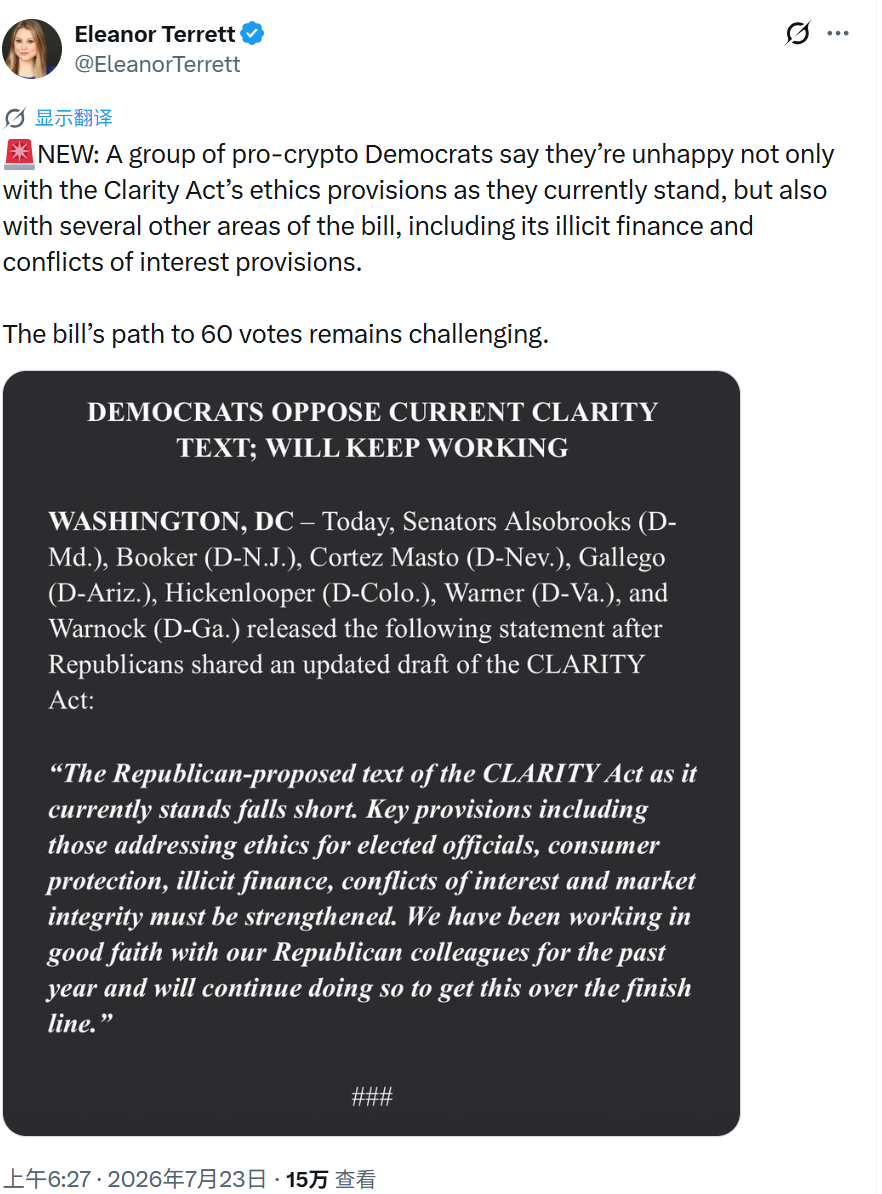
Aside from the ethics aspects, the new version of the Clarity Act largely adopts the previous version.
Trump's Crypto Income Exceeds $1.4 Billion
The inclusion of the ethics provisions may be a direct result of the political maneuvering and real political pressure between the two parties over the past few months.
Financial disclosure documents for President Trump in 2025 show that his crypto-related income exceeds $1.4 billion, making it one of his largest sources of income for that year. Approximately $635 million came from licensing agreements related to the "TRUMP" meme coin, and more than $500 million came from token sales and equity trades associated with his family’s involvement in World Liberty Financial. This figure quickly became a focal point for Democratic attacks after its disclosure. Multiple Democratic senators publicly stated that while establishing a federal regulatory framework for the crypto industry, not imposing clear restrictions on the current president sitting atop substantial crypto interests presents a structural conflict.
As early as May during the Senate Banking Committee meeting, the ethics amendment proposed by the Democrats was defeated along party lines. By July, ethical issues became a key barrier to whether the bill could achieve the 60 votes needed to reach the full Senate before the August recess. Some Democrats clearly stated that they would not support procedural votes without sufficiently strong ethics rules.
Around July 20, the White House completed negotiations on the ethics language with Lummis and Moreno and sent the text to certain Republican senators. Trump himself reportedly signed off on the relevant provisions during a meeting in the Oval Office. This move was seen by Republicans as a key step to break the deadlock.
However, from the Democratic joint statement on July 22, it appears that the current version still falls short of their demands. Senator Al Lawson had previously publicly stated that the proposal to hand enforcement authority to the Department of Justice is "not serious." She is one of the two Democratic senators who supported moving the bill forward during the bank committee vote in May, and her stance directly relates to whether the bill can surpass critical thresholds.
Path Forward
The release of the updated text marks the entry of the Clarity Act into the "final sprint" stage, but it also exposes substantive differences that still exist between the two parties.
For the industry, if the bill ultimately passes, it will articulate for the first time at the federal level the jurisdictional boundaries of the SEC and CFTC, provide clear legal protections for non-custodial developers, and establish customer asset isolation rules. This would have substantial implications for U.S. crypto businesses that have long been troubled by regulatory uncertainties. The retention of the BRCA is particularly critical—it enshrines the principles from FinCEN's 2019 guidance into law, preventing open-source developers from facing liability due to third-party misuse of their code.
On the political level, the bill still needs 60 votes to initiate full committee debate. While Republicans currently have a slim majority, given the absence of some Republican senators and the differences in their positions, a certain number of Democratic votes will be needed. The Democratic statement on July 22 indicates that even relatively pro-crypto Democratic members still require further strengthening of ethics, consumer protection, illegal finance, and conflicts of interest. This means that the upcoming days of negotiations will determine whether the bill can complete the legislative process before the August recess. If the current window is missed, the bill is likely to be delayed until fall or later, by which time the midterm elections will be approaching, making the political environment even more complex.
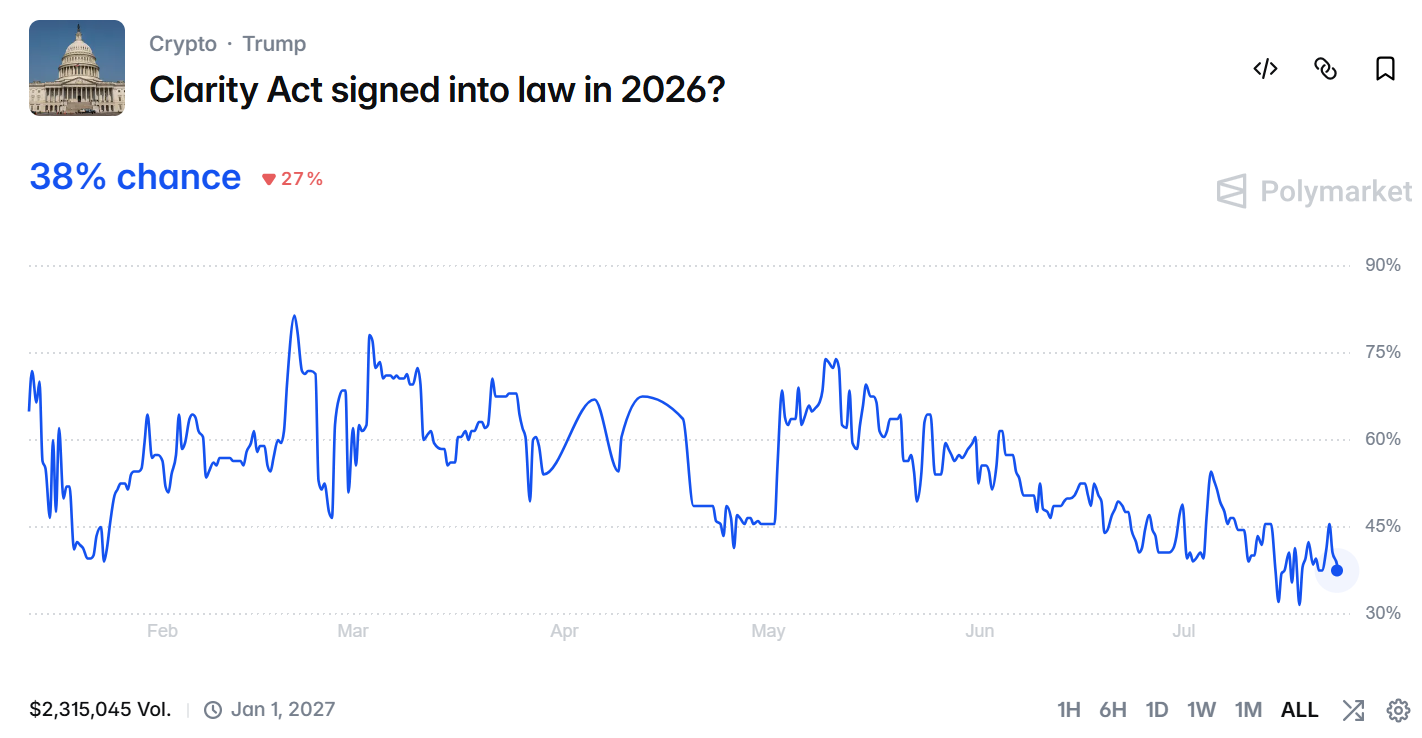
As of July 23, the odds on Polymarket for the Clarity Act being signed into law this year were 38%. The full text of the bill has not yet been officially released, and details still rely on stakeholder briefings and media disclosures. Bipartisan negotiations are continuing.
Senator Cynthia Lummis expressed gratitude to her Democratic colleagues for their significant contributions to the new version of the Clarity Act, committing to continue pushing for an agreement in the coming days to enable the bill to ultimately become law. Consumer protection and support for innovation are not contradictory; this bill draft proves that both can be achieved simultaneously.
Eleanor Terrett reminded in her report that the path to 60 votes for the bill "remains challenging." In the coming days, the final form of the ethics provisions, the extent of adjustments to enforcement mechanisms, and whether the Democrats can achieve enough compromise in other areas will directly determine whether the Clarity Act can complete legislation in the current Congress.
免责声明:本文章仅代表作者个人观点,不代表本平台的立场和观点。本文章仅供信息分享,不构成对任何人的任何投资建议。用户与作者之间的任何争议,与本平台无关。如网页中刊载的文章或图片涉及侵权,请提供相关的权利证明和身份证明发送邮件到support@aicoin.com,本平台相关工作人员将会进行核查。


