Written by: Rita
Trend Guidance
Bernstein recently released the third report in its memory LTA series, believing that the market's pessimistic expectations for LTAs are significantly off base. The new generation of contracts relies on backend-weighted margin to form a bottom support mechanism. Although there are differing opinions within the institutions, there is a unanimous judgment that the bottom pressure of this storage industry cycle will ease. The report identifies four outperforming stocks: SanDisk, Samsung Electronics, SK Hynix, and Micron, while KIOXIA is rated as underperforming, with the NAND value re-evaluation logic of SanDisk not yet fully priced by the market.
Margin Structure Reconstruction Changes Industry Contract Logic
Bears believe that the protective strength of LTAs is overestimated by the market. The total margin disclosed is approximately $33 billion, which is limited in scale relative to the tens of trillions of dollars in revenue that need protection. To truly support peak profitability levels, customers would need to prepay margins on the order of several hundred billion dollars, which poses significant operational challenges.
Bulls respond that the core reason Hemlock and Microchip's LTAs ultimately failed historically was due to the lack of substantial financial constraints in the contracts. After a customer defaults, suppliers can only pursue compensation through legal means, and during the litigation period, the party may have already gone bankrupt.
The new generation of memory LTAs has essential differences in mechanism, primarily in the backend-weighted margin structure. The cash margin paid in advance by customers is not significantly deducted in the early stages of the contract and is gradually refunded as the contract progresses. As the contract advances, the margin proportion of remaining purchasing obligations continuously increases, potentially reaching 100%, thereby increasing the cost of customer default. If market prices plummet two years later, the exit threshold facing customers will already be at a high level.
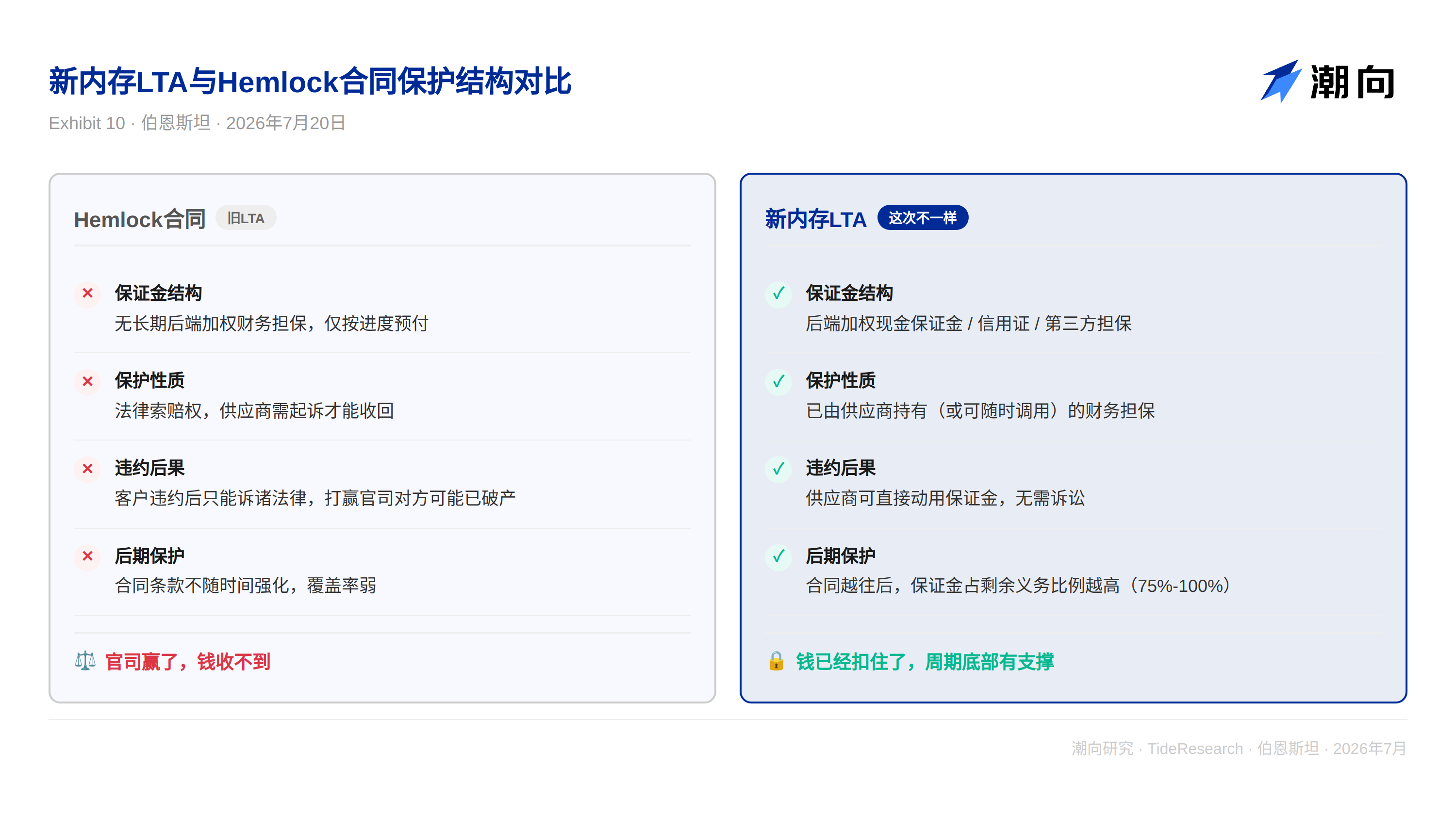
Bernstein's research report concludes that the core protective value of LTAs is reflected in the latter half of the contract, which corresponds precisely to the industry's most pressing need for support during the cyclical downturn.
Increased Fulfillment Capability of Current Contract Customers
Historically, Hemlock's customers were mainly solar panel manufacturers, who typically have thin profit margins, rely on subsidies, and possess weak financial risk tolerance. SolarWorld AG ultimately went bankrupt, and even if Hemlock won a lawsuit, it would be challenging to recover payments. Microchip's PSP customers are comparatively diversified, mainly comprising industrial manufacturers, OEMs, and distributors, and their willingness to honor contracts tends to be low during times of weakened demand.
The core customers signing LTAs this time are ultra-large cloud vendors and AI infrastructure providers. These companies have robust balance sheets and diversified operations, making AI infrastructure investments a strategic layout. For them, the costs associated with delays in AI computing power deployment due to memory shortages far exceed the costs of contract fulfillment. Even if market prices fall below contract prices, their decision-making logic revolves around "does default affect their AI competitiveness?".
NAND Supply and Demand Landscape as a Core Point of Divergence Among Institutions
The Asian research team holds a relatively cautious view of NAND. The core logic is that AI demand mainly benefits DRAM and HBM, while NAND will benefit to a limited extent. The threat from Chinese manufacturers in the NAND field is also greater than in DRAM, as NAND expansion does not require EUV equipment, making technology catch-up hurdles lower. Micron has also stated that the end point of the NAND supply-demand shortage will come earlier than that of DRAM.
The American research team presents a different perspective. They believe the AI industry is entering a new stage: early AI training and basic inference primarily consume DRAM and HBM, but current AI applications are evolving toward complex reasoning, longer context windows, and intelligent agents. To enhance model performance, systems must store context information (i.e., KV Cache) from previous searches, data that was previously stored mainly in HBM and DRAM, which is now starting to overflow into NAND flash memory. The single GPU NAND capacity on NVIDIA's Vera Rubin platform has increased from 4TB to 20 to 21TB, a fivefold increase.
The NAND industry cycle lags behind DRAM by about one cycle. Last year, the DRAM industry gross margin had reached 60%, while NAND was still in a loss-making state. NAND prices only began to rise last August and are still in a recovery phase. On the supply side, manufacturers prioritize capital expenditure for DRAM, and NAND expansion plans have been pushed to after 2028. This implies that NAND supply constraints may be tighter and last longer than market expectations.
Core Investment Logic of Each Storage Target
SanDisk is the most aggressive in its LTA plans, having signed five LTA agreements that cover about one-third of FY27 capacity needs. The company's CEO does not come from a traditional storage industry background, having experience in hard drives, Cisco, and the software industry, resulting in a relatively flexible strategic thinking. Bernstein values the company at 11 times FY28 earnings per share or 14 times the average earnings per share over the cycle, believing that NAND's structural opportunity has not yet been fully priced.
Samsung Electronics and SK Hynix are core holding targets in the DRAM sector, with Bernstein assigning a valuation of 6.2 times forward earnings per share. The execution in supply discipline by both companies, along with their natural immunity to competitive dynamics, forms the core supporting logic. Micron also benefits from the DRAM logic, with a valuation level of 7.7 times forward earnings per share, slightly higher than that of Korean manufacturers. The research report indicates that Micron has also been relatively proactive in signing LTAs, with 16 contracts signed, but its earnings elasticity is weaker than that of Samsung and SK Hynix.
KIOXIA is the only storage target rated as underperforming by Bernstein, mainly due to the reasons of the least proactive LTA arrangements, the highest valuation level, and a relatively poor NAND competitive landscape. When asked during the Q&A session why he recommends SanDisk while being bearish on KIOXIA, Mark Newman stated that the two are positioned at opposite ends in terms of LTA arrangements.
Trend Perspective
Analysts from the same institution in the US and Asia hold nearly opposite views on NAND. Mark Newman sees a fivefold increase in demand for NAND capacity on the Vera Rubin platform, while Mark Li sees the supply threat of Chinese NAND expansion without EUV. Both judgments have factual support, with the core difference resting on time dimensions. One side focuses on changes happening on the demand side, while the other looks at potential impacts on the supply side two or three years out.
The design of the backend-weighted margin structure merits further investigation. Downward cycles typically do not truly arrive until two years later, by which time margin coverage will have reached a high level. However, if the cycle turns earlier, the protective strength may be commensurately discounted. The protective effects of LTAs are lagging rather than leading, and the real risk to be mindful of is the risk of an early cycle arrival.
The pricing logic of HBM is also undergoing subtle changes. Traditional DRAM has undergone four rounds of price increases, and currently, the profit margins for producing traditional DRAM are higher than those for HBM. Suppliers are pushing up HBM prices. Bernstein estimates that by 2027, HBM prices could be 2 to 2.5 times that of 2026, while traditional DRAM price increases could reach up to 5 times, making HBM a relatively "cheaper" resource. If this judgment holds true, the earnings elasticity of HBM suppliers may exceed market expectations.
Bernstein's overall judgment on the storage industry can be summarized as follows: structural AI demand combined with new LTA backend protection, alongside supply discipline, collectively extends the cycle and narrows volatility. Mark Newman bets on the core logic that NAND demand will gradually catch up with DRAM, while Mark Li believes that Chinese supply will first impact the NAND market. The ultimate trajectory of their judgments directly determines the reasonableness of SanDisk's $3000 price target.
Disclaimer
This article is a compilation and interpretation of third-party broker research reports (Bernstein, July 20, 2026) by Trend Guidance. The ratings, target prices, earnings forecasts, and related judgments quoted in the text are the opinions of the broker's analysts, representing the stance of their respective institutions, and do not represent the views of Trend Guidance, nor do they constitute any investment advice.
The market has risks; investment should be cautious. This article should not be used as the basis for buying or selling any securities. Investors should make investment decisions based on their own independent judgment.
免责声明:本文章仅代表作者个人观点,不代表本平台的立场和观点。本文章仅供信息分享,不构成对任何人的任何投资建议。用户与作者之间的任何争议,与本平台无关。如网页中刊载的文章或图片涉及侵权,请提供相关的权利证明和身份证明发送邮件到support@aicoin.com,本平台相关工作人员将会进行核查。


