By the end of June, the market capitalization of tokenized stocks has grown fourfold over the past year.
Written by: Robert Hackett, Ryan Holloway, a16z
Translated by: Chopper, Foresight News
Tokenized stocks (or more commonly referred to as tokenized securities) intuitively showcase how cryptocurrency is continuously permeating Wall Street. These blockchain-based tokens correspond to traditional securities such as stocks, ETFs, and index products of real companies like Apple and Tesla.
Unlike traditional stocks, tokenized stocks can be stored in digital wallets for self-custody, transferred freely without permission, traded non-stop 24/7, and can also be used directly as collateral for various on-chain DeFi activities. In just the past two months, organizations such as Coinbase, the American Depositary Trust and Clearing Corporation (DTCC), the New York Stock Exchange, and Robinhood have been actively engaging in this space, from on-chain transaction processing to forming new joint ventures and launching new blockchains.
The enthusiasm for the sector is fully reflected in the data. By the end of June, the total market capitalization of global tokenized stocks was approximately $1.7 billion, up from just $329 million during the same period last year, marking a fourfold increase and becoming one of the fastest-growing subcategories in the field of real world assets (RWA).
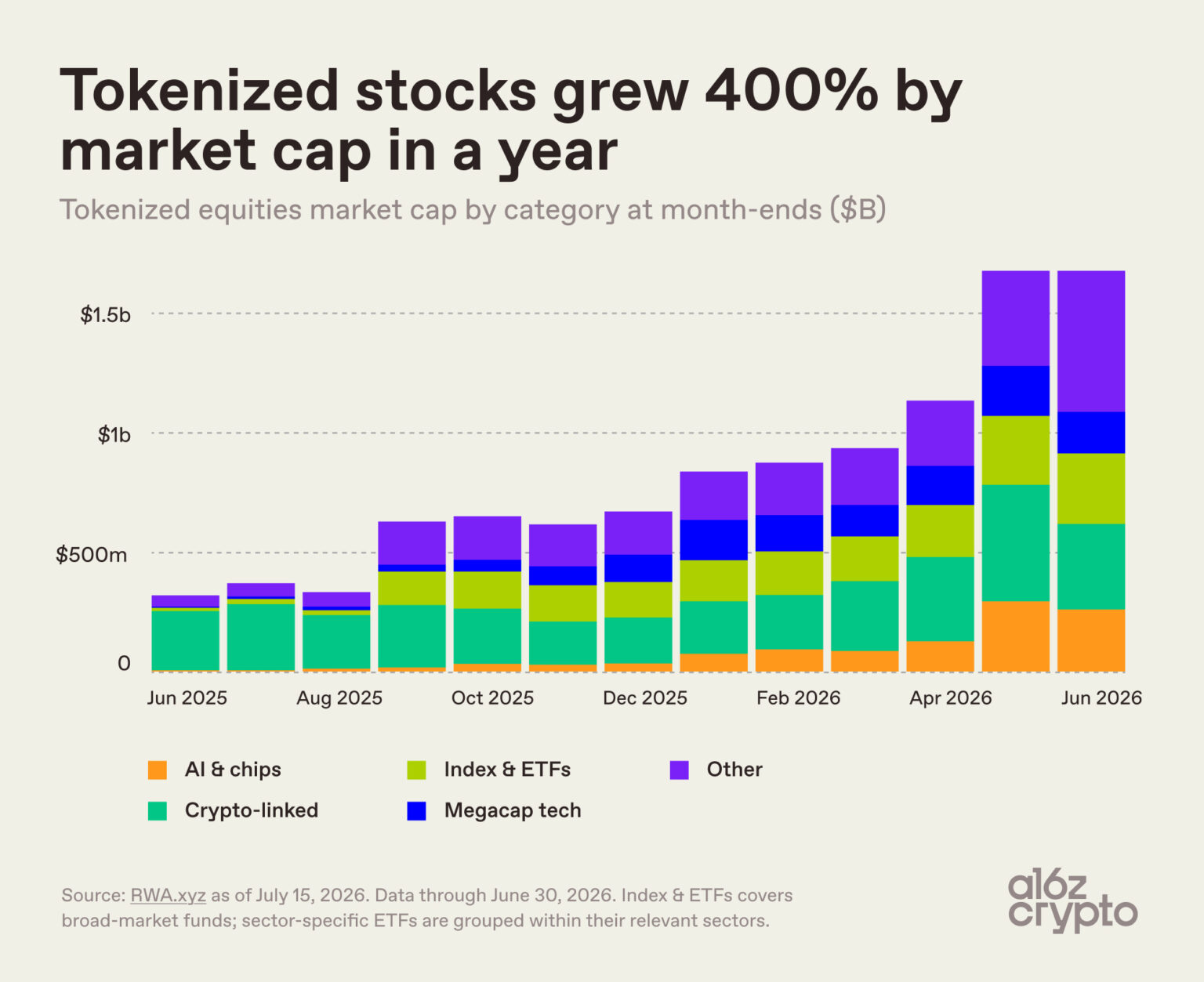
The market capitalization of tokenized stocks has increased 45 times in the past year
Is this growth driven by the issuance of a large number of new tokens, or is it the rising prices of the underlying stocks? The circulation of stablecoins can directly reflect market demand; 1 stablecoin is pegged to 1 dollar, and the logic is straightforward. However, the price of tokenized stocks is related to the price movements of their underlying stocks, making it hard to clearly distinguish the two major influencing factors: "newly minted tokens" and "price increases of existing tokens."
Existing data is sufficient to prove that the core driver of growth comes from the issuance of new tokens. Currently, over half of the total market capitalization consists of assets that were not circulating on-chain a year ago; the remaining existing assets mostly went live only mid-year this year, by which time the major rise and fall trends of the underlying US stocks had already been completed.
Although the market for tokenized stocks is still in its early stages, the internal structure of the sector has undergone dramatic changes over the past year:
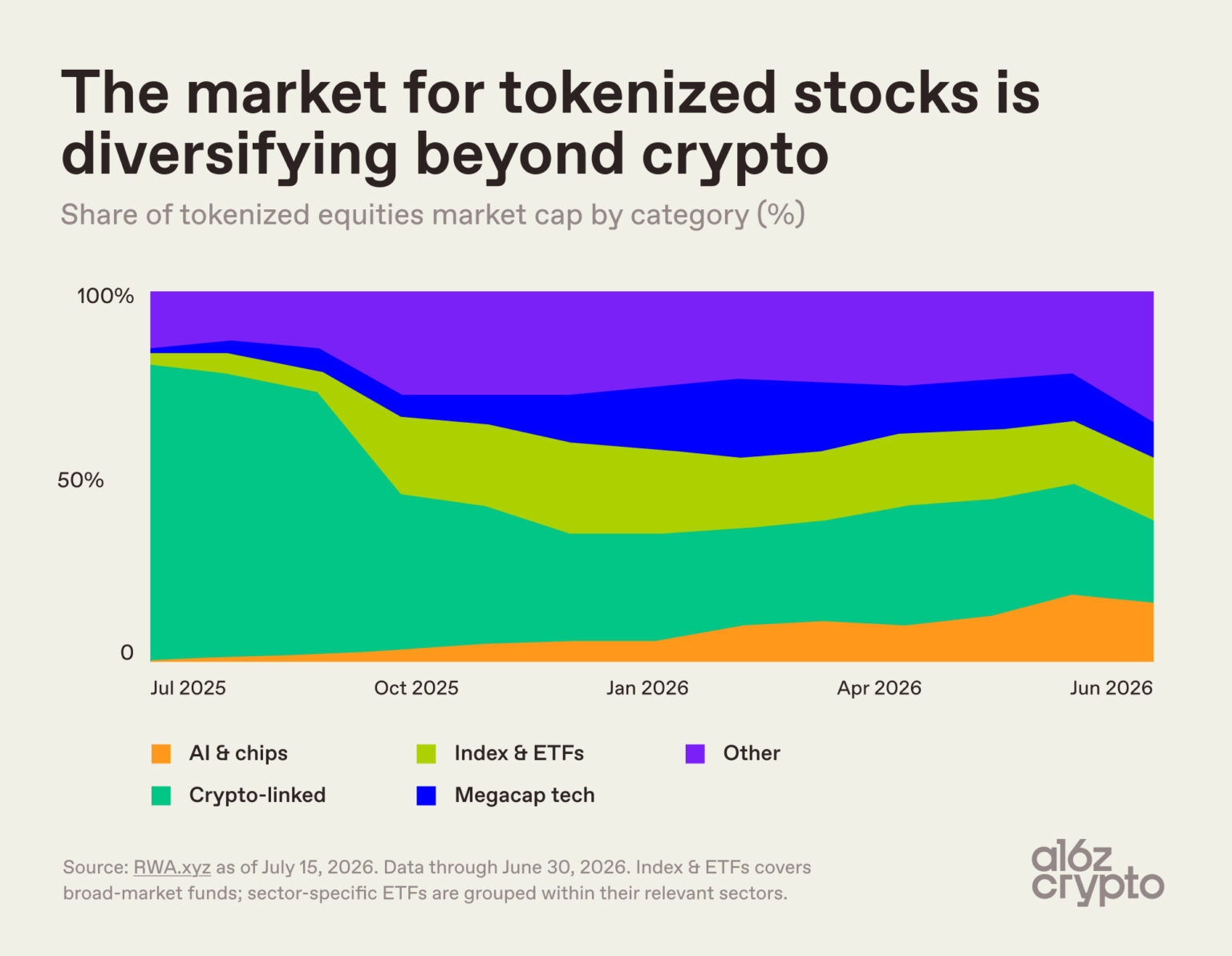
The categories of tokenized stocks have surpassed the realm of cryptocurrency
Cryptocurrency-related products once dominated the market, but their market capitalization share has declined from 79% a year ago to just 21% now (as of June). They have ceded market leadership to the "Others" category—an extensive category that includes hundreds of small products—which currently accounts for 35% of the market share, up from 15% a year ago.
Other sectors are also on the rise. By June, the proportion of tech giants with a market capitalization of $100 billion or more had reached 10.6%, up from 0.6% a year ago. At the same time, the market share of ETFs and indexes grew to 17.3%, up from 4.5% a year ago.
As expected, the fastest-growing fields are artificial intelligence and the chip industry. This sector had a market capitalization of less than $1 million in June 2025 (accounting for only 0.3% of the total market capitalization at that time), but surged to 15.5 a year later.
On-chain transfer activities are also continuously increasing. In June, the total monthly on-chain transfer amount of tokenized stocks reached $9.22 billion, compared to just $53 million in the same period last year, an increase of over 170 times. This indicator counts all on-chain asset flow activities, including secondary market trades, wallet transfers, and deposits into DeFi protocols as collateral.
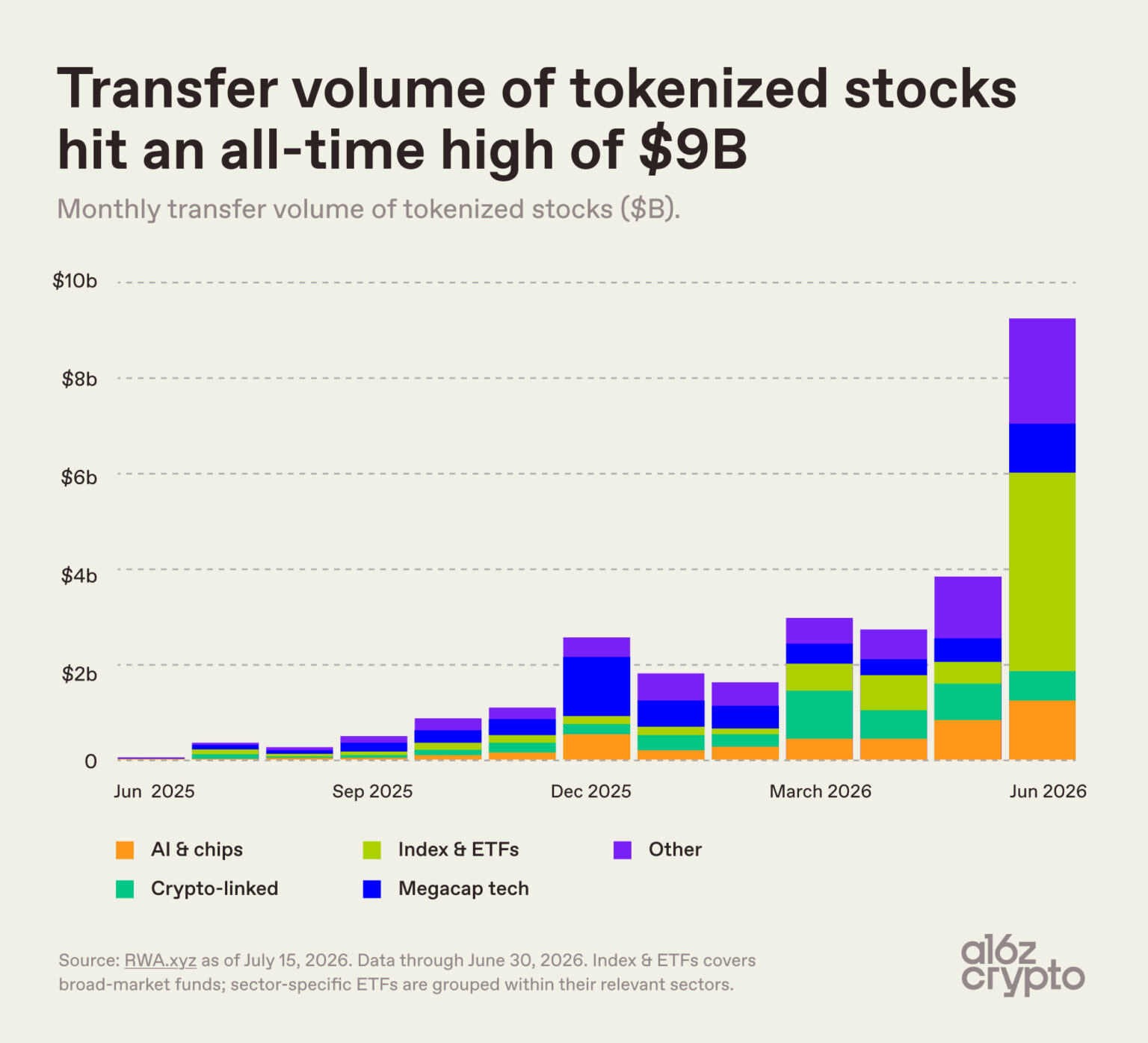
Monthly on-chain transfer transaction volumes of tokenized stocks
Institutional infrastructure is being fully established, and just in the past month, concentrated breakthroughs in foundational construction for industry institutions have occurred. DTCC completed the first real-time trades of tokenized government bonds and stocks on the Digital Asset's Canton network. Broader tokenized services are planned to launch comprehensively in October, at which point Wall Street will be able to directly access approximately $114 trillion in assets held by DTC custodians. Earlier this month, Robinhood launched its own chain on the mainnet, integrating traditional markets, cryptocurrencies, and real-world assets into an open network. On June 22, the parent company of the New York Stock Exchange announced a joint venture with OKX, which will offer tokenized stocks listed on the New York Stock Exchange to users upon obtaining regulatory approval. Earlier, on June 16, Coinbase announced it would offer 1:1 backed tokenized US stocks to non-US users, providing dividends, full shareholder rights, and around-the-clock trading. Binance also launched similar products a few days prior.
Compared to the traditional stock market with monthly trading volumes in the hundreds of trillions, the current scale of tokenized stocks is still quite small, but the trend is clear, with more and more issuers and trading platforms launching tokenized stock products as the sector continues to expand rapidly.
免责声明:本文章仅代表作者个人观点,不代表本平台的立场和观点。本文章仅供信息分享,不构成对任何人的任何投资建议。用户与作者之间的任何争议,与本平台无关。如网页中刊载的文章或图片涉及侵权,请提供相关的权利证明和身份证明发送邮件到support@aicoin.com,本平台相关工作人员将会进行核查。


