The staking threshold for deployers is 500,000 HYPE, with a maximum fee sharing of 50%, initially receiving 100 outcome quotas, with an auction mechanism for expansion to be introduced later.
Written by: angelilu, Foresight News
Jeff Yan, the founder of Hyperliquid, announced on its Discord a notice regarding HIP-4, stating that outcome markets will support permissionless deployment in an upcoming network upgrade, first on the testnet and then on the mainnet.
The announcement states that, like the deployment of spot and perpetual contracts, the outcome market technology needs to undergo thorough real-world verification in a validator's deployed environment before expanding to permissionless deployment.
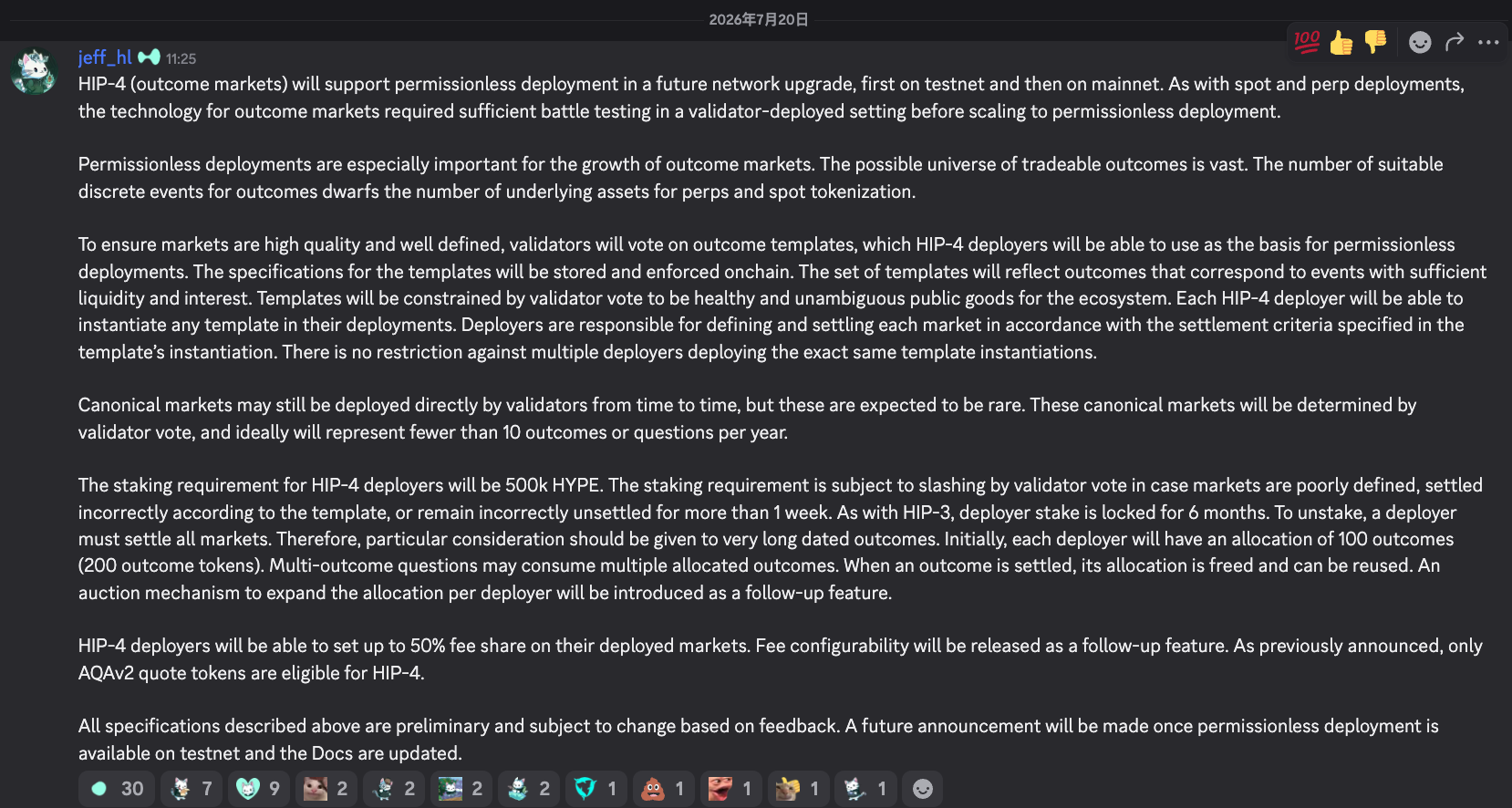
The announcement did not provide specific dates and noted at the end that all specifications are preliminary and may be adjusted based on feedback. However, several mechanism details disclosed have not been publicly detailed before.
Where HIP-4 Stands Now
On February 2, 2026, the Hyperliquid team announced HIP-4, introducing a new primitive called "Outcome Trading." According to the official documentation, outcome contracts are fully collateralized and the settlement price falls within a fixed range, suitable for prediction markets and bounded options tools, introducing non-linear characteristics and date-specific contracts, without involving leverage or liquidation. Each outcome market has two directions, each corresponding to a token, typically marked as Yes and No, with the order books of both merging to share liquidity. The so-called "question" is a collection of outcomes, of which exactly one outcome will settle as Yes.
In the same month, HIP-4 went live on the testnet. On May 2, it officially launched on the mainnet, with the first market being a cyclical binary outcome market, settling daily at 06:00 UTC based on the BTC marked price on HyperCore, with zero opening fee. Subsequently, Hyperliquid expanded the outcome market to off-chain events, with the first off-chain market being "May CPI Year-on-Year."
However, the mainnet phase is "validator deployment." The markets to open are decided by votes from validators, and external parties cannot open markets on their own. Thus, this new announcement discusses the next phase that has yet to arrive.
Why Permissionless Deployment is Necessary
Jeff Yan, the founder of Hyperliquid, provided a very straightforward reason in the announcement: the universe of tradable outcomes in outcome markets is extraordinarily large, and the number of discrete events suitable for outcome contracts far exceeds the number of underlying assets for perpetual contracts and spot tokenization. The targets for perpetual contracts are limited—coins, stocks, commodities, indices—countable. In contrast, the events in the real world available for betting are infinite. Relying on validators to vote for market openings one by one can never keep up with supply and demand.
To understand the urgency for permissionless deployment, one must first look at the actual performance of the HIP-4 mainnet over the past two and a half months.
In the 78 days since HIP-4's launch, it accumulated a transaction volume of $370 million, with a total of 7 million transactions. The peak daily transaction occurred on June 27, amounting to $12.96 million.
https://hl.eco/hip4
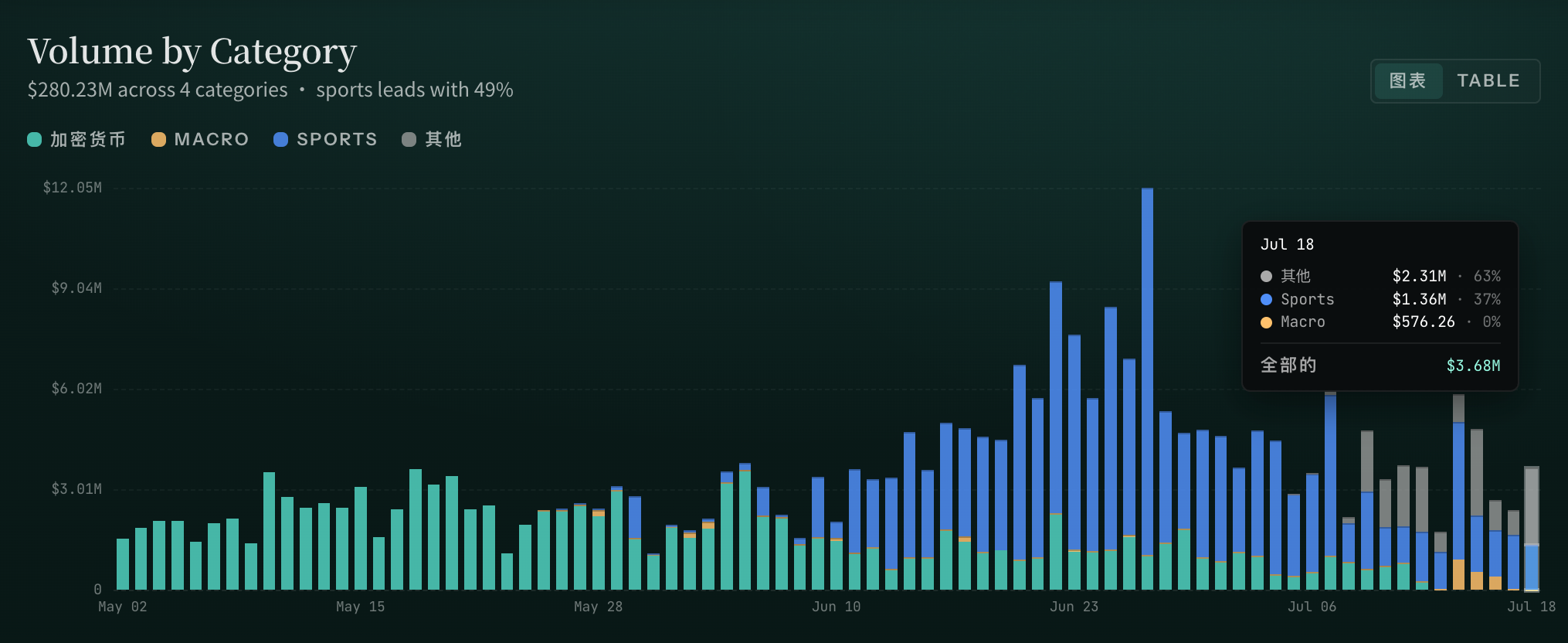
From May 2 to early June, nearly all trades came from cryptocurrencies, with daily transactions between $1 million and $3.5 million. On June 11, with the start of the World Cup, sports betting instantly took over, with transactions rising to three to four times the previous baseline.
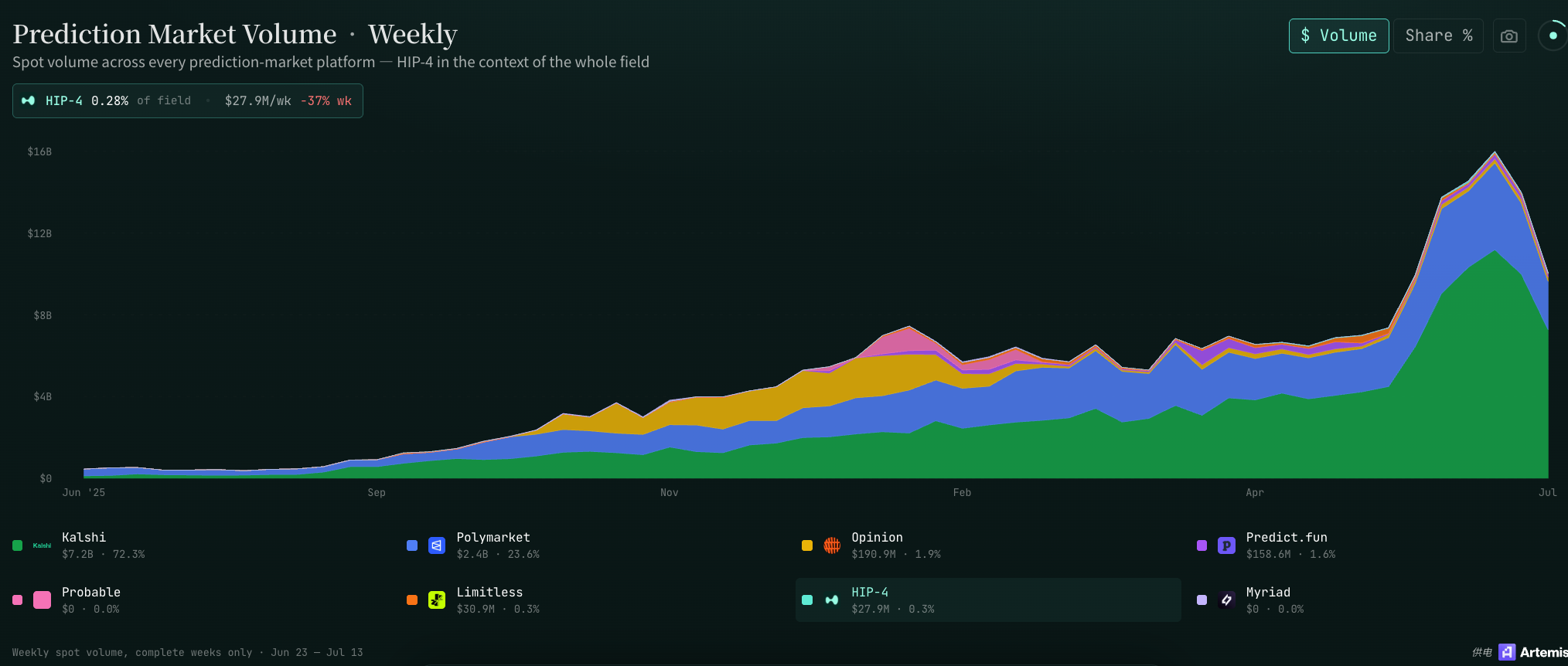
In the same period, competitor figures are on a different scale. For example, during the week of July 13 (during the World Cup), Kalshi and Polymarket recorded weekly trading volumes of $7.2 billion and $2.4 billion respectively, while HIP-4's trading volume was $27.9 million, giving HIP-4 a mere 0.3% market share in the prediction market.
However, this logic has already been successfully validated once in Hyperliquid. HIP-3 allowed anyone to stake HYPE and then deploy perpetual contract markets. It launched on October 13, 2025, and subsequently opened markets for Nvidia, Tesla, gold, crude oil, S&P 500, and more.
According to HIP-3 Ecosystem data, as of the publication date, HIP-3 has a historical transaction volume of $38.772 billion, with open interest rising from approximately $790 million in January 2026 to $3.43 billion in July; HIP-3 accounted for 47.2% of Hyperliquid's transaction volume by the publication date. Opening up the supply side has indeed led to explosive growth.
Several New Mechanisms of HIP-4
Therefore, as the World Cup comes to an end and all prediction markets explore new targets, Hyperliquid announced several new mechanisms for HIP-4 at this time.
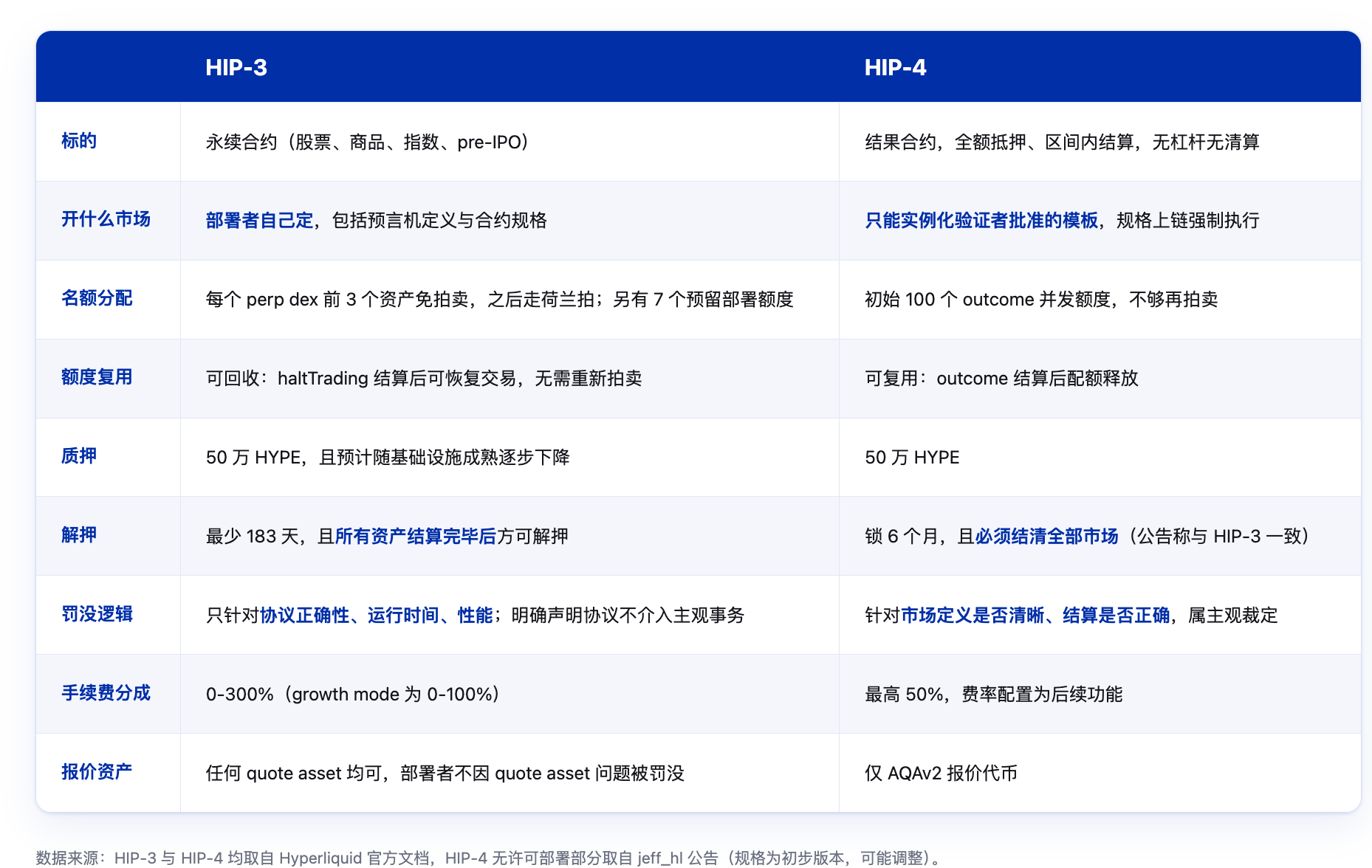
Staking Threshold of 500,000 HYPE
As for the staking threshold for HIP-4 deployers, this announcement is Hyperliquid's first public clarification on the staking requirements for permissionless deployment of HIP-4. There was prior community speculation that this number would be 1 million HYPE, double that of HIP-3. However, this announcement states it to be 500,000 HYPE, matching HIP-3. Staked tokens will be locked for 6 months, and if the market definition is unclear or settlement is delayed, the stake may be forfeited.
Template-Based Approach
The template-based approach is the core of this design. To ensure market quality and clarity of definition, validators will vote on "outcome templates," with template specifications stored on-chain and enforced. HIP-4 deployers can only conduct permissionless deployments based on these templates, specifying parameters and instantiating them into specific markets. The announcement requires that templates must be "healthy and unambiguous ecological public goods," and that the corresponding events must have sufficient liquidity and attention. Deployers are responsible for defining and settling each market according to the settlement standards specified when instantiating the template. The announcement explicitly does not restrict multiple deployers from deploying identical template instances.
The reason for adding this layer relates to product form. Perpetual contracts have continuous pricing, and if the judgment is off, the market will self-correct; however, outcome contracts settle at a definite value at expiration, and once judged incorrectly, the money directly goes to the wrong side.
Quota System
The quota system is another new element. Each deployer is initially allocated 100 outcomes (200 outcome tokens), with one outcome corresponding to the YES and NO tokens. Multi-outcome questions will consume multiple outcomes, for example, a five-choice question will be split into five binary outcomes, occupying five. After an outcome is settled, the quota is released and reusable, serving as a concurrent limit rather than a lifetime limit. The announcement states that an auction mechanism will be introduced later to expand the quota for individual deployers.
Forfeiture and Locking
Forfeiture and locking will determine what the market ultimately looks like. The stake can be forfeited by validator votes for three reasons: unclear market definition, incorrect settlement not adhering to the template, or failure to correctly settle after more than a week. Like HIP-3, deployers’ stakes are locked for 6 months, and all markets must be settled to unlock the stake. The announcement itself reminds that special caution is required for results with very long cycles.
The consequences of this rule are very tangible. Opening a market that settles two years later means 500,000 HYPE is locked for two years, and the quota is continually tied up. Rational deployers will only conduct short-cycle, high-frequency settling markets. The differences between HIP-4 and Polymarket in product form are not purely strategic choices, but also results of these mechanisms.
Additionally, deployers can set a maximum fee sharing of 50% for their markets, with fee rate configurations to be released in subsequent updates; only the AQAv2 quotation token can be used for HIP-4; validators may still occasionally directly deploy outcome markets, but this is expected to be very rare, targeting less than 10 outcomes or questions per year.
Problems Not Solved by the Template-Based Approach
From experiences with HIP-3, there are parts that HIP-4 should remain cautious about.
According to hl.eco, HIP-3 currently has 8 active deployers and 204 markets, but Trade.XYZ accounts for over 90% of the total open interest for HIP-3. Some analyses suggest that this high concentration of single deployers may pose structural/concentration risks to Hyperliquid.
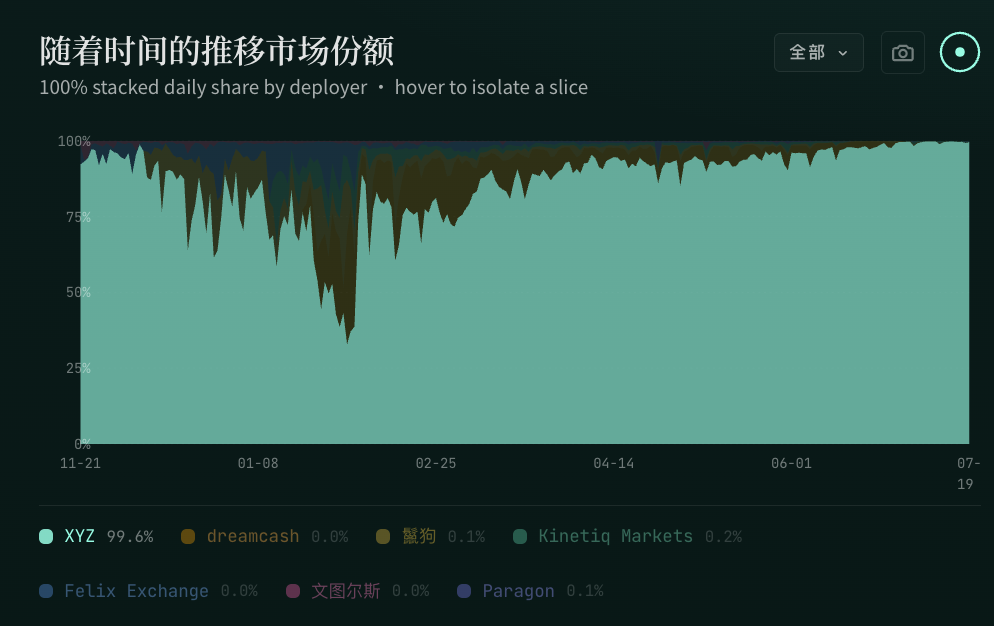
The new template-based approach within HIP-4 regulates market quality, not market share. Users choose a market to trade based on depth, and HIP-4 clearly allows multiple deployers to instantiate identical templates, which sounds like encouraging competition, but if the same question is opened into five identical markets, liquidity will only become more fragmented, ultimately still gravitating towards the deepest pool.
免责声明:本文章仅代表作者个人观点,不代表本平台的立场和观点。本文章仅供信息分享,不构成对任何人的任何投资建议。用户与作者之间的任何争议,与本平台无关。如网页中刊载的文章或图片涉及侵权,请提供相关的权利证明和身份证明发送邮件到support@aicoin.com,本平台相关工作人员将会进行核查。


