Citi downgraded South Korea's rating, yet still provided a 47% upside potential
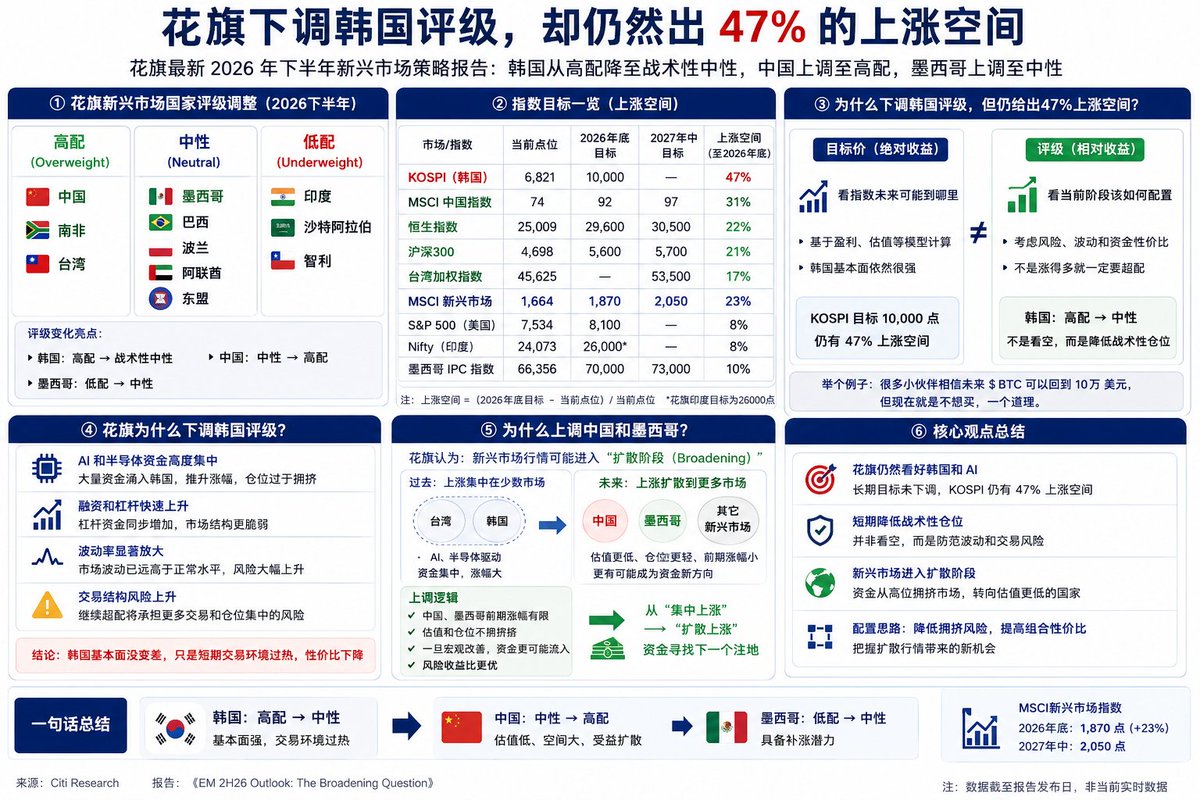
Citi has recently released its emerging market strategy report for the second half of 2026, downgrading South Korean stocks from overweight to tactical neutral, while upgrading China to overweight and Mexico to neutral.
This adjustment may easily confuse some, as Citi downgraded South Korea's rating while still giving a KOSPI target of 10,000 points, representing a 47% upside from the report's mentioned 6,821 points, the highest among all major markets.
It seems contradictory, but in fact, rating and target price are not the same thing.
The target price looks at where the index could potentially go in the future, while the rating considers whether capital should be overweight or underweight at the current stage. A market may still have significant upside potential, but that does not mean it is appropriate to continue to be overweight, especially when volatility has notably increased and positions are becoming increasingly crowded.
Citi's fundamental assessment of South Korea has not significantly worsened. The report emphasizes that South Korea's performance in the fundamental model remains strong, which is why the long-term target price for KOSPI has not been downgraded.
The downgrade of South Korea from overweight to neutral primarily targets the short-term trading environment. Recently, AI and semiconductor funds have been heavily concentrated in South Korea, with financing and leverage positions rising simultaneously, and market volatility has far exceeded normal levels. Maintaining an overweight position at this time entails greater risks associated with trading structure and concentrated positions.
Thus, Citi is not bearish on South Korea but is reducing tactical positions. In plain terms, it indicates that there is currently no consideration to completely sell off positions in the South Korean market, but rather to temporarily slow down continued purchases.
This also explains why there is still a 47% upside target for South Korea despite the downgrade in rating. The South Korean stock market may continue to rise, but achieving this 47% upside could involve higher volatility and pullbacks compared to other markets, such as China.
For asset allocation, as an example, many believe that Bitcoin can return to $100,000 in the future, but currently do not want to buy, which is a similar rationale.
@Gate Crypto, US stocks, Hong Kong stocks, South Korean stocks, gold, CFD, one-stop trading for the prediction market
免责声明:本文章仅代表作者个人观点,不代表本平台的立场和观点。本文章仅供信息分享,不构成对任何人的任何投资建议。用户与作者之间的任何争议,与本平台无关。如网页中刊载的文章或图片涉及侵权,请提供相关的权利证明和身份证明发送邮件到support@aicoin.com,本平台相关工作人员将会进行核查。


