Author: Claude, Deep Tide TechFlow
Deep Tide Introduction: Bitcoin has fallen from its peak of $126,000 in October last year to the $60,000 range, a decline of over 50%. The well-known trader, Doctor Profit, who accurately shorted this decline, announced a full closing of all short positions, entering long at $64,000, stating that structural variables have rewritten the four-year cycle script. On-chain analyst gumsays pointed out that the bullish divergence on the weekly chart has lasted for 147 days, approaching the 161 days seen before the low in 2022. However, cycle researcher Jake Pahor summarized the common characteristics of every bottom in bear markets since 2014 and found that this cycle has not met any of the three key conditions regarding time span, extreme panic days, and breaking the realized price. The market is currently torn between "preparing in advance" and "waiting for confirmation signals."
Bitcoin has dropped from about $126,000 in October last year to the $60,000 range, with the maximum drawdown exceeding 54%. This bear market has lasted nine months, and the focus of debate is shifting from "how much lower will it go" to "has the bottom already been reached."
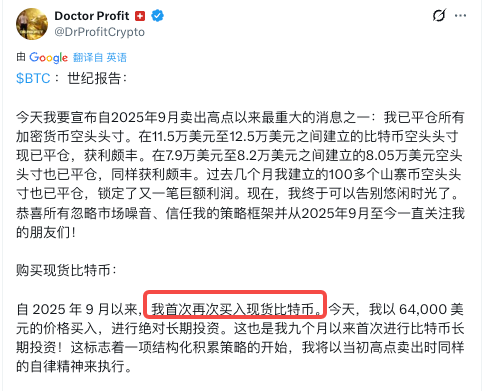
On July 19, the renowned crypto trader Doctor Profit, who accurately shorted this decline, posted a lengthy post on the X platform announcing a complete closure of all short positions and starting to buy Bitcoin spot at $64,000. This post attracted over 2.13 million views, quickly becoming a hot topic in the crypto community. On the same day, cycle researcher Jake Pahor provided a completely opposite assessment in his Substack column CryptoSuperHub: he reviewed 5,279 days of data since 2012 and found that every bear market bottom since 2014 has met three specific conditions, while this cycle has not met any.
Doctor Profit fully closes shorts, claiming the four-year cycle bottom will arrive early
Doctor Profit stated in the post that this is the "century report." He disclosed that all short positions established since September 2025 have been closed: shorts in the $115,000 to $125,000 range, shorts in the $79,000 to $82,000 range, and over 100 altcoin short positions, all locking in profits.
He entered the market by buying Bitcoin spot at $64,000, with a strategy of structured accumulation: as long as Bitcoin is in the $54,000 to $64,000 range, he will invest 5% of allocated funds to buy spot daily. Buy at $58,000, keep buying at $56,000, and increase the intensity if it drops below $54,000.
The core logic for turning bullish lies not in the technical aspect, but in the fundamentals. Doctor Profit believes that the mainstream market is still waiting for the "four-year cycle bottom" in September or October, but this consensus itself is a dangerous signal. "The market does not reward those who rely on the calendar. When everyone is waiting for the same date, the bottom often comes early."
He listed several variables that are changing the market structure of Bitcoin: the CLARITY Act may be passed by the Senate before August 10; BlackRock, Vanguard, JPMorgan, Goldman Sachs, and the New York Stock Exchange have joined DTCC's securities tokenization pilot, with Microsoft stock, SPY, QQQ, and U.S. Treasury bonds being tested as tokenized securities, with a formal launch scheduled for October; Citadel has just invested $400 million in Crypto.com, valuing it at $20 billion.
His judgment is that trillions of dollars in institutional funds are waiting off-market to enter, with the tokenization revolution and regulatory legislation advancing simultaneously. Retail investors are shouting on the X platform to wait for $40,000 to $50,000 to accumulate, but the biggest capital is already in action. "I will not stand behind the herd, seeking the market to give me chips at the same price as everyone else. I want to run ahead."
Doctor Profit also maintains all SP500 shorts. He believes that the bear market in the crypto market began in October 2025, months ahead of the stock market, and has already undergone repricing. If the stock market collapses, triggering funds to flow from overvalued assets to the undervalued crypto market, it would instead act as a catalyst.
gumsays: Weekly bullish divergence has lasted for 147 days, close to the previous bottom level
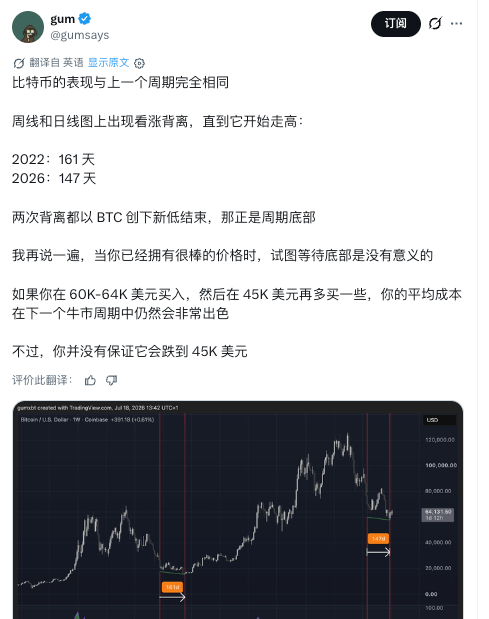
On the same day, on-chain analyst gumsays posted, providing technical support for his argument.
His observation is that the movement on the Bitcoin weekly chart is highly similar to the bottom of the 2022 cycle. In the 2022 cycle, the weekly bullish divergence lasted for 161 days, after which Bitcoin reached a new low and confirmed the cycle bottom; in the 2026 cycle, this divergence has lasted for 147 days, just about two weeks short of the duration seen in 2022.
gumsays’ conclusion is moderate but clear: "When you already have a good price, waiting for the absolute bottom does not make sense. If you buy at $60,000 to $64,000, then add at $45,000, your average price will still be excellent in the next bull market." But he also adds a risk warning: "You have no guarantee it will drop to $45,000."
Three conditions for bottoming, none met in this cycle
Jake Pahor provided the most systematic counter-argument in the CryptoSuperHub weekly report on July 19.
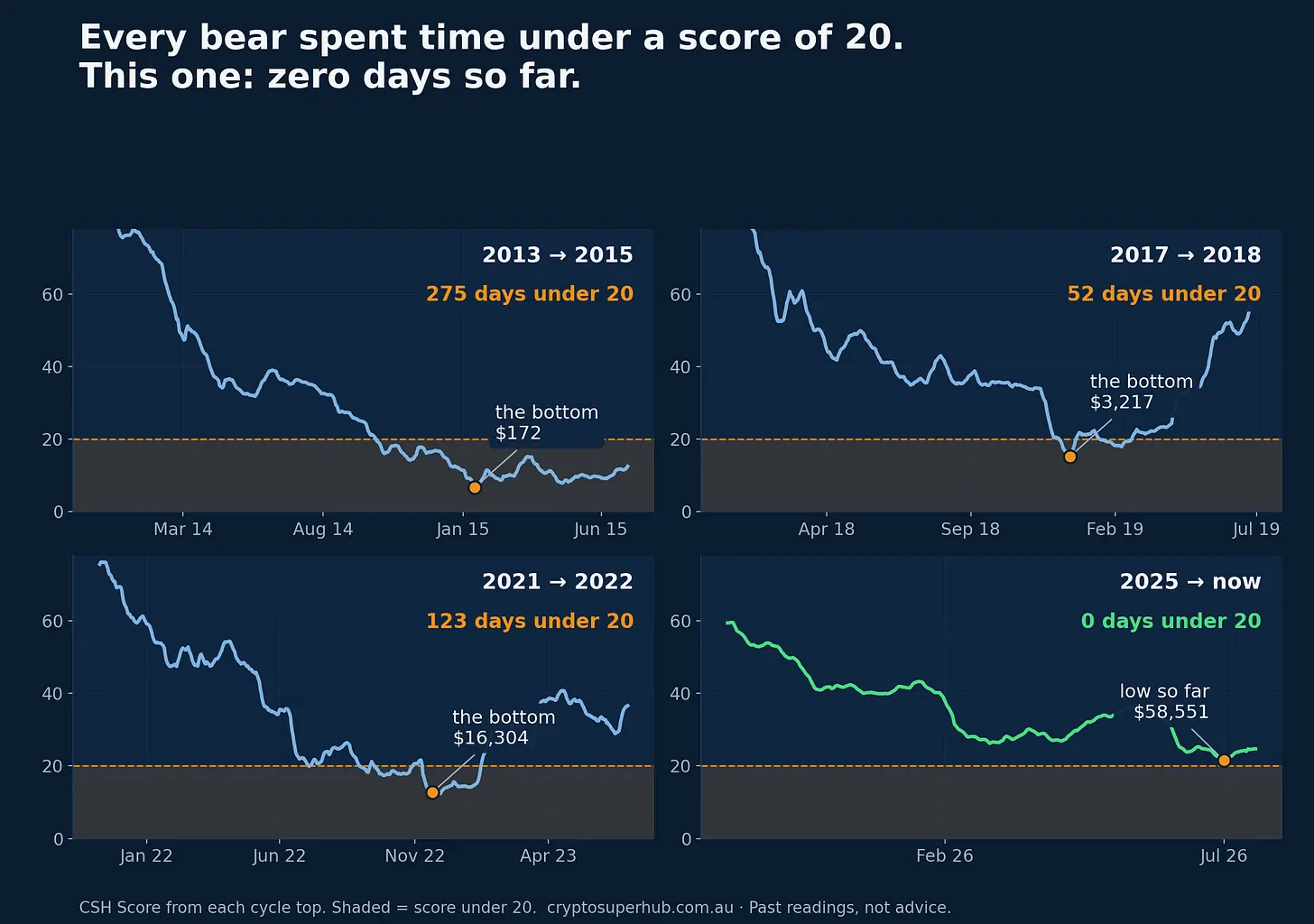
He reviewed 5,279 days of CSH risk score data since February 2012 and identified three common characteristics of the bottoms in every bear market since 2014:
First, the time span. Bear market cycles since 2014 have experienced about 12 months from peak to bottom. The peak of this cycle is in October 2025, corresponding to a window of 12 months in the fourth quarter of this year. Only 9 months have passed so far.
Second, the duration of extreme panic. The CSH risk score always falls below 20 before the bottom of each bear market and remains in that range for a considerable time. The bear market from 2014 to 2015 lasted 275 days below 20, 52 days in 2018, and 123 days in 2022. This cycle has not had a single day below 20, with a low of 21.5 on July 1.
Third, prices fall below the realized price. The realized price is the weighted average price at which all Bitcoins were last transferred on-chain, understood as the collective cost line of the entire market, currently around $53,000. In previous bear market bottoms, prices have always fallen below this level. The June low of $57,000 was close but did not reach it.
None of the three conditions met. This is why Jake Pahor refuses to join the "the bottom has been reached" camp.
But he is not purely bearish.
In the article, he acknowledged the reasonableness of the bullish camp: this round of drawdown is shallower than the same phase in previous years, and the ETF as a buyer force that did not exist in 2018 and 2022 may provide more substantial bottom support in this cycle, with over half of Bitcoin already in the loss zone at the June low (this condition historically correlates highly with bottom regions).
Jake Pahor's approach reflects his attitude: he continues to implement weekly dollar-cost averaging (rating 20 to 30 range), but larger buy orders are placed below a score of 20, which will not be triggered for now. "If the bottom has been reached, my dollar-cost averaging at a score of over 20 will perform well. If not, my larger buy orders are waiting below 20, with funds ready. The plan covers both outcomes, predictions can only cover one."
He also provided a set of historical backtest data: buying Bitcoin in the CSH score 20 to 30 range (the current position) returns a median of +132% after 12 months, with only 6% of trading days recording a loss; buying at a score above 60 results in negative median returns.
Two key time windows and one data anchor point
From the perspectives of multiple traders and analysts, the core of the current divergence can be summed up in one question: are the structural variables of ETF buying and regulatory legislation sufficient to detach this cycle from historical patterns?
Doctor Profit believes the answer is affirmative, betting on the bottom arriving earlier and going all-in long. Jake Pahor believes the evidence is insufficient to overturn historical rules, opting for systematic accumulation while keeping larger positions waiting for more extreme signals.
As of July 19, Bitcoin was quoted at about $64,800, with the 200-week moving average near $63,000, and the price is sitting right above this long-term support line. The fear and greed index is at 25 (extreme fear).
免责声明:本文章仅代表作者个人观点,不代表本平台的立场和观点。本文章仅供信息分享,不构成对任何人的任何投资建议。用户与作者之间的任何争议,与本平台无关。如网页中刊载的文章或图片涉及侵权,请提供相关的权利证明和身份证明发送邮件到support@aicoin.com,本平台相关工作人员将会进行核查。


