Written by: Rita
Trend Guide
The extreme volatility of AI infrastructure stocks is changing the market rules. In the past three months, Goldman Sachs' momentum factor annualized volatility reached 36%, the highest level for this factor during non-recession periods in its 45-year history. In the five trading days of this week, the momentum factor experienced more than 2% volatility on four days.
At the same time, the equal-weighted S&P 500 index has repeatedly hit new highs, and the correlation between individual stocks has fallen to its lowest level in decades. The market is shifting from a "universal AI" to differentiated stock picking.
The weekly outlook report from Goldman Sachs on July 17 specifically addressed the question most concerning to investors: what can be bought besides AI? The report provided three directions that are unrelated to AI and have very low correlation with the momentum factor: consumer experience stocks, high-quality compound growth stocks, and merger and acquisition candidates.
The extreme volatility of AI momentum has not ended
The recent performance of Goldman Sachs' momentum factor (going long on the best-performing stocks and shorting the worst-performing stocks) essentially reflects the structure of AI trading, heavily invested in semiconductors and technology hardware while underweighting software. However, this trade is undergoing a dramatic deleveraging.
The annualized volatility of the momentum factor has reached 36%, the highest level since 1981 during non-recession periods. In the five trading days of this week, the momentum factor had four days with single-day volatility exceeding 2%, as the market digests inflation data, bank earnings reports, and the uncertainty surrounding AI infrastructure stocks.
Historically, the momentum factor typically enters a consolidation phase after experiencing a similar rapid rise, which closely resembles the recent decline. Data from Goldman Sachs shows that although hedge fund positions in AI trading have significantly decreased, they still remain well above the average levels of the past few years.
Extreme volatility can be self-reinforcing, encouraging further position cuts and creating a vicious cycle. A fundamental catalyst that could change the situation should be a signal of AI investment ROI provided by mega-cap companies during this earnings season. However, Goldman Sachs believes it is still too early, and companies are unlikely to provide guidance on 2027 expenditures during the current earnings season.
Low correlation is suppressing index volatility
Although AI-related stocks experience extreme volatility, the volatility of the S&P 500 index remains low. This is due to the sharp decline in correlation between individual stocks.
The 3-month implied average individual stock correlation tracked by Goldman Sachs fell to a historic low of 0.14 this week. In other words, the average implied volatility of S&P 500 constituents (around 40%) is 2.8 times the index's implied volatility, which is also a historical record.
The volatility at the index level is masked by low correlation, but the risk at the individual stock level is much greater than it appears. Goldman Sachs concludes that in a low-correlation market, stock-picking ability becomes more critical than ever.
Theme One: Consumer Experience Stocks, Accelerated Growth, Not Expensive Valuation
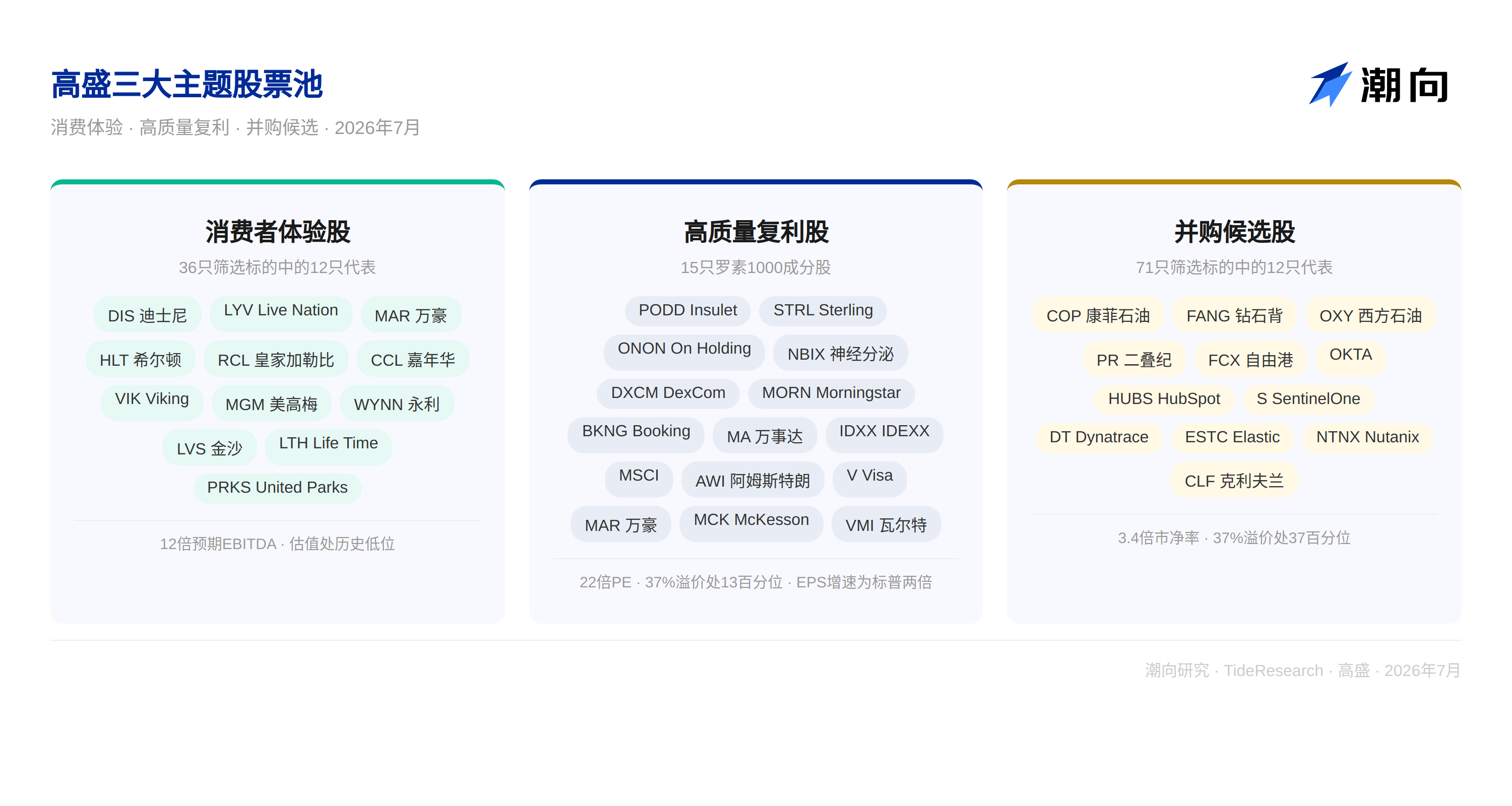
Consumer spending on "experiences" is accelerating, increasing from 1% in Q1 2025 to 6% in Q1 2026, while broader service spending growth is only 2%. Goldman Sachs screened 36 companies with a market value of over $2 billion that focus on physical consumer experiences, including cinemas, casinos, hotels, cruise ships, and recreational facilities.
This portfolio has already risen 17% this year, outperforming the equal-weighted S&P 500 index by 3 percentage points and the equal-weighted consumer discretionary sector by 17 percentage points. However, valuations remain inexpensive, with the median stock trading at 12 times expected EBITDA, which is in the 45th percentile and 21st percentile relative to the equal-weighted S&P 500 and consumer discretionary sector valuations since 2016.
Theme Two: High-Quality Compound Growth Stocks, Faster Growth, Lower Valuation
Goldman Sachs screened 15 Russell 1000 component stocks that exceed the index median on quality indicators such as earnings per share growth, free cash flow conversion rate, return on invested capital, and Altman Z-score. Over the past three years, these companies' EPS growth rate has been more than twice that of the S&P 500 median, with market consensus expecting them to maintain this advantage in the next two years.
However, year-to-date, this portfolio has underperformed the equal-weighted S&P 500 index by 7 percentage points, with valuations close to a 10-year low at 22 times earnings, representing a 37% premium over the equal-weighted S&P 500, which is in the 13th percentile since 2016.
Goldman Sachs believes that the macro environment and earnings growth outlook should support these companies' valuations. But if the Federal Reserve turns dovish or economic growth improves significantly, it could further suppress the relative performance of high-quality stocks.
Theme Three: Merger and Acquisition Candidates, Increasing Volume, Valuation Has Not Kept Up
This year, the total value of announced mergers and acquisitions in the United States has reached $1.2 trillion, a 32% year-on-year increase, with the number of deals climbing month by month. Goldman Sachs equity analysts have singled out 71 stocks assessed to have a greater than 15% probability of being acquired, which have outperformed the equal-weighted Russell 1500 index by 8 percentage points since the end of the first quarter.
However, valuations have not reflected the merger premium. The median merger candidate stock trades at 3.4 times price-to-book ratio, 37% higher than the Russell 1500 median stock, but this premium is in the 37th percentile range over the past 15 years. In the biotech field, merger candidates have higher valuation premiums, but this year, the average acquisition premium for biotech transactions has reached approximately 60%; in TMT and other industries, the valuations of merger candidates are roughly in line with their industry peers.
Goldman Sachs believes that loose financial conditions, solid economic growth, healthy CEO confidence, and a friendly regulatory environment will continue to support merger and acquisition activities. Some investment bank stocks focused on M&A consulting will also benefit, but recent valuation expansion has compressed the upside potential.
Trend Perspective
Consumers are willing to spend money on "experiences" and are spending more and more. This trend has nothing to do with AI, no relation to the semiconductor inventory cycle, but is only related to consumers' income distribution preferences. A 12 times expected EBITDA is considered cheap in the context of the past decade.
Compound growth stocks have strong profit capabilities but have been overlooked because they are not part of the AI narrative. A 22 times price-to-earnings ratio isn't cheap, but if benchmarked against the past decade, it is already at the floor price. When the market starts rewarding quality again will depend on when the macro environment changes.
Merger activity is increasing, but the market hasn’t given these potential acquisition targets enough premium. Excluding biotech, where the acquisition premium has been partially absorbed, TMT and other industries still have room for valuation recovery.
The commonality of the three themes is simple: they are all not related to AI, and they are all not expensive.

Disclaimer
This article is a整理与解读 of a third-party brokerage research report (Goldman Sachs, July 17, 2026) by Trend Research. The ratings, target prices, earnings forecasts, and related judgments cited in the text represent the views of that brokerage's analysts and only reflect their institution's position, not the views of Trend Research, nor do they constitute any investment advice.
The market carries risks, and decisions should be made independently. This article should not be used as a basis for buying or selling any securities.
免责声明:本文章仅代表作者个人观点,不代表本平台的立场和观点。本文章仅供信息分享,不构成对任何人的任何投资建议。用户与作者之间的任何争议,与本平台无关。如网页中刊载的文章或图片涉及侵权,请提供相关的权利证明和身份证明发送邮件到support@aicoin.com,本平台相关工作人员将会进行核查。


