Key Takeaways
- Polymarket prices a 39% chance the Clarity Act becomes law by December 31, 2026.
- Kalshi bettors set 67.8% odds the Senate votes on the bill before August 8.
- A $3.1M Kalshi market puts crypto market structure law odds at 61% before April 2027.
On Polymarket, the market asking whether the Clarity Act (H.R. 3633) gets signed into law before December 31, 2026, has drawn nearly $1.94 million in volume.
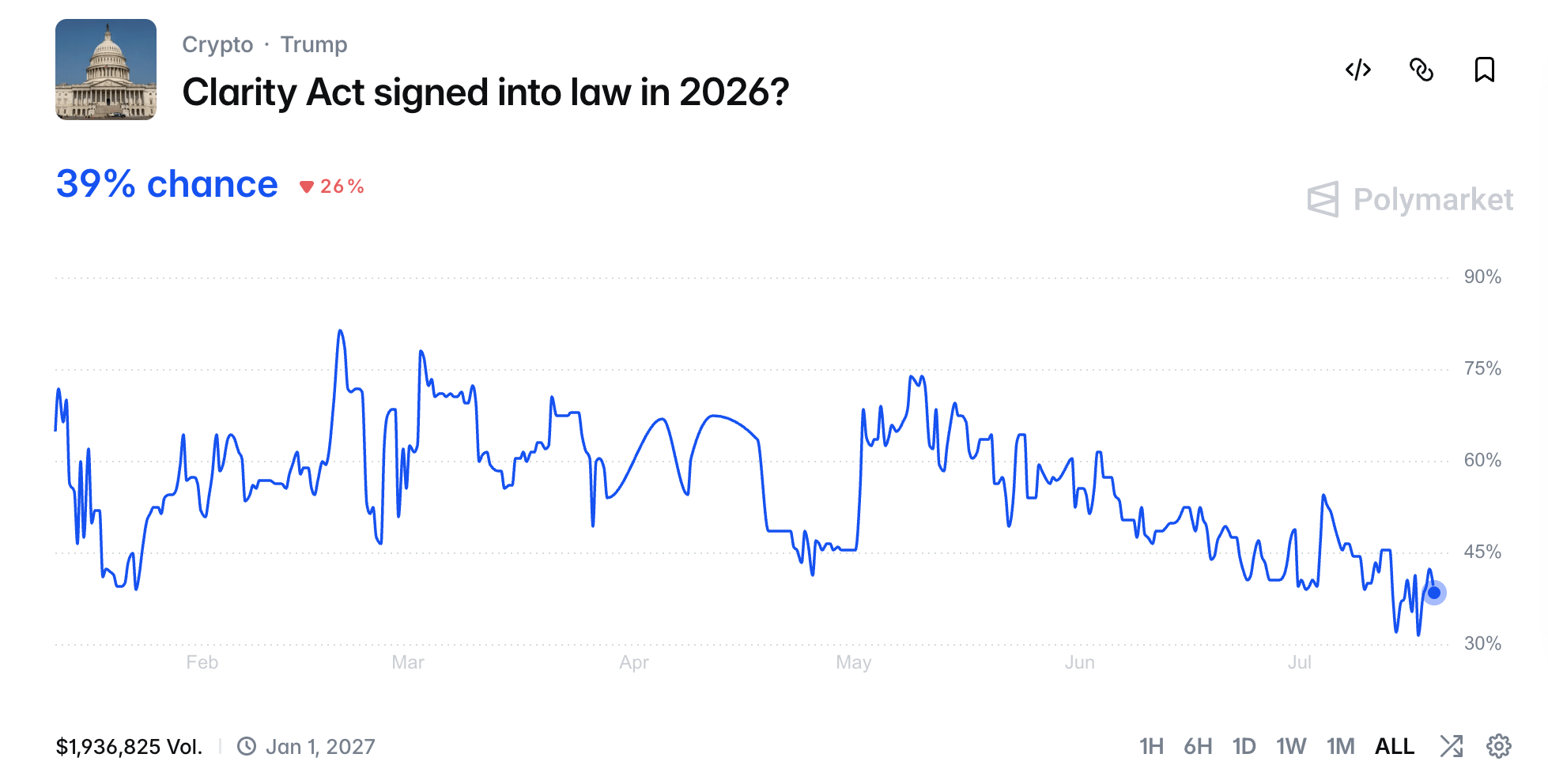
Polymarket odds at 10:30 a.m. Sunday, July 19, 2026.
Current odds sit at 39% for “yes” and 62% for “no.” That “yes” figure has fallen roughly 26% from recent highs.
A separate Kalshi market takes a narrower question: will the Senate hold a recorded vote on the Clarity Act before the August recess. Traders there are far more confident. YES contracts trade at 68 cents, putting implied odds at 67.8%.
That market opened July 10 and closes by August 8, or earlier if a qualifying vote happens first. Only recorded votes count. Voice votes and procedural rulings do not.
A third Kalshi market, with $3.1 million in volume, asks a broader question: will crypto market structure legislation become federal law at all, and when. That market breaks odds out by target date. Traders price a 61% chance of enactment before April 1, 2027, 53% before July 1, 2027, and 57% before October 1, 2027.
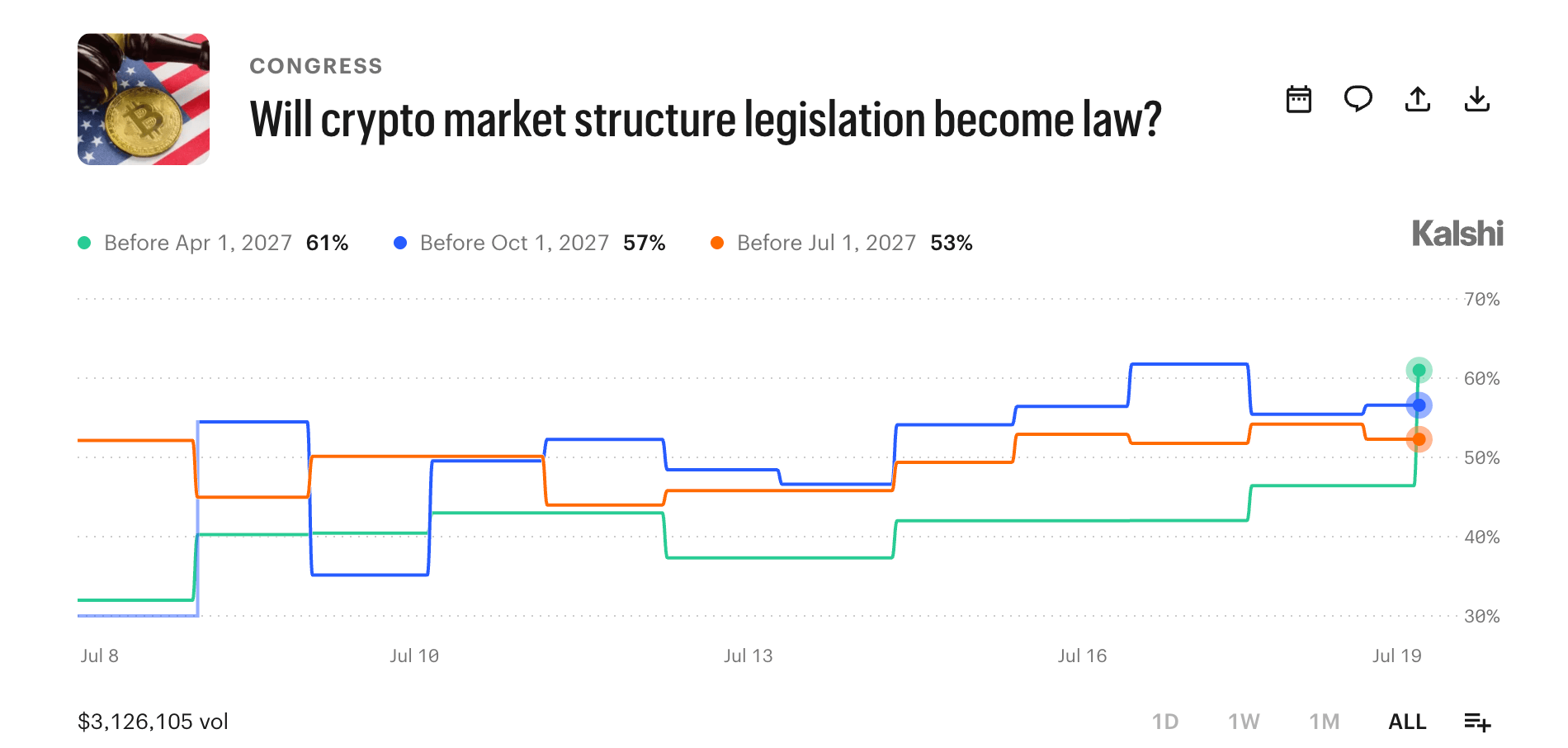
Kalshi odds at 10:30 a.m. Sunday, July 19, 2026.
This market has stricter resolution rules than the Polymarket contract. A qualifying bill must set up a full regulatory framework for digital assets, split authority clearly between the SEC and CFTC, and define when an asset counts as a security versus a commodity. Stablecoin-only bills like the GENIUS Act do not count. Neither do CBDC-specific bills or legislation that passes only one chamber.
The Clarity Act passed the House in July 2025 with bipartisan support. The Senate Banking Committee reported it out on June 1, 2026, with amendments, placing it on the Legislative Calendar. Sen. Tim Scott led that committee action. The House Digital Assets Subcommittee held a field hearing in New York on July 17, 2026, marking one year since House passage.
Supporters point to backing from the Trump administration and lawmakers including Sen. Cynthia Lummis. They argue the bill replaces years of SEC enforcement actions with clear rules for exchanges, custodians, and developers.
Critics, including some Senate Banking Democrats like Elizabeth Warren, warn that DeFi carve-outs in the bill could weaken anti-money laundering enforcement. They point to groups like North Korea’s Lazarus Group as a reason to keep oversight tight on decentralized platforms. Alongside this, President Trump’s own crypto investments have sparked more scrutiny.
The gap between the two Kalshi markets is the story for traders watching this closely. Bettors expect the Senate to act, and soon. They are far less confident that action turns into a signed law by the year’s end. A Senate vote is a procedural step. It does not guarantee passage, and it does not guarantee the version that passes matches what the House already approved.
Polymarket’s declining “yes” odds track that same skepticism. Congress has a history of letting crypto legislation stall even after committee approval. FIT21, the Clarity Act’s predecessor, passed the House in 2024 and never reached a Senate vote.
For traders positioning around crypto policy risk, the spread between a near-term procedural bet and a full-year enactment bet offers a read on where confidence actually sits. Kalshi bettors trust the Senate to show up for a vote. They trust Congress far less to finish the job before the year runs out.
免责声明:本文章仅代表作者个人观点,不代表本平台的立场和观点。本文章仅供信息分享,不构成对任何人的任何投资建议。用户与作者之间的任何争议,与本平台无关。如网页中刊载的文章或图片涉及侵权,请提供相关的权利证明和身份证明发送邮件到support@aicoin.com,本平台相关工作人员将会进行核查。


