Author: BlockWeeks
The most interesting aspect of the crypto market is that developers can never predict who will adopt their products first.
The newly launched native standard B20 by Base is a prime example. Originally intended to serve stablecoins and RWA, with a strong compliance background, this technical standard has now become the latest stage for meme traders to revel.
"Developers build the roads, speculators drive the cars." The explosive popularity of B20 in the meme realm superficially appears to be yet another speculative fest of liquidity overflow, but on a deeper level, it represents Base's attempt to break the fate of "Layer 2 is merely a transaction execution layer" and its initial foray into becoming an "asset issuance chain."
B20 is more than just "Base's version of ERC-20"
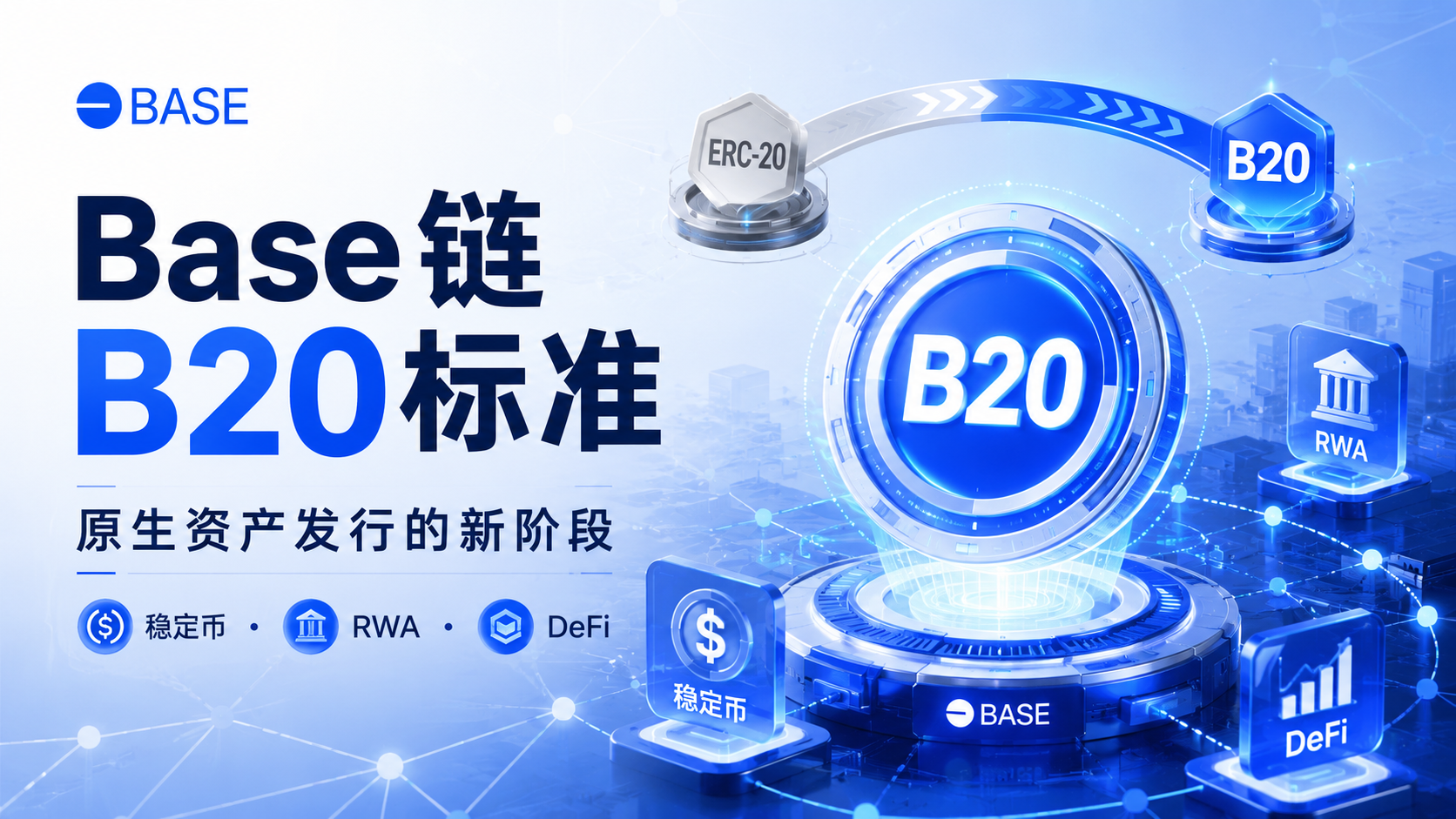
To understand the current enthusiasm for B20, it's essential to clarify one point: B20 is not simply an ERC-20 with a different name.
Base officially describes B20 as a native token standard. It is not a traditional ERC-20 smart contract deployed on the chain, but runs in the Base node software in the form of Rust precompile. In other words, the token logic of B20 is more akin to being part of the chain itself, rather than a contract deployed separately by a project party.
This brings three direct changes.
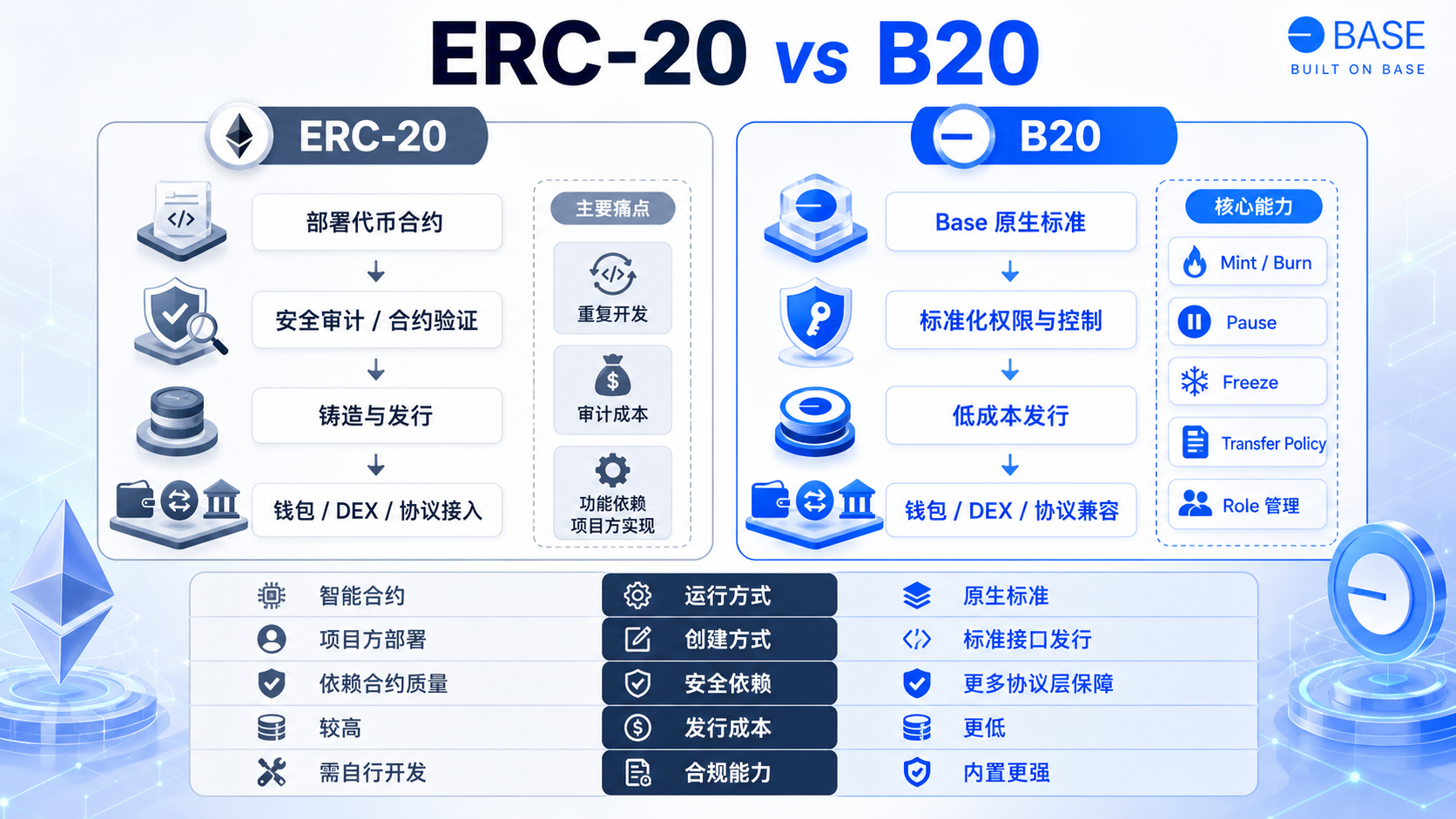
First, B20 remains compatible with ERC-20. The Base documentation clearly states that B20 is a superset of ERC-20, with standard interfaces like transfer, approve, balanceOf, and allowance remaining consistent, thus existing wallets, trading platforms, data indexers, and on-chain protocols can theoretically continue to be compatible.
Second, B20 standardizes many capabilities that previously required project parties to develop and audit themselves. For instance, role-based access management, supply caps, minting and burning, transaction pausing, transaction strategies, memo notes, permits, as well as the capability for freezing and disposal of compliance assets.
Third, B20 is embedded in Base's upgrade roadmap. The Base Beryl upgrade not only introduces B20 but also reduces the final confirmation period for single proof withdrawals from 7 days to 5 days, along with node performance optimizations brought by Reth V2. The activation time for the Beryl mainnet listed in the Base official documentation is June 25, 2026, at 18:00 UTC.
In other words, the technical positioning of B20 is actually quite clear: it is not merely a "coin issuance tool" tailored for memes, but a set of underlying standards prepared by Base for future stablecoins, RWA, on-chain payments, and institutional asset issuance.
But why is the market focusing on memes first?
Why did the first wave of B20's popularity come from memes?
The answer is not complicated: Memes are the group most skilled at pricing new standards in the crypto market.
In most industries, the adoption path of new standards typically follows this sequence: technology matures, institutions get involved, applications land, and the market acknowledges it. However, in the crypto market, the order often reverses: there's first a narrative, then an asset; first transactions, then ecosystems; first speculation, then the infrastructure improves.
B20 possesses several conditions that make it suitable for becoming a meme narrative.
First, it has a simple name. The naming of B20 is inherently easy for the market to understand: ERC-20 is the token standard of the Ethereum era, BRC-20 once ignited the inscriptions market in the Bitcoin ecosystem, and B20 can easily be packaged as "the new standard of the Base ecosystem." This symbolization capability is crucial for memes.
Second, it is tied to the robust Base ecosystem. Backed by Coinbase, Base carries inherent compliance, entry points, users, and brand imagination. Over the past two years, Base has accumulated meme assets such as Brett, Toshi, and Degen, along with ecological entry points like Farcaster, Coinbase Wallet, and Aerodrome. For the market, B20 is not an isolated new standard but one that appears on a chain with established meme soil.
Third, B20 provides the expectation of a "new asset class." The meme market gravitates more towards newly emerged, yet-to-be-consensus assets rather than those that have been thoroughly priced. Once B20 is tagged independently by wallets, trading tools, and data platforms, it can form a new asset classification, and asset classification itself is an entry point to liquidity.
Recently, Binance Wallet announced it would support Base B20 token trading and stated that Meme Rush would support B20 token filtering and tagging, which is one of the key nodes amplifying B20’s popularity.
For the meme market, "discoverability" often trumps "advanced technology." If a new standard only has developer documentation, it is hard to break out; but if wallet entries, leaderboards, tags, and filters emerge simultaneously, it transforms into a new track that can be traded, ranked, and disseminated.
What has Meme Rush changed?
The integration of B20 with Meme Rush is fundamentally not a simple matter of "wallets supporting a type of asset," but rather that the issuance layer, discovery layer, and trading layer have begun to connect.
Binance Wallet had previously launched Meme Rush - Fair Mode, aimed at allowing users to participate in meme projects earlier and utilize structured lifecycles, bonding curves, migration to DEX, leaderboard displays, and other mechanisms to provide a relatively standardized entry for early meme trading. Their official announcement mentioned that Meme Rush tokens would progress through stages of New, Finalizing, Migrated, and, upon meeting certain conditions, migrate to DEX and be displayed on the ranking page.
This mechanism is significant because the biggest pain point in the meme coin market has never been "lack of coins," but rather "there are too many coins."
Previously, users seeking early meme opportunities had to switch back and forth between social media, blockchain explorers, DEX Screeners, and Telegram groups. The information was highly fragmented, and risks were incredibly high. Now, wallets and aggregation points are starting to try to consolidate meme issuance, filtering, trading, and ranking.
When B20 is integrated into such systems, it gains not just technical recognition but also a flow entry point.
This is why the meme enthusiasm for B20 is worth noting. It may not stem from the strength of a specific meme coin, but from the market's bet on whether B20 could become a new asset issuance label on Base.
The essence of B20 memes: not value pricing, but narrative options
From an investment logic perspective, B20 memes resemble a kind of "narrative option."
The pricing of ordinary meme coins mainly relies on community dissemination, symbol identification, holder structure, liquidity depth, and trading enthusiasm. The memes related to B20 have an additional layer of expectation: if the B20 standard is adopted by more wallets, trading platforms, issuance tools, and project parties in the future, then assets formed early around the naming, labeling, and cultural symbols of B20 could potentially gain additional narrative premiums.
This does not mean that all B20 memes have value. In fact, most meme assets do not generate cash flow and lack a clear fundamental basis. Their rise is primarily driven by attention, liquidity, and expectation changes.
However, the peculiarity of the crypto market is that attention itself is a means of production.
This was true for early BRC-20, for Solana's Pump.fun ecosystem, and it holds for the Base meme ecosystem as well. Once a new standard forms a closed loop of "asset issuance + community dissemination + trading entrance + leaderboard selection," it can create market heat rapidly.
The current key for B20 is not how many long-term valuable assets it has generated but whether it is forming a new speculative entry.
But B20 also brings a contradiction: compliance standards, why are they first used by memes?
The most discussable aspect of B20 lies precisely here.
From its design intention, B20 leans more towards compliant assets. Base officials repeatedly emphasize that it targets stablecoins, RWA, equity-type assets, and issuers needing compliance controls. The B20 toolkit includes capabilities for transfer strategies, freezing and disposal, role permissions, and supply control, which are critical for stablecoins and RWA.
Yet, from the perspective of market popularity, it is first captured by memes.
At first glance, this seems contradictory, but in reality, it is not. In the on-chain asset market, memes often serve as the pressure testing layer for new infrastructures.
Low-cost chains being utilized first by memes indicates they are affordably priced; high-throughput chains being utilized first by memes demonstrates they can handle high-frequency trading; new coin issuance standards being tapped first by memes show they are easy to understand and disseminate.
Memes do not necessarily represent long-term value, but they often symbolize the earliest user behavior.
If B20 cannot accommodate the high-frequency issuance, high-frequency trading, and rapid dissemination of memes, it will struggle to prove its capability to handle more complex scenarios such as stablecoins and RWA. Conversely, if B20 can complete its first round of tools, indexing, trading, and user education within the meme track, it may be more favorably adopted by serious assets in the future.
In other words, memes are the ingress for B20 but do not necessarily dictate its ultimate purpose.
What Base truly desires is to become an "asset issuance chain"
From a broader perspective, the emergence of B20 indicates that Base's positioning is changing.
In the past, the core competition among Layer 2s revolved around transaction costs, TPS, ecological applications, and TVL. However, as Layer 2 technology matures, merely being "cheap and fast" is hard to create long-term differentiation. Base needs to prove that it is not just an expansion layer for Ethereum, but an on-chain economic entity capable of supporting asset issuance, circulation, and settlement.
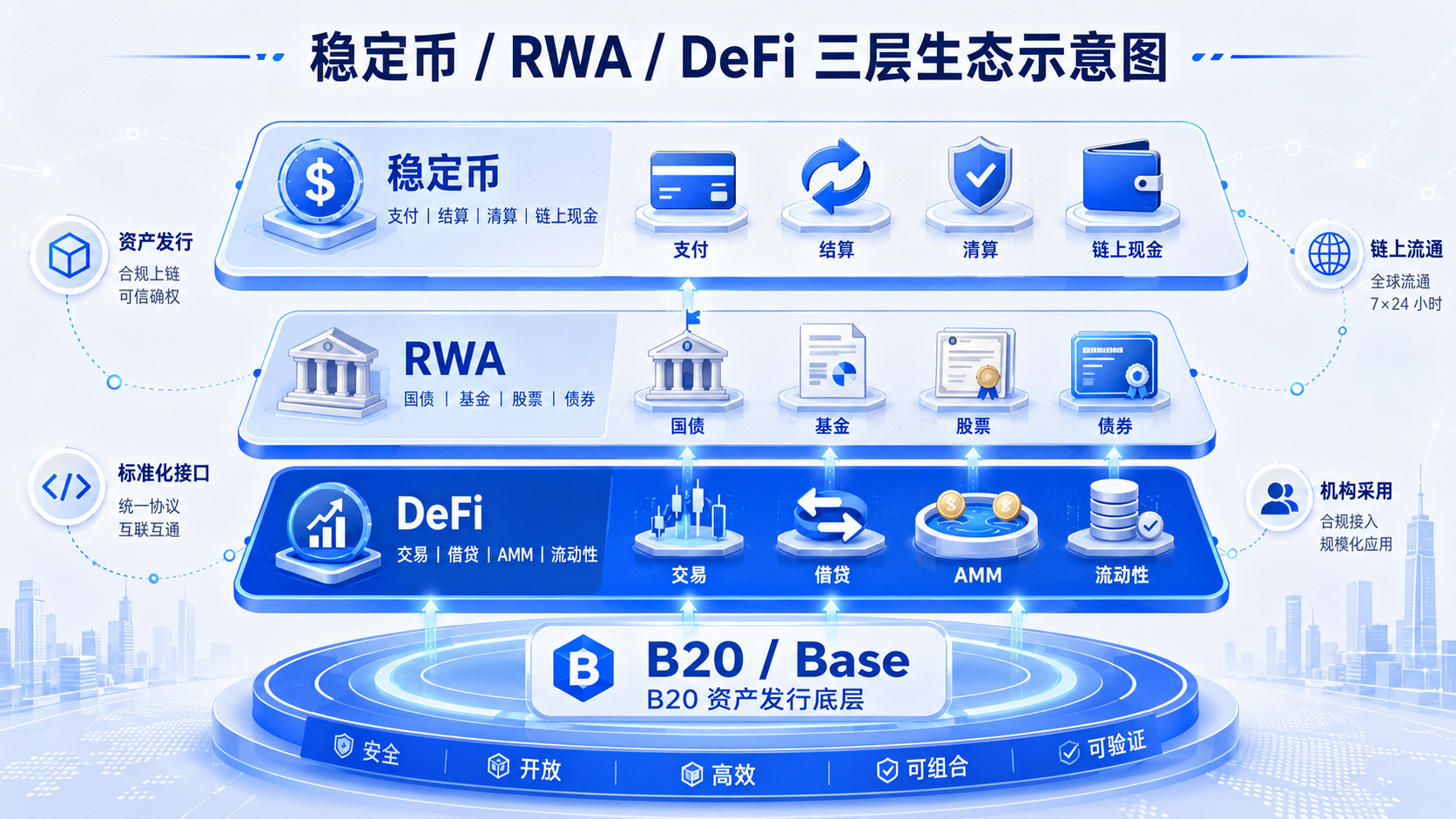
B20 is part of this strategy.
Base Beryl's official article states that Beryl makes Base a "first-class issuance platform." This statement is critical. It indicates that Base does not merely want to host contracts deployed by others but aims to provide more standardized asset issuance capabilities within the chain itself.
If the asset issuance logic during the ERC-20 era was "anyone can deploy a contract," then B20 wants to convey that "Base can offer a native asset issuance framework."
Behind this lies two different pathways.
ERC-20 is perfectly open. Anyone can copy the code, modify parameters, and deploy tokens. It sparked the DeFi explosion but also led to numerous low-quality assets and security risks.
B20 is more like a compromise between open issuance and standardized governance. It retains ERC-20 compatibility but embeds more commonly used capabilities for issuers into the standard, especially those needed for institutional assets that ordinary ERC-20 does not provide by default.
This is also the differentiating direction for Base compared to other Layer 2s: it aims not merely to be a cheaper chain but one more suited for asset issuance.
The risk of B20: the more standardized, the more transparency is needed
Of course, the higher the enthusiasm for B20, the more its risks need to be discussed.
The first risk is the high volatility of meme assets. Meme coins usually lack fundamental support, and their prices depend heavily on sentiment and liquidity. Binance has also explicitly cautioned in the Meme Rush announcement that such digital assets are highly speculative, subject to extreme volatility, and may lack intrinsic value or utility, potentially resulting in users losing all or most of their investment.
The second risk is permission transparency. Because B20 is not a traditional EVM contract but operates as a precompile, users and tools need new indexing and presentation methods to clearly see the permission structure of a given B20 token, such as who has minting rights, freeze rights, admin rights, etc. Reports from Unchained have also indicated that developers initially worried that existing block explorers and indexers were not adequately reading B20, making it difficult for ordinary buyers to directly perceive relevant permissions.
The third risk is the conflict between "compliance capabilities" and "decentralized narratives." Freezing, blacklisting, and transfer restrictions may be necessary functions for stablecoin and RWA issuers, but for meme users, these capabilities can also signify higher centralization risks.
Hence, the more B20 aspires to become an asset issuance standard, the stronger the need for robust transparency infrastructure.
In the future, when users purchase B20 tokens, they should not only see prices, K-lines, and market values, but also a clear permission panel: whether it can be issued additionally, whether it can be frozen, whether transfer can be paused, whether the admin has relinquished rights, and whether there are transfer strategy limitations.
If this information cannot be understood by ordinary users, the standardization of B20 may instead create new information asymmetries.
Will B20 become Base's "BRC-20 moment"?
The most pressing question in the market now is: Will B20 become Base's BRC-20 moment?
The answer may not be so simple.
The explosion of BRC-20 relied on the long-standing lack of native asset issuance narratives in the Bitcoin ecosystem; Ordinals and inscriptions brought new trading scenarios to Bitcoin. However, Base is different. Base already supports ERC-20, and there are already many meme coins in its ecosystem. Therefore, B20 does not create asset issuance from scratch, but rather provides a more native and standardized new choice within an existing asset issuance system.
Thus, B20 may not necessarily replicate the path of BRC-20.
It may take another route: initially driven by memes for breakout, complemented by wallets and trading tools for infrastructure improvement in the mid-term, and ultimately determined by stablecoins, RWA, payments, and institutional assets in the long run.
If it’s just a meme fad, B20 might turn into yet another short-cycle narrative; but if B20 can be adopted by more issuance tools, DEXs, wallets, explorers, data platforms, and institutional assets, it could become one of the true asset standards within the Base ecosystem.
The real highlight of B20 is not a specific meme, but Base's asset ambitions
The explosive popularity of B20 reaffirms one thing: the crypto market will never develop in sequence as dictated by technical roadmaps.
Base's launch of B20 was intended to serve stablecoins, RWA, and more standardized asset issuance; yet the market initially used memes to heat it up. This is not a deviation from the theme but a typical way the crypto market discovers new narratives.
Memes generate attention, infrastructure captures that attention, and the true ecological value depends on what remains after the attention recedes.
For Base, the significance of B20 is not merely "adding a token standard." It indicates that Base is extending from being a transaction execution layer to an asset issuance layer. The future Base may not only be a trading ground for DeFi and memes but also an important entry for stablecoins, RWA, on-chain payments, and institutional-grade assets entering the crypto market.
And this current wave of B20 meme enthusiasm may just be the first noise of this larger narrative.
Noises may not equal value, but in the crypto market, many important trends initially manifest in the form of noise.
免责声明:本文章仅代表作者个人观点,不代表本平台的立场和观点。本文章仅供信息分享,不构成对任何人的任何投资建议。用户与作者之间的任何争议,与本平台无关。如网页中刊载的文章或图片涉及侵权,请提供相关的权利证明和身份证明发送邮件到support@aicoin.com,本平台相关工作人员将会进行核查。


