
Uweb Research: Analysis of the Transformation Effects of Global Listed Companies to AIDC (Intelligent Computing Centers)
Co-produced by: Uweb × The Hong Kong Polytechnic University School of Business TGG Stablecoin and RWA Innovation Center
1. Global AIDC Enters Super Construction Cycle
AIDC is a physical expansion locked in by orders and power, with demand certainty significantly higher than general technology themes, which is the premise for judging whether listed companies can truly benefit.
1.1 Growth Drivers Have Shifted from Internet Traffic to AI; Whoever Holds AI Capacity Holds Incremental Growth
The essence of AIDC's growth is a physical expansion measured in GW, with AI having shifted from a supporting role to the only main engine of incremental growth. JLL's 2026 Global Data Center Outlook predicts that the 103GW in 2025 will double to 200GW by 2030, and it is expected that AI loads will account for approximately 50% of total data center capacity by 2030, up from about 25% in 2025. According to McKinsey's estimates, global data center demand is expected to increase from 82GW in 2025 (44GW AI, 38GW non-AI) to 219GW in 2030 (156GW AI, 64GW non-AI), with AI capacity expected to grow 3.5 times in five years, making up about 70% of total demand by 2030.
In the next five years, nearly all incremental data center capacity will come from AI, meaning the growth logic of the industry has shifted from traffic-driven of the internet era to AI-driven training and inference, determining whether listed companies can secure AI-ready capacity and orders, directly deciding whether they gain incremental or existing profits.
Simultaneously, the multi-trillion dollar investment means that the entire industrial chain will be re-priced. According to McKinsey's April 2025 research report, global data centers are expected to require $6.7 trillion by 2030 to meet the demand for computing power. Data centers that can handle AI processing loads are expected to require $5.2 trillion in capital expenditure, while those for traditional IT applications are anticipated to require $1.5 trillion. Overall, by 2030, this equates to almost $7 trillion in capital expenditures, an astonishing amount of spending on computing power by any standard.
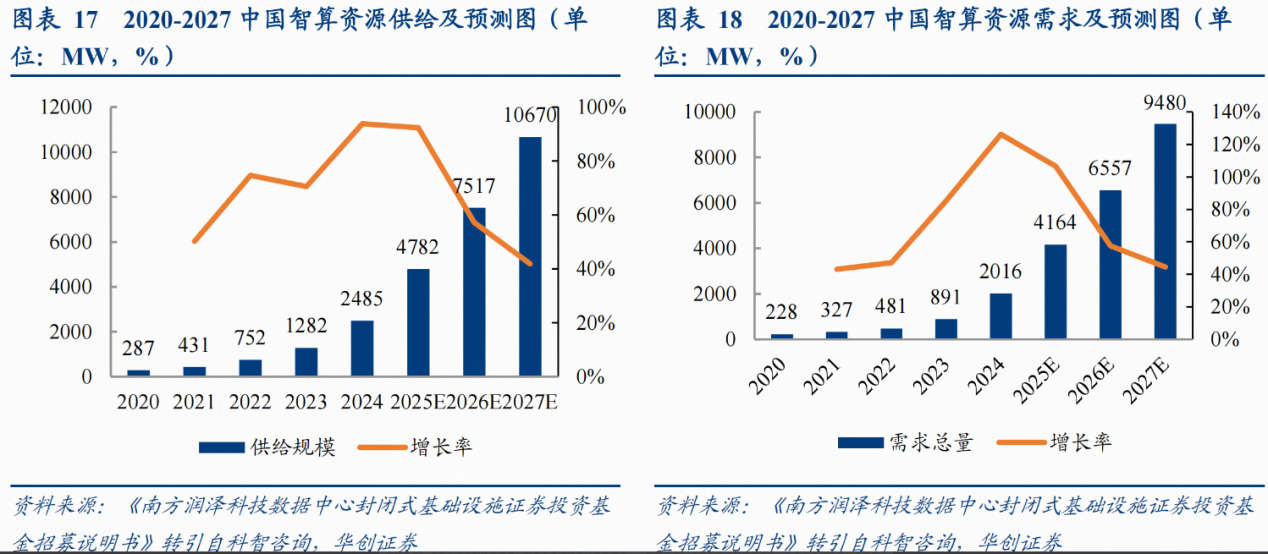
From a market scale perspective, the AIDC industry has entered a phase of rapid growth. In 2024, China's AIDC market size is about 49.4 billion yuan, and Kezhi Consulting predicts it will grow to 196.3 billion yuan by 2027, corresponding to a compound growth rate of about 58%. Structurally, the computing power leasing market size is expected to grow from 41.5 billion yuan to 152.8 billion yuan, continuing to increase its share and becoming an important component of the industry's growth; the intelligent computing infrastructure market is projected to grow from 7.9 billion yuan to 43.5 billion yuan, maintaining steady expansion. Against the backdrop of rapidly increasing AI computing power demand, service delivery models are accelerating penetration, with the AIDC industry transitioning from infrastructure construction to a model of "computing power services + infrastructure collaborative development."
In June 2026, Li Chao, Deputy Director of the Policy Research Office and Spokesperson of the National Development and Reform Commission, stated at a press conference, "During the 14th Five-Year Plan period, we will pay more attention to the matching of supply and demand, strengthen the collaborative integration of computing networks with new power grids and new-generation communication networks during planning and construction. In terms of hard investment, we will explore more effective models for synergizing computing and electricity, to enhance computing with electricity and promote electricity with computing; strengthen innovation in computing-network integration, appropriately promote the expansion of direct connection lines between national hubs, and further reduce network transmission delays. On the soft construction side, we will strengthen monitoring and market-based scheduling of computing resources and accelerate the establishment of a nationwide integrated computing network that is connected, universally accessible, and green and safe. The NDRC also announced that the entire list of 200 billion yuan equipment upgrade projects will officially be issued by the end of June 2026. This funding is an important part of the 'two new' policy and has previously been allocated in two batches totaling 185.1 billion yuan, benefiting over 11,000 projects and driving total social investment exceeding 840 billion yuan.
1.2 AIDC Demand Has Been Verified by Cold Hard Cash
The distinguishing feature of AIDC from most technology concepts is that its demand is not just forecasted; it is already reflected in the spending of cloud providers and Nvidia's revenue, raising the industry's certainty from narrative to order. According to a Dell'Oro Group report, the four major American hyperscale firms - Amazon, Google, Meta, and Microsoft - are entering 2026 with nearly $600 billion in data center capital expenditures, and global data center capital expenditures are expected to approach $1 trillion for the year. Nvidia's revenue for the fiscal year 2026 is projected to reach $215.9 billion, a 65% increase from fiscal year 2025, with data center revenue for the year amounting to $193.7 billion, up 68% year-over-year, accounting for over 90% of total company revenue. The first quarter of fiscal year 2027 revenue is approximately $75.2 billion, a sequential increase of about 21%, and a year-over-year increase of about 92%.
On one end, there is the cloud companies' commitment of nearly $600 billion in spending, and on the other, there is Nvidia's 92% growth rate in data center revenue, mutually confirming that the money from the demand side is being spent, and goods are being shipped. This means that for downstream AIDC operators, the issue is whether they can catch this demand.
1.3 Energy is a Real Physical Bottleneck
With sufficient capital, the real bottleneck for AIDC expansion has become electricity and grid connection capabilities, shifting the competitive edge from who has money to who has power and land. From electricity demand, the International Energy Agency (IEA) report shows that global electricity consumption in data centers is expected to more than double by 2030 to about 945 terawatt-hours, nearly matching Japan's total electricity consumption; AI-specific data center electricity usage is expected to grow over four times, with U.S. data center electricity consumption expected to account for nearly half of the country's incremental electricity growth before 2030. Consequently, electricity has become a genuine constraint for AIDC implementation, explaining why companies that first master electricity and land hold an advantage in this round of transformation.
SemiAnalysis forecasts that the annual compound growth rate of the intelligent computing center infrastructure market from 2024 to 2032 will exceed 30%. To meet the surging demand for AI computing power, operators and large cloud service providers are actively seeking areas rich in land and power resources for business expansion, further promoting the centralized and large-scale development of data centers. Although the growth rate of general data centers is slower than that of intelligent computing centers, they still maintain steady growth under the overall boost of the intelligent computing ecosystem, reflecting the strong radiation ability of AI computing demand from core to periphery.
2. Listed Company Transformation Four-Layer Classification and Three-Region Distinction
2.1 Mainland China, Hong Kong, and the United States have Different Degrees of Transformation Quality
Although all three regions discuss AIDC transformation, their quality and degree of transformation systematically differ.
- American listed companies primarily focus on transforming Bitcoin mining companies into AI hosting; these firms already own power, facilities, and cooling, making their conversion to AI a reuse of existing capacity;
- Mainland Chinese listed companies often see cross-industry transformations from unrelated sectors like monosodium glutamate, paper-making, steel, lottery, children's clothing, and furniture emerging from scratch;
- Hong Kong listed companies are in the middle, mainly focusing on cross-industry transformations in real estate and the upgrade of existing IDC.
2.2 Overview of Four-Layer Classification
Based on the effectiveness of the transformation, this report categorizes listed companies from mainland China, Hong Kong, and the United States into four layers of transformation subjects, with a separate listing for native IDC and industry references.
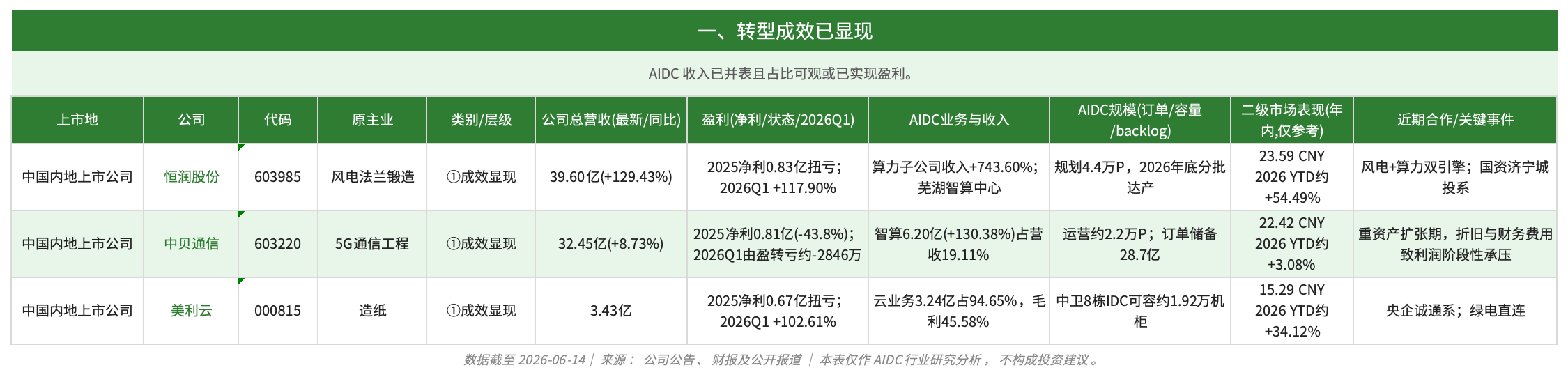
1. Transformation results are already evident: AIDC revenue is already consolidated into financial statements and accounts for a considerable proportion or has become profitable, represented by companies like Hengrun Co., Zhongbei Communication, and Meili Cloud.
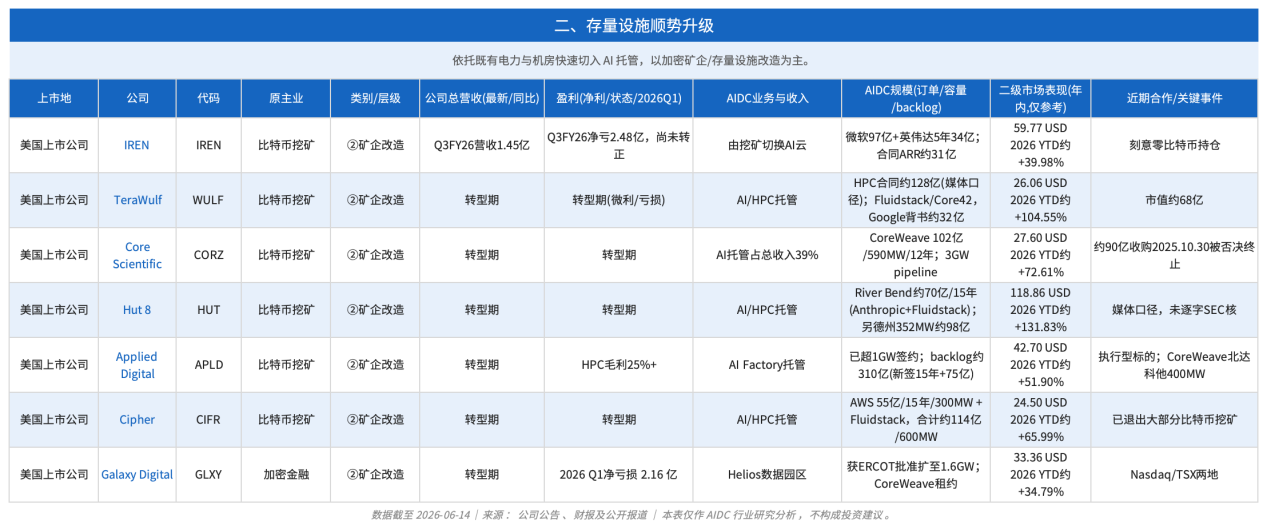
2. Existing facilities upgraded accordingly: Relying on existing power and facilities to rapidly enter AI hosting, represented by companies like IREN, TeraWulf, Core Scientific, Hut 8, Applied Digital, Cipher, and Galaxy.
3. Cultivation phase layout: Computing power businesses are still in early stages, with limited revenue contributions or related assets still in progress, represented by companies like Lianhua Health, Hanggang Co., Gaoxin Development, and Guangdong-Hong Kong-Macao Greater Bay Area Intelligent Computing.
4. Cautious adjustment phase: Some enterprises have adjusted or postponed their computing power layouts after evaluation, reflecting normal trial and error in the early stages of the industry.
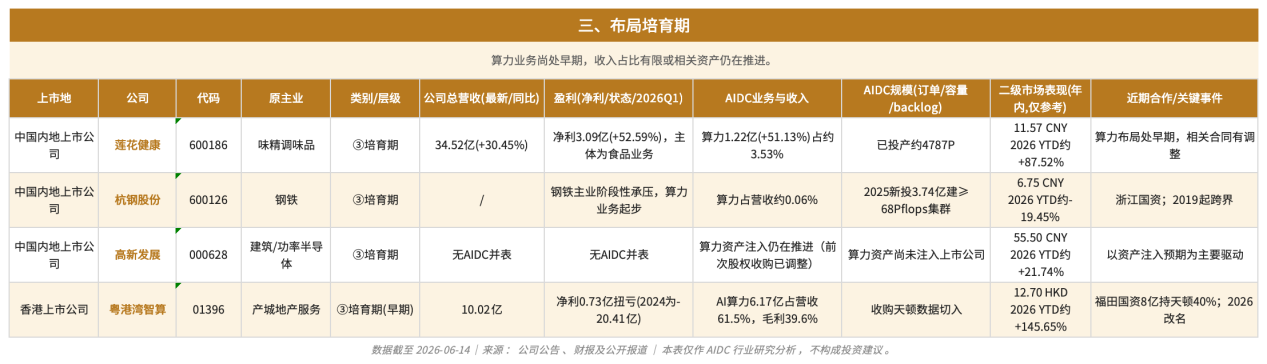
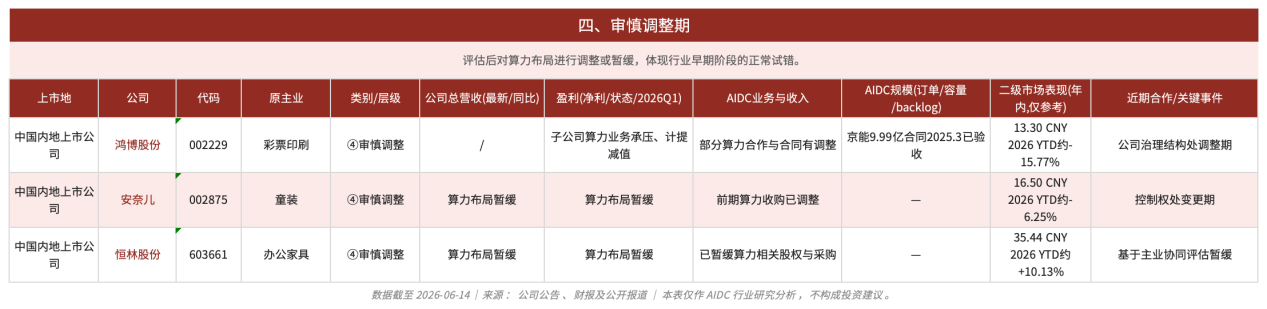
The fifth category consists of native IDC and industry references. In addition to the four layers of transformation subjects mentioned above, a unified comparison chart also includes a group of native computing service operators, cloud companies, and AI platform companies as references. Most of these do not belong to specialized cross-industry transformations, but represent a natural upgrade of their core business and computing power deployment, included to provide a more complete reference coordinate system.
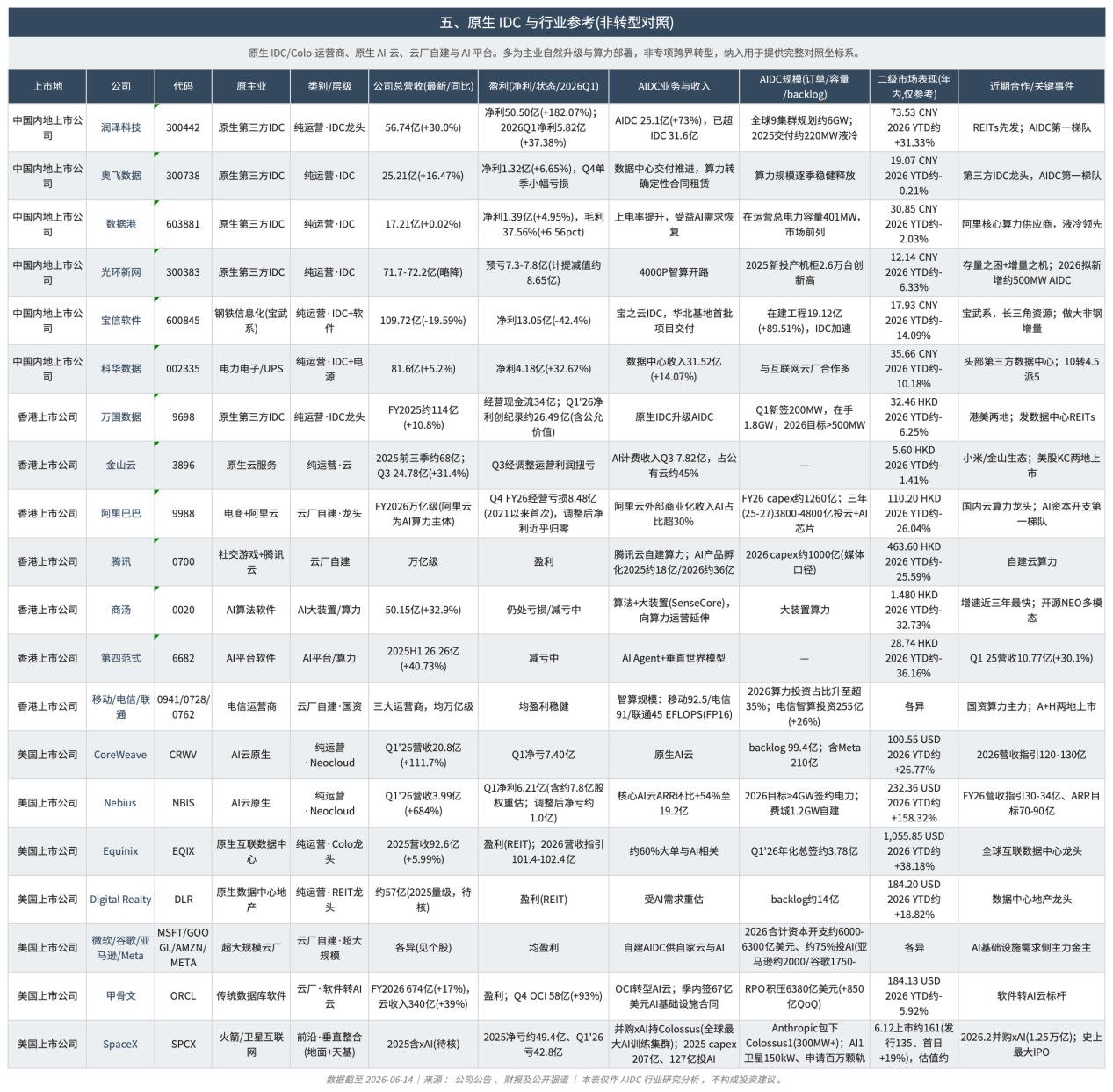
Ruize Technology, Aofei Data, Data Port, Guanghuan Xinwang, Baoxin Software, Kehua Data, and Wangguo Data are themselves data center operators transitioning from traditional IDC to high-power liquid-cooled AIDC capabilities, rather than cross-industry; their inclusion serves to anchor the real performance and listing levels of the industry’s first tier; CoreWeave and Nebius as native AI clouds also belong to this category.
Alibaba, Tencent, Microsoft/Google/Amazon/Meta, Oracle, and the three major operators primarily self-build computing power services for their own cloud and AI businesses, representing natural deployments of existing business rather than transformations. They are significant funders and major contributors to AIDC capital expenditures, included to observe upstream investment intensity. Companies like SenseTime and Fourth Paradigm extend from AI algorithms and platforms to computing power operations, existing between software and infrastructure, as extensions down the business chain.
Positioning these categories alongside the transformation subjects aims to provide complete references to distinguish between natural upgrades, cross-industry layouts, and early cultivation paths, not to assert that they all belong to transformations.
2.3 Mainland China Listed Companies: Diverse Participants with Differentiated Realization Rates
Participants in AIDC from mainland China are the most diverse, involving both professional operators and cross-industry companies, with significant differences in realization rhythms; from an industrial research perspective, key measures include whether AIDC revenue is consolidated, its proportion, and the quality of profitability. On one side, Hengrun Co. relies on both wind power and computing power as dual engines, achieving net profit of 83.48 million yuan in 2025, turning a profit; the computing power subsidiary, Shanghai Runliuchi, reports a year-on-year revenue growth of 743.60%, with a net profit of 65.14 million yuan in the first quarter of 2026, up 117.90% year-on-year.
The paper-making company Meili Cloud reports 324 million yuan in cloud business revenue for 2025, accounting for 94.65% of total revenue with a gross profit margin of 45.58%; its first-quarter net profit has grown 102.61% year-on-year with positive operating cash flow.
An alternative typical scenario represented by Zhongbei Communication shows a reserve of computing orders reaching 2.87 billion yuan in the first quarter of 2026, with rapid growth in intelligent computing revenue, but affected by depreciation, financial costs, and impairment, current profits faced some pressure. This reflects a common pattern during heavy asset expansion periods where profits often lag behind revenue; the faster the pace of construction, the greater the pressure on current profits.
Some cross-industry companies also see their computing power revenue accounting for a still-low proportion of overall revenue, or related asset injections and collaborations are still in progress. Their computing power business has not yet contributed significantly to overall performance, more reflecting market expectations of the concept, and subsequent realization still needs to be observed, characteristic of the early stage of the industry.
Some early participants have also experienced adjustments at the cooperation or project level, reflecting the uncertainty inherent in cross-industry layouts during implementation.
2.4 Hong Kong Listed Companies: Native Leaders Focus on Order Realization with Diverse Paths for New Entrants
The value of Hong Kong listed companies in AIDC centers on the realization of orders from native IDC leaders. Wangguo Data signed a record 200MW of new contracts in the first quarter of 2026 and reached a total order backlog of 1.8GW by the end of the first quarter, with AI order targets exceeding 500MW for 2026. On the cross-industry side, Guangdong-Hong Kong-Macao Greater Bay Area Holdings renamed itself Greater Bay Area Intelligent Computing in 2026 and, after acquiring Tiandun Data, entered computing power; in 2025, its AI computing revenue accounted for 61.5% of total revenue, with a state-owned asset injection of 800 million yuan further strengthening its AI business.
The 1.8GW backlog of Wangguo Data represents verifiable real demand, a typical case of steady realization; Greater Bay Area Intelligent Computing, conversely, represents a rapidly entering path for new entrants through acquisitions and cooperation with state-owned capital, although its computing revenue share is high, the duration of the business establishment is short, and sustainability needs time to be validated. Both reflect the diverse landscape of participants in Hong Kong listed companies, ranging from mature leaders to new entrants.
2.5 U.S. Listed Companies: The Most Mature Transformation Among Mining Companies, Contract-First, Revenue Follows
Among the three regions, U.S. listed mining companies are the most mature in transformation, as they follow the path of signing long-term contracts first, increasing capacity second, with revenue materializing afterward—valuation anchors are based on contracts in hand rather than current profits. IREN signed a $9.7 billion GB300 AI cloud contract with Microsoft; AWS signed a 300MW, 15-year hosting agreement with Cipher. The partnership between Core Scientific and CoreWeave extends to approximately 590MW, with a total of about $10.2 billion in take-or-pay hosting contracts over 12 years.
Long-term take-or-pay contracts signed with investment-grade counterparties like Microsoft, AWS, and CoreWeave essentially turn mining companies' electricity and facilities into predictable forward cash flows. This is the reason behind U.S. listed mining companies having relatively high quality; they are selling locked-in capacity to buyers. A quantifiable confirmatory statistic is that the revenue per megawatt from AI contracts is about three times that of traditional mining operations.
3. Judgement: Before and After Transitioning to AIDC
3.1 Valuation Anchors Have Shifted
Before transitioning to AIDC, a company's valuation anchor was its previous core business, with monosodium glutamate and paper-making linked to consumption and capacity cycles, steel linked to commodity cycles, and lottery printing linked to licenses. After transitioning to AIDC, for companies that have realized effective transformations, the valuation anchor shifts to verifiable long-term capacity contracts and power capacity. Wangguo Data was revalued based on its committed 1.8GW orders, while U.S. listed mining firms were revalued based on backlog and ARR, rather than current earnings per share.
3.2 The Real Distinction is in Contracts and Power
The real distinction between before and after transformation lies in whether companies have secured verifiable long-term contracts and power metrics, rather than simply announcing their computing power initiatives. Some companies announcing their computing power layout may experience noticeable stock price fluctuations due to low revenue contributions or project advancement not meeting expectations; in contrast, companies with power, land, and long-term contracts gain relatively stable valuation support. Power is the real bottleneck under the IEA's standards, explaining why the paths that prioritize power and land before discussing AI narratives are more realizable.
3.3 Profit Lag is a Common Characteristic
Whether it is Zhongbei Communication from mainland China or CoreWeave and IREN from the United States, heavy asset expansion periods present scenarios where revenue increases but profits come under pressure or even turn negative. The capital market's tolerance for this is established on the visibility of future cash flow provided by long-term contracts. If long-term contracts are not realized or power metrics are lacking, conceptual premiums can rapidly evaporate.
The capital market highly recognizes the AIDC concept, but the objects of recognition are contracts and power; for instance, Wangguo Data, CoreWeave, and various mining companies gain notable revaluation based on their backlogs, with mining stocks showing an approximate 70 percentage point increase overall in 2026; Oracle, through a backlog of hundreds of billions in RPOs, achieved a market capital revaluation from database software to AI cloud.
4. Risks and Sustainability
This chapter outlines the main risks in the investment cycle of AIDC from an industrial research perspective, serving as a reference when assessing the sustainability of the industry’s prosperity. The current prosperity is built upon the assumption of sustained high growth in AI training and inference demand. If the commercialization of large models does not meet expectations or if efficiencies in chips and algorithms significantly reduce unit power needs, the industry may face temporary capacity digestion pressures.
4.1Mismatch Between Depreciation and Technological Iteration
One of AIDC's core financial risks arises from the mismatch between the GPU depreciation cycle and accounting depreciation assumptions. According to public industry discussions, some computing power operators depreciate GPUs over approximately six years, while engineering and legal estimates of the actual usable life of GPUs often range from three to four years; some analysts believe it may be only two to three years. As Nvidia transitions from Blackwell to Vera Rubin, the residual value and rental levels of the previous generation’s computing power may decline faster than depreciation schedules; if actual life is shorter than book assumptions, operators' true returns will be overestimated. This is a key variable to verify when assessing the profitability quality of heavy asset operators.
4.2Customer Concentration and Contract Stability
Long-term contracts (take-or-pay) provide predictable cash flow for project financing but also lead to customer concentration risks. OpenAI's external commitments for computing power procurement include approximately $22 billion to CoreWeave, around $300 billion to Oracle, and about $38 billion to Amazon; many Neocloud companies and transforming mining firms also rely heavily on fewer investment-grade partners. The stability of long-term contracts may be tested amid market changes; if individual major customers adjust their demand rhythms, the revenue visibility of related operators may fluctuate.
4.3Leverage and Circular Financing
AIDC is capital-intensive, and debt financing scales are rapidly expanding. CoreWeave completed about $8.5 billion in financing in 2026 and received an investment-grade rating, being among the first to achieve investment-grade financing backed by HPC infrastructure, demonstrating initial recognition by credit markets for this model. Simultaneously, discussions around circular financing exist; Nvidia holds approximately 7% equity in CoreWeave and has pledged up to $100 billion in investment in OpenAI, with some funds eventually flowing back upstream through GPU procurement, akin to supplier financing by telecommunications equipment companies at the end of the last century.
5. Financing Innovation: REITs and Asset Securitization
AIDC is a typical heavy asset industry where relying solely on self-funding and bank loans is inadequate to support exponential growth, making financing models a key variable determining the pace of operators' expansion. Asset securitization (REITs, ABS, CMBS) allows operators to offload, recirculate funds from completed and listed mature assets, and reinvest into new constructions, forming a cycle of "construction - securitization - reinvestment," driving the industry from a heavy asset model towards lightweight operations.
Additionally, on June 18, 2025, the China Securities Regulatory Commission approved the first two publicly offered data center REITs, namely Southern Wangguo Data Center REIT and Southern Runze Technology REIT. The former's underlying asset is the data center project of Wangguo Data located in Kunshan, and the latter is the ICFZ A-18 data center project located at the national hub node of Runze Technology in the Beijing-Tianjin-Hebei region. This marks the first inclusion of data centers into publicly offered REITs in the domestic capital market, holding symbolic significance for asset valuation and expansion capacities of leading third-party IDC; the first-mover advantage of Runze and Wangguo in REITs also significantly supports their stronger expansion capabilities compared to their peers.
In the U.S. AIDC, the issuance scale of debt securitization (ABS/CMBS) is rapidly increasing, with some operators achieving investment-grade ratings for financing backed by HPC infrastructure. According to JPMorgan's forecasts, the annual securitization issuance scale of U.S. data centers is expected to reach $30 billion to $40 billion in 2026 and 2027. The maturity of financing channels is one key reason for the differences in expansion pace between Chinese and American operators.
Beyond asset-side securitization, the financialization of computing power is further extending to the output side. In May 2026, the Chicago Mercantile Exchange and Silicon Data announced the launch of the world's first GPU computing power futures, pegging daily GPU lease price benchmarks, allowing operators and computing power buyers to hedge computing price fluctuations as they would with oil and electricity prices; China, meanwhile, is steadily advancing with an index-first approach, piloting spot trading, and guiding policies with plans to explore computing power banks and computing power supermarkets by the end of 2025. Based on this, CITIC Securities predicts that computing power futures may land within the year. If REITs and ABS financialization relates to completed assets, then computing power futures financialization concerns the computing revenue itself, forming two layers of parallel advancement in the financialization of computing power along the asset and output ends; once pricing and hedging tools on the output side mature, they will further reduce revenue uncertainty for operators, feeding back into asset-side valuation and issuance capabilities.
However, the realization of computing power futures still faces challenges around standardization, as computing power lacks a unified reference price due to variations in chip models, computational accuracy, and network architectures; the transparency of pricing and delivery mechanisms remains unresolved. Its more precise positioning is as an emerging tool expected to land this year, still pending prerequisite conditions.
6. Conclusion
According to JLL's 2026 Global Data Center Outlook, the proportion of AI loads in total data center demand is expected to rise from about 25% in 2025 to around 50% by 2030, with a structural turning point anticipated around 2027, where inference loads will surpass training to become the main driving force behind AI computing demand. Current demand still primarily concentrates on large-scale centralized training.
Training and inference have different infrastructure requirements. Training tends to be centralized, ultra-large-scale, with extremely high point power density; inference requires proximity to users and low latency, thus being more decentralized and driving regional-level deployments and edge computing power growth, such as the rise of micro data centers and edge colocation. This suggests that competitive factors in AIDC will shift gradually from singular scale towards networked layout and latency coverage.
For operators, the migration of inference benefits players with multiple regional nodes close to core economic areas and users; for the equipment chain, the demands of inference for energy efficiency and cooling will further elevate the penetration of liquid cooling and high-efficiency chips. From an industrial research perspective, this is a key variable in determining the next stage of AIDC investment direction from building large clusters to deploying networks.
This report and related research are solely for AIDC industry research and transformation pathway analysis and do not constitute any investment advice or buy/sell recommendations for any securities, nor do they predict any company's future performance, valuation, or secondary market performance. Information regarding secondary market performance in the charts within the report is provided solely for industry observation reference and may contain delays or discrepancies. Readers should verify independently and make their own judgments; any decisions made based on this document are unrelated to the author.
免责声明:本文章仅代表作者个人观点,不代表本平台的立场和观点。本文章仅供信息分享,不构成对任何人的任何投资建议。用户与作者之间的任何争议,与本平台无关。如网页中刊载的文章或图片涉及侵权,请提供相关的权利证明和身份证明发送邮件到support@aicoin.com,本平台相关工作人员将会进行核查。


