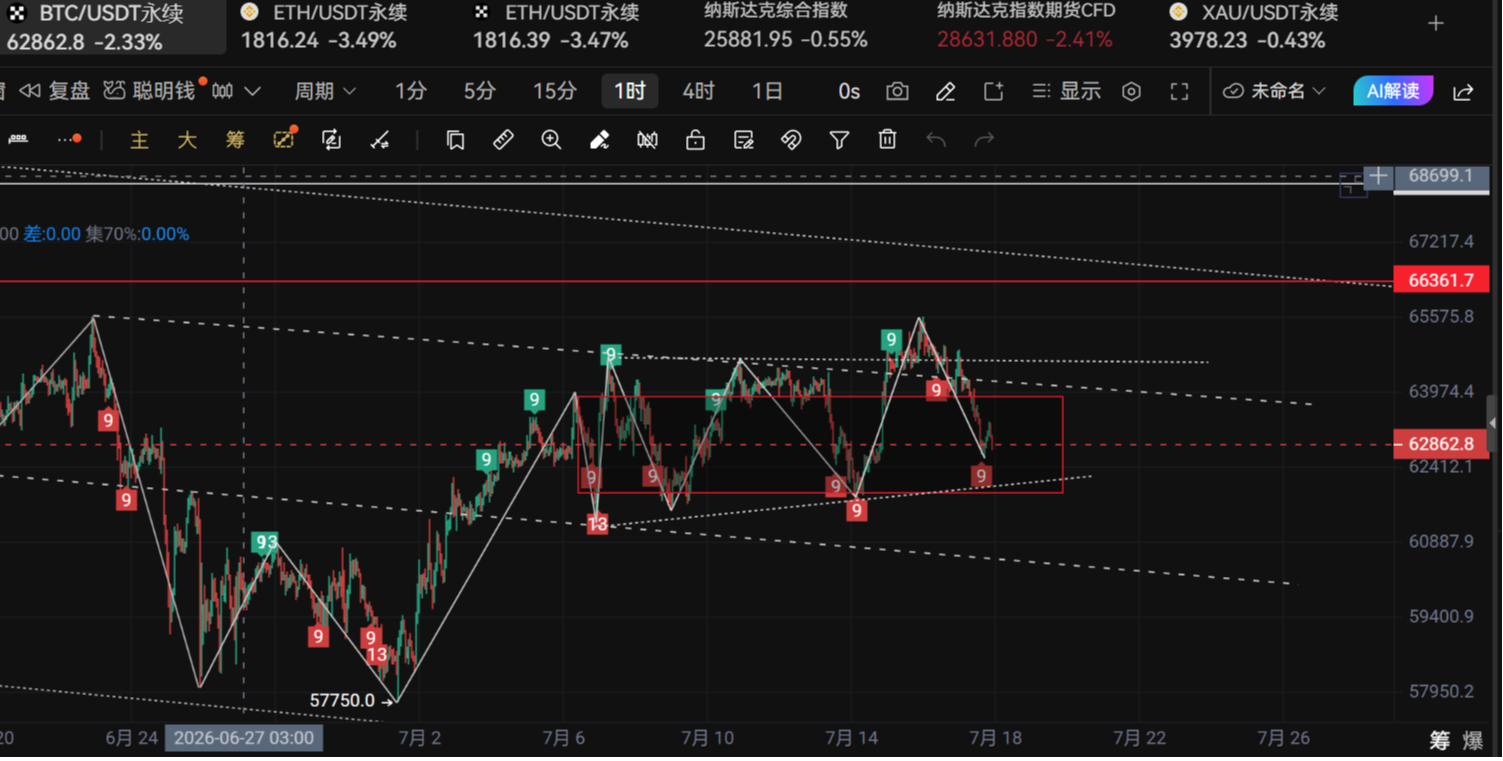
The Coinbase Bitcoin premium index essentially tracks the price difference between BTC/USD on Coinbase Pro and BTC/USDT on other major exchanges (such as Binance): a positive index means that prices on the U.S. platform are higher, and capital is more actively buying; a negative index means that the price on Coinbase is long-term "discounted," and the U.S. side is more like exporting to the global market. According to Coinglass data, this indicator has been negative for 60 consecutive days from May 19, 2026, to July 17, with the latest value at -0.0908%, still lingering in a slightly negative premium range. Moreover, this is not an ordinary short-term deviation, but a record rewritten in terms of "duration": during the "1011 crash" in 2025, negative premiums lasted for about 30 days, and the previous round of consecutive negatives from January 16 to February 24, 2026, only lasted 40 days. The current 60-day negative premium has clearly extended, becoming the longest continuous negative period since the index was introduced. Given Coinbase's status as one of the largest compliant exchanges in the U.S. and its long-term view as a representative of U.S. capital and trading demand, this "60-day negative" data clue intuitively points to a core issue: the willingness to buy Bitcoin in the U.S. market has persistently remained weaker than the global average over the past two months, and capital may be shifting its focus from the U.S. side to other trading venues.
Price Inversion in the U.S.: What Signals Does Coinbase's Discount Convey?
The so-called Coinbase Bitcoin premium index essentially compares the transaction price of BTC/USD on Coinbase Pro with that of BTC/USDT on other major exchanges like Binance, expressing the relative quote level on the U.S. side as a proportion of the price difference to the global mainstream price. A positive index means that at the same point in time, Coinbase's U.S. dollar quote is higher than the benchmark prices on other exchanges, which is usually interpreted as the U.S. buyers being more active and willing to transact at relatively higher prices; a negative index indicates that Coinbase's quote is lower than others, often seen as greater selling pressure in the U.S. market or a clear lack of new buying, with funds in the U.S. side more inclined to wait or sell. As Coinbase is one of the largest compliant exchanges in the U.S., continually accommodating U.S. dollar funds and local investors' trading needs, this premium index is viewed as a high-frequency "thermometer" to observe whether U.S. capital is more inclined to chase high prices or sell at a discount relative to the global average.
Historically, this "thermometer" does not show a calm reading under pressure conditions. During the "1011 crash" around October 11, 2025, the Coinbase Bitcoin premium index remained in the negative premium range for about 30 days, which almost coincided with discussions around panic sentiment and concentrated selling. Prices on the U.S. side were significantly lower than the global average, reflecting how local capital was the first to throw chips toward the market with greater intensity. Entering early 2026, from January 16 to February 24, there followed another 40 days of negative premium. Many market participants still viewed this as a temporary phenomenon under a background of bullish market expectations, believing that U.S. funds were only retreating in the short term and not lacking in the long term. In contrast, the current 60-day negative premium is clearly a significant extension in terms of duration, conveying a signal to the market that the U.S. price discount is no longer merely a short-term emotional fluctuation, but rather resembles a weakened state of ongoing demand that requires serious evaluation.
From 40 Days to 60 Days: New Signals Released from the Longest Continuous Negative Premium
Looking at the timeline, the focus is no longer on the impact of a single event but on how long the negative premium can persist. During the "1011 crash" stage, there was a continuous negative premium for about 30 days, amidst plummeting prices and panic sentiment, which could easily be understood as an extension of a one-off risk event; the 40-day consecutive negative from January 16 to February 24, 2026, in an atmosphere still filled with bullish expectations, was categorized by many as a "phase adjustment," more akin to a short-term contraction of U.S. funds. Now, the negative premium stretching from May 19 to July 17 has extended to 60 days, not only surpassing the roughly 30 days during the "1011 crash," but also extending the record from the beginning of the year by a full 50%. The negative premium has shifted from an "event-driven" phenomenon to a "cycle-driven" one, which itself is a risk signal that requires re-evaluation.
What’s even more subtle is that the "form" of this round of negative premium differs from the previous two: the latest index stands at -0.0908%, representing a very slight discount level, yet it has maintained this position in the negative range for a full two months. In other words, the market is not seeing a sharp deep discount under intense tugging but is instead observing a prolonged, low amplitude state consistently below the zero axis. The reason media outlets (such as Jinse Finance, Rhythm BlockBeats, and Odaily) focused heavily on this 60-day record is that it has propelled an index originally meant to capture extreme emotions into a long-term window for observing the "structural weakness of U.S. demand." In the absence of more detailed price trajectory and capital flow data, this curve alone confirms that prices in the U.S. market continually linger slightly below those of other major exchanges. This makes the 60-day slight negative premium seem more like a signal of underlying structural changes rather than simple noise that can be easily ignored.
Are U.S. Funds Retreating or Diversifying? Possible Reasons Behind the Negative Premium
A negative premium quantitatively means that at the same point in time, Coinbase’s BTC/USD quote is lower than that of other major exchanges’ BTC/USDT quote, and this price difference has not been fully repaired over the past 60 days. Considering that a high proportion of compliant capital and institutional clients reside in Coinbase's user base, the sustained discount is naturally interpreted by many participants as a signal of "insufficient buying power on the U.S. side" or "relatively greater selling pressure." However, from a data boundary perspective, such interpretations can only remain at the level of possibilities: a negative premium can result from weakened buying power, enhanced selling pressure, weak liquidity, different market-making strategies, and other factors; currently, there is no evidence to lock it as originating from a single factor.
More troublesome is the information gap in terms of capital flow. Research briefs clearly indicate that there is a current lack of inflow and outflow data for tools such as ETFs and GBTC, as well as a lack of premium comparisons from other exchanges and finely granular price trajectories. Therefore, we can only make directional speculations: part of the U.S. capital may be shifting from compliant platforms like Coinbase to other exchanges, on-chain tools, or different assets; or it may be choosing a more diversified allocation strategy after the intense bullish expectations from late 2025 to early 2026 broke down, causing the marginal buying power of the "U.S. market" to no longer be concentrated in Coinbase’s spot premium. The negative premium itself provides an outcome, rather than a path. In the absence of cross-platform, cross-product capital flow data, it is difficult to answer whether U.S. funds are retreating altogether or diversifying into more channels and assets. The negative premium only illustrates this structural issue that has not been adequately quantified.
Bullish Expectations Colliding with U.S. Indifference: Is Pricing Power Shifting Toward Offshore Markets?
From a temporal perspective, the current round of negative premium, which has persisted for 60 days since May 19, 2026, precisely overlaps with the mainstream narrative around the bullish market from late 2025 to early 2026: on one hand, there is optimistic pricing for future market conditions, while on the other, the U.S. compliant market represented by Coinbase continues to trade Bitcoin at a "discount price." This contrast is not merely an abstract emotional misalignment, but is quantified through the specific index of the Coinbase Bitcoin premium—a direct comparison of BTC/USD on Coinbase Pro with the transaction prices of BTC/USDT on offshore major platforms, including Binance. When the index remains negative for an extended period, it can be intuitively understood that the transaction prices on offshore platforms are systematically higher than those on the U.S. side. Against the backdrop of bullish expectations still widely cited, U.S. prices being on sale for an extended period effectively convey to the market that the anticipated "U.S. incremental buying" has not materialized into premiums on Coinbase's spot level.
If this discounted state becomes the norm for months or even longer, an inescapable question arises: will global Bitcoin pricing power gradually shift from the U.S. compliant market to offshore exchanges and non-U.S. funds? The negative premium itself implies that price anchors are increasingly derived from offshore transactions; the longer the duration, the more easily it can be interpreted as indicating stronger offshore demand and weaker buying power or greater selling pressure from the U.S. However, in the current absence of premium indices from other exchanges, cross-platform transaction volume structures, and capital flows for products like ETFs and GBTC, such judgments regarding "pricing power migration" still remain at a preliminary inference level based on the indicators and cannot be precisely validated by capital distribution data. Moving forward, whether cross-exchange price differences continue to widen or narrow, and whether liquidity and transaction volumes among mainstream platforms further concentrate from the U.S. to offshore, will constitute key windows for observing whether the focus of global capital is migrating, as well as critical variables for assessing whether the Bitcoin price discovery mechanism has shifted from the U.S. to a more decentralized offshore market.
After the Record Rewrite of Negative Premium, What Risk Signals Should Investors Focus On?
From about 30 days of the "1011 crash," 40 days at the beginning of 2026, to the current continuous negative record lasting 60 days since May 19, the Coinbase Bitcoin premium index has repeatedly pointed to the same issue at critical moments: the U.S. market represented by Coinbase is seeing a cyclical weakening of buying power relative to other global exchanges. The latest reading is only -0.0908%, indicating that the discount magnitude is not extreme. However, while rewriting the longest continuous record, it still has not returned to positive premium, and signals of marginal weakness in U.S. demand still exist. For investors, the risk does not lie in the three words "negative premium," but rather in the possibility that if the premium index continues to linger in the negative range for an extended period, with deeper discount magnitudes alongside an expansion of prices and volumes on other global platforms, it may indicate a further shift of capital and price discovery towards offshore markets. It is worth emphasizing that this 60-day negative premium phase lacks specific price pathway data (highs, lows, volatility) and also lacks key information such as premium indices from other exchanges and capital flows for ETFs and GBTC. The current analysis cannot deduce whether U.S. funds are orderly exiting, passively waiting, or being disturbed by short-term emotions. Therefore, any conclusions drawn from a single premium indicator carry inherent risks of bias. In the face of incomplete information, a more reasonable approach is to view the Coinbase premium index as a reference scale for "relative strength of U.S. demand compared to the global market," in conjunction with upcoming data on cross-exchange price differences, transaction volume structures, and macroenvironmental changes, focusing on whether the duration and magnitude of negative premiums continue to break records and whether they amplify or converge alongside global liquidity and price fluctuations. This will construct a foundational observational framework for market risks and changes in capital focus in the next phase.
Join our community to discuss and become stronger together!
AiCoin exclusive Hyperliquid benefits: https://app.hyperliquid.xyz/join/AICOIN88
AiCoin exclusive Aster benefits: https://www.asterdex.com/zh-CN/referral/9C50e2
On-chain Telegram community: https://t.me/AiCoinWhaleData
On-chain community: https://www.aicoin.com/link/chat?cid=N6OVMor5g
AiCoin on-chain Twitter: https://x.com/aicoinwhaledata
免责声明:本文章仅代表作者个人观点,不代表本平台的立场和观点。本文章仅供信息分享,不构成对任何人的任何投资建议。用户与作者之间的任何争议,与本平台无关。如网页中刊载的文章或图片涉及侵权,请提供相关的权利证明和身份证明发送邮件到support@aicoin.com,本平台相关工作人员将会进行核查。