HTX (suspected) launched US stock perpetual contracts using xStocks as a reference — Interpreting HTX's US stock model
Today, while scrolling through tweets, I accidentally saw a friend mention that HTX is providing liquidity subsidies for US stocks, which suddenly made me curious. Theoretically speaking, if the product is real US stock spot trading, the most comprehensive approach would be to collaborate with brokers and connect to the real stock order books of Nasdaq or the New York Stock Exchange. Why would there be a need to use subsidies to increase liquidity?
Later, I found out that the subsidies are for contracts, not for spot trading, which makes sense. If it's contracts, then it’s normal to provide some subsidies to obtain deeper liquidity based on the liquidity of each platform. However, I thought again that something seems off. The focus of xStocks should be on-chain, and without the support of physical stocks, HTX's contracts actually cannot use the stocks sold by the exchange as joint collateral.
Of course, this is unrelated to the contracts themselves; it can only be said that HTX currently has not opened the connection between stock spot and contracts.
But the general index rules publicly disclosed by HTX mainly list cryptocurrency exchanges such as Binance, OKX, Coinbase, Kraken, Bybit, and Bitget, without clearly listing stock market data providers or detailing how to handle stock indices during US market holidays in regular launch announcements.
While this does not mean that HTX does not use professional stock data sources, from the level of public disclosure, HTX’s stock perpetual pricing source is not as clearly explained as other exchanges. I am not entirely certain, but it appears to be a perpetual contract referenced against the xStocks token.
This part is very important for contracts, as the mark price will affect the funding rate, unrealized profits and losses, and liquidation. If the index sources are only a few tokenized stock markets with relatively weak liquidity, the price stability during extreme market conditions will be lower than directly reading real US stock quotes.
Moreover, while I continued to review the disclosed information, I suddenly found that HTX is not listed in the currently displayed collaboration cases of xStocks. I also did not find any official announcement of cooperation between the two parties. So there is a high probability that HTX has launched corresponding US stock perpetual contracts using xStocks as a reference.
As for whether there is any collaboration in price data, indices, or other aspects between the two parties, and whether prices are directly referenced from xStocks spot trading, this cannot be confirmed at the moment.
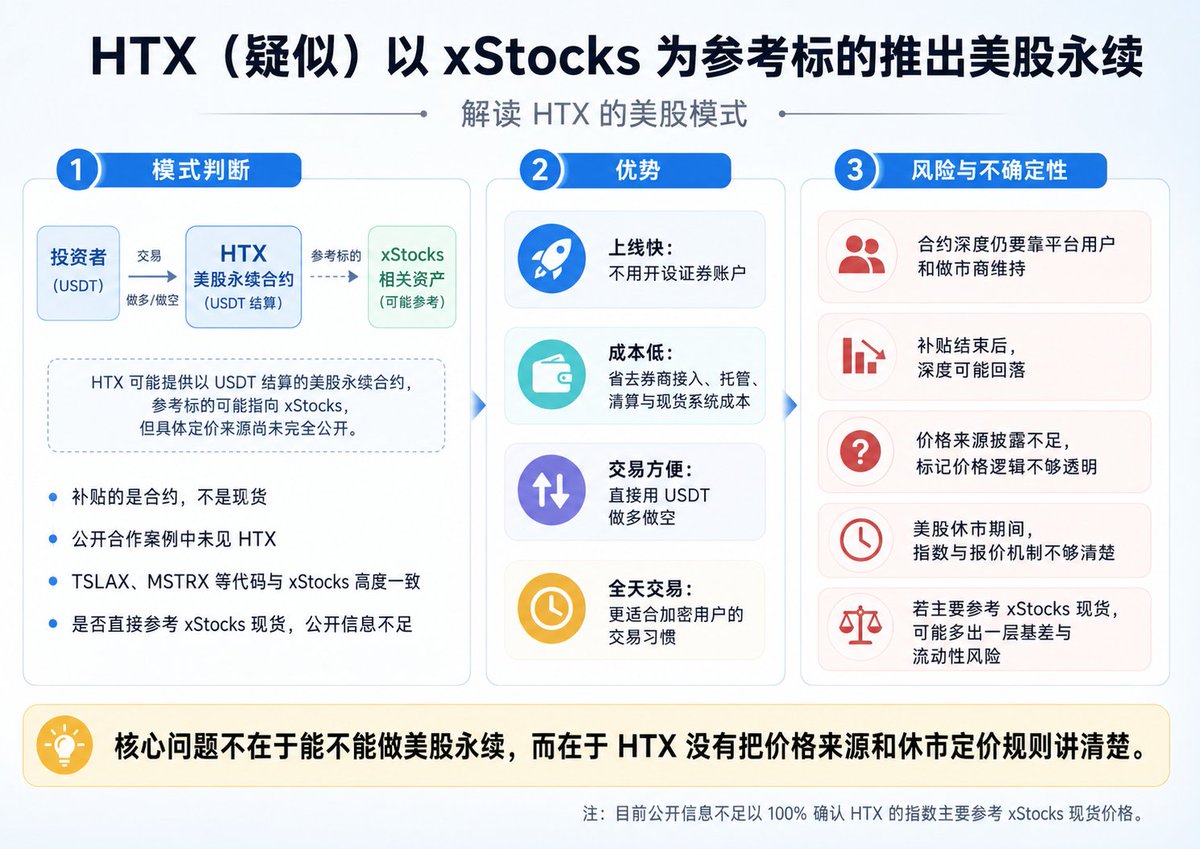
Of course, this approach does have its advantages; the most direct one is the quick launch. HTX does not need to set up securities accounts for every user, nor does it need to handle stock custody, delivery, dividends, stock splits, and shareholder registration in user accounts. As long as it can piece together the index price, mark price, funding rate, margin, and liquidation rules, it can quickly launch new US stock contracts.
Whenever a stock suddenly becomes a hot topic, HTX can promptly issue corresponding products. For crypto users who only want to trade on price fluctuations, this model does not pose significant issues; at most, there may be some instances where prices and markets are not synchronized. For HTX itself, it can also save costs associated with broker access, securities account opening, custody, clearing, and spot systems.
However, the disadvantages are equally obvious, with the core issue being the liquidity of the contracts. HTX's depth still relies on its own users and market makers. While subsidies can indeed temporarily increase the number of orders and trading volume, once the subsidies end, if real trading demand does not pick up, depth may still decline again.
Additionally, as I mentioned earlier, the source of US stock contract prices at HTX is not clear, nor has it explained how it will adjust the index after the US stock market closes. If HTX's index primarily references xStocks spot prices, the real stock prices must first pass through xStocks before entering HTX’s index and perpetual contracts, adding an additional layer of basis and liquidity risk.
In normal market conditions, this discrepancy may not be obvious. But when faced with earnings reports, sudden news, or extreme fluctuations, the prices of xStocks and real stocks may show premiums or discounts, and HTX's index and mark prices might also be affected. Therefore, whether the price source comes from real stock prices or from relatively limited liquidity tokenized stock markets is one of the very important reasons for contract trading.
The situation during US market holidays is the same. When real stocks stop trading, HTX contracts can continue to operate, relying on market maker valuations, other market quotes, or the platform's own algorithms to maintain prices. HTX currently does not have a public explanation to the same extent as other exchanges, making it difficult for users to anticipate how indices and mark prices will change during weekends, holidays, and significant news events after market hours.
Overall, the advantages of HTX’s model are clear: quick launches, low costs, support for all-day trading, and convenience for users to directly use USDT and leverage. However, the disadvantages are also apparent; the depth of the contracts needs to be cultivated by the platform itself, and the disclosure about the price sources and market halt pricing mechanisms is not sufficiently transparent. Users find it hard to accurately assess basis, mark price, and liquidation risks in extreme markets.
If the index mainly references xStocks spot prices, then real stock prices must be relayed through the tokenized stock market before being transmitted to HTX contracts, potentially adding an additional layer of risk during extreme conditions. If HTX directly connects with professional US stock quotes, the risks might actually be smaller.
The biggest issue now is the insufficient public information, making it temporarily impossible to determine which specific pricing method HTX is using.
PS: To emphasize once more, the currently available public information is not enough to 100% confirm that HTX's index mainly references xStocks spot prices, nor is it sufficient to determine the valuation method used by HTX. If HTX could disclose this information, it would be more beneficial for enhancing user trading confidence.
免责声明:本文章仅代表作者个人观点,不代表本平台的立场和观点。本文章仅供信息分享,不构成对任何人的任何投资建议。用户与作者之间的任何争议,与本平台无关。如网页中刊载的文章或图片涉及侵权,请提供相关的权利证明和身份证明发送邮件到support@aicoin.com,本平台相关工作人员将会进行核查。


