- FTX paradox: US Justice Department retained just 15% of the dollar value of seized Shiba Inu
- Why the Binance founder believes AI is useless against inflation, unlike Bitcoin
- Large investors bought 70 million XRP as the price stabilized near $1.10
- Crypto market outlook: AI payments, the Senate, and a new Bitcoin cycle
TL;DR
- The US Justice Department transferred 54.89 billion SHIB seized in the FTX case after the tokens' value fell from $1.55 million to approximately $235,500, representing an 85% decline.
- Binance founder Changpeng Zhao argued that AI can increase productivity but cannot protect purchasing power like Bitcoin's fixed supply. BTC recovered above $65,000 as US inflation pressures eased.
- XRP wallets holding at least 1 million tokens accumulated another 70 million XRP, worth approximately $77 million, as buyers defended support near $1.08 and resistance remained around $1.14.
- US spot Bitcoin ETFs recorded $108 million in daily inflows, led by BlackRock's IBIT with $80.82 million, while BTC's $65,000 resistance, Ethereum's recovery toward $2,000, and the CLARITY Act remained the main market catalysts.
FTX paradox: US Justice Department retained just 15% of the dollar value of seized Shiba Inu
Large-scale activity across US government wallets has exposed the specifics of state custody of volatile digital assets. Over the past several days, US agencies have moved more than $338 million in confiscated cryptocurrency, according to Arkham on-chain data.
Most of the funds, including 3,940 BTC and 40,000 ETH, were sent to Coinbase Prime. However, the market's attention was drawn to a much smaller but more revealing transfer involving Shiba Inu (SHIB) tokens.
HOT Stories US Nets Just 15% of FTX's Shiba Inu (SHIB) Value; Bitcoin Does What AI Cannot, Binance Founder Explains; 70 Million XRP Lands in Millionaire Whale Wallets - Morning Crypto Report Shiba Inu Adds 60% in Weekly Spot Flows: Explaining What It Means for Price Health
The transaction involved a pool of 54.89 billion SHIB tokens seized by officials during the investigation into the collapse of the FTX exchange and Alameda Research. The changing value of these confiscated assets clearly illustrates the impact of prolonged legal proceedings on high-risk assets:
- Last year, this volume of tokens was valued at $1.55 million.
- On July 15, the Justice Department completely emptied the "FTX Alameda Seized Funds" address, transferring the same tokens to a new wallet. At the time of the transaction, their value had fallen to just $235,500.
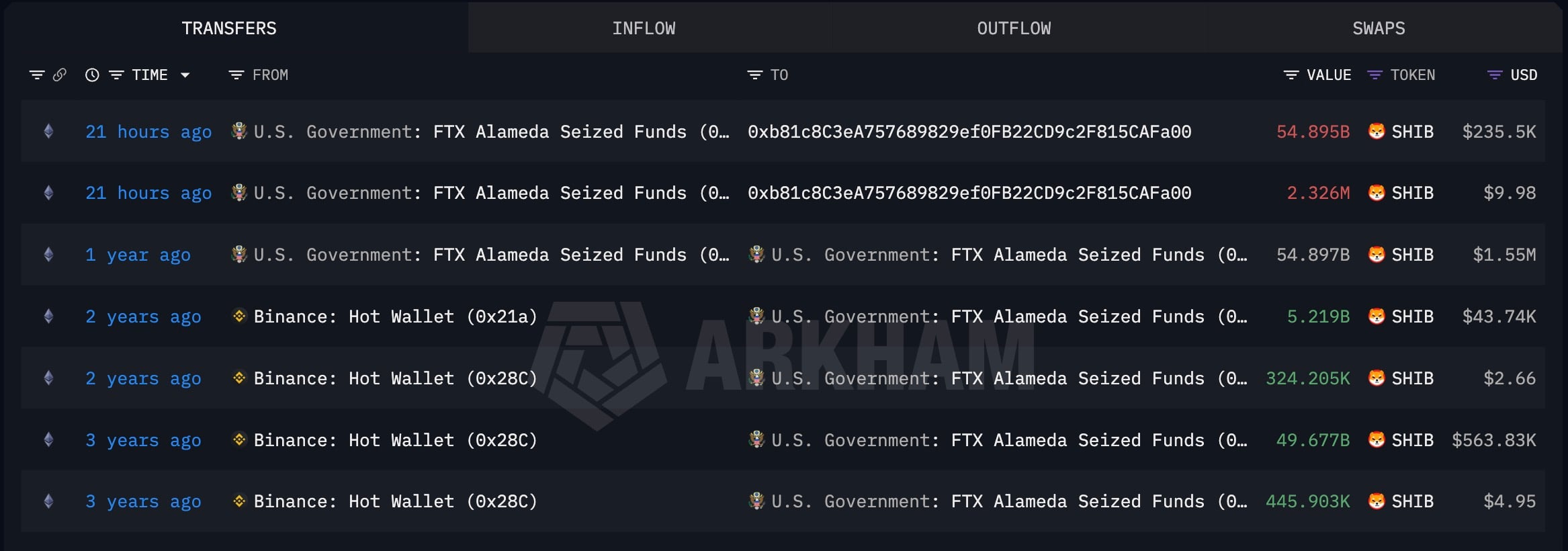
US Government history of transactions with Shiba Inu (SHIB) coin seized from FTX, Source: Arkham
As a result of market corrections, the government retained only 15% of the position's former dollar value. According to available information, this volume of SHIB is not intended for sale on the open market. The US government will continue holding the assets for subsequent settlements with FTX creditors.
For affected exchange customers, this creates a precedent in which the repayment procedure involves distributing the original tokens, although their actual purchasing power declined by 85% during the legal proceedings. The transactions followed the agencies' standard practice of conducting $10 test transfers and also involved small balances of WBTC, COMP, and MANA.
Why the Binance founder believes AI is useless against inflation, unlike Bitcoin
While the technology sector remains focused on the capabilities of neural networks, Binance founder Changpeng Zhao, known as CZ, has brought investors back to a harsh economic reality. Artificial intelligence can radically increase business productivity, but it is technologically incapable of protecting personal capital from depreciation.
According to CZ, this role still belongs exclusively to Bitcoin because its issuance is strictly limited at the code level.
The position of the Binance founder was effectively supported from the perspective of traditional institutional finance by BlackRock CEO Larry Fink. In his assessment, following a major reduction in leverage, the crypto market has cleared out excessive speculative positions and become significantly more resilient.
AI is great, but it does not protect you against inflation.
Bitcoin does.
The industry leaders' statements came against the backdrop of fresh US macroeconomic data. The latest CPI report showed that US consumer inflation had declined to 3.5%, while the Producer Price Index surprised the market by falling 0.3%.
The market immediately responded to the easing of inflationary pressure. Bitcoin began a confident recovery, broke through local resistance, and consolidated above the psychologically important $65,000 level.
Large investors bought 70 million XRP as the price stabilized near $1.10
The largest XRP holders have intensified their purchases. According to fresh on-chain data from Santiment cited by Ali Martinez, wallets holding at least 1 million XRP added another 70 million tokens over the past week. At the current market price, the investment is worth approximately $77 million.
The purchases were made gradually between July 9 and July 15, increasing the total holdings of these large investors to 3.83 billion XRP. This group of large market participants now controls an impressive 74% of the token's total circulating supply.
From a technical perspective, the chart shows a classic accumulation period. XRP remains trapped within a downward trend, with the exponential moving average near $1.14 acting as the key barrier and resistance level.
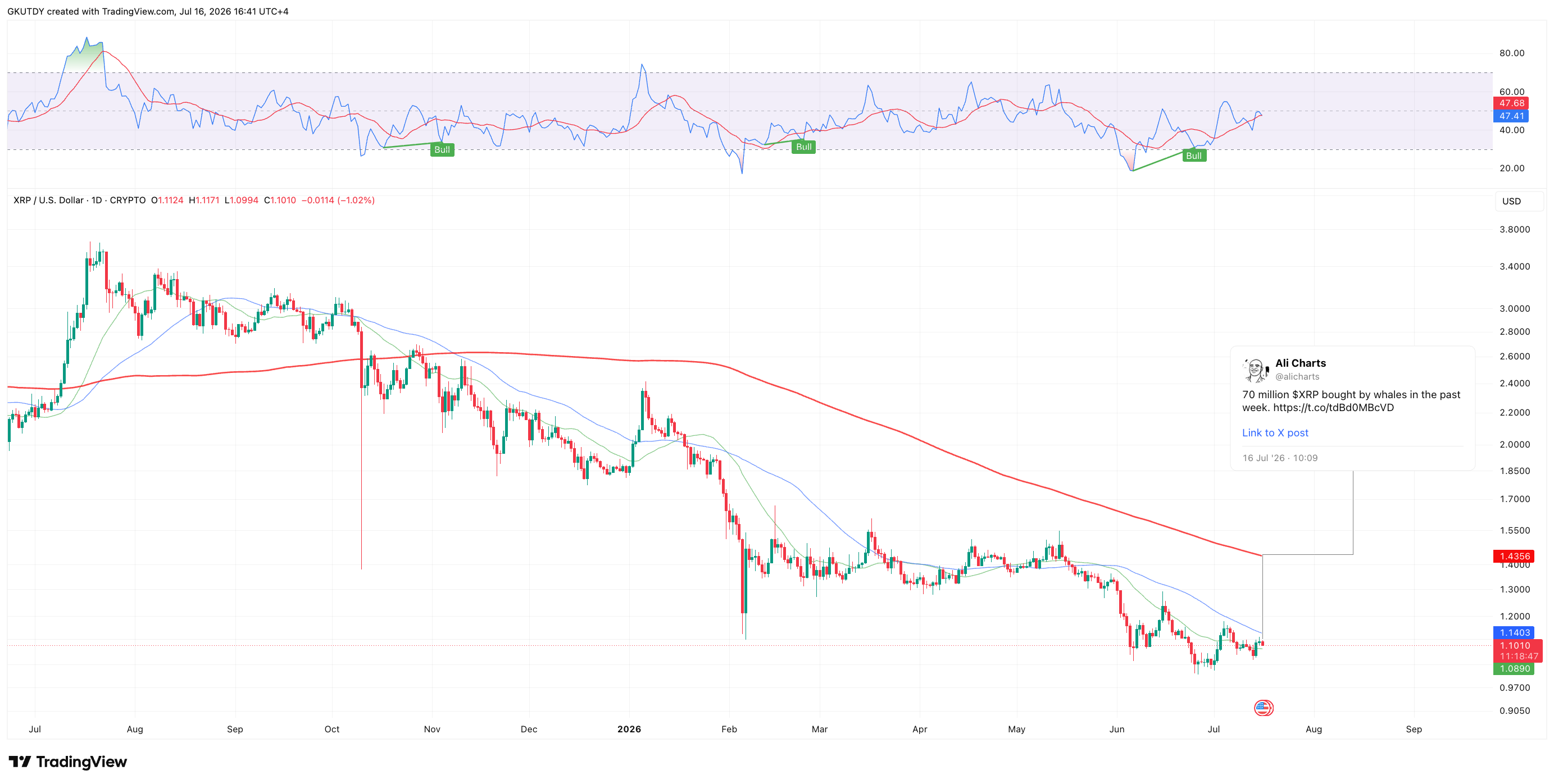
XRP price chart on a daily timeframe with fresh report from Ali Martinez, Source: TradingView
Large investors are using the current consolidation near $1.10 to methodically increase their positions at a relatively stable price without causing sharp market fluctuations.
At the same time, buyers have formed a strong support zone below the current price, with the $1.08 level actively defended by large orders. The RSI momentum indicator also points to a potential recovery as it begins turning upward from oversold territory.
Meanwhile, tokens continue to flow from trading platforms to cold wallets, while the total number of active addresses on the XRP Ledger has exceeded 8 million.
Crypto market outlook: AI payments, the Senate, and a new Bitcoin cycle
The cryptocurrency market is showing clear signs of forming a local bottom in mid-July 2026. The industry is currently caught between renewed demand for Bitcoin ETFs, expectations of key regulatory decisions in the US Senate, and the expansion of stablecoins into the real economy.
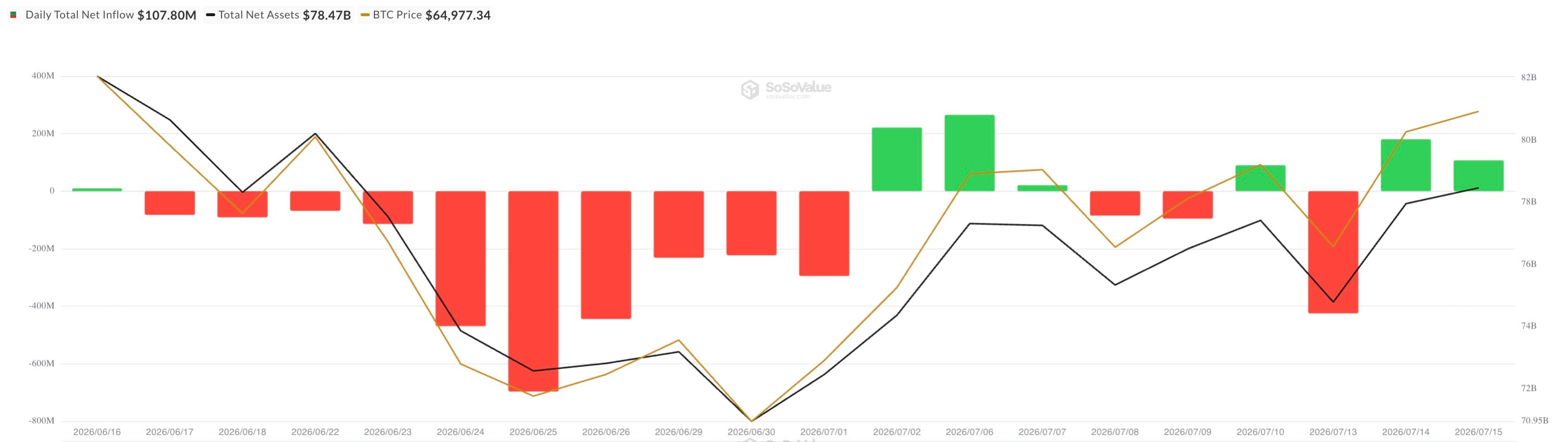
Total Bitcoin Spot ETF net inflow in US over the last 30 days, Source: SoSoValue
Bitcoin is holding the strategic $64,000–$65,000 range, laying the foundation for a potential short squeeze.
Key checkpoints:
- ETFs return to the market: After an extended period of selling pressure, spot Bitcoin ETFs recorded net daily inflows of $108 million. BlackRock's IBIT fund led the recovery, attracting $80.82 million on its own and confirming institutional interest at current price levels.
- Bitcoin holds its position: BTC has consolidated above an important liquidity zone near $64,000. A breakout and sustained move above the $65,000 resistance level would open a direct path toward testing the long-term barrier near $67,000. At the same time, a strong volume shelf at $57,511 remains the main line of defense for holders.
- US legislative trigger: Investors are focused on Washington, where the House Financial Services Committee will hold a hearing on July 17. Senator Cynthia Lummis confirmed that Clarity Act, which is critically important for the regulation of innovation and digital assets, is expected to be brought to a Senate vote during the week beginning July 20.
- Ethereum shows strength: ETH staged a dynamic recovery from a three-week low of $1,630, rising into the $1,910–$1,918 range. Sellers are capitulating, but buyers must hold the intermediate support level at $1,850 to maintain momentum toward the psychological target of $2,000.
- Real-world adoption and stablecoin expansion: The crypto market's infrastructure foundation continues to strengthen as Visa and Artemis have officially identified stablecoins as the best payment solution for microtransactions within AI ecosystems. At the same time, Tether invested $20 million in Latin American fintech giant Ualá, valued at $3.2 billion, expanding access to digital dollars for 11 million users.
You Might Also Like

Thu, 07/16/2026 - 00:01 Bitcoin (BTC), Ethereum (ETH), XRP and Zcash (ZEC) Price Analysis for July 16: Rapid Injection of VolumeByArman Shirinyan
免责声明:本文章仅代表作者个人观点,不代表本平台的立场和观点。本文章仅供信息分享,不构成对任何人的任何投资建议。用户与作者之间的任何争议,与本平台无关。如网页中刊载的文章或图片涉及侵权,请提供相关的权利证明和身份证明发送邮件到support@aicoin.com,本平台相关工作人员将会进行核查。


