
On June 27, OpenAI officially released the new generation flagship model GPT-5.6, aiming to reclaim the throne from Anthropic.
Although this leading AI company has not gone public yet, Crypto users have already had the opportunity to position themselves early — on July 15, Gate opened the subscription for the second phase of the Pre-IPO project OpenAI (OPENAI) stock tokens.
According to the official information released, this subscription values OpenAI at an implied market cap of $895 billion, with a total subscription target of $20 million. The total number of stock tokens is 27,700 OPENAI, corresponding to a price of $722 per token. Users can participate in the subscription using USDT and GUSD, with a minimum subscription of $100 per transaction, and a maximum token amount of 277 OPENAI per person. Regarding the allocation mechanism, it adopts the "average locked amount per hour" as the basis for asset certificate allocation. The earlier users participate and the longer the locking time, the higher the allocation weight. As of the time of publication, the subscription amount has exceeded $226 million.
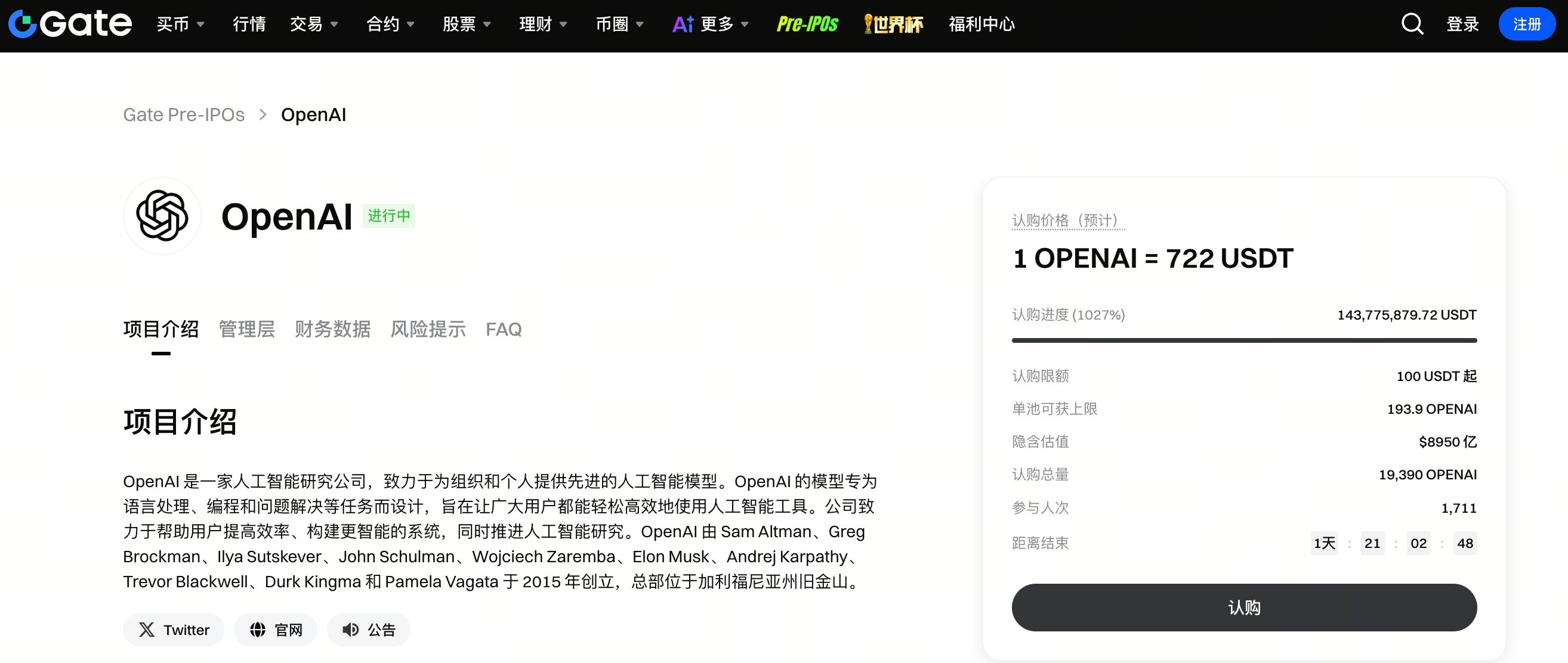
According to Gate's official description, unlike traditional stocks, the stock tokens OPENAI obtained through this subscription are mirror notes (Mirror Note) of OpenAI before its IPO, used to mirror the market value before and after OpenAI goes public.
After the subscription is completed, OPENAI will be unlocked and issued in three phases. Meanwhile, users holding OPENAI will have two exit options — before the IPO and during the lock-up period, Gate will provide 24/7 free trading in the pre-market; on July 20, the Pre-IPOs section will open for pre-market trading; after the lock-up period (6 months post-IPO), Gate will provide an exclusive exit page for users, allowing them to convert their holdings to stock tokens or redeem them for USDT based on the real-time market price of the stock post-IPO.
From SpaceX to OpenAI, how does Gate build its stock "new issuance" service?
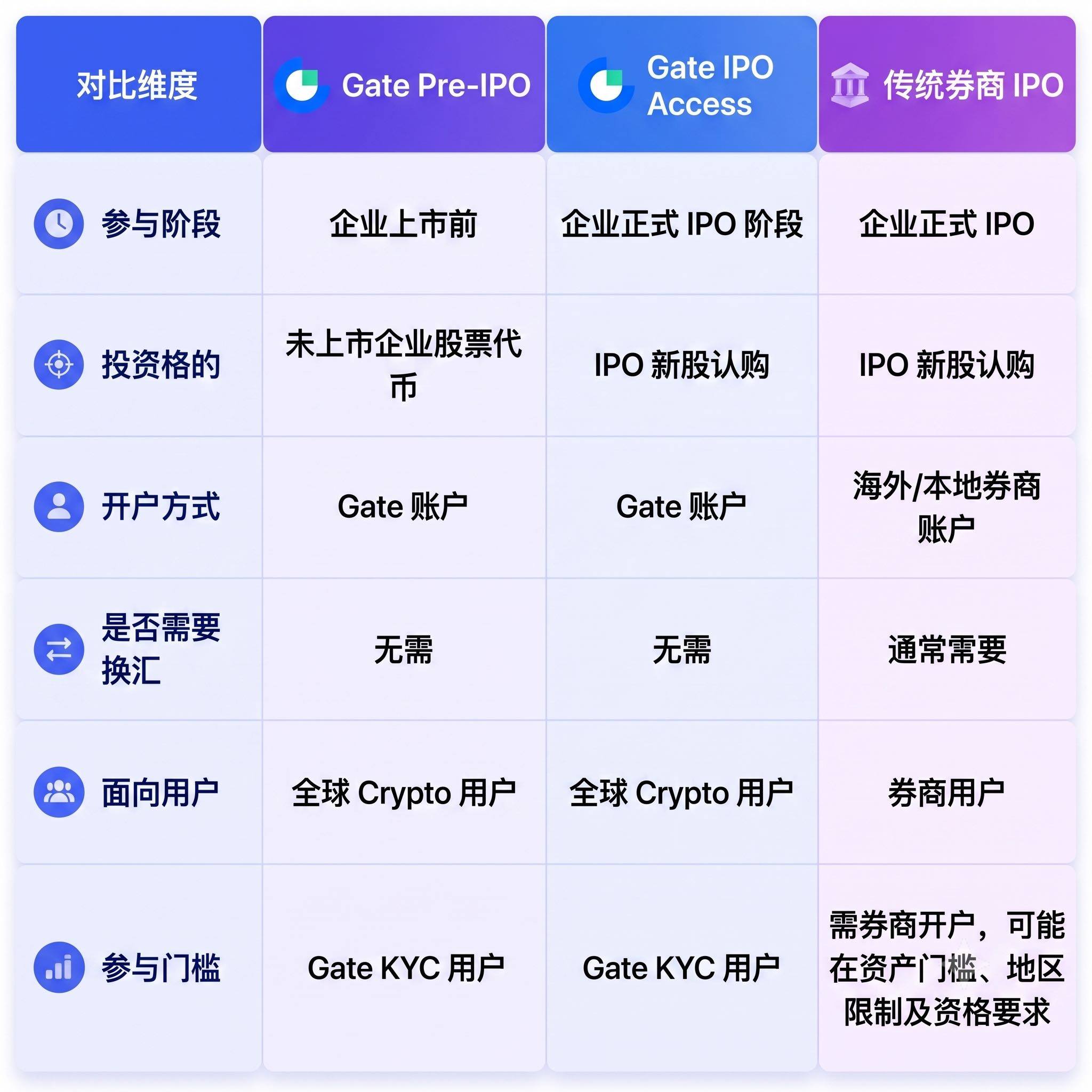
OpenAI is not Gate's first attempt in the IPO scenario. Prior to this, Gate had built a complete product system around SpaceX covering Pre-IPO, IPO Access, and secondary market stock trading, creating an investment path that stretches through different stages before and after a company goes public. For users, they can position themselves early before a company goes public, participate in new stock subscriptions during the official IPO, and continue trading through Gate's stock account after the IPO.
Specifically, Pre-IPO leans more towards pre-IPO investment, allowing users to participate in unlisted companies via stock tokens; IPO Access focuses on the formal IPO phase, offering users IPO allocation opportunities, which is closer to the traditional "new issuance" model in capital markets.
Taking SpaceX as an example, in April this year, Gate launched its first Pre-IPO project, raising nearly $395 million; in June, it launched IPO Access service with a minimum subscription threshold of 100 USDT. Successful users in the new issuance received actual new stock allocations, with a maximum of 154 shares per account. During the SpaceX IPO subscription period, market demand far exceeded expectations, and Gate successfully completed the allocation of the first phase of the IPO Access project, ensuring users' participation rights and further validating the implementation capability of its IPO product design.
Stocks are becoming the new battlefield for CEX
Over the past year, global capital markets have continued to diverge. The cryptocurrency market continues to bear bearish trends, while U.S. stocks are constantly strengthening under the AI wave, and markets like Hong Kong stocks and Korean stocks have also emerged with numerous structural opportunities. More and more investors, originally focused on Crypto, are beginning to attempt cross-market allocation of stock assets.
However, for Crypto users accustomed to on-chain trading and CEX operation experiences, traditional brokers still present issues such as complicated account opening processes, the need for multiple accounts across different markets, high currency exchange costs, and limited trading hours, making it difficult to manage digital assets and stock assets in a unified manner. Against this backdrop, several mainstream CEX have gradually launched stock-related trading services, hoping to further bridge the gap between Crypto and traditional financial markets.
Although the approaches of various companies differ, their goals are highly consistent — on one hand, by introducing stocks and other traditional financial assets, they meet users' investment needs across markets and asset categories; on the other hand, using the native account system of Crypto, efficiency of fund circulation, and 24/7 trading experience to supplement and innovate traditional brokerage models, making global asset investment more convenient.
In horizontal comparison of the solutions provided by various CEX, Gate stands out with its comprehensive product matrix that covers assets spanning U.S. stocks, Hong Kong stocks, and Korean stocks, addressing different needs, and the efficiency of capital use through a single account unlocking all scenarios.
Dissecting Gate's product matrix: How to meet different trading needs?
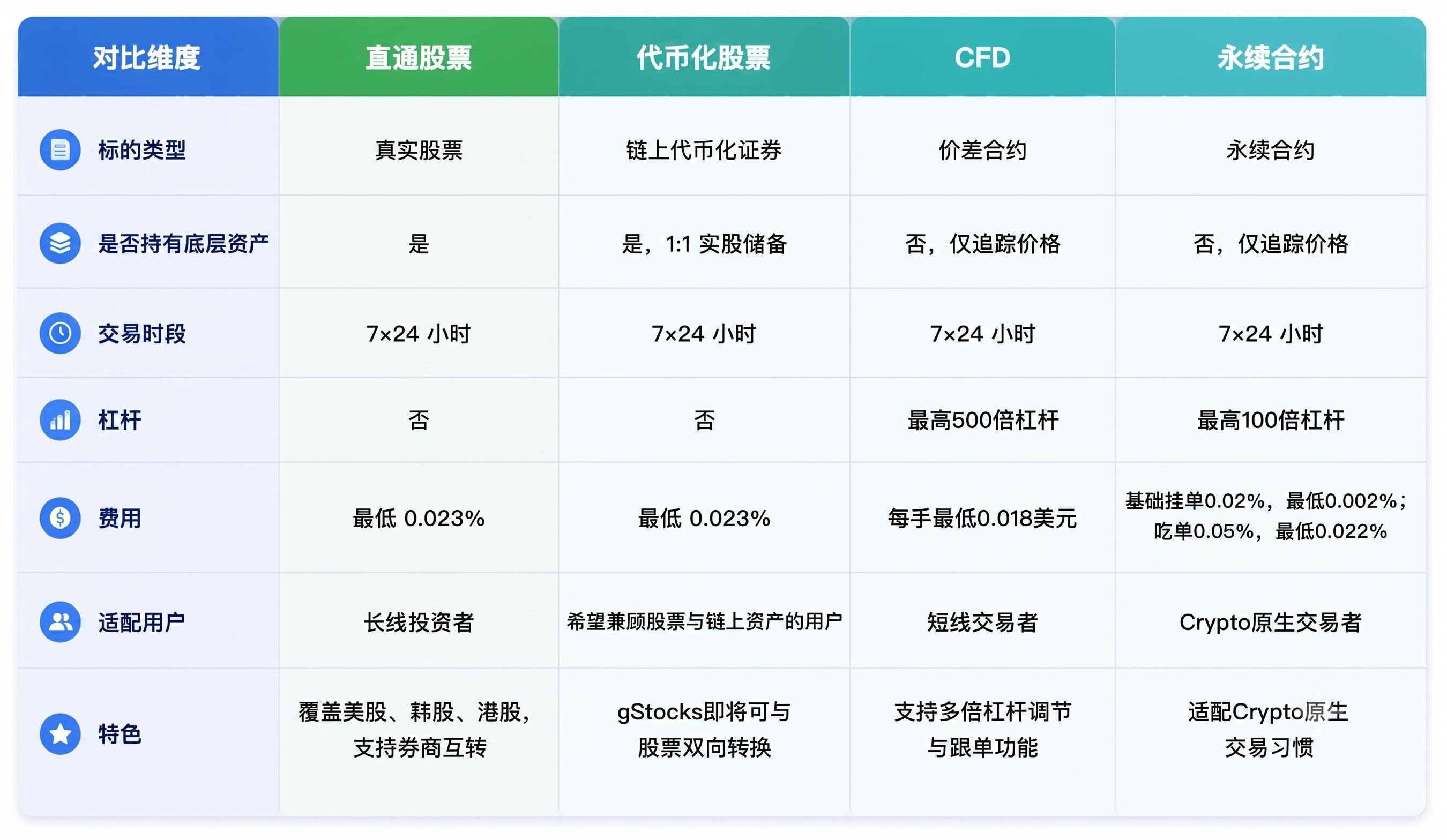
Focusing on different investment scenarios, Gate has gradually built a complete product matrix covering CFD, direct stock trading, stock perpetual contracts, and tokenized stocks.
1. Real Stocks: A single account, bridging core markets globally
For those wishing to allocate long-term in core global enterprises, prioritize asset safety, and enjoy real stock rights, direct stock trading is undoubtedly the optimal choice.
Currently, Gate's direct stock trading covers the three major core securities markets: U.S. stocks, Hong Kong stocks, and Korean stocks, supporting over 12,500 stock assets, with the stock account asset scale surpassing $200 million. Among them, the U.S. stocks cover over 10,000 stocks and ETFs; Hong Kong stocks cover over 1,500 high liquidity targets; Korean stocks cover the top 1,000 listed companies by market capitalization on the Korean exchange, including Samsung Electronics, SK Hynix, and more.
Compared to traditional cross-border investment processes, Gate's direct stock trading further simplifies the trading process. After completing KYC, users only need to transfer USDT to the stock account to trade U.S. stocks, Hong Kong stocks, and Korean stocks directly through a unified account, without needing to separately open overseas brokerage accounts or manually complete cross-border exchanges. Regarding trading, Gate offers fractional share trading starting at 0.01 shares and a 24/7 trading experience, allowing stock trading to integrate with the existing VIP fee system, reducing trading fees to as low as 0.023%.
In addition to the trading experience, Gate also strives to retain the rights associated with real stocks, such as dividends. Gate is also the industry's first platform to support cross-broker transfers of stocks, allowing users to apply for transferring stocks held by external brokers into Gate and vice versa.
2. Tokenized Stocks: Unlocking 24/7 trading of stocks
If direct stock trading addresses the issue of "real ownership," then the significance of tokenized stocks is to further expand the usage scenario of stock assets — by expressing traditional stock assets on-chain through blockchain technology, tokenized stocks, while maintaining the value anchoring of underlying assets, also give stocks liquidity and composability more akin to Crypto assets.
Currently, Gate has launched several tokenized stock products such as xStocks, Ondo, and gStocks. Among them, gStocks adopts a 1:1 fully-backed real stock reserve mechanism, with each token corresponding to real stock assets, ensuring asset value anchoring while also possessing the liquidity of on-chain assets.
Compared to traditional stocks, gStocks supports minimum investments starting at 1 USDT, fractional purchases, and 24/7 trading, aligning more closely with Crypto users' trading habits. More importantly, leveraging a unified account system, gStocks can not only be traded but also serve as collateral for leveraged lending, compatible with wealth management products like the residual coin treasure, and supports various tools such as grid trading, trading bots, and API interfaces, meeting the needs of both individual and institutional users in automated trading, liquidity management, and quantitative strategies.
In the future, Gate also plans to launch features for mutual conversion between stocks and gStocks, automatic dividend settlement, and more.
3. CFD: Providing more strategy options for short-term trading
Unlike long-term holders, some investors pay more attention to short-term market fluctuations, hoping to amplify opportunities during rising and falling markets; some professional traders and institutional users may also have certain hedging needs to manage portfolio risks more flexibly. For these types of needs, CFDs (Contracts for Difference) may be more suitable products, allowing users to participate in trading price fluctuations without actually holding the underlying stock assets.
Currently, Gate has launched 653 stock CFD trading pairs, covering multiple popular stock targets, supporting up to 500x leverage, with the minimum trading fee per contract as low as $0.018. Unlike traditional stock trading that requires actual asset ownership, the CFD product allows users to trade based on asset price trend judgments and supports long and short operations, providing more flexible tools for trend trading, event trading, and risk hedging strategies.
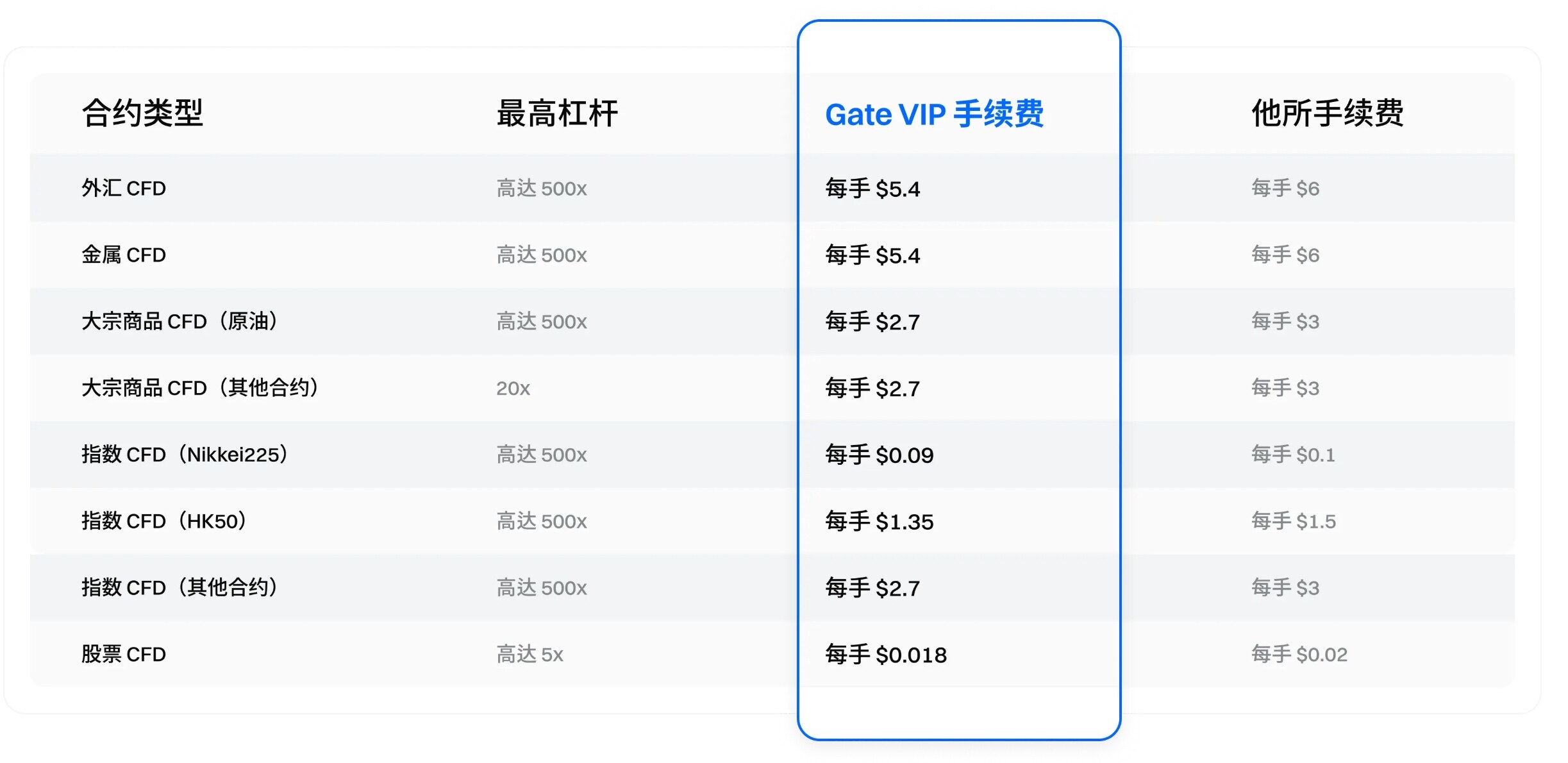
In terms of product experience, Gate's CFD has also further optimized for trading user needs. Among these, Gate has introduced an industry-first adjustable multi-leverage feature, allowing users to adjust the leverage multiplier according to their risk preferences and trading strategies, rather than being limited by fixed leverage models. Currently, Gate's multiple CFD assets such as gold, silver, and crude oil support this feature, enabling users to manage risk exposure more finely.
Additionally, Gate has launched an industry-first CFD copy-trading feature, allowing users to reference professional trading strategies and lowering the barriers for learning strategies.
4. Perpetual Contracts: Extending the trading experience familiar to Crypto users
Finally, for users who are long-term active in the cryptocurrency market, perpetual contracts are the product form they are most familiar with and comfortable with.
Currently, Gate offers 223 stock perpetual contract trading pairs, integrating stock assets with the perpetual contract mechanism, allowing users to participate in the global stock market within a familiar trading framework and flexibly utilize strategies like leverage and risk hedging.
Looking at Gate's stock product matrix, it is clear that its layout is not merely about transferring stock products to the Crypto platform, but rather constructing a complete solution around different investment scenarios — long-term investors can configure global quality assets through direct stock trading, short-term traders can capture market fluctuations through CFDs and perpetual contracts, while tokenized stocks further unlock the liquidity and capital efficiency of stock assets on-chain. The four types of products complement each other, jointly covering the complete investment chain from asset allocation, trading strategies, to fund management under a unified account system.
The financial market is moving toward a new normal
Looking back at the developmental history of the cryptocurrency market, the product boundaries of CEX have actually been continually expanding.
In the early days, cryptocurrency trading platforms primarily provided spot and derivative trading around digital assets like BTC and ETH; subsequently, wealth management, lending, on-chain assets, RWA, and other businesses have emerged one after another, gradually evolving the platform from a single digital asset trading venue into a comprehensive financial service platform; and now, stocks, funds, bonds, and more traditional financial assets are also entering the investment vision of Crypto users, with global asset allocation becoming an important direction for the new round of industry development.
With continuous maturation of infrastructures like RWA and tokenized securities, the boundaries between traditional financial assets and on-chain assets are becoming increasingly blurred. In the future, investors may no longer need to separately manage brokerage accounts, exchange accounts, and on-chain wallets, but can complete trading, holding, and fund management of stocks, Crypto, and more real-world assets within a unified account system.
This is not a distant vision but a foreseeable new normal for financial markets. And Gate is already a pioneer on this path.
免责声明:本文章仅代表作者个人观点,不代表本平台的立场和观点。本文章仅供信息分享,不构成对任何人的任何投资建议。用户与作者之间的任何争议,与本平台无关。如网页中刊载的文章或图片涉及侵权,请提供相关的权利证明和身份证明发送邮件到support@aicoin.com,本平台相关工作人员将会进行核查。


